EDITORIAL
As he openly explained, Russian President Vladimir Putin launched Moscow’s invasion of Ukraine last February to destroy its government, subjugate its people, obliterate their national identity, and incorporate it into a rebuilt greater Russian empire.
With working people in the lead, Ukrainians have fought back courageously, determined to defend their country’s independence. This struggle is in the interests of working people everywhere and deserves our solidarity and aid.
The imperialist rulers in Washington, as well as in Berlin and Paris, are looking for the realities of battlefield losses to force the two sides to the negotiating table. Bourgeois politicians here, especially in the left wing of the Democrats and right wing of the Republicans, seek to pressure the capitalist government in Kyiv to cede territory occupied by Moscow in return for “peace talks.”
A bogus “new peace movement,” a coalition of Stalinist and middle-class radicals, is trying to gather forces to act as shills for Putin’s war, calling rallies and “teach-ins.” Some of these forces, such as Medea Benjamin of Code Pink, are also joining a “Rage against the War Machine” rally in Washington, D.C., Feb. 19 organized by currents both right and left, including the Libertarian Party and People’s Party. Demands center on calling for Washington to cut off funding and arms shipments to Ukraine and press Kyiv to make concessions to end the war.
Behind the slogans, “NATO Expansion, No! Peace in Ukraine, Yes!” a Jan. 14 rally in New York drew over 100 people, organized by the ANSWER coalition, People’s Forum and others. This self-proclaimed “new peace movement” is determined to give aid and succor to Putin’s war.
All these forces peddle the slanderous canard pushed by Putin that the massive, popular Maidan uprising in 2014 that overthrew the dictatorial pro-Moscow regime of Victor Yanukovych was in reality a fascist coup engineered by Washington.
The idea that the millions of Ukrainian working people who fought to take control of the destiny of their nation were nothing but a band of neo-Nazis is absurd.
Militant editor John Studer helped lead a series of reporting and solidarity teams to the Maidan in Kyiv — and to dozens of Ukrainian cities and towns, including Sokol, Chernobyl, Kharkiv, Pavlograd, Kryvyi Rih and Energodar. They met with coal miners, rail and nuclear workers, Jewish leaders, supporters of Cuba’s socialist revolution and others — all of whom backed the Maidan and continue to fight to defend Ukrainian independence. You can find lively reports from those trips on our website.
Putin’s claim — echoed by the new “peace” forces — that he was forced to launch his murderous invasion because of moves by Washington and other NATO governments is utterly false and cynical. A sovereign and independent Ukraine poses no military threat to Russia of any kind.
These petty-bourgeois apologists for the Kremlin claim Moscow’s invasion and destruction is in fact a “proxy war” with Washington. This cynically attempts to bury the unrelenting fight for national sovereignty being waged by the Ukrainian people, as well as the growing opposition to Putin’s war among Russian soldiers and working people.
These so-called peace forces are determined to strangle support for Ukraine’s fight for sovereignty. In March the International Longshore and Warehouse Union adopted a strong statement condemning the Russian invasion as “an act of aggression that endangers a population of more than 40 million people.” A number of retired union officials and others signed a letter run in the Dec. 26 Workers World demanding the ILWU reverse its positions and “oppose the U.S./NATO-provoked war!” They called for “dockworkers around the world” to take action to block military cargo being shipped to Ukraine for its defense.
Working people do need to oppose the economic and financial embargo imposed on Russia by Washington and its allies, as well as military maneuvers by these governments. Those sanctions fall most harshly on workers and farmers in Russia and are obstacles to building solidarity between toilers in Ukraine and Russia.
Class-conscious workers place no political confidence in the capitalist government in Kyiv, which upholds the system of exploitation of working people by Ukraine’s wealthy rulers and uses the war to justify attacks on workers’ wages, working conditions and political rights.
The struggle by the Ukrainian people for self-determination — which was championed by V.I. Lenin and the Bolshevik Revolution — deserves the support of working people everywhere. That is why it is important to campaign for Moscow’s invading forces to get out of Ukraine, all of Ukraine!
Mu

Sunday, January 22, 2023
‘Peace’ movement backs Putin’s war aims – The Militant

Saturday, December 3, 2022
Moscow forced deadly 1932-33 famine on Ukraine – The Militant
Ukrainians are commemorating the 90th anniversary of the 1932-33 Holodomor, which literally means killing by hunger. Millions starved to death across the Soviet Union as the counterrevolutionary Stalinist regime in Moscow imposed forced collectivization on the peasantry, measures carried out with special brutality in Ukraine.
Ukrainians, Jews, Tatars and other ethnic minorities across Central Asia and the Caucasus region had long been oppressed under czarism. They couldn’t use their native language, practice their religion or control their cultural, economic and political affairs.
With the victory of the Bolshevik Revolution in 1917, self-determination for all the oppressed nationalities, who had revolted against czarist tyranny, was championed by V.I. Lenin and the Bolsheviks. Ukrainian workers and farmers were among those who formed their own voluntary Soviet Socialist Republic, expanding use of their language, history and culture.
After Lenin’s death, Joseph Stalin consolidated a political counterrevolution against this communist course, driving working people out of politics and imposing Moscow’s control, crushing Ukrainians’ national aspirations. The Stalinist regime executed thousands of writers and officials who Lenin had led to advance the “Ukrainization” of Ukraine.
In 1929 Stalin launched forced collectivization of the countryside. This shattered the working-class alliance with the peasants, the backbone of the revolution, and devastated agriculture.
The brutality of these measures against the peasants was severest in Ukraine, as Moscow was determined to crush the Ukrainian people’s aspirations for self-determination. Some 3.5 million starved to death there.
To meet Moscow’s impossible quotas for grain requisitions, peasants were robbed of their harvests, leaving nothing to sell or even eat. Backed by the death penalty, this produced famine across the Soviet Union.
Leon Trotsky, who led the fight to continue Lenin’s political course, said in 1939 that a source of the “irreconcilable hostility of the Ukrainian masses” to the Soviet bureaucracy was “the suppression of Ukrainian independence.”
Saturday, May 21, 2022
Putin’s charge Ukraine gov’t is ‘fascist’ is a lie – The Militant
Russian President Vladimir Putin claims Moscow had to invade Ukraine to “denazify” the country. He propagates through his rigidly government-controlled media the charge that “neo-Nazis” and “far-right nationalists” took over Ukraine in 2014 in a “coup” backed by Washington and are carrying out “genocide” against Russian speakers in the Donbas region in eastern Ukraine.
But his accusations are false to the core. The government of Ukraine is elected and not much different than other liberal capitalist regimes around the world. Russian speakers are a significant part of the Ukrainian population. They overwhelmingly back Ukraine independence and are proud members of the fierce resistance to Moscow’s invasion.
In the United States, calling anyone you disagree with “Nazis” or “fascists” has become the stock in trade of many middle-class radicals, who use it as a way to shut down debate and discussion and silence opposition.
For Putin, his slander has an additional purpose. In World War II, Moscow’s resistance to Nazi Germany’s invasion of the Soviet Union was a key part of defeating Hitler, at a huge cost of millions of lives of Russian, Ukrainian and other peoples there. By invoking the specter of fascism, Putin hopes to convince working people in Russia to support the war effort or at least keep quiet.
Full article:
Saturday, April 30, 2022
Saturday, April 23, 2022
Putin: ‘Butcher’ of Aleppo and Grozny
....In just two months, the Kremlin’s war on Ukraine has shaken up alliances between imperialist governments worldwide as the capitalist rulers search for how best to defend their national interests. The invasion has disrupted trade and delivery of everything from wheat to oil and increased the volatility of financial markets. Every capitalist regime is beefing up its military capacity in anticipation of more wars to come.Russian forces launched an attack on Ukrainian defensive lines dug in along a nearly 300-mile front in an arc from Kharkiv in the northeast through Luhansk and Donetsk to the still surrounded and besieged city of Mariupol in the southeast, to Kherson further west. “The battle for Donbas,” which is the main industrial and mining region in Ukraine, looms.
Amassed Russian troops and tanks are being hurled at Ukrainian defenses in a drive to conquer territory adjacent to the parts of Donetsk and Luhansk that Moscow-backed separatists, reinforced by Russian agents, seized in 2014. This covered roughly a third of the two Ukrainian provinces. While Putin claims the inhabitants there are all Russians, he is planning a massive war against them.
While the Russian military commands much greater heavy armor and air power, its growing number of troops there are weakened by earlier losses and morale problems. They also face determined resistance by 40,000 Ukrainian soldiers and volunteers seasoned in battle since the 2014 conflict and today’s combat.
Saturday, March 12, 2022
Celebrate the life of Ivan Dzyuba (1931-2022)
Ivan Dzyuba died Feb. 22 at the age of 90, ironically on the eve of Moscow's invasion of Ukraine. Dzyuba was a literary critic and Marxist who was jailed by the then-Stalinist Soviet government of Ukraine in 1973 for his defense of political rights and of V.I. Lenin's views on the right of Ukraine and other oppressed nations to self-determination. Lenin was the central leader of the 1917 Bolshevik Revolution that overthrew the czarist regime in Russia.
"I have always endeavored to consider nationality problems — just as, in fact, all other problems — from the viewpoint of the principles of scientific Communism and of the teaching of Marx, Engels and Lenin," Dzyuba said in 1969 when he published his book Internationalism or Russification? "perceiving the prospects for their successful solutions to lie along the road towards the fulfillment of Lenin's legacy and Communist construction."
Dzyuba was born in 1931 in the Donbas coal-mining region of eastern Ukraine, which is currently under the control of Moscow-backed separatist gangs. By 1962 he was a well-known writer and head of literary criticism at Vitchyzna magazine, but was removed, accused of "ideological mistakes."
Crimes of Stalin
By that time he had joined with others fighting to recover the cultural and literary heritage of Ukraine, as part of a growing anti-Stalinist revolutionary movement in Ukraine and across Russia. This came on the heels of Communist Party leader Nikita Khrushchev's 1956 revelations of the tip of the iceberg of Joseph Stalin's crimes in power, as well as the powerful working-class rebellion in Hungary that year.
Layers of working people, writers and artists in the Soviet Union, including Ukraine, were chafing at the oppressive policies and actions of the bureaucracy that came to power in the Stalinist counterrevolution in the Soviet Union after Lenin's death.
On Sept. 4, 1965, at the premiere of "Shadows of Forgotten Ancestors," a film that broke with the Stalinist-imposed historiography of Ukraine, Dzyuba, Vyacheslav Chronovil and Vasyl Stus spoke to a packed theater. They denounced the arrests earlier that year of more than 100 young people and "intellectuals" across the country for their anti-Stalinist political views.
That December Dzyuba wrote to the Central Committee of the Communist Party of Ukraine and the Council of Ministers of the Ukrainian Soviet Socialist Republic to call for an end to the "most frightful injustice" of this political persecution.
Dzyuba wrote, "It is no secret that during recent years a growing number of people in the Ukraine, especially among the younger generation (not only students, scientists and creative writers and artists, but also now quite often, workers), have been coming to the conclusion that there is something amiss with the nationalities policy in the Ukraine." In fact, he said, the people of Ukraine face "perpetual, flagrant violations of Marxism-Leninism on the nationalities question, and the abandonment of scientific principles in communist national construction."
To further an open discussion and debate on these questions he sent them the manuscript of his book Internationalism or Russification? later published in Russian, English and Ukrainian editions.
That book — distributed in English at the time by Pathfinder Press — is a cogent explanation of Lenin's view of the necessity for communists to support the right of oppressed nations in the Soviet Union and elsewhere to self-determination, including independence if they so choose.
Dzyuba describes the flowering of culture in Ukraine during the early years of the Bolshevik Revolution under Lenin's leadership. He notes that "the Ukrainian language was introduced into all spheres of social, civic and industrial life, knowledge of Ukrainian history and culture was fostered; there developed a sense of national belonging and of the national duties of a Ukrainian communist."
He described how the bloody Stalinist counterrevolution overturned the gains made by the Bolshevik Revolution in relation to Ukraine and other nations.
Standing up to Jew-hatred
Dzyuba also played a key role in speaking out against antisemitism. On Sept. 29, 1966, he joined a spontaneous action of thousands at Babyn Yar in defiance of Stalinist authorities to commemorate the 25th anniversary of the beginning of the Nazi massacre of 100,000 Jews and tens of thousands of others in that ravine in Kyiv.
When participants realized that Dzyuba and other writers were there, they demanded they speak. "Babyn Yar is a tragedy of all mankind but it happened on Ukrainian soil. And therefore, a Ukrainian has no right to forget it anymore than a Jew," Dzyuba told the crowd. "It seems that Lenin's instructions concerning the struggle against antisemitism are forgotten in the same way as his precepts regarding national development of the Ukraine."
In 1972 Dzyuba was expelled from the Writers' Union, arrested and sentenced to prison. After 18 months in jail he signed a statement saying his writings were the work of a "mistaken man," and appealed for clemency, which he was granted. He was able to get work as a proofreader of the factory newspaper at the Kyiv Aviation Plant.
After getting out of jail Dzyuba was less politically active, focusing more on literary projects. But after the implosion of the Stalinist regime in the Soviet Union in 1991, he became minister of culture of an independent Ukraine from 1992 to 1994. He wrote a preface in 2018 to a forthcoming translation into Ukrainian of Capital by Karl Marx.
In the last chapter of Internationalism or Russification? Dzyuba wrote that Stalin "destroyed several million Ukrainians but did not destroy the nation. And no one ever will." Words that remain true to this day.
The book is well worth reading today.
Source: https://themilitant.com/2022/03/12/ivan-dzyuba-marxist-fighter-for-the-sovereignty-of-ukraine/
Saturday, March 5, 2022
NY meeting: Defend Ukraine, Cuba’s socialist revolution!
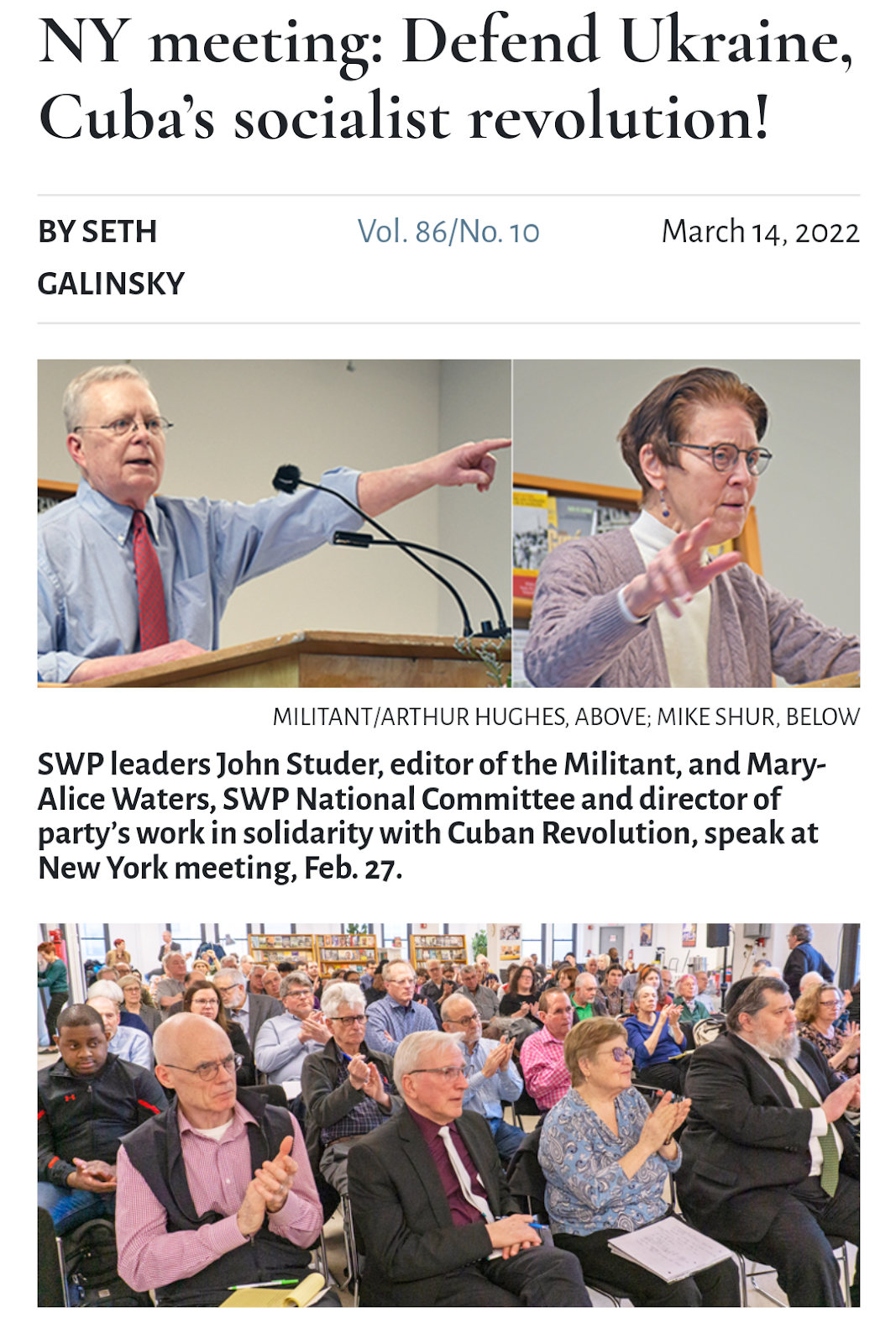
NEW YORK — "Tens of thousands of workers and others in Ukraine are throwing themselves into defending the sovereignty of their country. They are putting up a fierce resistance, against a murderous invasion by Vladimir Putin's regime in Russia aimed at conquering and obliterating their nation," Militant editor John Studer told a special meeting of over 100 people in New York City Feb. 27. "We want to join their defense, using the Militant and the Socialist Workers Party campaigns to tell the truth about what is unfolding there and the need for Putin's forces to be defeated."
Studer participated in three reporting trips to Ukraine in 2014 and 2015 following the Maidan popular uprising there that overthrew the dictatorial pro-Moscow regime of Viktor Yanukovych. The aim of those trips was to find the truth in order to use the Militant to get out that truth about the battle by Ukrainian working people to defend their independence as they fight to protect their class interests.
At the center of the Feb. 27 meeting was arming and mobilizing members and supporters of the Socialist Workers Party to throw themselves into campaigning in defense of the sovereignty of Ukraine, opposing Moscow's invasion, and calling for U.S. troops out of Europe. "Despite their show of crocodile tears for the people of Ukraine, the rulers in Washington, Paris, Berlin and elsewhere care nothing about them. They are each focused on how they can advance their own imperialist interests, including in Ukraine," he said.
Studer said the Militant has launched an international drive to expand the reach of the paper, explaining the importance of working people acting in support of the Ukrainian people's fight to defend their sovereignty.
The meeting — sponsored by the SWP in New York and New Jersey — also included a talk by Mary-Alice Waters, director of the party's work in defense of Cuba's socialist revolution: "Havana International Book Fair and May 1, International Day of the Worker; Rich exchanges on working-class politics in the U.S. and world and solidarity with Cuba's socialist revolution."
"Lenin built the Bolshevik Party on the fight for the right to self-determination of oppressed nations that were under the thumb of the czarist empire, including in Ukraine," Studer said. "This is the continuity the SWP draws on today."
Russian President Vladimir Putin, a former KGB thug, is determined to extinguish all vestiges of Ukraine as an independent nation. "He aims to rebuild a Great Russian empire like the czarist prison house of nations before him," Studer said. "But you can see the problem he faces with the fearless struggle of millions in Ukraine and the solidarity they've won around the world, including from working people in Russia."
On the three Militant reporting trips to Ukraine, Studer and SWP leader Frank Forrestal spoke with coal miners, nuclear workers in Chernobyl and Enerhodar, rail and other workers and defenders of Ukraine sovereignty in Kharkiv, Kryvyi Rih and in Dnipro. They met with Mustafa Dzhemilev, the central leader of the Crimean Tatar people, who was expelled from Crimea after Moscow occupied it in 2014.
They paid special attention to the history of Nazi occupation as well as virulent Jew-hatred under the Stalinist regime. They interviewed leaders of Jewish organizations in Ukraine on the Holocaust and the Nazi slaughter of 30,000 Jews in Babyn Yar. When they visited Sokal, the hometown of the team's volunteer translator, Oksana Demyanovych, she took them on a tour, pointing to a mural of Che Guevara, and then to "the burned-out synagogue." The two SWP leaders asked, "When was that?"
Demyanovych said she didn't know. It turns out Sokal was conquered and occupied by German troops in the second imperialist war. Fascist troops organized to slaughter all the Jews there or ship them to concentration camps. Only 30 Jews in the town survived the war.
Today Volodymyr Zelensky, president of Ukraine, who Putin calls a Nazi, is in fact Jewish. Putin's slander of him is nothing but a lie.
Though the 2014 Maidan revolution succeeded in removing Yanukovych and Moscow's control, Ukrainian working people didn't have a party and a leadership that could lead them to overthrow capitalist rule.
Ukrainian workers with whom the SWP is in continuing touch send reports to the Militant on fights over unpaid wages, government efforts to shut down state-owned coal mines, and other social struggles against the ravages of capital. "The government of Ukraine rules for the capitalist class there," Studer said.
He appealed to all those at the meeting to join the SWP in using the Militant to get out the truth and advance today's fight to defeat Moscow's invasion and defend Ukraine independence.
Havana book fair: 'To read is to grow'
A program combining discussion of Moscow's invasion of Ukraine with a book fair and May Day activities in Cuba may seem "incongruous," Mary-Alice Waters told the meeting. "But it's not." We are looking at the two opposing faces of the imperialist epoch in which working people are fighting to open the way forward for humanity.
"Solidarity with the people of Cuba and their 60-plus years of unyielding battle in defense of their socialist revolution in face of the mightiest imperialist power in the world is not a question of solidarity alone," Waters said. Like the right of self-determination for Ukraine, "this is a life and death question for the working class. Without this there will never be a socialist revolution in the U.S."
The Havana International Book Fair, set for April 20-30, is the most important cultural event that takes place in Cuba each year, Waters noted. Tens of thousands of Cubans come to it, thirsting for discussion on culture and politics, science, literature of the world, children's books and more. It takes place under the banner: "To read is to grow."
Our participation in the annual Havana book fair for more than 35 years "has been central to our work producing books published by Pathfinder Press and articles for the Militant that make the reality of Cuba's socialist revolution known in the U.S. and around the world." At the same time, Waters emphasized, "We've brought an understanding of the class struggle in the U.S. and other imperialist countries to working people in Cuba."
This year's fair — the first in two years because of the COVID-19 pandemic — takes place in the midst of "a profound economic crisis in Cuba. It's part of the broader imperialist crisis, which has hit working people everywhere, including here in the U.S., but even more so throughout the underdeveloped nations."
"On top of this the brutal tightening of sanctions imposed on Cuba by both Republican and Democratic administrations, including the current one, have taken a heavy toll on Cuba's toilers," Waters said. "The fact that even under these conditions they refuse to turn culture and learning into capitalist commodities says a great deal about the character of a genuine socialist revolution."
Pathfinder Press will present two books at public meetings during the book fair this year: The Jewish Question: A Marxist Interpretation by Abram Leon and Labor, Nature, and the Evolution of Humanity: The Long View of History with articles by Frederick Engels, Karl Marx, George Novack and Waters.
"There couldn't be two books that are more germane to the politics that will be at the front of this book fair and all of the discussions we have in Cuba," Waters said.
Members and supporters of the SWP and the Communist Leagues in Canada, the U.K., Australia, and New Zealand will staff the Pathfinder Press booth there, introducing the publisher's wide range of political literature and joining in discussions on the war in Ukraine, the fight against Jew-hatred, defense of the scientific and cultural advances throughout millennia of human civilization, the worldwide capitalist economic crisis, and examples of resistance by U.S workers and farmers.
The Jewish Question takes up the roots of Jew-hatred in the evolution of class society and why it's an intrinsic part of capitalist rule today. With the deepening crisis of capitalism, the rise of new fascist movements is inevitable. The bosses will foster Jew-hatred as a welcome diversion of the growing anger and desperation of a devastated middle-class and some workers who will be led to believe that Jews, not capitalism, are the source of their problems. Workers must explain and fight against Jew-hatred in whatever guise it raises its head, Waters said, including on the left.
The panel presenting The Jewish Question at the Havana book fair among others will include José Altshuler, a former vice president of the Cuban Academy of Sciences who as a member of the Popular Socialist Party was part of the underground during the fight against the Batista dictatorship. He's famous in Cuba, Waters told the audience, for having constructed the radio transmitter that Che Guevara used in the Sierras during the revolutionary war that brought down the Batista dictatorship.
The second book that Pathfinder will feature is Labor, Nature, and the Evolution of Humanity, which presents "the scientific foundations of Marxism and everything we do," Waters said. "Dialectical materialism, including historical materialism, is under renewed assault today in the U.S. and around the world," Waters said, "and this book will help arm us to answer those 'woke' elements who believe that the history of the western world has been driven by white supremacy and racism." That's simply not true, Waters said, "but we have to raise the debate to a higher level. The entire history of humanity has been driven by the increasing productivity of human labor acting on and transforming nature, including human nature. The systemic racism we are fighting today in the United States is the product of capitalism, not the other way around."
The panel on Labor, Nature, and the Evolution of Humanity will include Fernando González, president of Cuban Institute for Friendship with the Peoples (ICAP) and one of the Cuban Five, who read some of these works while in prison in the U.S. for more than 14 years; Zuleica Romay, former president of the Cuban Book Institute and now head of the Afro-American Studies at Casa de las Américas; and Pedro Pablo Rodríguez, head of the José Martí Studies Center.
May Day in Havana
The end of the book fair this year overlaps the beginning of the celebration of May Day, International Workers Day, organized by the Central Organization of Cuban Workers (CTC). The three days of activity will include events in workplaces and working-class neighborhoods, an international solidarity conference, and a march of tens of thousands through the streets of Havana on May Day itself.
"There's nothing like experiencing the giant May Day march in Havana in person," Waters said, "to see the strength of Cuba's working people and depth of their support for their socialist revolution. And our entire delegation will be doing that together with the CTC" and hundreds of supporters of Cuba from around the world who will take part in the march and activities associated with it, she said.
After the meeting one of the participants, Rojon Spence, told the Militant, "What most struck me was what John Studer said about protests taking place inside Russia. It shows that when there's a conflict not everyone in the aggressor nation supports what their government is doing." Now he said he wants to join the protests taking place in New York.
After a serious and lively discussion period, participants responded to a fund pitch by Joanne Kuniansky, one of the party's candidates for Congress in New Jersey, contributing over $7,500 toward the work of the SWP.
The party's spring campaigns are well underway.
https://themilitant.com/2022/03/05/ny-meeting-defend-ukraine-cubas-socialist-revolution/#
Ukraine toilers put up fierce resistance to Putin’s invasion – The Militant
Moscow admitted that 498 troops were killed by March 2, but losses are likely to be in the thousands.
Thousands of residents of Melitopol, a city of a quarter of a million near the Sea of Azov, shouted “Go home” at a Russian column. Dozens blocked vehicles. When soldiers fired into the air they chanted, “Who are you shooting at? We are unarmed,” and “leave our land!”
A 40-mile-long Russian military column amassed 17 miles north of Kyiv has been stalled since March 1.
Emigrants are returning to Ukraine from across Europe to join the fight for their country’s sovereignty. In the week after the invasion, some 22,000 headed back across the Polish border....
Defend Ukraine’s independence! For defeat of Moscow’s invasion! US troops, nuclear arms out of Europe, all of Europe!
The Socialist Workers Party stands and acts on our communist continuity with V.I. Lenin, under whose leadership the Bolshevik Party in October 1917 led the working class to state power in Russia. It was that revolutionary workers and peasants republic that ensured the right to self-determination to oppressed nations formerly trapped within the czarist empire.
* * *
SOCIALIST WORKERS PARTY STATEMENT
Defend Ukraine's independence!
For defeat of Moscow's invasion!
US troops, nuclear arms out of Europe, all of Europe!
The following statement was issued March 3 by Jack Barnes, national secretary of the Socialist Workers Party, on behalf of the SWP National Committee.
The Vladimir Putin regime in Russia has unleashed a murderous war, including massive bombardment of civilian-occupied urban centers in Ukraine. In face of this intentional carnage, and despite Putin's dangerous and provocative action placing Moscow's nuclear forces on high alert, Ukrainians are fighting courageously, often arms in hand, to defend Ukraine's national sovereignty and independence. The Socialist Workers Party hails their resistance and calls for the defeat of Putin's invading forces.
As the Stalinist regime in the Soviet Union collapsed in face of massive popular mobilizations at the beginnings of the 1990s, Ukraine was one of 14 former republics to declare national independence. Now Putin's regime is ruthlessly seeking to claw back, under Moscow's hegemony, those nations incarcerated in the czarist prison house of nations, regenerating the Russian empire today with Putin as its czar.
Putin's aim is "to erase our history, erase our country," as Ukrainian President Volodymyr Zelensky concisely put it March 1.
Putin insists Ukraine is not a nation and has no right to exist as one. "Modern Ukraine was entirely and fully created by Russia," he claims. It is "an inalienable part of our own [Russian] history, culture and spiritual space." He proclaims that his hoped-for resurrection of the empire is a step toward rejuvenating Christendom, with its "Holy See" in the Russian Orthodox patriarchate of Moscow.
Russia's armed forces are facing tenacious resistance and taking thousands of deaths and injuries in the first week of the assault. In face of these setbacks, Moscow's armed forces have now stepped up heavy bombardment of residential and commercial areas in hopes of sowing terror and cowing the Ukrainian people into submission. Russian planes and cruise missiles have struck apartment buildings, homes, schools, hospitals and railway stations in Mariupol, Kharkiv, Kherson, Kyiv and numerous smaller cities. Ukraine's State Emergency Service reported March 1 that 2,000 civilians had been killed during the first week, as well as many Ukrainian soldiers.
Under Putin's direction, his high command is intensifying siege warfare against the entire population of Ukraine, cutting off electricity, water and sanitation, and cellphone, television, and radio communications.
In face of the rise of Jew-hating demagogy and violence in today's world, there is mounting disgust among Jews in Ukraine and beyond at the outrageous claims by Putin — himself a product of Russia's notoriously Jew-hating secret police, formerly called the KGB — that the aggression aims to "denazify" Ukraine.
Ukrainian President Zelensky is Jewish, with a grandfather who fought in the Soviet army to turn back the German imperialist invaders, and other family members who were killed in the Holocaust. On March 2 "denazifying" Russian missiles struck a TV tower in Babyn Yar — the site of the slaughter of more than 30,000 Jews by Nazi forces during World War II — desecrating a Jewish cemetery. No wonder Jews around the world are seeing more of the truth and encouraging Jews in Ukraine to join with others there to stand and fight.
More Russian soldiers and sailors are becoming demoralized and disillusioned. They've been lied to by Putin's regime about what to expect, being told they'd be welcomed as "liberators," and would quickly roll over Ukraine's military forces. Now they're not only taking substantial casualties but facing shortages of food and fuel. Some are disobeying orders to shell civilian targets; retreating from battle or surrendering without a fight; even sabotaging or abandoning Russian military equipment.
Inside Russia, tens of thousands have poured into the streets of cities and towns all across that vast country to demand a halt to the war. They are doing so in face of police repression, with more than 7,000 arrests the first week, as well as government threats of being charged with "treason." Street demonstrations are spreading across Europe, the Americas, and worldwide, as well.
The Socialist Workers Party opposes the broadly aimed economic and financial embargo imposed on Russia by the U.S., European, and other imperialist ruling classes, as well as military maneuvers by these governments. Those sanctions ultimately fall most harshly on working people in Russia.
Washington and its capitalist allies in London, Paris, Berlin and elsewhere shed crocodile tears over Ukraine's national sovereignty and the plight of its people. High-flown phrases aside, however, their only real concern is to protect their own profits and strategic political interests in the region. The Socialist Workers Party demands the complete withdrawal of all U.S. troops and both conventional and nuclear arms and nuclear missile systems from Europe!
Since the 1990s, both Democratic and Republican administrations and Congresses have acted to reinforce U.S. imperialism's post-World War II position as the dominant "European" military power. In collaboration with other imperialist governments in Europe, as well as the other bourgeois regimes involved, Washington has extended the reach of its armed might close to Russia's borders. This includes deployment of ballistic missiles in Poland and Romania.
Putin's efforts to excuse his bloodthirsty invasion of Ukraine on grounds of moves by Washington and other NATO governments are as cynical as they are false. A sovereign and independent Ukraine poses no military threat to Russia of any kind.
At the same time, the Socialist Workers Party lends no political confidence to the capitalist government in Kyiv, which stands behind Ukraine's wealthy rulers in their pressure on the living and job conditions and political rights of coal miners, rail workers, farmers and others among the oppressed and exploited.
The Socialist Workers Party stands and acts on our communist continuity with V.I. Lenin, under whose leadership the Bolshevik Party in October 1917 led the working class to state power in Russia. It was that revolutionary workers and peasants republic that ensured the right to self-determination to oppressed nations formerly trapped within the czarist empire.
In 1922, after consolidating victory over the counterrevolutionary armies of the capitalists, landlords and 16 invading foreign powers, the Bolshevik-led government established a voluntary federation of the Russian, Ukrainian, and four other republics: the Union of Soviet Socialist Republics.
Communists in Russia, Lenin insisted, must "declare war to the death on Great Russian chauvinism." It was only after the counterrevolution led by Joseph Stalin against Lenin's proletarian internationalist course that Ukraine and other oppressed peoples were again denied their language, cultural, and other national rights.
Members and supporters of the Socialist Workers Party are campaigning to get out the truth about the Russian government's murderous assault on Ukraine's sovereignty, on its right to exist as a nation. We and fellow communists in other countries will organize to get this statement, along with weekly Militant coverage of the struggle of the Ukrainian people, into the hands of working people far and wide, including strike picket lines, social protests, at workers' doorsteps and everywhere else we go. And to take them with us in protests against Russia's invasion that are occurring across the United States and the world over.
The Socialist Workers Party is mobilizing its candidates for the U.S. Senate, House of Representatives, and other public offices to use the 2022 election campaign period to maximize getting out the truth and presenting an independent working-class foreign policy. A foreign policy that starts from the interests of the toilers at home and internationally — not from hypocritical chants about "democracy" and "freedom" behind which the capitalist rulers seek to mask their exploitation and oppression of billions the world over.
The stakes are enormous. Working people must see the necessity of taking political power into our own hands — as toilers did in Cuba at the opening of the 1960s, following a popular, workers-and-farmers-based revolution — or we will face a future of social devastation, reaction, world war, and even nuclear catastrophe.
Join us in this effort to raise an independent working-class voice in the United States — to have an impact on public opinion here, elsewhere in the Americas, Europe, and the world. Join us in demanding:
For the defeat of Moscow's murderous invasion and bombardment of Ukraine!
Defend Ukraine's independence and sovereignty!
Get Washington's nuclear weapons and armed forces out of Europe, all of Europe, now!
https://themilitant.com/2022/02/26/defend-ukraines-independence/
Saturday, February 26, 2022
Putin blames Lenin for Ukraine
The Russian president’s speech attacked Ukraine’s right to exist, denying it had achieved “stable statehood.” He claimed it was “an inalienable part” of Russia’s history and culture. He condemned “the severing of what is historically Russian land” by the Bolshevik Revolution.
There was a brief period during the early Russian Revolution — in the 1920s while Bolshevik leader V.I. Lenin was alive — when the independence, the culture and the languages of Ukraine and other oppressed nationalities were encouraged. This was the Ukraine of which Lenin was “the author and architect,” in Putin’s words. This was brutally reversed as part of a bureaucratic counterrevolution against Lenin’s policies led by Joseph Stalin.
Putin, harking back to the Russian Empire, is driven by the expansionist appetite of Russia’s capitalist class to try to restore its domination over oppressed nations that were formerly part of the Soviet Union. Putin said that it was “madness” in 1991 for Moscow to give “these republics the right to leave the union without any terms and conditions.”
The nationalist “disease” Lenin and the Bolsheviks fought against was Great Russian chauvinism, the nationalism of the oppressor at the heart of the domination by the Russian Empire, both under the czars and later under the Stalinized Soviet Union. For more on this see the article, “Communist continuity backing Ukraine independence” in the Feb. 21 issue of the Militant.
Oppose Moscow’s invasion of Ukraine! – The Militant
The Russian government’s invasion of Donetsk and Luhansk is a blow to working people in Ukraine, Russia and worldwide. It must be opposed.
Like its occupation of Crimea in 2014, Moscow’s violation of Ukrainian sovereignty is aimed at advancing the reach of Russia’s capitalist rulers. They are seizing territory, subjugating the Ukrainian people and threatening peoples across Eastern Europe in countries Moscow lost control over when the Stalinist-run Soviet Union came apart in 1991. And Vladimir Putin’s regime will use these war moves to intensify assaults on political rights at home.
In Ukraine, the Russian rulers seek to regain control they lost in 2014 when popular mobilizations by hundreds of thousands of workers, farmers and youth overthrew the tyrannical pro-Moscow regime of Viktor Yanukovych.
After Yanukovych’s overthrow, the Kremlin seized Crimea, launching a brutal assault against the Tatar people and worsening living conditions for working people as a whole. They funded and orchestrated a war by pro-Moscow separatist forces in eastern Ukraine. The bloody toll from Moscow’s conflict is paid for by both Ukrainians and Russians.
Putin insists that the Ukrainian people, who fought centuries of oppression imposed by Russia’s czarist rulers, are really Russians and their country’s independence should be crushed.
As workers here organize to stand with workers and farmers in Ukraine against Moscow’s war, they should also oppose the sanctions imposed on Russia by Washington, as well as calls for the U.S. rulers to unleash its military might there. Their imperialist foreign policy is an extension of their relentless assaults on our wages, jobs and rights here.
Working people need our own foreign policy — in opposition to U.S. military moves abroad and in solidarity with workers and farmers fighting to defend their interests against exploitation and oppression worldwide.
Washington’s last war in Europe was a brutal bombing campaign against the former Yugoslavia in the 1990s, furthering the dismemberment of that country. The U.S. rulers asserted their dominance in Europe on the corpses of the Yugoslav peoples. Everywhere Washington intervenes it does so solely to advance the rulers’ power and enrich their class at the expense of workers and farmers.
Under the revolutionary leadership of V.I. Lenin, the Bolshevik government in Russia championed the rights of the Ukrainian people to self-determination. It combated all expressions of Great Russian chauvinism and strengthened the unity and fighting capacities of working people to advance the forging of a truly voluntary Soviet republic. That was made possible because the Bolsheviks had led workers and farmers to overturn capitalist rule in 1917 and make a socialist revolution.
Standing on that continuity, Socialist Workers Party members participate in and urge others to join actions to demand the immediate and unconditional withdrawal of Moscow’s forces from Ukraine.
Thursday, February 24, 2022
Ukraine context: Internationalism or Russification?
Internationalism or Russification?: A study in the Soviet nationalities problem By Ivan Dzyuba is available here.
Sunday, March 23, 2014
Maidan today: no fascists in sight
The first report can be read here.
One of the most remarkable facts the story provides is this: workers from all over Ukraine are still encamped in the Maidan square. They continue to organize food and medical work in tents set up near the burned Trade Unions House.
As a former coal miner told the reporting team, “While we watch Russia.... we also watch the politicians of the new government. Most of them are not much different from those who fled.”
All the petty bourgeois right and left, from Lyndon LaRouche to Workers World Party, have proclaimed the triumph of fascism in Kiev. But self-organized workers occupy Maidan, as they have for the last three months. There are no government-directed fascist street-fighting units sweeping them off the streets.

Actual fascists are denouncing the mass mobilizations that caused Yanukvich to flee.
A friend on Facebook commented earlier today:
Interesting facts on some real fascists denouncing the so-called "neo-nazi coup" in Ukraine:
"The Eurasian ideology draws an entirely different lesson from the twentieth century. Founded around 2001 by the Russian political scientist Aleksandr Dugin, it proposes the realization of National Bolshevism. Rather than rejecting totalitarian ideologies, Eurasianism calls upon politicians of the twenty-first century to draw what is useful from both fascism and Stalinism. Dugin’s major work, The Foundations of Geopolitics, published in 1997, follows closely the ideas of Carl Schmitt, the leading Nazi political theorist. Eurasianism is not only the ideological source of the Eurasian Union, it is also the creed of a number of people in the Putin administration, and the moving force of a rather active far-right Russian youth movement. For years Dugin has openly supported the division and colonization of Ukraine.
"...Glazyev’s book Genocide: Russia and the New World Order claims that the sinister forces of the “new world order” conspired against Russia in the 1990s to bring about economic policies that amounted to “genocide.” This book was published in English by Lyndon LaRouche’s magazine Executive Intelligence Review with a preface by LaRouche. Today Executive Intelligence Review echoes Kremlin propaganda, spreading the word in English that Ukrainian protesters have carried out a Nazi coup and started a civil war."
[Source: http://www.nybooks.com/articles/archives/2014/mar/20/fascism-russia-and-ukraine/]Mention of Carl Schmitt send me back to the pages devoted to him in Georg Lukac's book The Destruction of Reason [1962]; a scan of the Schmitt pages can be found here.
Dugin had this to say several months ago about the protestors in Ukraine:
....First of all, all these groups hate Russia and the Russian president. This hate makes them comrades. And the left wing liberal groups are not less extremist than the neo-Nazi groups. We tend to think that they are liberal, but this is horribly wrong. We find especially in Eastern Europe and Russia very often that the Homosexual-Lobby and the ultranationalist and neo-Nazi groups are allies. Also the Homosexual lobby has very extremist ideas about how to deform, re-educate and influence the society. We shouldn´t forget this. The gay and lesbian lobby is not less dangerous for any society than neo-Nazis."
A responsibility of communists explaining events in Ukraine to fellow workers is not to ape the rhetoric and rationalizations of Russia's capitalist leaders and their publicists (like Dugin), using facts and spin of "fascism triumphant" promoted by the Putin regime to further Moscow's centuries-old domination of Ukraine.
In all questions of analysis, it is important to work from facts and not preconceptions. Jack Barnes said something similar pertaining to the U.S class struggle:
...It is important to be concrete about where we find ourselves today along the long-term curve of capitalist development worldwide, as well as in class politics in the United States. Otherwise, we will speak in formulas, instead of presenting a sharp, clear analysis, a communist program. We won’t be able to accurately explain what we need to do now to build a proletarian party in this country. This dialectic between the international program and national terrain of communists’ march toward state power applies to party building everywhere in the world. But nowhere are the consequences of failing to act on that class reality more damaging to revolutionary prospects and proletarian integrity than in the strongest bastion of world imperialism, the U.S.A. In the closing paragraphs of the draft political report before this convention, we address this question directly. Thinking and acting along proletarian internationalist lines, we say, is and will remain not only a special responsibility but a special challenge for revolutionists who live and work in the United States: [We] carry out our political activity not only in the wealthiest country on earth, but in one that has not experienced war on its own soil since 1865. It is a country in which there have been bloody class battles and proletarian social movements, but there has never been a revolutionary situation or workers’ insurrection. It is a country that has seen genocidal treatment of native populations and organized murderous violence over decades by reactionary outfits such as the Ku Klux Klan, as well as systematic brutality by cops, National Guardsmen, and employer goons—but has experienced only limited combat in the streets and on the picket lines between fascist gangs and defense guards of labor and the oppressed.[22]
Along the road to a revolutionary situation, the working class in the United States, together with its broad political vanguard, will go through all these combat experiences. Each of them will take concrete forms, not identical to what has happened anywhere else or ever before in history. There will be unique combinations. Certain stages of class politics will be truncated and combined, others extended. Some will be accelerated, “with a truly American speed,” to use Trotsky’s phrase.[23] But communist workers in the United States will experience all these forms of political struggle before the revolutionary battle for power is posed. The working class in this country will face efforts by the capitalist rulers, their government, and ultrarightist forces to smash the labor movement. Bonapartist regimes, whether installed with electoral cover or through open military coups, will use the power of the imperialist state and heightened levels of demagogy against organizations of workers and farmers. In order to maintain capitalist rule, the propertied families of the bourgeoisie will accept methods they themselves fear and seek to avoid in more tranquil times. They will promote the rise of fascist demagogues and movements, including their most virulent form: national socialist organizations that seek a mass base among the insecure middle classes and layers of demoralized workers by combining radical, anticapitalist verbiage with appeals to the most reactionary—and deadly—nationalist, racist, anti-Semitic, and antiwoman prejudices and superstitions."
"Capitalism’s Long Hot Winter Has Begun" - (http://www.pathfinderpress.com/site/winter.html)
The Militant's invaluable first-hand reporting from Maidan concludes with this paragraph, more concrete and useful today than any statements by Putin's supporters among the US left today.
“I hope that these events and the Maidan will help change the consciousness of the workers, get them more involved,” said Anya Tchaikovska, who used to work in a bus and construction equipment depot and has been volunteering for the last four months to help coordinate food supplies. “If workers’ demands are not met, there will have to be another Maidan,” she said.