Mu

Mu
Showing posts with label Whither Greece?. Show all posts

Friday, December 17, 2010

Greece is the word


Greek workers set for seventh general strike of the year

Workers in Greece were to end a year of struggle with a general strike this Wednesday 15 December—the day of the government’s budget.

The Pasok Labour-style party is attempting to push through massive austerity at the behest of the European Union and the International Monetary Fund.

There has been a wave of resistance to this attack, with this week’s action being the seventh full general strike this year.

“The government has gone on a generalised attack after a long period of saying that it would not need to make any more cuts,” said Panos Garganas, the editor of the Workers Solidarity newspaper in Greece.

“But the crisis is getting worse so it is pushing through cuts in wages in the public sector.

“This is producing a generalised response. There have been a number of confrontations with the government, including all‑out strikes.

“The seafarers struck for seven days, while the local authority workers struck for five days.

“Transport workers struck for five days this week, there’s an all-out strike by bank workers, and media workers are to strike on Friday 17 and Saturday 18 December.

“This latest strike has been coordinated from below. We are seeing a new, huge explosion of anger and the vote in parliament won’t be the end of it.”


Massive general strike shows power of Greece's workers


Greek workers in the crosshairs again

Greece: A critical point in its history


Yesterday, December 15, Greece was shaken by yet another powerful general strike, which saw at least 80,000 workers march through the streets of Athens, with many more demonstrating in other cities against the latest round of austerity measures introduced by the government. A very angry mood is developing among workers and youth, which will inevitably lead to a major confrontation between workers and the capitalist class.

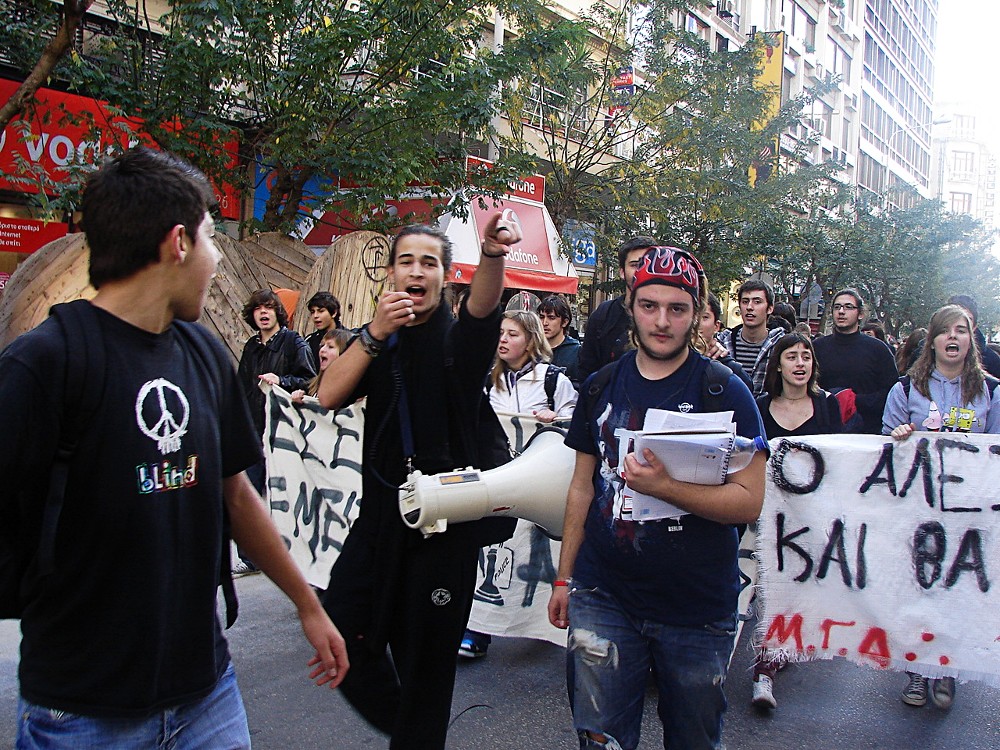
Students protesting in Thessaloniki in memory of Alexis Grigoropoulos who was killed by police two years ago. Photo: apαs
The anger of workers and youth was epitomised by the attack on former conservative minister Kostis Hatzidakis as he came out of the parliament building. As soon as he was recognised angry demonstrators surrounded him, physically attacking him and shouting “Thieves! Shame on you!”

In the recent period known politicians, especially government ministers, have been insulted by members of the public when recognised on the streets. The comment on today’s news reports was that it has become so bad that many MPs no longer dress in jacket and tie, but wear casual clothing to be less conspicuous.

This event is similar to what we saw last week in Britain when Prince Charles’ Rolls Royce was attacked by demonstrators who were protesting against the hike in university tuition fees, and it highlights the growing chasm that is opening up between the classes in society.

The general strike came in the midst of growing worker discontent, with several groups of workers already out on strike. Bank workers had already begun a two-day strike on Tuesday protesting against the government's austerity measures. Bus and railway workers were already on strike as they had declared a week-long walk out. They only partially suspended their stoppage on the actual day of the general strike so as to facilitate workers getting to the rallies. Now the strike is back on and is due to end tomorrow, Friday.

State-run hospitals only operated an emergency service on the day. Doctors have also been organising a series of rolling 48-hour strikes. Journalists also joined the 24-hour general strike resulting in no news being broadcast on TV or radio stations. The state TV channels were in fact completely off the air. Journalists are due to stage a further 48-hour strike on December 17-18.

In the first six months of this year there had already been seven general strikes as the PASOK government attempted to impose severe austerity measures on the working people of Greece. However, in spite of the immense willingness to struggle on the part of the Greek workers, the government managed to push through its measures.

Biggest crisis since Civil war

This highlights a very important lesson for the workers of Greece, and of all countries. As in France, a series of one day general strikes and mass mobilisations – although an important stage in the struggle – has proven to be not enough to stop the bourgeois from carrying out its attacks. What determines the ruthlessness of the bourgeois is not any kind of ideological stubbornness or some innate cruel nature of the capitalists. It is the logic of capitalism locked in a severe crisis that determines their thinking.

The situation is so serious that the old game of tinkering with the system here or there no longer works. Even a social-democratic government like that of the PASOK, elected with the votes of the workers, cannot escape the grip of international capitalism. The only way out is to be found in the socialist transformation of Greece. On the basis of capitalism, whoever comes to power, unless they are prepared to take over the commanding heights of the economy, to expropriate the big bourgeois, will be forced to bow down before the God of capital and do his bidding.

All activists within the labour and student movement internationally should study the situation in Greece, for in it they will find mirrored their own future. As we said, Greece is at a critical point in its history. It is no exaggeration to say that it is facing the biggest crisis since the Civil War in the 1940s. According to both government and EU calculations the Greek economy will have contracted by 9% in the period 2009-12. This will make it the biggest economic fall since 1949.

The workers and youth have valiantly fought back, but still the austerity measures keep getting pushed through. As a result the poor, the working class and the lower layers of the middle class are in a state of shock. This is expressed in widespread anger, but also a kind of generalised depression. According to medical statistics a staggering 70% of the Greek population is revealing a tendency to fall into real depression. Life is becoming very difficult for working people in this country. There is real suffering behind the walls of many working class homes as people struggle to survive day to day.

However, it would be wrong to deduce from this that the workers are in any way on the retreat. After the huge mobilisations of the first half of this year, there has been no real respite in the class struggle, except for short periods. One such moment of “calm” was this autumn when the workers turned to the political front during the administrative elections. These elections saw a massive turning away from the PASOK as close to one million of its supporters decided not to vote for anyone. (See Greece: Recent local elections reveal significant shift to the left for a more detailed analysis of this).

Workers back on warpath

Now, with yesterday’s big general strike the working class is back on the warpath. What provoked the strike was the attack on the workers employed in the semi-state run companies, those companies that have been partially privatised and are now being prepared for total privatisation. These workers have managed so far to preserve some of the conquests of the past, but now the government wants to destroy all those gains and is trying to cut wages and jobs.

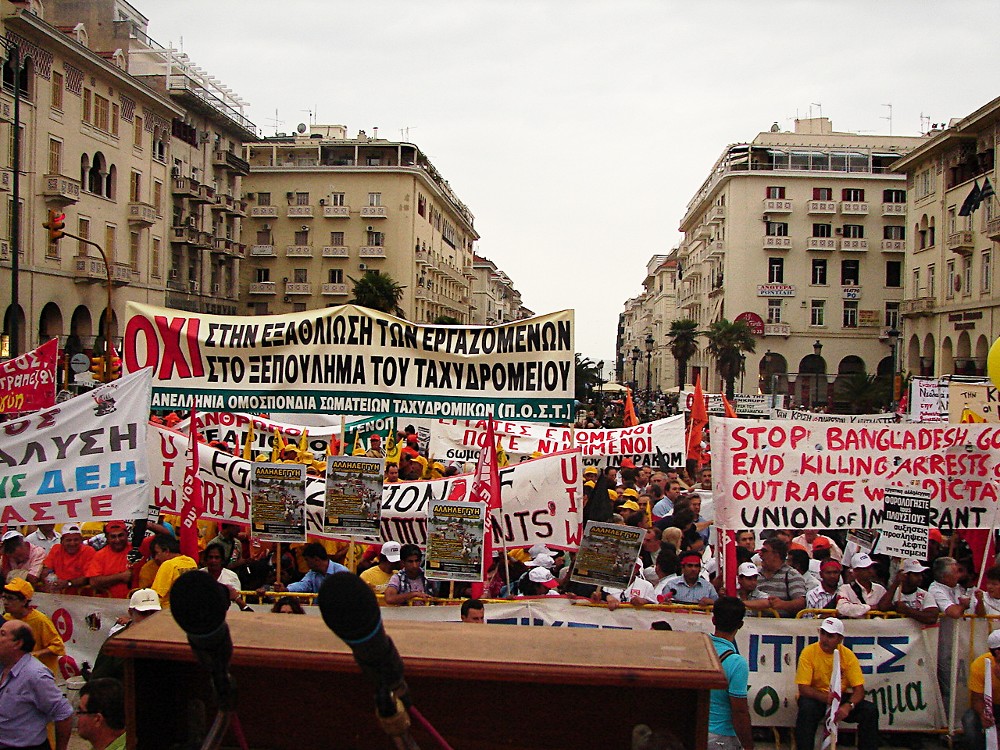
Protest outside international fair in Thessaloniki where the Greek Prime Minister Papandreou was speaking. Photo: apαs
The plans are drastic, to say the least. Workers in these companies are facing cuts of anything between 800 and 1500 euros a month. Most of the workers earn between 1300 and 2100 euros a month. There is a layer that due to long service of many years and bonuses, overtime, etc., can earn up to 3000 to 3500 euros. But all this is now under attack as the government moves on inexorably.

At the heart of the present attack are the workers in DEI (electricity company), and the transport workers, both on the buses and the trains. Yesterday’s general strike had these workers in the vanguard, but the strike also involved the wider working class as all sectors are under attack.

On Tuesday, December 14, the government passed a law which allows bosses in the private sector to cut wages by up to 20-25%. There has been for some time a national minimum wage in Greece negotiated centrally by the GSEE (trade union confederation of the private sector workers). That agreement has now been rescinded by Tuesday’s law as the bosses will be allowed to negotiate at company level and impose wages below the national minimum. These measures were part of the conditions of the €110bn EU/IMF bailout intended to lift Greece out of its debt crisis. They have now de facto done away with national collective bargaining agreements and abolished the minimum wage. Thus, it is not just the public sector that is under attack. Now the whole of the Greek working class, both in the public and private sectors, is facing a severe cut in its standard of living.

While the world economy is technically in a recovery, the Greek economy is still in recession. This year alone GDP is expected to fall by 4.6%. In the construction industry there has been a fall of 50%. Industrial production has fallen by 8%. Profits from trade have fallen this year by between 10 and 15%. Unemployment has shot up, with 850,000 workers losing their jobs this year. Official unemployment stands at 12.5% with one million registered as unemployed; this in a country of around 11 million people.

Dilemma facing bourgeoisie

The Greek bourgeoisie is very alarmed by this situation. An example of their concern is the comment of Alexis Papachelas in the conservative bourgeois daily, Kathimerini:

“Fear, anxiety and uncertainty are starting to surface in everybody’s eyes. No one believes anything anymore and no one trusts anyone.

“The people of Greece seem to have reconciled themselves to a great degree with the fact that the cutbacks and sacrifices they are experiencing are necessary, but they need to know when it will all end, when Greece will crawl out of the hole that it finds itself in. Unfortunately, no one can answer this question with any degree of certainty.”

And while the main line of media propaganda is to try to reassure people and calm their nerves, in an attempt to convince them that the austerity measures will get the Greek economy back on track and growing again, Papachelas points out that:

“One example of how little people know is the fact that at some point in February, the markets, the International Monetary Fund and the European Union will realize that Greece is a long way away from its fiscal targets for 2010. Will the markets turn a blind eye? Will our lenders recognize the huge efforts already made, or will they impose a fresh round of measures and cutbacks in the public sector? Furthermore, how much more pressure can the ruling PASOK party, the government and, more importantly, society take?”

The fact is that they have no choice but to attack, but they also know the Greek working class very well with its revolutionary traditions. They realise there is a limit to what they can impose on the Greek workers before they rise up against them. The ruling class is coming to the conclusion that there is a limit to how far they can go on the basis of the present bourgeois democratic parliamentary set up.

It is the level of Greek debt that determines their thinking. It is an accepted fact that Greece will not be able to pay back its debts. In the two years 2014-15 the Government is scheduled to pay 148 billion euros, but this time with no help from the IMF or the EU. The package that was cobbled together to bail Greece out runs out in 2012. Thus, all that the package achieved was to put off the dreaded day of reckoning and make it even worse than it would have been, as it simply increased Greece’s overall level of debt.

Total annual government revenue in Greece is 55 billion euros. That figure alone shows that making the repayments required in 2014-15 will be an impossible task. This year government debt reached the staggering figure of 148% of GDP and next year it is expected to rise to 152%. This means that next year alone the government must cut 13.5 billion euros from state spending. And in order to pay back the whole debt, serious analysts have calculated that the Greek economy would have to grow by 5% per year for the next 20 years, something which is clearly well beyond the capabilities of capitalist Greece.

Now the government is in negotiations with the IMF, the EU and the European Central Bank (ECB) to see if the repayments can be delayed. This, however, would come at a cost with a higher rate of interest. The overall IMF/EU/ECB bail-out came to 110 billion euros. If an extension of the repayments is granted, Greece would have to pay back 200 billion euros over a longer period. Without an extension it would have to pay back 130 billion.

Neither of these two options is going to be very palatable to the Greek workers. No extension means immediate sharp pain; with an extension it means even more severe cuts over a slightly longer period. In reality, whichever agreement they reach, Greece is, sooner or later, destined to default on its debt. That explains why now the government is desperately trying to get some of its debt cancelled and is in negotiations with the lenders with this aim in mind.

Euphemistically, they call this “reconstructing the debt”. As always, they invent new terms to describe what is happening in an attempt to camouflage reality. But reality has a stubborn way of forcing its way through. The government is naked and is attempting to hide behind a very small fig leaf!

Default inevitable

No one now seriously believes Greece is going to pay. The discussion now is about whether they can cobble together the conditions for a “controlled default” or whether it will be an uncontrolled sudden collapse.

The first of these two scenarios involves an agreement to cancel a part of the debt, but Greece would have to leave the euro, or at best be part of a two-tier euro together with the weaker EU economies. This would also apply to countries like Ireland and Portugal. Such a scenario would drag the whole of the eurozone and the EU into a severe crisis. For if Greece and other countries prove incapable of paying back their debts, it would be the banks of countries like Germany who would feel the full brunt of all this. And this is considered the best case scenario.

The second option, the uncontrolled collapse, would materialise should the European economy fail to grow sufficiently or enter into a new recession, the famous double-dip. In such a situation Greece would face even worse problems and would be thrown into an even deeper and longer recession. This could happen either before or after being pushed out of the euro by the EU.

It is this economic impasse which is dictating the policies being pursued by the Greek bourgeois. And this means the struggle between the classes will be forced onto a much higher level. Yesterday’s general strike was a confirmation of this. In spite of the cold and rain there was a big turnout of around 80,000 on the rally in Athens. How deep the feeling of resentment is, was confirmed by the presence of retired army officers concerned about cuts in their pensions and even sections of the police were out protesting against austerity!

Police brutality

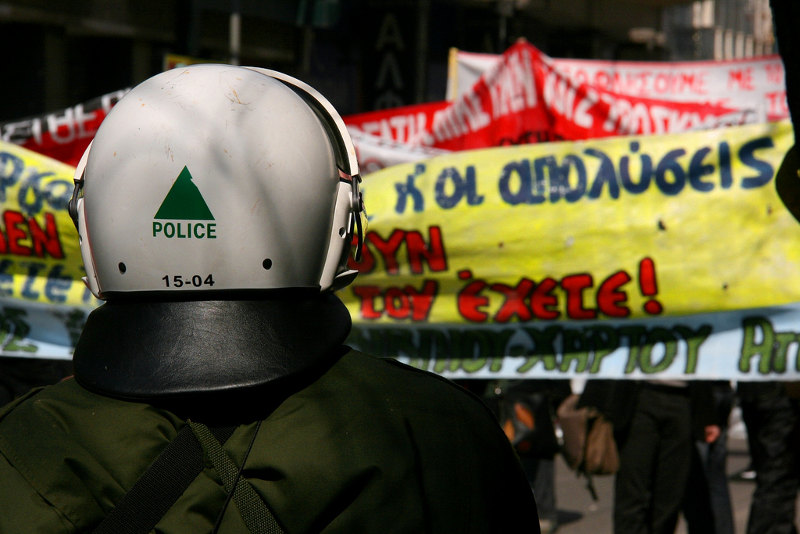
Of course, not all the police were in that mood. The special riot police was out in force yesterday and were in no mood for routine service. In the recent period the behaviour of the police has been increasingly provocative and violent. Workers and youth who turn up at demonstrations these days are more likely to be brutalised by the police than in the past. This is something we are seeing across Europe, and for a very good reason: the bourgeois, no longer able to concede anything concrete, want to force the workers and youth to accept their policies. Youth are in fact being picked up, arrested and put on trial after having participated in protests, almost as if they were terrorists.

It is clear that the police have received instructions from the top to terrorise the movement. Recently the police even attacked the headquarters of the Youth wing of the Synaspismos party, and the next day during a protest picket outside the courts, where Synaspismos Youth members were on trial for having taken part in clashes with the police, the general secretary of the organisation was beaten over the head by police officers who were also shouting fascist slogans. The Synaspismos is a party with parliamentary representation, regarded as a traditional party of the left. It is in no way an anarchist or terrorist grouping, but this is clearly a way of sending a message on the part of the police to the radicalised youth of the party!

The ruling class is facing a big dilemma. They would like to have a solid and stable parliamentary majority with which to push through their austerity measures. But no party is emerging that can do the job for them. The PASOK was voted in last year in protest at the outgoing New Democracy’s programme. Very quickly the PASOK leaders have thrown much of that support away. As we have seen, in the recent administrative elections close to a million PASOK supporters decided to abstain. The PASOK government is in fact in crisis and may possibly have only a few months of life left in it. The paradox is that the New Democracy in opposition is not growing; far from it, for it too is in crisis. It also suffered from the effects of mass abstentionism, with 500,000 of its supporters not bothering to go and vote.

A wing of the bourgeois organised a split from the New Democracy around Dora Bakoyani, but the opinion polls indicate that this party would only get around 2.5% in elections, not enough to get into parliament. Thus open direct representatives of the bourgeois would fail to get elected!

Something similar has happened to the right-wing split away from the Synaspismos, that also seems to be stuck at 2.5%. This split was organised to come to the aid of the PASOK government should it need it, but at such a low vote it also would fail to get into parliament.

All this means that no single party would emerge today, if elections were held, with a majority to govern the country. That explains why they are trying to get the two main parties, PASOK and New Democracy, to “cooperate”. Kathimerini commented positively on recent signs of a preparedness on the part of the leader of New Democracy to cooperate with the government on changes to the Constitution and on economic policy:

“Prime Minister George Papandreou and the leader of the main opposition New Democracy party, Antonis Samaras, yesterday [December 14] proved that they can agree, if only on a few points, when it comes to policy that will affect the entire nation. The fact that they agreed there was a need to review the Constitution, (…) is a big deal and may prove to be important if it goes beyond just words and is actually put into practice. (…)”

New Democracy has been demagogically voting against the government’s measures, the very same measures it would implement if it were in office. Therefore this recent spirit of cooperation is seen as a step in the right direction. The same article explained that:

“Some may argue that this rudimentary level of consensus is nowhere near enough, considering the challenges that Greece is facing. But Samaras certainly showed himself to be more responsible than the chief of the Communist Party, Aleka Papariga, who all but declared war on the government in what is an obvious hint that her party is poised to test democracy’s tolerance of mass protest action.”

Bonapartist temptations

This comment on testing “democracy’s tolerance of mass protest action” is an indication of another idea that is starting to grow among the serious strategists of capital in Greece, who are in fact considering some kind of Bonapartist measures. The above quotes indicate they are working towards achieving some changes to the Constitution that would give more power to the executive that would thus be less constrained by the niceties of a democratic parliamentary procedure.

An open military option is out of the question for now. Greek workers and youth still have the memory of the 1967 Colonels’ coup and how it ended. The bourgeois are well aware of the fact that if they tried such an option it could provoke open conflict between the classes, and even civil war.

However, many articles have appeared in the serious bourgeois press, such as Kathimerini, which discuss the option of a so-called government of “technocrats”, which means no politicians directly from the political parties, but economists and all kinds of experts would be ministers. Last month Alekos Papadopoulos, the ex-Minister of Finance, gave a speech in which he raised this idea. He said it should be a government made up solely of technocrats and he added that instead of the present four year legislature it should remain in power for five years. Of course, all this he says should be with the common agreement of all the parties, and it should be independent of parliament itself. This amounts to a kind of “government of national salvation” that would remain in power to impose the emergency measures.

Dora Bakoyanni has even raised for the first time the idea of taking away from the trade unions their right to organise strikes. She said that unless a majority of the workforce (members and non-members of unions) expresses itself in favour of strike action through a referendum (ballot) the unions should not have the legal right to call its members out. In her speech she also added the fact that 130,000 public sector workers must be sacked.

An influential top bourgeois journalist has even posed the question of abolishing certain articles of the constitution which would allow the government to govern by decree, by-passing parliament.

Added to this, the idea was raised that all these measures would be implemented in “consultation with the people” through referendums. This amounts to government through plebiscites. What they really want is a free hand to do whatever they want, but because of the balance of class forces the Greek bourgeois are forced to tread carefully, very carefully.

In the long run, some sections of the army and the police could move to “restore order”. The bourgeois have no real alternative, as what they are asking the Greek workers to accept is more than can be achieved through normal democratic bourgeois methods. However, before such a stage is reached the working class will have many opportunities to mobilise and to take power. But all these discussions among the bourgeois for a curtailment of certain democratic rights is a warning to the working class of what could happen should they fail in their attempt to transform society.

Yesterday’s general strike was a confirmation of the power of the Greek working class. It was not a general strike the leaders of the unions wanted, but they were forced to call it because of the mounting pressure from below. Recently Panagopoulos, the president of the GSEE, held secret talks with the bosses in which he negotiated cuts in workers’ wages. This has enraged the workers against him and is leading to opposition currents within the unions.

A process of polarisation has begun within the trade unions, which is also having an impact on all the left parties and groups in Greece. We will return to this question in another article. Suffice it to say for now, that after the initial struggles against the austerity measures earlier this year, we have entered a new phase in which the seriousness of the crisis and the degree of severity of the measures being imposed are now seeping into the consciousness of the workers preparing the ground for a struggle on a qualitatively higher level.

Athens, December 16, 2010

Website of the Greek Marxists:Μαρξιστική Φωνή (Greek)

Friday, November 19, 2010

Greek conjuncture: political anger, frustration and scepticism


Greece: Recent local elections reveal significant shift to the left


The results of the recent municipal and regional elections in Greece clearly outline the current social and political crisis in the country. The main feature that stands out is the rejection of both the PASOK government and the New Democracy, the right-wing conservative opposition. This was expressed by a high level of abstentions and also by the increase in the votes for various Left forces, especially in the largest municipalities of Greece. In particular, the growth of the KKE [Communist Party] reveals a shift to the left within the Greek electorate.

The large level of abstention

Photo: dreamsailor.
Abstentions reached unprecedented levels, especially in the largest cities. In Athens, 57.74% of the electorate abstained, in Piraeus 57.38%, in Salonika 46.62% and in Patras 39.81%. This level of abstention is in reality a confused political protest on the part of hundreds of thousands of people, who are facing with a deep capitalist crisis and who have lost faith in the ability of the current institutions of bourgeois parliamentarianism to offer any improvement in their lives.

Abstention is not an expression of a once and for all fixed conscious standpoint. It is rather a symptom of the current transitional phase in the psychology of the masses, characterised by a basic political anger, frustration and scepticism. It is the reaction to the shock suffered by the masses as a result of the violent eruption of the crisis, and the realisation that right now there is no viable, immediate solution to their problems.

The government, on the other hand, has claimed that abstention was in reality the expression of tolerance towards its policies. But this is entirely false. The reason for the abstention was rage and indignation against the government, not tolerance of its policies! And this was clear in every discussion held with voters who chose to abstain.

Moreover, the leaders of the traditional left-wing parties [KKE and Synaspismos] should not accuse the voters who abstained of being “political immature” as they did in the past elections, but rather contemplate on their own deficiencies. For, if the traditional left had advocated a united, clear class programme for socialism, those confused masses would have chosen them over abstention.

Defeat of the government and its future

The PASOK government, quite arrogantly, claimed to be satisfied with the fact that the majority of its supporters had preferred to abstain rather than to vote for another party. However, the figures show that the loss of supporters, compared to the last general elections, a mere one year ago, is big.

In the Attica region (the biggest prefecture in Greece, including Athens and its suburbs and Piraeus), the PASOK lost 400,000 votes, more than the half of its support last year. In the municipality of Athens, it lost 60,000 votes and in Piraeus almost 50% of its voters. In Salonika and Patras, it lost one third of its voters. Nationally, the PASOK lost 1.1 million votes.

Two weeks ago, the Prime Minister, G. Papandreou threatened to hold early national elections if the government lost the municipal ones. However, he ate his words after the results of the recent local elections, claiming that there are not going to be early elections. This was no bluff, as some people claim. It was a decisive means of pressurising the voters, and terrorising them, in order to maintain as much support as possible. However, the deep recession and the fast approaching bankruptcy, as many capitalist commentators are saying, from the point of view of the ruling class, demand a government with a wider consensus among the electorate, which means early elections in order to form a coalition government. Had the rate of abstention been lower and had the PASOK lost the position of first place in the Attica region, the possibility of early elections would have been greater.

Despite the postponement of early elections, the results still amount to the same thing: this has been a big defeat for the PASOK, which means an important weakening of the government, considering the harsh measures which it has to apply in the next months. The results have also unsettled the bourgeois press about the future of the government. “Kathimerini”, the main bourgeois paper, is only giving Papandreou a few more months, while at the same time expressing concern about instability, because of the government’s weakness. Moreover, other bourgeois media fear for “the government’s loss of support and the strengthening of the Left”.

In reality, this government has a limited lifespan. Under the pressure of the inability to repay the debt and the reaction of the masses, against the new, harsh measures it is preparing, early elections and coalition governments are not that far off.

ND and LAOS: a confirmation of their weakness

ND, the right wing opposition party, also suffered a heavy defeat. Its demagogic objections to the government and the IMF didn’t produce any significant results. On the contrary, the main bourgeois party lost 550,000 votes in comparison to the previous elections. In Attica as a whole and in Piraeus in particular, it lost more than half of its support, while in the municipalities of Athens, Salonika and Patras it lost more than one third.

These results confirm that the ND has not recovered since last year’s debacle. Although its rhetoric changed to a more populist one (in comparison to the neo-liberalism, used by the Karamanlis government), its support is waning, which shows that even sections of the petty bourgeoisie do not support it anymore.

Despite the crisis and the losses suffered by ND, LAOS, the far-right party has proved its total impotence. Although its national results have not been published yet (because, in many places, it supported candidates of ND), there has not been any indication that it achieved its goal, i.e. to win at least the percentage of 5.63%, the result it had in the last elections. In Attica, it lost almost 56,000 votes, almost half of its previous support, despite the fact that the capitalist crisis was favourable for its racist rhetoric.

Since last year’s national elections, the sum of the votes of the two bourgeois parties (ND and LAOS) has steadily been decreasing: in the municipality of Athens alone, it has gone down by more than 50,000 votes.

These figures demonstrate that in reality, there isn’t room for the formation of a new mass bourgeois party. D. Bakoyanni, a former ND minister, has attempted to form a new bourgeois party, but this will be in competition with the other two that already exist, especially during a period when the influence of the bourgeois is decreasing, and thus, it cannot play a significant role.

KKE results

One of the most important elements of these recent elections was the increase of the KKE’s influence. Nationally, the Communist Party increased its percentage of votes to 10.5%, 3% more than in the last elections. Moreover, it was the only traditional party whose votes increased by 70,000 since 2009. Without a doubt, this has created a new hope and proves that the working masses are looking to the Left for a solution to the dead end of capitalism.

The question is: why in particular, was it the KKE that increased its influence? The KKE leadership attributes this to those policies of the party that are actually wrong and damaging to the movement. But, this is not the reason for their success. By voting the KKE candidates, thousands of workers and youth were not doing so to reward the party for its sectarian policies in the workers’ movement, nor its anti-Marxist and anti-communist, constant attempt to defend Stalinism. Their motive was clearly a class one. By voting for the KKE, they expressed a class protest against capitalism itself. Of course, this is the case for SYRIZA also, the electoral front formed by Synaspismos, the other left party. But the working class sees SYRIZA nowadays torn by petty disputes over everything but politics. On the contrary and despite the damaging sectarian politics of the KKE, it still has an image as an organised and strong party. Thus, thousands of workers thought that the message they wished to send to bourgeoisie would be stronger through the KKE.

This increase of the KKE votes must not be interpreted as an expression of reward for the party’s sectarian policies. On the contrary, it is those precise policies that are the main obstacles that prevent the party from achieving further increase of its influence. And this is also shown by the pattern of voting in the elections: in the biggest cities, where the majority of the working class lives, the increase of the KKE vote was anaemic. In the Attica region, the party won 3,000 votes more than in 2009, while in the municipality of Athens and Salonika it lost a hundred votes.

If the KKE adopted a genuine Marxist programme, dissociated itself from Stalinism and its destructive policies and took up Lenin’s policy of a United Front of the workers’ movement, its influence would increase much faster, by winning the masses over to socialism.

SYRIZA results

The results of SYRIZA reveal stagnation and loss of support: nationally, its percentage is 4.5%, but its absolute number of votes has decreased significantly.

In the Attica region, SYRIZA supported two candidates, but neither of them managed a satisfactory result for the Left. Different organisations that make up the SYRIZA front supported different candidates and this created an image of dissolution of the front. Moreover, these candidates were “imposed” on the rank and file, as no previous discussion about the programme was held, and there was no serious attempt to find a solution that could unite the front. The result was rather a predictable one: during this period of intense capitalist attack on the workers, when class unity is a burning necessity, the rank and file of SYRIZA was frustrated. This image of dissolution, which was not based on a clear (if any at all) political issue, discredited SYRIZA in the eyes of the workers nationally.

The sum of votes which the two candidates won was down by 15.000, compared to last year’s elections. This failure to reach their own goals cannot be attributed to the fact that in Attica there was another candidate, supported by the former right wing of Synaspismos (the main party that constitutes SYRIZA), which left the party at last June’s party congress.

The first candidate, A. Mitropoulos, was the choice of the Synaspismos leadership, who they considered as a person who could become a centre of attraction, because of his social-democratic past, for the rank and file of the PASOK. However, because of the artificial and hurried way in which this “alliance” was forged, the left-wing of the rank and file of the PASOK either preferred to vote for other candidates like G. Dimaras (an independent candidate and former PASOK MP, who was recently expelled from the party) or to abstain.

The bonds between the SYRIZA and the PASOK rank and file, who oppose their party’s bourgeois policies, must be forged in the workers’ movement, in the trade unions, in a context of discussion and common action against the capitalist attacks. Unfortunately, this was hardly the case at all. In reality, it was a caricature of an alliance: an unconditional alliance of the leadership of Synaspismos with a group of high-ranking PASOK cadres, who did not have any significant influence on their own rank and file.

The other candidate, A. Alavanos, is the former Secretary of Synaspismos and was supported by some small groups inside SYRIZA. He received 30,000 votes (2%), which was a kind of punishment for his stubborn attempt to impose himself as the leader of the Left in these elections.

The elections results proved that there is a simpler and clearer way to help the working class and the youth: put forward and defend a programme against unemployment and all those other capitalist plagues and take the initiative in working for the unity of the Left. This is the road the leadership of SYRIZA should have chosen.

Thus, we see how the results of SYRIZA were disappointing, especially in the large cities. In the municipality of Athens, its candidate received about 11,000 votes, half of the votes received in the previous elections. In Salonika, the results were even lower. Those disappointing results serve to underline the mistakes of the leadership of Synaspismos and SYRIZA. They demonstrate the need for a united SYRIZA, where the rank-and-file will determine its policies, which will have strong roots in the working class and a programme which can persuade the masses of the need to overthrow capitalism and fight for socialism.

The successes of the “independent” candidates

The high level of votes recorded by the "independent" candidates was also a remarkable feature of the election results. It is worth noting that 121 of the 221 candidates who led the second round, i.e. 58.3% of the total, were not party nominated. Also worth noting is the percentage of the "independent" G. Dimaras in Attica with 15.9% and G. Amyras in the City of Athens with 7.37%.

The success of "independent" candidates reflects the confused political trend of hundreds of thousands of voters who want to break with the two main parties that dominate Greek politics [PASOK and ND], but at the same time do not trust the policy of the “traditional Left” [KKE and Synaspismos].

In the Municipality of Athens, the remarkable result of G. Amyras seems to have come from a disgruntled section of PASOK supporters and also from a layer of New Democracy voters, a petit bourgeois strata, that has not been politicised through the experience of participating in mass organisations and collective class action, thus having as their only link with politics the bourgeois media, and which is receptive to the non-political and non-class based language of the television programmes that are supposedly neutral, and that promote "glamorous" people.

The case of G. Dimaras in the region of Attica is different, however, despite his acceptance by the bourgeois media. He has a long political history in the PASOK and DIKKI [or Dimokratiko Koinoniko Kinima , the Democratic Social Movement, which was founded in 1995 by Dimitris Tsovolas and several ex-members of the PASOK]. The relatively high vote for this "independent" candidate, who put forward an anaemic and obscure opposition to the government, is to some extent an indication of the beginnings of the development of strong currents to left within the ranks of the PASOK supporters.

Growth of ANTARSYA

ANTARSYA is the “Anticapitalist Left Cooperation for the Overthrow” which is a coalition of several small extra-parliamentary left groups, which was set up in 2009. The overall shift to the Left within the electorate was also expressed in the percentages won by ANTARSYA. In the Region of Attica ANTARSYA won 22,000 more votes than in the national elections of 2009, surpassing even the formation of Alekos Alavanos with 2.29%. In the Municipality of Athens from 0.55% they went up to 2.84%; in the Municipality of Piraeus from 0.45 to 2.41%; in the Municipality of Salonika from 0.42% to 1.71% and in the Municipality of Patras from 0.52% to 4.48%.

The remarkable rise of ANTARSYA is a symptom of the growing revolutionary mood, mainly among the youth. Unfortunately, the political and sectarian tactics of the unions and "parties" that make up ANTARSYA wastes this mood by building a so-called experimental "revolutionary party" on the margins of the mass organisations of the working class and leads to a political dead end.

Success of "Chrysi Augi" in Athens

It is necessary to underline the results of the neo-Nazi organisation "Chrysi Augi” (Golden Dawn) in the Municipality of Athens, where they won 5.26% and 10,000 votes and as a result, for the first time elected a councillor. However, it should be noted that at national level, the influence of this organisation remains marginal, since it only dared to stand independently in two cities and two regions throughout the country (Peloponnese and Western Greece). Even in Salonika, the main base of the far right in recent years, they received only 1%, and about 1000 votes. In the Peloponnese region they won 1.45% and in Western Greece they 1.88%.

This relatively high score of "Chrysi Augi" in Athens was centred on the most deprived neighbourhoods in the centre of the city: Attica Square and Victoria where they won 14.72% and Saint Panteleimon Square where they won 12.27%. These results reflect xenophobic and racist attitudes that have been nurtured as a result of the economic crisis, with the generous support of the state, turning the petit- bourgeois and lumpen elements of the cities against the thousands of immigrants and refugees living in squalid conditions in neighbourhoods of the centre of Athens.

The bourgeoisie, using the bourgeois state apparatus, is seeking to divert the attention of the workers and petit bourgeoisie who have been ruined by massive impoverishment that awaits them – away from those who are really to blame, i.e. the bourgeoisie itself. They are trying to direct the anger of these layers against the immigrants who have come to Greece in an attempt to escape the brutality prevailing in their own countries. With this aim in mind the "Chrysi Augi" grouping is acting in coordination with the Police and is being used as a "battering ram" against immigrants in order to fire up the petit bourgeois and lumpen layers with nationalist and racist venom and also to tray and infect the most backward sections of the working class.

Although the appearance of these neo-Nazis in Athens has not yet been replicated in the rest of Greece, it is certainly a warning sign for the labour movement and youth, and principally for the Left. Ultimately, only the determined struggle of the Left on the basis of a plan to overthrow capitalism and establish a socialist planned economy will finally solve the problems of the working masses and thus completely isolate the racist extreme right and neo-Nazis.

The rise of “Chrysi Augi” on the extreme right along with the strengthening of the Communist Party and ANTARSYA on the left is a characteristic expression of class polarisation that develops during a severe crisis, a class polarisation which will be accentuated in the next period with the working class and the youth trying to find a solution in the traditional mass workers' organisations, trade unions and in the “traditional Left”, especially since the leadership of PASOK is implementing the toughest anti-working class policies in recent decades.

Left Unity: the most vital political task

The most important political conclusion from the results of these elections is the enormous political potential for a united Left. If SYRIZA, the Communist Party, other broader forces of the Left and the left PASOK members and cadres who are opposed to the government were to join forces in the elections, then the results would be completely different. The motivation for the workers and the youth to exercise their right to vote would be very powerful, and abstentionism would not be the main feature of the elections and the government would have no excuse for staying in power and continuing with its anti-labour policies.

Such a United Left could have won a large number of municipalities in Greece, and also several regions. Hope in times of deep capitalist crisis would make its appearance again in the psychology of the working class and youth. It could strengthen the confidence of the workers, as they would have, for the first time in many years, the feeling that they had been presented with a viable political solution.

The election results speak for themselves. If we had a broad left coalition in the Region of Athens – even excluding the dynamics that it would set in motion and the significant reduction in the level of abstentions that this would imply - the left would start from a base of 25.19% (the sum of SYRIZA, KKE and ANTARSYA) and thus go through to the second round. In the Municipality of Athens also it would have been at 22.3%, in the Municipality of Piraeus 25.06%, in the Municipality of Salonika at 14.45%, and in the Patras Municipality it would start from a massive 42.3%.

Any thinking person on the Left can see the magnitude of the opportunities lost, and how the labour movement and youth in their struggles against the offensive of capitalism could have been strengthened if the Left had managed to take from the hands of the government the largest region of Greece, the municipalities of Piraeus and Patras, and gather significant double-digit figures in Athens and Salonika. Unfortunately, the leaders of the Left refuse to see what their basic tasks are. The prime responsibility for this rests on the shoulders of the sectarian leadership of the Communist Party, which is the biggest obstacle against unity of the Left.

There is no other major obstacle today to the unity of the Left other than the very attitude of the leaders of the Left itself. The different policies and programmes of the components of the Left is not an obstacle in and of itself, as an agreement on a mutually acceptable set of key policies would be sufficient - demands that would attempt to solve the most pressing problems of the working class such as poverty, unemployment and the rising cost of living and to make the capitalists pay for this. This would have to be based on thoroughly democratic dialogue within the alliance.

We must emphasise that in order to have substance and effect, the unity of the Left should not be occasional, for electoral purposes only. Instead we need to build daily in the movement of the working class and youth, in the trade unions, schools and neighbourhoods, so that the electoral agreement is a reflection and culmination of joint class action on the most basic demands of the workers.

The failure of the two separate factions of SYRIZA in the region of Athens to muster significant support, the painful consequences of abstention of the left voters that was the result of fragmentation of the Left parties, and the realisation of the huge potential for unity of the Left in the great political battles, must lead to the creation of a strong current in the base of the traditional Left parties that will push the leaders to finally take to the road of unity.

It is incumbent on the SYNASPISMOS and SYRIZA leaders, together with the Communist Party, linking up with the left wing in the PASOK that will inevitably develop in the immediate future, to unite and to show to all those who are disappointed and who feel betrayed by the leadership of the PASOK that there is a way out of this crisis. That alternative must be based on uniting all the struggles around the idea of a socialist solution, a left government that would nationalise the banks and the commanding heights of the economy. This is the only way.

Website of Greek Marxists: Μαρξιστική Φωνή (Greece)

[Postscript:]

In the second round of the recent municipal and regional elections in Greecethe level of abstention was even higher than in the first. In Athens 67% of the electorate did not turn out! There was also a significant vote of the workers against the right-wing candidates. For the first time in 28 years the New Democracy mayoral candidates failed to win in Athens and Salonika, where they were replaced by two PASOK candidates, Yannis Boutaris in Salonika and Giorgos Kaminis in Athens.

Tuesday, November 9, 2010

Reclaiming "a Europe that gave birth to ancient Greek democracy, and to the French and October revolutions"

Capitalism and the assault on reason
By Slavoj Zizek


In May 2010, large demonstrations exploded in Greece after the government announced the austerity measures that had to be adopted in order to meet the conditions of the European Union for the bailout money to avoid the state's financial collapse. One often hears that the true message of the Greek crisis - and that of the more recent protests in France - is that not only the Euro, but the entire project of the European Union itself is dead.

But before endorsing this general statement, one should ask, "Europe is dead, OK - but which Europe?" The only answer is the post-political Europe of accommodation to the world market, the Europe which was repeatedly rejected at referendums, the Brussels-shaped technocratic-expert Europe. The Europe, in other words, which presents itself as standing for cold European reason over against Greek passion and corruption - for mathematics against pathos.

But, as utopian as this may seem, the possibility remains open for another Europe, a re-politicized Europe, a Europe founded on a shared emancipatory project, a Europe that gave birth to ancient Greek democracy, and to the French and October revolutions.

This is why one should resist the temptation to react to the ongoing financial crisis, especially in Europe, with a retreat to protectionism, localism and the supposed safety of sovereign nation-states, which themselves are easy prey for freely-floating international capital.

More than ever, the reply to every such financial crisis should be that we need to be even more internationalist and universalist than the illusory universality of global capital. Indeed, the idea of resisting global capital by retreating to the protection of particular ethnic identities is more suicidal than ever.

Let me suggest that the first front for the struggle against the destructiveness of global capital should be those threats to trans-national open space, such as the ongoing reforms of higher education through the Bologna Process, which represents a massive and concerted attack on what Immanuel Kant called the "public use of reason."

The underlying idea of these spurious reforms is the urge to subordinate higher education to the needs of society, to make it useful for the solution of concrete problems we are facing, to produce expert opinions meant to answer problems posed by social agents.

What disappears here is the true task of thinking: not only to offer solutions to problems posed by "society" (which is defined by the conjunction of state and capital), but to reflect on the very form of these "problems" in the first place, to re-formulate them, to discern the problem in the very way we perceive such problems.

The reduction of higher education to the task of producing socially-useful expert knowledge is the paradigmatic form of the "private use of reason" in today's global capitalism.

It is crucial to link the ongoing push towards streamlining higher education - not only in the guise of overt privatization and links with business, but also in the more general sense of orienting the education towards its so-called "social use," the production of expert knowledge which will help to solve practical problems - to the process of enclosing the commons of intellectual products, the privatizing of the general intellect.

If in the Middle Ages, the key state apparatus through which people are formed, are made subjects of the state, was the Church (religion as institution), then in capitalist modernity the Church has been replaced by twin hegemony of legal ideology and education (in the form of the state school system).

So the self-identities of subjects are formed as patriotic free citizens, subjects of the legal order, while individuals are formed into legal subjects through compulsory universal education. In this way, the gap is maintained between bourgeois and citizen, between the egotistical, utilitarian individual concerned with his private interests, and the citizen dedicated to the more general well-being of the state.

To revert for a moment to Marxist jargon, insofar as ideology is limited to the public or universal sphere of citizenship, while the private sphere of egotistical self-interests is considered 'pre-ideological', the very gap between ideology and non-ideology itself has been transposed into the dominant ideology.

Consequently, what has happened in the latest stage of post-1968 "postmodern" capitalism is that economy itself (the logic of market and competition) has been elevated to the rank of the hegemonic ideology.

So, for instance, in education, we are witnessing the gradual dismantling of the classical bourgeois school apparatus: the school system is becoming less and less the compulsory network elevated above the market and organized directly by state, the bearer of enlightened values (of liberty, equality and solidarity). At the behest of the sacred formula of "lower costs, higher efficiency," it is progressively being penetrated by various forms of public-private partnership.

In the organization and legitimization of power, the electoral system is increasingly understood on the model of market competition. Elections are themselves like a supermarket where the voters "buy" the option that offers to do the most efficient the job of maintaining social order, prosecuting crime, and so on. Guided by the same formula of "lower costs, higher efficiency," even some functions which should be the exclusive domain of state power (such as the running of prisons) can be privatized - and armies need no longer be based on universal conscription, but can be composed of hired mercenaries.

Even the process of forming emotional relationships is more and more organized along the lines of a market-relationship. Alain Badiou has observed the parallel between today's search for a sexual (or marital) partner through appropriate dating agencies and the ancient procedure of marriages prearranged by parents.

In both cases, the proper risk of "falling in love" is suspended - there is no contingent "fall" proper - as the risk of the real called "love encounter" is minimized by preceding arrangements which take into account all material and psychological interests of the concerned parties.

Robert Epstein brought this idea to its logical conclusion, providing its missing counterpart: once you choose your appropriate partner, how do you arrange it so that you will both love each other? Based on the study of arranged marriages, Epstein developed "procedures of affection-building" - one can "build love deliberately and choose whom to do it with."

Such a procedure relies on self-commodification - on internet dating or in marriage agencies, each prospective partner presents itself as a commodity, listing his qualities and photos.

In her book Cold Intimacies: The Making of Emotional Capitalism, Eva Illouz perceptively explains the usual disappointment when internet partners decide to meet in reality. The reason is not that we idealize ourselves in our self-presentation, but that this self-representation necessarily limits the enumeration of abstract features (your age, hobbies, and so on). What is missing is what Freud called der einzige Zug, the "unary feature," that je ne sais quoi which instantly makes me like or dislike the other.

What I would argue is that this state of affairs demonstrates why we need an alternative to the current system of global capitalism, and that communism remains the best name for that alternative. For communism begins with the "public use of reason," with thinking, with the egalitarian universality of thought.

When St Paul says that, from a Christian standpoint, "there are Jew nor Greek, no slave nor free, no male nor female," he was thereby claiming that ethnic roots, national identity, gender and so on are not a category of truth.

Or, to put it in precise Kantian terms, when we retreat to the comforts of ethnicity, localism, or even the indulgences of commodity capitalism, we engage in a private use of reason, constrained by contingent dogmatic presuppositions.

We behave, in other words, as "immature" individuals, not as free human beings who occupy the dimension of the universality of reason.

Slavoj Zizek is the International Director of the Birkbeck Institute for the Humanities, University of London, and one of the world's most influential public intellectuals. His most recent books are Living in the End Times (Verso, 2010), and, co-edited with Costas Douzinas, The Idea of Communism (Verso, 2010).


Tuesday, May 4, 2010

Lazy workers around the world: unite against IMF austerity!

The myth of the “lazy Greek workers”


Since the crisis in Greece has hit the headlines there have appeared in the bourgeois media many stories about how Greece has too many civil servants, how the working week is very short, how people retire early on fat pensions, and so on, as if this were the cause of the crisis. Facts and figures, however, can be very stubborn things and they tell a completely different story.

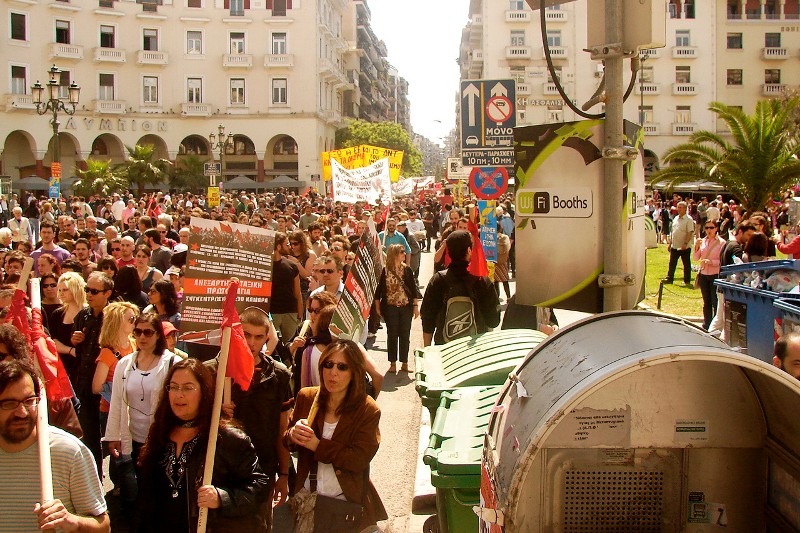
Thessaloniki on 1 May. Photo by apαs.
During the last few days we have witnessed an unprecedented smear campaign against the Greek working class by the European bourgeois media, in particular by the tabloid press, which is specifically aimed at working class people. This campaign is aimed at deceiving the European workers and its objective is clearly to prevent them from assuming internationalist action of class solidarity towards the working class of Greece, which is being brutally attacked by both Greek and foreign capitalists.

The first myth being promoted in this campaign goes more or less like this: “these lazy Greek people, who constantly go on strike without any reason, then come running to the Europeans to finance their own laziness”.

The rank-and-file of the European Left and of the workers’ movement internationally must be told the truth, but unfortunately this will not be forthcoming from the main media outlets. Let us look at some facts. According to Eurostat, Greek workers work on average longer hours than the rest of Europeans. They work a 42-hour week, while the average working week in the 27 member states of the EU is 40.3 hours and within in the “Eurozone” it is 40 hours. So that is myth number one dispelled.

Again, according to Eurostat, Greece also has the most underpaid private sector employees compared to the rest of the “Eurozone”. In Greece, the average gross monthly wage, including social security and taxes, is 803 euros [about £700 or US$1063], while the lowest gross salary in, for example, Ireland is 1300 euros, in France 1250 euros and in the Netherlands 1400 euros. So myth number two doesn’t stand up to any serious analysis of the real figures.

Another idea being bandied about is that if it were not for the EU and the IMF stepping in and imposing strict measures, the Greeks would have happily continued to live on ever-increasing wages. However, according to the Labour Institution of the GSEE [the Greek general confederation of private sector unions], the austerity programmes already imposed by recent governments in Greece even before the current crisis had erupted had already cut the real average wage in the private sector to 1984 levels.

Thessaloniki on 1 May. Photo by apαs.
What about the age of retirement and pension levels? If we were to believe the bourgeois media Greeks live in a kind of workers’ paradise, where they can all retire early and nice big pensions. Again, facts and figures are stubborn things and they give a completely different picture. The average age of retirement in Greece is 61.4 years, a little higher than the European average of 61.1 years.

And what about these fat Greek pensions? According to the GSEE Labour Institution, the average pension in Greece is 750 euros per months [£650 pounds or US$990], while in Spain this figure reaches 950 euros, in Ireland 1700 euros, in Belgium 2800 euros and in the Netherlands 3200 euros. Moreover, this figure was calculated before the implementation of the new government measures, which increase the age of retirement from 65 to 67 years while at the same time cutting pensions by 30 to 50%.

Furthermore, according to the annual report of the joint GSEE-ADEDY trade union confederations on the economy and employment levels in 2009, of the current four and a half million labour force, more than a million work without any social security or other forms of legal protection. According to the report of the Commission for Social Security, established by the Greek Ministry of Labour, this figure reaches 30% of the overall workforce, while in the rest of the EU the percentage of workers in these conditions are only between 5 and 10% of the total.

And whose fault is that? Contributions are supposed to be calculated by the bosses, who pay a part themselves and the remainder is paid by the workers out of their wages. But that would mean declaring the workers legally and paying taxes on the profits made. The bosses prefer to hire a sizeable number of workers illegally, in the “black economy”, and thus save on both taxes due to the state and contributions. If the bosses had paid all taxes due in recent years, and if they had paid what they are supposed to pay into social security funds, the situation would not be anywhere as bad as it is today. It is the Greek capitalists and the foreign investors who have profited from this situation. But who are they blaming? The Greek workers and poor, of course!

On top of all this, in Greece there is also the phenomenon of around 300,000 “false self-employed workers”. These are workers who have in reality been forced to set themselves up as self-employed. In reality they work for a boss who can freely assign the manner, the time, the place of work, and the working conditions and thus this form of working is essentially employment by a boss, but with the added advantage that he can sack them whenever he wants, as formally he is the workers’ “client”. Bosses prefer this method of employment because these workers are not treated legally as employees; they don’t have the same legal rights as the rest of the working class, such as monthly salaries, paid holidays, etc. Employers can fire them freely, even without any compensation. We must also add to the list the 200,000 “part-time” employees, most of whom work full-time but are being paid half-time.

In the smear campaign, there have been many reports concerning the supposedly “excessive” number of civil servants in Greece. According to reports of the ILO (International Labour Organization), civil servants in Greece represent 22.3% of the total workforce, while in France the percentage is 30%, in Sweden 34%, in the Netherlands 27%, in the UK 20% and finally, in Germany 14%. So we can see that Greece is actually below the average. The most important fact, however, that has to be borne in mind is that 300,000 of the public sector employees are working under temporary contracts, which means they have far lower wages and much fewer rights.

Instead of civil servants’ wages going up in recent years, we have seen the opposite phenomenon. As a result of the constant cuts carried out since 1990, according to an ADEDY report [the civil servants trade union confederation], the total real income of civil servants has fallen by 30%. During recent years, governments have preferred to grant “allowances” to civil servants instead of real wage increases. These allowances have neither been included in the annual pay rises nor are they taken into account when calculating pension levels upon retirement.

The bourgeois propaganda also continues to attacking the so-called “13th and 14th month’s salary”, in an attempt to create the impression that Greek workers enjoy higher wages than their European counterparts. In reality, these extra “salaries” are bonuses for Christmas (the 13th salary), Easter and allowances (14th salary), which were given separately as a method of fragmenting total annual income, in order to facilitate commercial and tourist growth during “peak periods” (i.e. holiday periods), in a country whose economy is based mainly on commerce and tourism. With the new recent measures taken by the government, civil servants and pensioners lose both of these salaries. What must also be noted is that all the wage levels, all the facts and figures about the Greek workers’ wages listed above include these extra “salaries”.

The myth of the “opulent” Greek workers is ultimately destroyed if we look at the massive increase in the cost of living in Greece. While the wages and salaries are among the lowest in the Eurozone, the prices of basic goods keep soaring. Let us take a look at a few examples. In Greece a packet of cereals costs on average 2.86 euros, while the same packet costs 1.89 euros in the UK (51% cheaper than in Greece) and in France 2.25 euros (27% cheaper). Greeks buy a toothbrush for 3.74 euros while in the UK the same toothbrush is sold for 2.46 euros (52% cheaper). A pack of soft drinks that costs 3.1 euros in Greece, costs 2.76 in Belgium, 2.3 in France and 2.68 in UK. The most prominent examples are a cup of coffee or tea: in Greece the average price is between 3 and 3.5 euros, more than twice the average in most European countries.

Of course, during the same period, there are some Greeks that could be accused of living in opulence, indeed at record levels, compared to both Europe and globally. But these are not to be found among the Greek working class. During the first half of the past decade Greek capitalists were constantly in the three top places in the league table of profitability globally, while Greek bankers even now are enjoying the highest rates of interest in Europe. This is not by chance. Their profits have been based on the fact that they had at their disposal a workforce that has been on some of the lowest wages in Europe. Added to that they had a sizeable section of this workforce employed in the “black economy”, where they were able to save huge sums on taxes and social security contributions.

The smear campaign of the capitalist press throughout Europe is thus based on nothing but lies. The truth must be explained within the labour movement in every European country and beyond. Real wages are far lower, the working week is longer than average, the age of retirement is higher than average, but one thing has indeed been higher: the profits made by the Greek and foreign capitalists in Greece.

This does not mean that workers in the rest of Europe are living that much better. What is being done to the Greek working class, tomorrow will be done to the Portuguese and the day after to the Italian, the Belgian, the British workers and so on. Already in Ireland we have seen what the capitalist are capable of. Greece provides merely a foretaste of what is coming very soon in the rest of Europe.

What the bourgeois media is trying to do is to play off one working class against another. They are putting the blame for the present crisis of the euro on the Greek workers, using them as a scapegoat. This is all in preparation for the attacks they are preparing across the whole of Europe. Tomorrow, no doubt, we will hear about the lazy Portuguese, the lazy Italians. In Britain no doubt, the campaign about social security “scroungers”, i.e. unemployed workers, will be stepped up, and finally the day will come when the German capitalists will discover that German workers too are “scroungers”, that they have lived it up for too long and some “sacrifices” need to be made.

The European working class must not allow this campaign to go unanswered. It is the duty of the labour movement organisation in all European countries to counter this campaign and tell the truth and put the blame for this crisis where it lies, at the door of the European and world capitalist class.

The workers of Europe must act in solidarity with the Greek working class, which is being cruelly attacked by the EU and struggle together against this attempt to first divide the workers and then to pass the burden of the crisis to the European workers as a whole. This will involve a European-wide struggle. In all countries similar conditions are being created. In all countries the attack is the same. What is required is international solidarity across borders, a struggle for a socialist Europe that will finally make those who are responsible for the crisis pay, by expropriating those who are truly lazy, those who produce nothing, those who live off the sweat of the working class, the industrialists, the bankers, the financial speculators, the ship-owners and the owners of the huge commercial chains.

Tuesday, March 16, 2010

Greece's general strike - and after

Greece: March 11 general strike – conclusions and tasks


Last week, on March 11, Greece was shaken by an even bigger general strike than on February 24. As the government announced its third austerity package the mood of Greek workers has become one of growing anger and militancy. All the conditions are there for a massive escalation of the conflict.

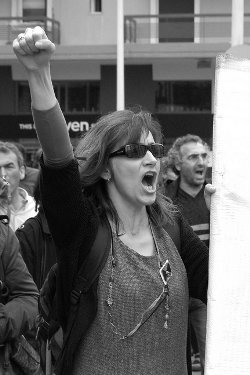
Photo by Left~Lens.
On March 11, for the second time in two weeks, Greece came to a standstill as workers came out in a massive general strike. This general strike was called soon after the announcement by the government of its third consecutive “package” of anti-working class measures on March 3. This package takes directly from the pockets of the workers, in both the public and private sectors, about 1.3 billion euros through an increase in VAT, and cuts 1.7 billion euros from pensions and government workers’ wages, and a further 500 million euros from public investments and 100 million euros from education, with the sole aim of securing 32.5 billion euros to pay interest to the speculators.

These measures were the last straw and produced an explosive reaction amongst the workers. The first opinion polls showed a disapproval rating of 80% and 45% in favour of a general strike throughout the whole population (which means that these percentages would be even higher amongst the workers). This has made the initial high popularity ratings of the government a thing of the past within just a few hours.

There had already been a big demonstration of 25,000 in Athens, two days after the first announcement, during which Manolis Glezos, the 88-year-old hero of the Greek National Resistance against the Nazis and veteran leader of the Communist Movement was sprayed in the face with teargas by a policeman and rushed to hospital with breathing difficulties. If this had led to the death of Manolis Glezos today we would be talking of an insurrectional situation in Greek society.

It can be safely said that participation in the strike on March 11 was bigger than on February 24. According to the GSSE, the participation levels reached 90%. The bourgeois press reported that 30,000 were on the demonstrations in Athens. In fact, those who witnessed both demonstrations of the GSSE-ADEDY at the Pedion Areos and of PAME at Omonia Square say that there were 50,000 in total.

There are three important factors that reveal the psychological state of the working class at this critical point in the struggle.

Firstly, there is anger against the government’s measures and the capitalist class. Ever more workers are starting to see the naked brutal class reality and the real role of this government, as their pockets are emptied in order to secure the super-profits of the Greek and international speculators.

Photo by Left~Lens.
Secondly, there is huge distrust of the trade union bureaucracy. It is important to underline the fact that very few workers actually stayed in the vicinity of the speakers’ platform, where there were mainly leaders of unions that are under the control of PASKE [the PASOK faction of the unions]. The main body of the demonstration at the Pedion Areos turned their backs on the platform and gathered in front of the Museum where SYRIZA and other left movements were gathering. This development is a clear indication that the workers reject the bureaucratic leadership of the unions. Talking with workers gathered in the square, the lack of trust in the union leadership was evident. This has emerged during the talks between the unions, the government and the capitalists, where the trade union leaders offered no clear stand and gave no alternative to the measures being proposed.

Thirdly, there is confusion over what demands the working class should be raising. This is the result of the lack of any clear demands from the leaderships of both the trade unions and the opposition workers’ parties, who are simply limiting their demands to calling for the withdrawal of the measures without proposing any concrete solutions in favour of the working class.

What needs to be done?

The justified anger and the fighting spirit of the workers by themselves are not enough to win this battle. The bourgeoisie is staring default in the face and as they are in a deep recession they are not going to step back easily. In order to win, the working class needs to draw up a clear plan of coordination and escalation of the struggle, with concrete demands that are a real solution to the problem.

Moments like these are historical. If the draconian austerity measures are allowed go through, this will inevitably create a feeling of disappointment amongst the workers for a certain period of time. For the struggle to be effective it must be a united one. To succeed in this, the leadership of PAME [Communist Party faction in the unions] should allow the thousands of communists and their comrades in the trade unions to demonstrate jointly with the rest of the workers! All the mass political and trade union organisations of the working class should act jointly. GSEE, ADEDY, SYRIZA and the KKE [Communist Party of Greece] should set up a united front, calling on the forces of the PASOK that disagree with the government to also join.

The leadership of the working class must be aware of the fact that the workers have already made important sacrifices in order to participate in the struggle against the austerity measures, but without seeing any results. They have participated in a record-breaking number of general strikes in the last 4-5 years, losing significant income without achieving any victories. And apart from this, the workers in the public sector such as those of DEI, the schoolteachers, the dockers, the contract workers and local government workers, as well as participating in these the general strikes, have also organised their own specific sector strikes with long and bitter battles without getting any concrete results. In the last few weeks alone, the government workers have been out on strike many times, losing many days’ pay. There is a limit to the resistance that workers can put up, especially in periods of crisis like the one we are passing through.

That is why the leadership has as a duty to immediately build on the present fighting spirit and not waste it in mobilisations that are not part of a concrete programme of action. If the workers do not see a concrete programme of escalation of the struggle and a determination on the part of the leadership to take the struggle to the end, they will start to get disappointed. If, on the other hand, they were to see a united leadership prepared to fight to the end, they would “dig in” and respond massively to the calls to mobilise, as they would have the confidence that any sacrifices they make could lead to victory.

So what plans does the leadership have to step up the struggle? No one knows! All we have is a call from the ADEDY leadership and the Workers’ Federation for a rally this Tuesday [March 16]. But one more rally does not equal a stepping up of the struggle. On the contrary, if it is not accompanied by a more decisive and concrete plan of strike action, it can actually mean the opposite, i.e. demobilisation. If such a message is sent in the wider masses of the working class, then what we will see in such rallies is a leadership of the trade unions that will feel immense loneliness…

It would be a criminal mistake if now, with the fresh memory of two successful general strikes, the leadership were to move to so-called “other forms of action”, instead of decisively stepping up strike action. The government has no intention of stopping at its latest measures. On March 7, the bourgeois press announced that a further 200,000 redundancies are expected in the civil service and that wage cuts are inevitable in the private sector.

This attack against the working class is not going to stop; it will unfold over a whole period and is part of a concrete plan. That is why we need to work out our own workers’ plan of action, and adopt a concrete programme that should be discussed and debated in mass assemblies in the all the workplaces and working class neighbourhoods. A first step in such a stepping up of the struggle should be a new, united, and coordinated 48-hour general strike in the next ten days, with united and well stewarded mass strike rallies and demonstrations in all the major cities, combined with the call to the workers in large enterprises that are being threatened with redundancy or have not had their wages paid, to occupy the factories and demand nationalisation under workers’ control and management.

At the same time, it is necessary to raise clear demands that will show to the workers a way out from the crisis, one that defends their own class interests. Further to these demands there should be: 1) a freeze on the repayment of speculative loans, 2) nationalisation of the banks that would allow the cancellation of 30% of debt that is owned by the Greek banks, 3) “35 hours, 5 days a week, 7 hours a day” without any loss in pay in order to fight unemployment, 4) the expropriation under workers’ control and management of every major company that threatens closure or redundancies, and so on. (See also the list of demands we drew up Marxistiki Foni, published on February 24).

Above all, the leadership of the Left parties must provide an answer to the agonizing search on the part of the workers for a political solution. They should abandon their vague discourses and explain to the workers that the government in saying that the fall in workers’ living standards is a one way road is a lie and they should explain that another policy exists. The leaderships of the KKE and SYRIZA should call on the workers to fight for the nationalisation under workers’ control and management of the commanding heights of the economy and ask for their political support in order to carry out this policy once they are in government.

Only by adopting such a stance can we vindicate the struggles of the workers and provide a positive perspective to Thursday’s big general strike.