Mu

Mu
Showing posts with label Cuba. Show all posts

Saturday, November 6, 2021

Cuban Revolution vs. US capitalism – The Militant

"There is no COVID-19 vaccine mandate in Cuba. Yet by the time you read this some 73% of the population will be fully vaccinated and over 90% will have at least one dose, one of the highest rates in the world..."


Cuban Revolution vs. US capitalism – The Militant

Saturday, August 28, 2021

Imperialist scorn, Cuban solidarity on display after earthquake in Haiti – The Militant

Imperialist scorn, Cuban solidarity on display after earthquake in Haiti

BY SETH GALINSKY
September 6, 2021
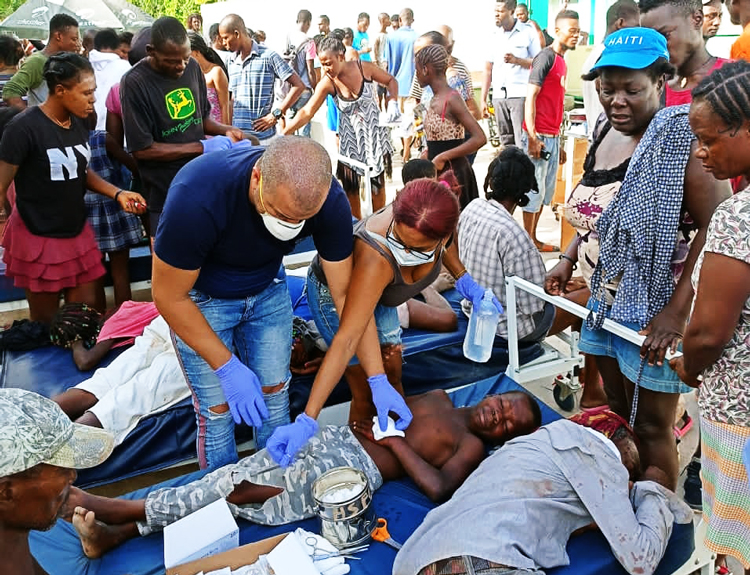
Volunteer Cuban health workers treat earthquake victims, other patients outside hospital in Corail, Haiti, Aug. 24. Cuban internationalists have worked continuously in Haiti for 22 years.
BRIGADA MÉDICA CUBANA EN HAITÍVolunteer Cuban health workers treat earthquake victims, other patients outside hospital in Corail, Haiti, Aug. 24. Cuban internationalists have worked continuously in Haiti for 22 years.

With more than 2,100 dead, over 12,000 injured and an estimated 136,000 families left homeless after an Aug. 14 earthquake that ravaged southwest Haiti, the trickle of international aid is nowhere near what is needed.

Just like in previous disasters there — including the 2010 earthquake that left about 300,000 dead and Hurricane Matthew in 2016 — the grossly inadequate aid shows that working people in Haiti don’t count for much in the eyes of the capitalist rulers in Washington and other imperialist powers. Despite the death toll from previous disasters, Washington and the succession of Haitian governments it has dominated haven’t improved the utterly inadequate health care available on the island.

The sharp exception is the internationalist aid from revolutionary Cuba, whose medical workers have provided care and health education in Haiti continuously since 1998, when it sent 350 volunteers in the wake of Hurricanes George and Mitch. To combat the spread of cholera introduced in Haiti by U.N. troops in 2010, the Cuban health care workers went house to house in the most isolated mountain regions, educating people about the necessary measures to prevent the spread of the disease.

Among thousands of Cuban medical volunteers providing health care all over the world, there are currently 253 doctors, nurses and other medical workers in Haiti, who will remain there as long as they are needed. This is a significant contribution in a country where there are at best 2,500 doctors, most in private practice and concentrated in wealthier neighborhoods.

Cuban internationalist medical workers already in the hardest hit earthquake zone began setting up makeshift hospitals and operating rooms. At the same time, they continue treating and aiding people across the country. Some of the volunteers are “sleeping in tents, like the more than 130,000 families who lost everything on Aug. 14,” reported Trabajadores, the weekly newspaper of the Central Organization of Cuban Workers.

For the last 22 years, these medical volunteers have collaborated closely with their Haitian colleagues and working people, including giving classes in the health centers and individual homes to raise consciousness about preventive medicine and sanitation.

Proud of Cuba’s socialist revolution

While the Cuban volunteers are scrupulous about not interfering in the internal politics in Haiti, they are proud of representing their socialist revolution.

We are “showing in practice the values of solidarity and humanism that the heroic guerrilla Ernesto Che Guevara has bequeathed to us,” reads a post on the Facebook page of Cuba’s mission in Haiti. Guevara was part of the Marxist leadership in Cuba that led workers and farmers to take power and subsequently served on internationalist missions to Congo and Bolivia.

The U.S. rulers and other opponents of the Cuban Revolution have been trying to stir up divisions in Cuba over the challenge the revolution faces in the midst of the COVID-19 pandemic and the tightening of the U.S. embargo. It’s a struggle for Cuba to get raw materials and syringes it needs to produce and administer its own vaccines.

Despite these obstacles, the Cuban government reported Aug. 24 it has now obtained supplies needed to inoculate everyone on the island and expects to have done so by the end of November.

“You are keeping medical brigades in other countries, as if there were doctors and medicine to spare” in Cuba, complained the editors of CiberCuba, a Spanish-based website, Aug. 23. “Everything is for propaganda, isn’t it?”

These counterrevolutionaries, who defend the dog-eat-dog morality of the capitalist market, are incapable of understanding that such solidarity is not “for propaganda,” but is in fact a product of working-class values that are the bedrock of a living socialist revolution. “We don’t offer what we have left over,” Cuban volunteers often explain. “We share what we have.”

What a difference from the so-called nonprofits, nongovernmental agencies and private companies that use the disaster in Haiti ostensibly to provide aid, but in fact to legitimize their operations and line their own pockets.

Working-class solidarity

In addition to the aid from the Cubans, workers and farmers in Haiti have turned to each other’s solidarity to get through the current crisis. “I have a friend who came from Port-au-Prince to bring me water and food and I shared that with my neighbors,” Marcel Francois told the press.

Dominican journalist Deisy Toussaint, who traveled by land from Port-au-Prince to Les Cayes, told channel 24 TV that she saw areas with homes totally destroyed, where five days after the quake no aid or rescue crews had arrived. “People told us they could hear people still alive under the rubble, and all they had were their hands to try to get them out.”

In the absence of any serious government response to the disaster, a handful of recent graduates from Haiti’s public medical school pooled their money for supplies and set up a clinic in Marceline.

More than 100 years of U.S. imperialist domination and superexploitation are perpetuating the miserable conditions working people confront in Haiti, ensuring natural disasters rapidly become social catastrophes.


Imperialist scorn, Cuban solidarity on display after earthquake in Haiti – The Militant

Earthquake, decades of US plunder brings social catastrophe in Haiti – The Militant

Earthquake, decades of US plunder brings social catastrophe in Haiti – The Militant

Saturday, August 21, 2021

Defend, emulate Cuba’s socialist revolution! End US embargo! – The Militant

NEW YORK — Why does Cuba’s socialist revolution continue to live, fight and set an example worldwide more than 60 years after workers and farmers there took power? What makes class and social relations in Cuba so different from anywhere else in the world today?

Because 62 years ago the working people of Cuba were led by a Marxist leadership to make a socialist revolution, Martín Koppel and Róger Calero told a Militant Labor Forum here Aug. 14. Both are members of the Socialist Workers Party; Calero is the party’s candidate for mayor of New York.

“The revolutionary government was a new state power — workers power — that organized workers, farmers, youth and others,” Koppel said. “A socialist revolution is marked by a different kind of social relations, based on working-class solidarity, not capitalist competition.”

“There were two great socialist revolutions in the 20th century, one in Russia, the other in Cuba,” Koppel said, quoting from a letter sent by SWP National Secretary Jack Barnes to Cuban President Raúl Castro in November 2016 after the death of Fidel Castro (reprinted in this issue). In it Barnes noted that Castro’s “highest achievement was forging in struggle a revolutionary cadre, a communist cadre, capable of leading the workers and farmers of Cuba to establish the first free territory of the Americas and successfully defend it for more than five and a half decades” — now more than six! — “against the determination to destroy it by the mightiest and most brutal empire the world has known.”

The Cuban Revolution has been distinguished from the start by its proletarian internationalist record  — sending volunteer combatants to aid anti-imperialist struggles, or doctors and nurses to respond to earthquakes and hurricanes, and to combat Ebola and COVID-19.

“The U.S. rulers fear that workers and farmers around the world, including here in the United States, will follow the living example of Cuba’s socialist revolution,” Koppel said.

Transformation of social relations

The leadership of the Cuban Revolution instilled in working people confidence in their own capacities to transform and lead society, Koppel said. This transformation began during the revolutionary war itself, as the Rebel Army began to organize working people in liberated regions to take charge of health care, education, justice and agriculture.

In the days following the Jan. 1, 1959, popular insurrection that toppled the U.S.-backed dictatorship of Fulgencio Batista, the Rebel Army crossed the island and in every town along the way Castro spoke with crowds of workers and peasants to explain what they were fighting for.

Peasants were led to carry out a sweeping land reform. Workers “took more and more control of job conditions. They expropriated the capitalists’ factories, banks and big landholdings, and began to organize the economy to meet the needs of the majority, not the profits for a small exploiting class,” Koppel said. “Decisive steps were taken to outlaw racist discrimination, and to draw millions of women into economic, social and political activity.”

In 1961 an army of volunteer teachers, largely teenagers, spread across the countryside and wiped out illiteracy in a year, which also helped break down divisions between working people in city and country, Koppel said. That April the Cuban people defeated a U.S.-organized mercenary invasion in less than 72 hours.

As they were doing this, Koppel said, the Cuban leadership set out to “lend support to those around the world who were fighting to be free of imperialist oppression — from Algeria to Angola, a course of international solidarity that continues to this day.”

It’s these class relations, based on the expropriation of the capitalist exploiters and built over decades of promoting working-class consciousness, that make Cuba’s revolution different. This is why the U.S. rulers are determined to destroy it. And why it’s so important for working people the world over to defend it.

Cuba, like the rest of the world, is affected by the world capitalist economic crisis, Koppel said. The embargo imposed by Washington, and enforced on other countries, sharply limits Cuba’s access to the hard currency needed to buy food, fertilizer, fuel, medicine, spare parts, and other necessities. The embargo is compounded by the pandemic, which has decimated tourism, a major source of hard currency.

“Despite these challenges the Cuban government has sought to guarantee medical care and basic necessities to the population and to involve it in the process,” Calero said.

In response to a question from the audience, Koppel noted the collective response of the Cuban people to the pandemic. “No one has been left to fend for themselves,” he said. “And Cuba has now fully vaccinated a quarter of the population with their own extremely effective vaccine. They’ve done this while maintaining nearly 30,000 volunteer medical personnel around the world.”

On July 11 protests took place in Cuba “orchestrated by groups and individuals opposed to the revolution that receive funds from the U.S. government,” Calero said. “These groups took advantage of the hardships and effects of Washington’s sanctions that have been building up. Many people, including some who support the government, were drawn into the protests because they see no end to the difficulties they face.”

This is compounded by shattered illusions among some Cubans who had hoped that President Joseph Biden would reverse some of the most draconian restrictions of Washington’s punishing embargo.

But seeing the pressures in Cuba that are building up, the U.S. rulers have no intention of backing off their bipartisan effort to tighten the economic squeeze aimed at overthrowing the Cuban Revolution — an effort carried out by the previous 12 U.S. administrations since 1959.

Both open enemies of the revolution as well as liberals and “socialists” are part of the current political offensive against the Cuban Revolution, Calero said. He gave the example of Alexandria Ocasio-Cortez, the Democratic Party socialist congresswoman from New York, who calls for an end to the embargo while backing the recent U.S.-provoked protests in Cuba, repeating “the timeworn slanders that the Cuban government is a dictatorship that violates human rights.”

In the discussion one participant noted that among many in the U.S. who oppose the embargo there are those who say we should downplay the socialist revolution. They say this is the best way to win “progressive” politicians and businesses who might join in calling for ending aspects of the embargo for their own reasons, a strategy they argue is more likely to succeed. Behind this is their prejudice that “backward U.S. workers” can never be won to support a socialist revolution.

“The stronger the revolution is, the better the chances to force the U.S. rulers to back off their attacks on it,” Koppel said. “That’s the lesson of history.”

Defense of the Cuban Revolution is part of advancing the class struggle here, he said. “The best aid we can give to the Cuban people is to advance working-class struggles in the U.S.,” Calero said.

“The lessons of the Cuban Revolution and its Marxist leadership can’t be separated from the task of building a communist party here to lead the working class to power in the United States.”

“For young people and workers who are waking up to the crisis of capitalism today and want to do something about it, taking the time to study, absorb and use the lessons of the Cuban Revolution will prove decisive in who will win the class battles to come — the working class or the fascist thugs the capitalist rulers will unleash,” Calero said. That’s why the Socialist Workers Party spends so much time publishing and promoting study of books by leaders of the revolution.

Calero pointed to the efforts by the Cuban government and mass organizations to enable every Cuban — including those with physical and other disabilities—to participate actively in society and realize their full potential.  This includes everything from film programs for the blind to special steps, in face of the embargo, to ensure hearing aids and other equipment for those with special needs.

Human solidarity vs. barbarism

“It is the deeply ingrained sense of social solidarity and internationalism that underlies the Cuban people’s determination to defend the conquests of the revolution and to advance the social and political aspirations of working people around the world,” Calero said.

“Socialist revolution draws on human diversity. It seeks to provide human beings with the scientific and cultural advances that have accumulated over centuries of human activity, to allow for the development of every person to their fullest potential. This has been a guiding principle of the Cuban Revolution from the beginning.

“These values can only be produced by a socialist revolution. Values that millions of working people in the United States can recognize and be won to fight for,” Calero said.

Economic instability, war crises and class battles of major proportions lie ahead, he said. Pointing to midtown Manhattan with its boarded-up stores and thousands of homeless workers, he said, “That’s what Cuba was like for working people before the revolution, and what capitalism has to offer today.

“The Socialist Workers Party sees building a revolutionary working-class party in the United States as the central task in defense of the Cuban Revolution. We invite you to join us.”


Defend, emulate Cuba’s socialist revolution! End US embargo! – The Militant

‘Fidel belongs to the working people of the world’ – The Militant

The following letter was sent by Socialist Workers Party National Secretary Jack Barnes to Raúl Castro Ruz, first secretary of the Communist Party of Cuba, on Nov. 27, 2016, after the death two days earlier of Fidel Castro, his brother and central leader of Cuba’s socialist revolution.

There were two great socialist revolutions in the twentieth century, one in Russia, the other in Cuba. Neither was the product of a single individual. Both were the result of the operations of capitalism itself. But without the presence and political leadership of Vladimir Lenin and of Fidel Castro Ruz at decisive moments in those historic battles by working people, there is no reason to believe either revolution would have been victorious.

Apart from Lenin and Fidel, the history of the twentieth century — and the twenty-first — is unthinkable. Both of them, Marxist students of science and history, gave their lives to uprooting the dog-eat-dog exploitation, oppression and compulsion on which the capitalist world order depends and replacing it with a workers state, with new social and economic relations based on the liberating capacities of working people and the youth they inspire.

Fidel belongs to Cuba first and foremost, to the men and women of José Martí and Antonio Maceo. His highest achievement was forging in struggle a revolutionary cadre, a communist cadre, capable of leading the workers and farmers of Cuba to establish the first free territory of the Americas and successfully defend it for more than five and a half decades against the determination to destroy it by the mightiest and most brutal empire the world has known.

But Fidel belongs to the working people of the world as well. From Latin America and the Caribbean, to Africa and Asia, to North America and Europe, he showed us in action what proletarian internationalism means. During Cuba’s historic sixteen-year mission aiding the people of Angola and Namibia against apartheid South Africa and its promoters in Washington, Fidel demonstrated his unmatched political leadership on a world scale. He also proved, as the Rebel Army combatants of the Sierra knew well, that he was one of the toilers greatest military commanders ever.

All this is why Fidel became the most loved as well as the most hated, the most slandered man of our lifetimes.

As Fidel said in his farewell words to the Seventh Congress of the Communist Party of Cuba in April, “We all reach our turn.” He cannot be replaced, but his life work, Cuba’s socialist revolution — its example, and above all its ongoing march — stand as his monument. He needs no other.

For our part, members of the Socialist Workers Party and Young Socialists will continue to do everything in our power to publish and spread the truth about the Cuban Revolution and Fidel’s leadership, to make it known to working people in the United States and throughout the world. With unshakable confidence in the working class and its allies, we will continue to organize and act on the course Fidel uncompromisingly presented to the world in 1961, a month before the victorious battle of Playa Girón: “There will be a victorious revolution in the United States before a victorious counterrevolution in Cuba.”


‘Fidel belongs to the working people of the world’ – The Militant

Wednesday, July 9, 2014

No ‘Laws’ for the Transition from Capitalism to Socialism

25 years ago this month I joined the U.S. Socialist Workers Party.

A variety of events in world politics confirming the party's perspectives led to the decision:

  • Cuba's rectification process
  • The uptick in the anti-apartheid struggle
  • Eastern Airlines and Pittston Coal Strikes


Each confirmed the "spread of rank and file leadership" in militant working class struggles. 
Because SWP cadre carried out their political assignments as rank and file members of industrial unions, the ability to unite "theory and practic" was a daily challenge.

And a daily pleasure.

It is a decision I celebrate and am grateful I made.

_______

One of the first Pathfinder books I bought after joining was the collection of Castro speeches In Defense of Socialism.  To a young socialist like myself it was particularly useful in differentiating the Cuban proletarian course  from the petty bourgeois rationalizations of Gorbachev era Stalinism.  


Socialism built on consciousness, active solidarity of masses 
(Books of the Month column)

The excerpt reprinted here is from a Jan. 8, 1989, speech by Fidel Castro titled, “The Young Generation Must Improve and Defend Socialism,” which is included in In Defense of Socialism: Four Speeches on the 30th Anniversary of the Cuban Revolution. Castro is speaking about Cuba’s “rectification process,” which began in 1986. That political initiative sought to return to the communist course of the revolution’s earlier years, placing the consciousness and initiatives of working people at the center — as opposed to the administration of workers and farmers and other capitalist-style methods copied from the Soviet Union that were leading away from socialism. Copyright © 1989 by Pathfinder Press. Reprinted by permission. 

BY FIDEL CASTRO  

It would be an illusion to think that the whole difficult period for the revolution and for the nation is over. That would be an illusion that the current generation and the coming generations can never harbor. Imperialism has not renounced the idea of liquidating socialism in Cuba, of liquidating revolutionary ideology in Cuba; imperialism has not renounced the idea of liquidating our revolution. Imperialism might change its tactics, its weapons, but U.S. imperialism is too arrogant, too high-handed, too haughty to renounce the idea of overturning the Cuban revolution, to renounce the idea of liquidating socialism in Cuba. …

We face a tremendous historic challenge. Who will win? Who will prevail? The selfish, chaotic, and inhumane capitalist system? [Shouts of “No!”] Or the more rational and humane socialist system? [Shouts and prolonged applause] This is the challenge that now faces not just Cuban youth and the Cuban people, but the youth and peoples of all the socialist countries.

Of course this is a task for all of us and especially the new generation, which will have to make a special effort to better itself.

We must have a clear understanding of what we face and the battle in which we are involved to improve socialism in our country. And perhaps the greatest challenge is that this is a battle to improve socialism without resorting to the mechanisms and style of capitalism, without playing at capitalism. [Applause] That’s what we are trying to do in the process of rectification.

A few days ago I said that we’re starting to see some results of this process. We have seen some examples; to mention one, the contingents of construction workers. I believe that we have with us a group of the young people working in the Havana contingents. [Applause] In these days we have witnessed great feats: we have seen what the Blas Roca Contingent did, what the Sixth Congress Contingent did, what the contingents that built ExpoCuba did. [Applause] We have seen what the minibrigades did there, we have seen what the contingents in different provinces are doing. And we have seen the principles these groups of workers are applying, which have nothing in common with capitalist methods of motivation nor capitalist methods of organization. [Applause] I am sure there are no groups of workers like that anywhere else.

This shows what man can do; what man can do when there is faith in man, trust in man, when you don’t start from the premise that man is like a little animal who only moves when you dangle a carrot in front of him or whip him with a stick. [Applause] The minibrigades, contingent workers, and hundreds of groups of workers in our country that are now making great efforts, and we could say thousands of groups of workers, don’t act or do what they do because of a carrot or a stick. [Applause] …

What carrot or what stick was used on the Sixth Congress Contingent, which in barely a year has just finished building — and done an excellent job — a big hospital in the capital? [Applause] What carrot or what stick motivated the minibrigade and contingent members who in barely a year — because the bulk of the work was done in a year — have built the tremendous ExpoCuba project? [Applause] What carrot or what stick was used on the citizens who put in 400,000 hours of voluntary work in building the Miguel Enríquez Hospital? [Applause] What carrot or stick led thousands of senior high school and technological students to put in millions of hours of voluntary work on social projects? [Applause]

What carrot or stick led secondary school students in the citrus project in Jagüey to harvest more than 400,000 tons of citrus fruit? [Applause] … What carrot or stick motivates hundreds of thousands of students who work three hours a day in the schools in the countryside? [Applause and shouts of “For sure, Fidel, give the Yankees hell!”]

But in relation to other fields, we could also ask: What carrot or what stick motivated the fighters of the Rebel Army who for two years confronted and defeated the army of the tyranny? [Applause and shouts of “For sure, Fidel, give the Yankees hell!”] What carrot or stick motivated many thousands of teachers, doctors, or workers who have rendered internationalist service? [Applause] What carrot or stick motivated the 50,000 Cuban fighters in Angola who made possible the victory? [Exclamations and prolonged applause]

A final question for the list, which could go on forever: What carrot or what stick motivated the 300,000 Cubans who honorably fulfilled their internationalist missions in Angola over the last thirteen years? [Exclamations and prolonged applause]

So are we or are we not correct in trusting in people, in their consciousness and spirit of solidarity? Are we or are we not right in feeling people can really do what they set out to do; that people can live in a society that is more humane, more just, more generous, and more based on solidarity than is capitalism, where the law of the jungle prevails? Could a society educated in the selfish ideas of capitalism carry out a single one of these things we’ve mentioned? That’s why our confidence in the future of the revolution is so unshakable. 

http://themilitant.com/2014/7825/782549.html

Tuesday, November 9, 2010

Oppose ""the need to get beyond Marxism and "adapt" to "the new circumstances" "

XXI Century Socialism, or There is nothing new under the sun

by Alan Woods

At a time when the Cuban Revolution is facing great dangers, a serious debate is opening up in the ranks of the Cuban Communists. Last week’s Marxist conference organised by the study group Cuba and Society under the auspices of the Instituto de Filosofia de La Habana in November 2010 to discuss Socialism in the XXI Century in the run-up to the forthcoming Party Congress therefore assumes a particular importance. Among the few foreign guests invited to address this event was the editor of Marxist.com, Alan Woods, whose latest book Reformism or Revolution, has attracted a lot of interest in Cuba. We are publishing today the text submitted by comrade Woods to the conference.

The times we live in

In the first decade of the century, humanity stands at the crossroads. On the one hand, the advances in science, technology and industry open the way to a dazzling future of prosperity, social welfare and cultural advancement without limits. On the other hand, the very existence of the human race is threatened by the devastation of the planet in the name of profit. Millions live in poverty, hanging on the brink of starvation. In country after country there are elements of barbarism. The future of the planet is threatened by global environmental degradation.

The fall of the Soviet Union gave the green light to an unprecedented ideological offensive against the ideas of socialism. The collapse of planned economies under bureaucratic control of the East was presented as the ultimate proof of the failure of "communism" and, of course, of the ideas of Marx. The defenders of capitalism saw the fall of the Soviet Union as the final proof that their system was the only one possible.

Twenty years ago, after the fall of the Berlin Wall, the ruling class was ecstatic. They dreamed of a New World Order based on peace and prosperity. They figured that the current temporary economic boom meant not only a return to the days of their youth but also the abolition of all crises in general. At that time they promised a world of peace and prosperity, a new economic paradigm of uninterrupted growth.

These illusions were quickly shattered. Today not one stone upon another is left of the dreams of the bourgeoisie. All those promises have proven to be false. The current crisis of capitalism is probably the most serious in its history. The huge debts of banks have turned into huge government debts. The dead weight of debt weighs heavily on the global economy, preventing a recovery.

New ideas?

In the ideological battle in defence of Marxism, we must face all kinds of attacks. There are frontal attacks that come directly from the bourgeoisie and its ideologues. This kind of criticism is the easiest to detect and respond to. But there is another type of attack that is a bit more difficult to address because it appears disguised as a friendly criticism, intended not to abolish Marxism but only introduce a few changes to "get it up to date".

Unfortunately, this campaign of the bourgeoisie has found an echo in the ranks of the communist movement. The collapse of the USSR has led to a period of tremendous confusion and disorientation in the world communist movement. The fall of the USSR has had dire consequences. Many former Communists abandoned Marxism. For two decades, there has been a persistent insistence on the need to get beyond Marxism and "adapt" to "the new circumstances" of the current historical moment.

Since the collapse of the Soviet Union, there has been a ferment of discussion within the Left worldwide. The ignominious failure of Stalinism and the unprecedented ideological counteroffensive of the bourgeoisie against socialism has led some to conclude that the "old ideas” of Marxism (scientific socialism) are no longer valid, and that there is a need to invent something new and original in its place.

In Venezuela, the debate on socialism is taking place, not in narrow intellectual circles, but at every bus stop, in every factory and market place. But as soon as Hugo Chavez raised the question of socialism, all sorts of pseudo-intellectual reformists and academics were quick to rush in and try to confuse the issue. These elements fell over themselves in their haste to explain that the ideas of Marx, Engels and Lenin were outdated, outmoded and there was a burning need to develop "new ideas".

Heinz Dietrich, the most prominent representative of this trend, has promised us a brand new version of socialism, called "XXI century socialism." This idea has a great advantage over other ideas, in that no one has the slightest idea of what it means. It is an empty bottle that can be filled with any content.

Incredibly, the ideas advanced by Dietrich the need to form a new Latin American regional bloc to compete with the US, the theoretical formulation of "XXI Century Socialism", the abandonment of the nationalisation of the means of production, workers' control and workers' democracy have found some echo in the Left in Venezuela and other Latin American countries. This fact in itself shows how far the deterioration of the Left has gone and the poverty of its theoretical level.

What we are confronted with is a modernised version of the old ideas of reformism. In my book Reformism or Revolution, I have shown that there is nothing new in this so-called XXI century socialism. We do not find here a single new idea, but only a rather poor repetition of the old unscientific ideas of the utopian socialists such as Proudhon and Robert Owen that were answered by Marx and Engels long ago.

The writings of Dietrich simply repeat the old pre-Marxist ideas of the utopian socialists and present them as something new, a form of "socialism” without class struggle with no need to expropriate capitalism. The ideas of the utopian socialists were really ahead of their time and deserve all our respect. Their limitations were in not being able to understand the role of class struggle, but it must be kept in mind that mainly at that time the working class had scarcely developed. There is no excuse for people like Heinz Dietrich to repeat these ideas today, after over 200 years of development of the working class movement.

It is not the first time we have seen such things. The XXI century revisionists merely repeat the same arguments championed by Bernstein and Kautsky long ago, except that they did so in a much more interesting and intelligent way.

Under a false flag

All this chatter about "entirely new and original ideas" is superficially attractive. After all, who would not prefer a nice new car or latest model of a computer instead of last year's model? But in reality, the analogy is false and contradicts our experience. What is new is not necessarily better in all cases, nor is something necessarily bad for being old. A car or a new computer that does not work is worse than some old one that does.

The wheel is a pretty old invention, but after thousands of years still works fairly well. What should we think of someone who asks us to abandon the wheel because it is old and look for a wheel of the XXI century? What type of wheel would this be? Triangular perhaps, or square? Whatever form it took, we are convinced that it would not take us one step further.

The distortions and manipulations of socialist thought are carried out from different fronts. Incredibly, there are communists who insist that Communism can be maintained while in practice what is being defended is capitalism. To hide the purely reactionary character of these theories, they try to disguise them with academic verbiage and an obscurantist language as impenetrable as a tropical rainforest.

The writings of Marx and Engels are so clear because they have a clear socialist message. Marx and Engels wrote in a wonderfully simple language because they were writing for the workers and any worker of average intelligence can understand their writings. This is not a coincidence. A good writer is one who knows how to turn complex ideas into simple ones, while a bad writer only knows how to make simple ideas complicated.

The reason these books are so difficult to read is not because they have a profound content, but precisely the opposite. Here the absolute lack of content is generously compensated for by a wealth of complicated language, obscure vocabulary and a maze of tangled syntax. Of this kind of thing the old Hegel once said: "Just as there is a breadth that is empty, there is a depth that is empty also." These words express all that is necessary to say on the subject.

Venezuela and Cuba

One of the arguments of Dietrich is the so-called "low consciousness of the working class." It is impossible to listen to these arguments without a sense of deep outrage. In Venezuela during the last decade the masses have proven time and again their high level of consciousness. It was they who saved the revolution on 13 April 2002, when the masses came out, without direction or party, to defeat the reactionary coup organised by the owners of the banks, industry and land, along with the reactionary generals, the Church and imperialism. The same was the case in the oil lockout and the recall referendum.

On April 13, 2002, the reactionary oligarchy fled like rats and there was no force in Venezuela prepared to defend the old order. One word of Chavez and the expropriation of the ruling class could have been carried out in a peaceful manner. Unfortunately, this word never came. But this is not a problem of lack of awareness of the people but the lack of a revolutionary party with a revolutionary leadership.

One of the principal dangers currently facing the Venezuelan revolution is that it has not yet taken the decisive steps to carry out the revolutionary process to the end, expropriating the oligarchy and imperialism, in order to build a planned economy under workers' control. It is not possible to speak of socialism in Venezuela unless it puts an end the economic power of the oligarchy once and for all.

The reformists believe it is possible to reach socialism without nationalisation, without revolution, without class struggle. This is a very dangerous idea. The reformists say that the revolution must not overstep the limits of private ownership of the big bourgeoisie. Instead of the expropriation of the commanding heights of the economy it should encourage small cooperatives, and instead of the planned economy the Keynesian model must be implemented. In other words, the revolution must stop halfway. But all history proves that it is not possible to carry out half a revolution.

The most important lesson of the Cuban Revolution is that the bourgeoisie and imperialism could only be defeated on the basis of the expropriation of the productive forces. Without a nationalised planned economy the Cuban Revolution could never have achieved what it did. The so-called national bourgeoisie in Cuba was incapable of playing a progressive role. And the same is true of the bourgeoisie of Venezuela, Bolivia and the entire continent of Latin America.

The bourgeoisie of Latin America has had two centuries to show what it can do, and all that it has achieved is to waste the colossal productive potential of the continent. Che Guevara pointed this out long ago, when he wrote: "The indigenous bourgeoisie has lost its ability to oppose imperialism, if it ever had it, and now just constitutes its tail. There is no more change to be made: either socialist revolution or a caricature of revolution”. (Ernesto" Che "Guevara, Message to the peoples of the world through the Tricontinental)

To refuse to carry out the socialist revolution in Venezuela, to refuse to expropriate the oligarchy would be precisely a caricature of a revolution. It would be doomed to failure. In the final analysis, the alternative is either the victory of the revolution or the victory of the counterrevolution. The defeat of the Venezuelan revolution would have serious consequences for Latin America and to Cuba above all. Ultimately, the only way to preserve the Cuban Revolution is by breaking the isolation of the revolution by extending the socialist revolution throughout Latin America, an idea for which Che Guevara fought and died.

Failure of bourgeois ideology

All the theories of bourgeois political economy have been shattered following the 2007-08 crisis a crisis that, according to these theories, should never have happened. To indicate the total confusion of the bourgeois economists, it is sufficient to note the despairing comments of the bourgeois economists in recent months. The same people who imagined that their elaborate models could predict with mathematical accuracy the behaviour of the global capitalist economy, and predicted with absolute confidence the impossibility of a slump, are now beating their breasts in public.

The total incapacity of the bourgeois economists to explain anything is clear. They say it themselves. Barry Eichengreen, an economic historian and prominent US economist at the University of California, Berkeley, writes: “The crisis has cast into doubt much of what we thought about economics." (See The National Interest, October 27, 2010)

Paul Krugman, who received the Nobel Prize for Economics in 2008, in a speech at the London School of Economics in June, 2010, said: "Over the last thirty years, macroeconomic theory has been spectacularly useless at best, and positively harmful at worst. "(Quoted in The Economist)

The bourgeoisie does not understand what is happening and is in a state of panic. That is why they are taking steps that are totally irresponsible from the standpoint of orthodox economics. This is a sign of desperation. Some say, "We must reduce the deficits, or there is no solution to the crisis." Others say, "If we cut public spending, we will create a new slump." And both are right.

Interestingly, the immediate cause of both the English Revolution in the seventeenth century and the French Revolution in the eighteenth century was the huge deficits of public spending. In both cases the bottom line was the same: who will pay? Everywhere the ruling class wants to put the full weight of its bankruptcy on the backs of the working class, middle class and the poor and vulnerable sectors of society: the unemployed, the sick, the old and the disabled. The smiling mask of "capitalism with a human face" has slipped, to reveal the real face of the bourgeoisie. The ignominious failure of Obama in the US is an expression of this fact.

The error of the reformists is that they believe it is possible to go back to a period when the economic boom that followed World War II allowed the bourgeoisie in Europe and the US to make big concessions to the working class to take the steam out of the class struggle. But this is now impossible. From a capitalist standpoint, not only is it impossible to carry out further reforms; it is impossible to tolerate the continuation of the reforms that were conquered by the workers during the past fifty years.

We can express the dilemma of capitalism as follows: a) the bourgeoisie cannot accept the existence of reforms; b) the workers cannot accept further cuts in their standard of living. This is a finished recipe for the intensification of class struggle everywhere. In other words, any attempt by the bourgeoisie to restore economic equilibrium would destroy the political and social equilibrium. The present events in France are an eloquent proof of this assertion.

Everywhere we see the awakening of the masses who are seeking a way out. It is the beginning of a new period of class struggle. In Latin America the revolutionary trend has gone further than elsewhere. But we also see a revival of the labour movement in France, Greece, Spain and other European countries. Everywhere there is a growing questioning of capitalism and a growing interest in the ideas of socialism and Marxism.

The relevance of Marxism today

The critics of Marxism call into question the relevance of Marxism in all fields: philosophy and science, historical materialism, economics, the theory of the state. And it must be so, because Marxism is a set of ideas that cannot be regarded separately. Engels already answered these critics in one of the finest works of Marxism: Anti-During. For my part, I consider the ideas of Marx, Engels, Lenin and Trotsky to be as valid and relevant as they ever were. In fact they are more necessary and relevant now than at any other time.

Naturally, if someone can convince me that he possesses a body of ideas that is superior to Marxism and renders it obsolete, I am willing to change my mind. But until today I have never encountered such an option. For over half a century I not only have carefully studied all the works of the great Marxist writers, but also a good number of their critics. Having heard many arguments from people who claimed to offer an alternative, I have not heard anything that is even remotely comparable with the depth and richness of Marxism. I have yet to see a body of ideas that comes anywhere near the heights of Marxism and that can replace it as a scientific tool for understanding the world in which we live.

After carefully reading the writings of Dietrich and other revisionists I have not found any reason to change my ideas. Quite the contrary, I am even firmer in my beliefs and convictions. Today more than ever, it seems to me that scientific socialism is an essential tool to carry out the struggle of the working class towards their emancipation, to achieve the triumph of a conscious and free humanity.

My friend and comrade Fernando Buen Abad says that reformism is chameleon-like and slippery. Reformist demagoguery can be disguised in many ways, but its mission remains the same. Reformists and social democrats are committed to slow up, confuse and defeat the socialist revolution and undermine the ideas of Karl Marx. We must demolish the fallacies of reformism. This is a scientific struggle without quarter.

Marxism has been corroborated by advances in science, which has furnished us with examples of the correctness of the dialectic that are far more striking than those used by Engels in The Dialectics of Nature. I have given a list of these examples in my book Reason in Revolt (published in Cuba by the Social Sciences Publishing House). For the present, suffice it to mention chaos theory and its variants (complexity and ubiquity theory), which represent a purely dialectical method; the writings of Stephen Jay Gould on the evolution of species, in which he pays tribute to the role of Engels; the discoveries of the human genome, and so on. All this shows that "ultimately nature works in a dialectic" in the words of Engels. In the field of political economy, as we have seen, things are clearer still.

The vast superiority of the Marxist method can be seen in the founding document of scientific socialism. It would be impossible to find any bourgeois book on political economy, history or sociology written in 1848 that has more than a mere historical interest. Instead, we can say without fear of contradiction, that the most modern book you can read is The Communist Manifesto written by Karl Marx and Frederick Engels. Here's a book written over 150 years, which explains what is happening in the world now, including phenomena such as globalisation and concentration of capital in few hands.

In the same way that we need not reinvent the wheel, we need not reinvent the ideas of scientific socialism, which retain their full validity and relevance. Of course, we will have to make this or that change, but what is surprising is how little needs to be altered. Certainly, the basic ideas remain as valid as when they were written, and in many cases are more relevant today than in the times of Marx and Engels.

Of course, it is good to discuss the ideas of socialism, and we participate in this debate with the greatest of enthusiasm. What is not so good is that some people should try to monopolise the interpretation of socialism of the XXI century, introducing confusion of all kinds. Even worse is the attempt to present a kind of "socialism" that turns out to be exactly the same as capitalism.

Some people are talking about a “Chinese way” or a “Vietnamese model” for Cuba. The change of terminology is irrelevant. Regardless of how they want to describe their model, the proposals are clear. “The state should no longer plan the economy but regulate it”, “manufacturing and agriculture should be opened to foreign investment”, etc. No doubt the intentions of those proposing these measures are of the best. But the way to Hell is paved with good intentions, and the restoration of capitalism would be Hell for the people of Cuba, even if some do not yet recognise the fact.

Long ago, Fidel Castro rejected the “Chinese model” because it was just another name for the restoration of capitalism. But even if we were to consider this option, it would immediately become clear that it cannot apply to Cuba. The concrete conditions are completely different. Cuba is a small island with a small population and few resources. China is a vast territory with over a billion inhabitants, many resources and a powerful industrial base. The huge Chinese peasantry has provided China’s capitalist enterprises with a vast reserve of cheap labour, which has constantly supplied the factories of Guangdong with workers who work under virtual slave conditions for very low wages. The only thing that a Cuban variant would share is the last: low wages.

A capitalist Cuba would resemble neither China nor Vietnam, but rather El Salvador or Nicaragua after the victory of the counter-revolution. It would soon revert to a similar situation that existed before 1959 – one of misery, degradation and semi-colonial dependence. And irrespective of the intentions of those responsible, the danger is that market reforms can unleash powerful tendencies towards the restoration of capitalism, which would eventually destroy all the conquests of the revolution. It is the entry to a very slippery slope, and once it starts it will be difficult to stop. The capitalist road (even if it masquerades as the "Chinese road" or the "Vietnamese road") cannot provide any solution to the problems of the people of Cuba.

The restoration of capitalism in Russia has had disastrous consequences, not just for the peoples of the former Soviet Union but for Cuba also. The restoration of capitalism in Cuba would be an even greater disaster. It is ironic that precisely at this moment, the revisionists want to abandon socialism and embrace the market economy, just when it is in a mess everywhere. The crisis of the global capitalist system shows that it is unable to offer any prospect for most of the world's population, condemning millions of human beings to poverty and hunger.

The fact is that the so-called free market economy has failed on a global scale. What is necessary is a rationally planned economy where economic decisions are taken to satisfy the needs of the many, not the profits of the few. Of course, we must learn from the failure of the Soviet Union. But it is important to note that what failed in the USSR was not the nationalised planned economy, which gave astonishing results and transformed backward tsarist Russia into a powerful industrialised nation.

What failed in Russia was not socialism in the sense understood by Marx or Lenin, but a bureaucratic caricature of socialism that stifled all initiative and creative thought and led to corruption and inefficiency on a vast scale. These things are not something inherent in a socialist planned economy but the product of the isolation of the Russian Revolution in conditions of frightful backwardness. What was necessary was to combine the nationalised planned economy with the democratic control and administration of the workers, as Lenin explained many times.

Marxism is perfectly suited to develop an alternative to the tactical and strategic problems of Cuba and the world revolution. What is needed is a fraternal debate between the various trends in the communist movement. This debate has been initiated and is leading to the revival of communism worldwide. Debate in the hands of revolutionaries should serve, among other things, to clarify ideas and mobilise our forces for concrete actions that are aimed at the overthrow of capitalism and its replacement by a qualitatively superior system: socialism. Nothing and nobody must deviate from this goal.

London, October 29, 2010

Saturday, January 23, 2010

Is Cuba racist? So say Ruby Dee Davis, Prof. Cornel West, and Rev. Jeremiah Wright among others


Defend the Cuban Revolution!

(editorial)

The recent statement by a group of prominent African Americans condemning the Cuban Revolution’s “racism” is an assault on the conquest of power by the working class in Cuba, and the effective wielding of that power for more than 50 years in the interests of working people. It is also an assault on the fight of workers in this country to replace the dictatorship of capital—and all of the exploitation and discrimination it perpetuates—through the working class taking power and establishing the dictatorship of the proletariat.

With the deepening world capitalist crisis, the pressure of the imperialist encirclement of Cuba is growing. Some former “friends” of Cuba are running for cover. The Militant has been a defender of the Cuban Revolution since its opening days, and joins with others who are beginning to counter this latest assault on workers power in Cuba.

The message of the declaration against Cuba is clear: Look at what 50 years of a socialist revolution gets you. A few may benefit, but blacks still face high unemployment, repression because of the color of their skin, more are in prison, and few are promoted to positions of responsibility. It is better to stick with a ‘democratic’ capitalism.

This assault is part and parcel of the 51-year-long campaign by Washington—through economic and political pressure, through lies and distortions, and through military action—to isolate and defeat the Cuban Revolution. But since the triumph of working people there in 1959, the revolution has been overwhelmingly supported by the workers and farmers of Cuba, including by those of African descent, who today make up the majority of the population.

The new book Malcolm X, Black Liberation, and the Road to Workers Power explains that the “revolutionary conquest of state power by a politically class-conscious and organized vanguard of the working class—millions strong—is necessary” and “provides working people the mightiest weapon possible to wage the ongoing battle to end Black oppression and every form of exploitation and human degradation inherited from millennia of class-divided society.”

This dictatorship of the proletariat is the instrument Cuban toilers have used to uproot the foundations of race discrimination and make tremendous gains since the opening days of the revolution. Among the first acts of Cuba’s revolutionary government was to end the Jim Crow-style system of segregation, not simply by decree, but enforced by the mobilization of armed militias of workers and peasants. Programs like the elimination of illiteracy, extending health care to everyone, and giving peasants land disproportionately benefited the black population.

Despite these gains, some of the vestiges of the centuries-long legacy of chattel slavery and capitalist oppression remain. Blacks are still subject to some of the deep-rooted prejudices held over from class society. In the face of the world’s worst economic crisis in living memory, these inequalities can become more pronounced. The Cuban government has stood out in its efforts to mobilize resources, both human and material, to minimize the impact of the world depression on the lives of working people, and at the same time extend international solidarity to workers abroad, as they are doing in Haiti today.

As Cuba’s revolutionary leadership faces the historic challenges of maintaining the gains working people have achieved, now is the time to step up the defense of the only living, fighting dictatorship of the proletariat that exists.

Above all it is the example that Cuba provides for working people in the United States and other capitalist countries that the U.S. rulers fear, and the signers of the declaration against Cuba hope to curb. Cuba is the only living example working people have today that shows how the road to workers power is the way forward for combating racism and all other forms of oppression and exploitation bred by the capitalist system. And whatever remains to be done in this fight, the Cuban working class is armed, as nowhere else in the world, to advance this struggle.


Latest attack on Cuba falsifies
history of fight against racism

(front page)

BY BEN JOYCE
AND PAUL MAILHOT

A declaration signed by a number of prominent African Americans claiming the Cuban government has fostered a “racial system” and perpetuated discrimination has opened a new assault on Cuba’s socialist revolution. Supporters of the Cuban Revolution in this country have begun responding to this attack, which is seen as part of the U.S. government’s five-decades-long campaign to overturn Cuba’s working-class revolution.

Titled “Acting On Our Conscience: A Declaration of African-American Support for the Civil Rights Struggle in Cuba,” the November 30 statement was signed by a group of 60 academics, artists, professionals, and others. Signers include actress Ruby Dee Davis, Prof. Cornel West, and Rev. Jeremiah Wright. An article reporting on the statement appeared on the front page of the December 2 Miami Herald. It was run together in that same issue with an opinion piece by Carlos Moore, a longtime opponent of the Cuban Revolution, who is credited with initiating the declaration.

The statement claims the Cuban government is carrying out “unwarranted and brutal harassment of black citizens in Cuba who are defending their civil rights.” It cites an October appeal by Brazilian professor Abdias Nascimento that calls for the release of Darsi Ferrer, another longtime opponent of the Cuban Revolution who has been incarcerated since last July.

Ferrer, an Afro-Cuban doctor, operated the so-called Center for Health and Human Rights, to put “an end to the boastful myth about the successes of the government in the field of health,” as he said in a 2006 letter to Marc Masferrer, a well-known right-wing opponent of the Cuban Revolution. Masferrer quotes Ferrer as saying, “I call on all Cubans to bury this regime.”

Carlos Moore is an Afro-Cuban writer who turned against the revolution. He left Cuba in 1963. His book Castro, the Blacks, and Africa, published in 1988 with a grant from the Ford Foundation, charges that the 1959 Cuban Revolution “was essentially a victory of the anti-imperialist segment of the white Cuban middle class.”

His latest book Pichón contains pictures of Moore with Malcolm X, the U.S. Black rights fighter Robert F. Williams, and even Fidel Castro. Moore suggests that Malcolm X was a backer of his views. But he doesn’t cite a single statement by Malcolm, who was an outspoken supporter of the Cuban Revolution, to support that.

Two online petitions are being circulated that counter the claims of Moore and others who align themselves with the imperialist campaign against Cuba. These include “In Solidarity with the Real Anti-Racist Movement in Cuba,” which can be found at www.petitiononline.com/racecuba/petition.html; and “Declaration of African American Activists, Intellectuals and Artists in Continued Solidarity with the Cuban Revolution,” which can be found at www.petitiononline.com/withcuba/petition.html.

Record of Cuban Revolution
The real record of the Cuban Revolution is an example of how racism and all forms of exploitation and oppression can be confronted when the working class wields the instrument of state power.

Cuba’s prerevolutionary history was marked by a legacy of imperialist domination. It was one of the last countries to abolish slavery, which existed on the island until 1886. The U.S.-backed government of Fulgencio Batista, until its downfall, maintained a system of Jim Crow-style racist segregation.

In January 1959 working people in Cuba toppled the Batista dictatorship and established a revolutionary government. Many blacks in Cuba—which is a country whose majority today is of African descent—were prominent leaders of the revolution and blacks overwhelmingly supported the overthrow of capitalism and the working class taking power.

The revolution immediately began combating racism by outlawing discrimination and segregation. Distinctions based on race were erased from the constitution. And more importantly, the revolutionary government saw to the swift implementation and enforcement of the law through workers’ and peasants’ militias.

The revolutionary Cuban government’s record of combating racism is also exemplified in its internationalist mission to Angola, where 375,000 volunteer troops helped defeat the invading South African apartheid forces between 1975 and 1991. At a speech in Cuba in July 1991 Nelson Mandela described the victory over the South African army as “a turning point in the struggle to free the continent and our country from the scourge of apartheid!”

By eliminating the source of institutionalized racism—capitalism—the Cuban Revolution opened the door to unprecedented gains by blacks and their fuller integration into all aspects of society, even though many deep-rooted prejudices remained.

“We can’t leave it to chance to correct historical injustices,” said Fidel Castro at the Third Congress of the Communist Party of Cuba in 1986. “It has to be the work of the party; we have to straighten out what history has twisted.”

The decision of the Communist Party of Cuba in 2007 to establish a commission to commemorate the Independent Party of Color in Cuba, a chapter of Cuban history in the fight against racism that was drowned in blood in 1912, is an example of how the revolutionary leadership continues to advance the discussion of how to confront the challenge of combating the legacy of racism today.

The recent attacks on Cuba for “racism” come in the context of a deepening world depression, which exacerbates inequalities and places major challenges before the leadership of the Cuban Revolution. The record of the revolution over 50 years has been, and continues to be, to address these challenges.

At a recent session of the Cuban National Assembly of People’s Power, President Raúl Castro reaffirmed the government’s commitment to eradicating the legacy of racism. “I personally believe it’s a disgrace how insufficiently we have advanced in this,” Castro said. “I will use all my influence to make sure these harmful prejudices keep giving ground until they are eliminated for good, and that women and blacks are promoted to leadership positions at all levels on account of their merits and professional training.”

Cuban doctors in Haiti
respond rapidly to crisis


BY SETH GALINSKY
Cuban doctors already stationed in Haiti when the January 12 earthquake struck were the first to begin treating the injured. The response of Cuba’s revolutionary government, which rapidly boosted its medical personnel in Haiti in the wake of the disaster, stands in sharp contrast to the callous indifference of Washington, the governments of other wealthy nations, the United Nations, and various aid groups.

After the earthquake Cuban medical personnel reopened three hospitals in Port-au-Prince, set up field hospitals—including one in the courtyard of the Cuban volunteers’ living quarters near the National Palace—and converted an eye clinic into a medical center to treat injuries.

Some 60 medical specialists in natural disasters arrived from Cuba the day after the earthquake to reinforce the effort under way by 344 Cuban medical volunteers. On January 16, 32 Haitian doctors who graduated from medical school in Cuba arrived to join the contingent. The Cuban government has also flown in 10 tons of medical supplies.

CNN reporter Steve Kastenbaum tried to find functioning hospitals in Port-au-Prince. In a January 17 broadcast he noted that La Paz Hospital, operated by the Cubans, is one of “the few places ordinary Haitians can turn to” to get urgent care. “It’s amazing to see,” Kastenbaum said, they’re treating “six to seven hundred patients a day.” The Cuban doctors keep three operating rooms running 24 hours a day, he noted.

The discipline, efficiency, and solidarity demonstrated by the Cubans inspired some Chilean and Spanish medical workers to ask to join the Cuban teams.

CNN medical correspondent Dr. Sanjay Gupta was present, on the other hand, when Belgian doctors and nurses abandoned 25 patients overnight in a mobile hospital, including three who had just undergone surgery, after hearing rumors of rioting in the area. The Belgians took their supplies with them. One Haitian nurse refused to leave. The Belgian medical personnel only returned the next day when the United Nations agreed to provide security.

A team of 267 from the U.S. Centers for Disease Control and Prevention arrived in Haiti January 15 but sat at the airport for two days because they were waiting for military “escorts” to take them into the city.

Cuban medical aid to Haiti goes back to 1998, when Cuban volunteers arrived to treat victims of Hurricane George. Since then more than 3,000 Cuban volunteers have helped provide medical care under an agreement with the Haitian government.

The Cubans repaired broken medical equipment, opened up health centers, immunized more than 370,000 people, arranged for eye operations for more than 41,000 patients, and helped lower the infant mortality rate in many parts of the country.

Since 1999 Cuba has trained 544 Haitians as doctors at Cuban medical schools. According to the daily Juventud Rebelde, some 200 Haitian graduates of these schools are working with the Cuban volunteers in Haiti to treat quake victims.

Gonzalo Estévez Torres, a leader of the Cuban medical brigade in Port-au-Prince, told Juventud Rebelde that many Haitians are still in shock from the earthquake. The brigade will be working with the Haitian doctors graduated in Cuba to prepare people for the problems they will face in the weeks ahead.