Mu

Mu
Showing posts with label Whither Ireland?. Show all posts

Tuesday, November 30, 2010

From Greece to France to Ireland

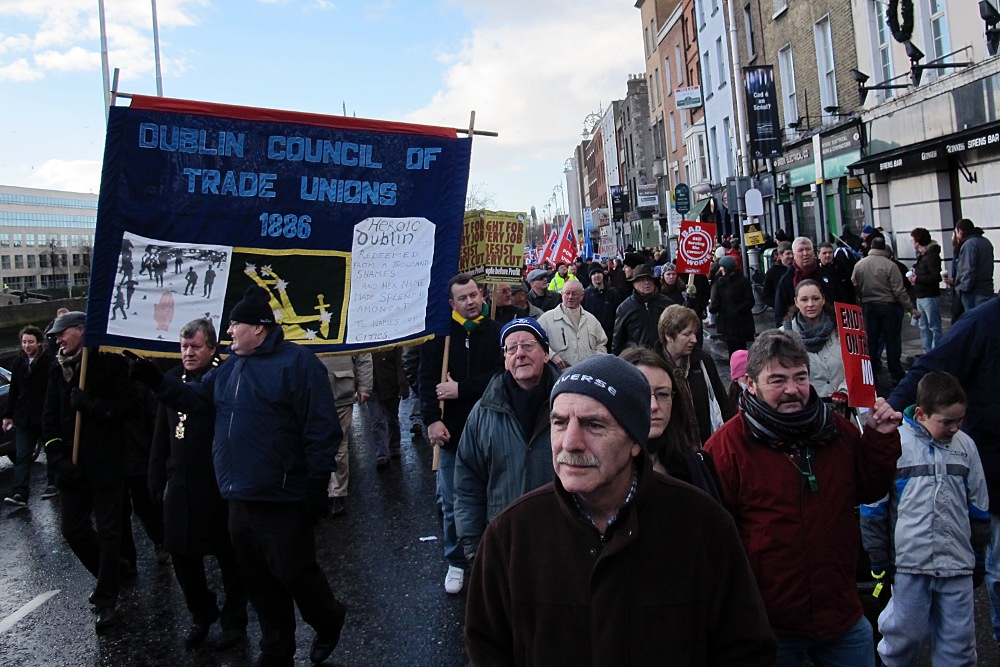
Ireland: 100,000 march to the GPO


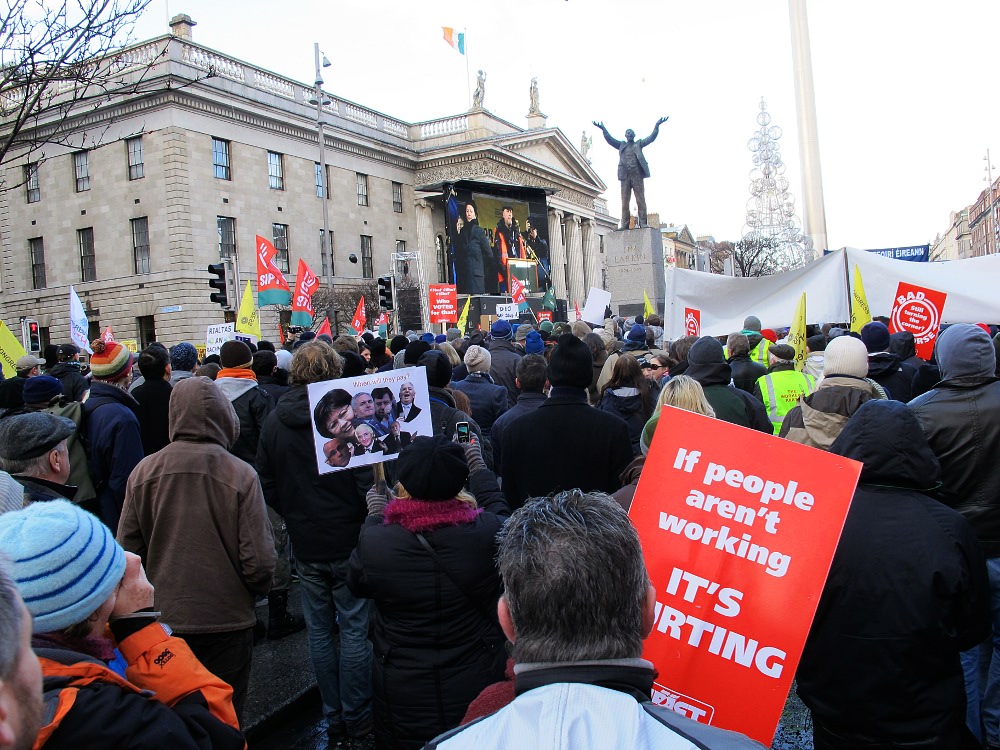
100,000 marched from Wood Quay to the GPO today in protest against the austerity measures outlined in the four year plan despite the cold wintery weather. A few even demonstrated in a curagh on the Liffey – the workers navy has arrived. Meanwhile the government are behind closed doors discussing the bailout package with the officials.

Photo lusciousblopster
The contradiction between the reasons for the crisis and the government’s so called solution is stark. On the one hand the bankers and the speculators – the so called risk takers, put us here, but the risk has been transferred onto the very people least able to take any more “risk”. The minimum wage is to be cut by €1 per hour which amounts to an 11.56% cut. It’s the sort of situation that people write songs about, which is convenient as Christie Moore himself was on hand.

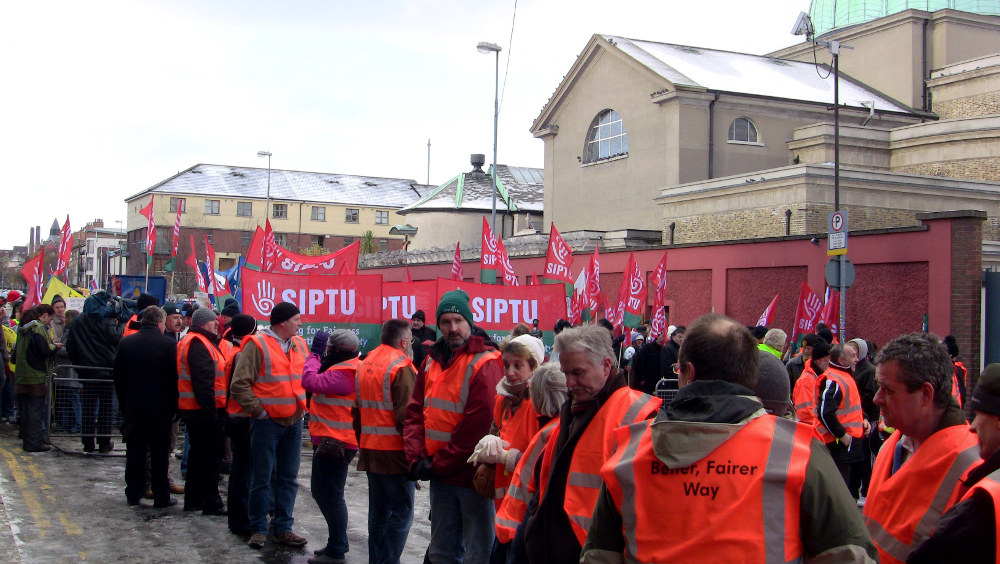
There were dozens of trade union banners from SIPTU, Impact, INTO, TEEU and TUI among others and many home made placards in evidence also. It is clear that the political crisis has put the class struggle back on the agenda. The demonstrations against the pension levy in February last year and the demonstration on November 6th 2009 were of similar size, but this time the mood is different. The government is on the retreat and the stakes have been raised massively because of the intervention of the EU and the IMF.

Cowen and Lenihan have nowhere to hide, the by-election on Thursday illustrates that. Now, 95 years after the Easter Rising the choice of the GPO as the rallying point for the demonstration illustrates the anger in the state over the government being forced to go begging to Europe for a bailout. In an ex-colonial country like Ireland the memory of foreign rule runs deep.

But the crisis in Ireland is a crisis of Capitalism and it falls most heavily on the working class. That’s why there are big demonstrations like this, and that’s why the FF and the Greens are going to get banjaxed in the forthcoming election. But central to the struggle against the austerity and the cuts has to be the trade union movement and particularly its leadership. Whilst the trade union leaders made some important speeches today, what they do tomorrow is the important thing.

Photo: lusciousblopster
The cuts outlined in the four year plan will re-emerge in the budget. The trade union leaders have a huge responsibility to defend the public services and their members. The days of the Celtic Tiger have long passed now. The idea that somehow “Social Partnership” can resolve the problem has been shown to be an illusion. Everytime the trade union leaders and the government have entered talks they’ve collapsed because of the scale of the crisis. Now the Croke Park Deal is under threat although the government has tried to avoid a direct conflict for now, no doubt for fear of the reaction to further wage cuts. The government intends to “fully implement” the deal, which means attacks on services and workers conditions. The four year plan includes cuts in wages for new entrants into the public sector. This is an attack on the Deal via the back door. But it’s also an attack on young people, at a time when emigration is on the rise and unemployment is over 400,000.

The movement has to campaign to defeat the cuts and drive the government out of office. The demonstration today shows the extent of worker’s anger. But the next step should be to galvanise the movement against the cuts into a 24 hour general strike encompassing private and public sector workers together. As the placards said today Fianna Failed. Now’s the time to drive them out.

Source: Fightback (Ireland)

Photo: lusciousblopster
Photo: William Murphy

Thursday, November 25, 2010

"threat to Irish democracy through the imposition of EU bureaucrats and the IMF on the Irish people"

Posted by IRSP at 22 November , 2010

The Irish Republican Socialist Party has warned of the threat to Irish democracy through the imposition of EU bureaucrats and the IMF on the Irish people.

Ross Gildea of the IRSP said:

“This government is an affront to democracy and obviously has no respect for Irish citizens. We now face a disastrous situation whereby the vultures of the capitalist class, the IMF, are circling and their influence in Ireland not only represents a further erosion of Irish democracy and sovereignty but also will serve to have a devastating social effect. The IMF are the enemy of working class people and their record in other countries should act as a warning for what is to come. They champion privitisation and will provide a recipe for even further unemployment in Ireland. This will mean that investors in London and New York will have significant input and power over your future and the lives of your children. The IRSP will not stand idly by as another draconian austerity budget looms with the most vulnerable in our society, as always, being left to pick up the tab for the boom and bust capitalist system”

He continued:

“It is outrageous that this government, which has it’s fingerprints all over the current economic crisis, is still in office. Likewise, it is a disgrace that private financial institutions can effectively hold the Irish people to ransom. The banks must be nationalised, but as we have seen from Anglo-Irish Bank, that is not enough. In both the political and economic spheres we as a country need to re-assess what we mean by the term democracy. We need representatives that are subject to recall at any time by the population and we need democratic worker control over any institution that is vital to building a sustainable economy. Our recent political and economic woes have shown the necessity of this.It is clear that those who walk the corridors of power have decided to move away from any semblance of social protection and are encouraging a race to the bottom with regard to workers’ wages and living standards. The presence of the IMF is disastrous for Ireland and mass emigration will continue. We need only look at what the IMF did in Argentina and Jamaica, to give just two examples, to know what is in store for Ireland”

The IRSP activist concluded by saying:

“We need to send a clear message to this government, EU bureaucrats and the IMF. The Irish people will fight for their sovereignty and will resist any attempts to make the working class pay for this crisis. The IRSP will continue to oppose undemocratic and draconian cuts both North and South of the border and we believe that people taking to the streets is the only way in which this situation can be changed. The establishment parties are only interested in power, they will not bring about the radical changes we require and therefore we must stand up and do it for ourselves”.
——
The IRSP urges workers, the unemployed and all progressive forces
in Irish society to mobilise for the upcoming protests in Dublin
on November 27th and December 7th.

Greens `cut and run' - another nail in the "third way" coffin

(Updated Nov. 24) Ireland: Fianna Fail/Greens cave in to EU/IMF on `bailout'; Left vows to fight austerity

Photo by Christina Finn/Politico.

November 23, 2010 -- Irish Republican News -- The public finances of the 26-county state [Ireland] will, for the next three years at least, be subject to “regular reviews” by external monitors working on behalf of the International Monetary Fund (IMF), the European Union (EU) and the British and Swedish governments.

On November 21, the Taoiseach [Prime Minister] Brian Cowen and minister for finance Brian Lenihan, after a week of shocking lies and deceit, said they were accepting the IMF/EU bailout. It later emerged that the G7, comprising the seven most powerful countries in the world, had met to give its approval to the deal....


....

Sinn Fein TD, protesters attacked

osnodaighgardaprotest.jpg

A group of 100 protesters clashed with Gardai [police] as they made their way the gates of the Dublin parliament earlier on the afternoon of November 22, following a protest against the government’s handling of the economy.

Some members of the group, led by Sinn Fein TD Aengus O Snodaigh entered the Merrion Street gates of government buildings. A number of the protesters, including O Snodaigh -- the TD for Dublin South Central -- were pushed and punched by members of the police.

The group were calling for the immediate resignation of the Taoiseach Brian Cowen, following the announcement that the government had been forced to seek emergency bailout funding from the European Union and International Monetary Fund.

Amid the fracas, O Snodaigh, who was attempting to calm the situation, was among those assaulted before an impromptu sit-down protest eventually saw tensions dissipate.

There were also scenes of anger at the Dublin parliament on November 21 night during a protest involving Dublin Sinn Fein members and local Ogra [Sinn Fein Youth] members. A contingent of Sinn Fein and Ogra activists had gathered with other members of the public outside government buildings following news of the Fianna Fail/Green government's EU and IMF bailout.

Eventually, government ministers were driven to the gates when Sinn Fein and Ogra activists staged a peaceful sit-down protest.

A number of Gardai employed brutal tactics in an effort to move the protesters, while another Garda motioned for the state cars to continue on their path, with one state car, believed to be that of a senior minister, running over the leg of a young Ogra Shinn Fein activist. An ambulance quickly arrived and the Ogra member was brought to hospital. Ogra Shinn Fein spokesperson Daithi Byrne criticised both the government and the Gardai who interfered with the peaceful sit-down protest.

“Today’s developments has created huge anger in this country. We have, effectively, been bought and sold. The government has ran up the white flag of surrender to the IMF/EU who are notorious for their utter contempt for the rights of working-class people. Already, within hours, the government is dancing to their tune, with rumours of cuts to the minimum wage and social welfare. Surely we can't be blamed in that context for protesting?

“The Gardai dealt with the peaceful protest irresponsibly. The heavy-handed tactics employed effectively resulted in a hit and run incident which seen a dedicated Ogra Shinn Fein activist sustain an injury. The events today, couple with those which took place at the recent national student march, demonstrate the widespread anger but also the low tolerance for peaceful protest.”

Greens `cut and run'

Independent TDs oined with the opposition parties to pile pressure on the crumbling Dublin government to pull the plug after the Green Party on November 23 finally succumbed to public outrage and said it is set to pull out.

The Greens have called for an election to be called by the end of January, but the opposition parties and the public are clamouring for Brian Cowen’s renegade regime to quit as soon as possible.

With negotiations on an IMF/EU bailout continuing and a massive budget adjustment inevitable, the discredited administration has clung to power in recent weeks even as its last claim to a mandate disappeared.

With only the support of Minister for Health Mary Harney to count on, the Fianna Fail/Green Party coalition has lost its working majority, with only 80 TDs in the Dail, compared to 81 TDs now forming the opposition.

Sinn Fein’s senator Pearse Doherty is the favourite to win the forthcoming Donegal South West by-election, a result that would further strengthen the opposition. Three other by-elections are pending, all certain to be lost by the government. The High Court in Dublin has ruled that two of these should already have been held, a ruling that the government has so far ignored.

At a press conference on November 23, Green Party leader John Gormley defended his party’s decision to stay in government with Fianna Fáil until after the budget on December 7, insisting it was in the national interest to ensure it was passed.

“We have always said that our involvement in government would only continue as long as it was for the benefit of the Irish people. Leaving the country without a government while these matters are unresolved would be very damaging and would breach our duty of care”, he said, adding that the Irish people need political stability over the coming months.

But Sinn Fein Dail leader Caoimhghin O Caolain accused the Greens of "cutting and running" while denying the people an immediate general election. “It is absolutely shameful that this party is denying the people an immediate general election and helping Fianna Fail to inflict further massive damage on the Irish economy and Irish society”, said Mr O Caolain.

“The Green Party has played a disgraceful role in one of the worst cabinets that has ever governed in any country. We now have the unprecedented situation where a coalition partner has announced it is to pull out of a government while at the same time preparing to help frame and vote for its budget.”

Maverick independent Jackie Healy-Rae issued a statement saying he can “no longer honour his word” to the Fianna Fail and the time has come to “go to the people”. The TD for Kerry South said recent events “have totally undermined whatever little bit of confidence” he had in the government. He accused Brian Cowen of telling “blatant lies” to the Irish people regarding the IMF and EU, and added it was “very unlikely” he would support the annual budget next month but would have to wait to see what it contained. Along the proposals expected to be included are highly controversial cuts in social welfare and the minimum wage.

Tipperary North Independent TD Michael Lowry also withdrew his support from the Fianna Fail-led government. He said that while his vote was no longer guaranteed, he believed that the budget had to be passed in the national interest. But he said that the Fine Gael and Labour parties should say whether they are going to cooperate with the budget -- and that if they are not, that a general election should be called immediately.

Labour Party leader Eamon Gilmore called on Taoiseach Brian Cowen to dissolve the Dail and said the electorate should be able to vote in a new government as early as next month. He said the Greens “had finally recognised the government was past its sell-by date”. “Fianna Fail has made a mess of the country; they have crippled the economy and and brought national morale to an unprecedented low”, said Gilmore.

“After 13 years of bad government and weeks of lying to the Irish people, the unprecedented decision taken on Sunday effectively represents the handing over of the deeds of the country to the EU and the International Monetary Fund (IMF). It is essential that we have a new government elected as soon as possible.”

Fianna Fail backbenchers have also urged Cowen to go. “At this stage the country has lost faith in him, and I think it needs a new opportunity”, said Kildare TD Sean Power.

The EU and IMF intervention will effectively open a second front against the working class

Ireland in Crisis


Despite some increasingly desperate and clumsy attempts to hide the fact that they were in discussions with the EU and the IMF over a bailout the Government was eventually forced to admit what everyone already knew; that they were desperate to secure a huge bailout to attempt to stabilise the Irish economy. The announcement was met with a huge wave of anger and the thin veneer of normality in Ireland has been ripped apart on prime time TV.

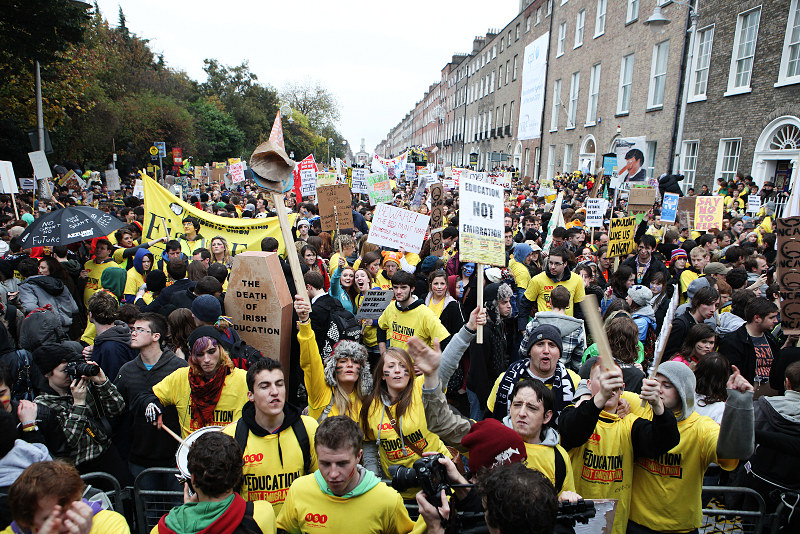
Student protests against education cuts on 3 November. Photo: Neil Dorgan
The coalition government is in meltdown after the Green Party decided to pull the rug out from beneath the Taoiseach and as consequence Brian Cowen looks to be slowly swinging in the wind, although at the moment he seems to be desperate to hang on until the small business of the four year draconian budget is dealt with. The fallout from the government’s dithering and vacillation in respect of the intervention of the EU and IMF has accelerated with the decision of the Greens to call for a General Election in January. However, the depth of the crisis within the Fianna Fáil means that it’s not unlikely that the budget might fail in the Dáil. Certainly, none of the “independents” will be racing to the defence of Messrs Cowen and Lenihan. The political survival instinct apparently gets stronger the closer to the edge of the abyss.

The crisis in Ireland has entered a new stage since the arrival of the EU in Dublin. But it is important to examine the reasons behind the current impasse. The crisis in Ireland is particularly acute, but Ireland is merely the latest European Country to be crucified by the financial speculators and the greed of big business. The roots of the Irish crisis lie in an economic recession in the US leading to a collapse of the US Sub Prime Mortgage Market in 2007. The huge credit bubble in the USA and Western Europe sparked a massive hike in house prices and a speculative building boom in Ireland. However, when the crisis in the US banks spread to Europe and to Ireland. The Irish economy was massively affected by the huge drop in world trade and the effect of the banking crisis.

The Irish Banks were particularly exposed, in part because of the speculative nature of the property boom, but also because of their relatively small size. In addition the general crisis within the euro zone means that Europe is far from the situation that existed during the Celtic Tiger years where the various euro zone economies were growing. Under those conditions the huge disparities between big rich economies like France and Germany and small peripheral economies were masked. Now the superficial character of “convergence” has evaporated and the underlying contradictions between the various economies have come to the fore. In the past the various states would have had the option of devaluing their currencies to seek some competitive advantage. While any advantage would have been temporary and soon wiped out by rival economies taking the same line, the rigidity of the euro zone frame work means that the contradictions between the economies need to be expressed in other ways. This means that the role of the bond markets has become extremely important.

The crisis that developed in respect of the state finances is a direct result of this. Ireland’s trade based, small, peripheral economy had entered a serious crisis which placed it at or near the bottom of the heap among the euro zone Countries. The Government was further weakened by the revelation that the cost of bailing out AIB would run to “€34.6 or maybe even €46 billion euro”.

But even if the government secures a huge €90 to 100 billion loan, that will be accompanied by stringent conditions. The forthcoming four year economic plan and by extension the forthcoming budget has been inspected with a fine tooth comb by the EU and the IMF. The budget is likely to be draconian with attacks on welfare, further cuts and “reform”. Under these conditions the limited protection afforded by the Croke Park Deal – which stated that there would be no further public sector wage cuts for the next four years, in return for major “reforms” in the public sector- will most likely be swept away.

The EU and IMF intervention will effectively open a second front against the working class. The mood in the state is angry and this has already been reflected in the decision of the TEEU trade union to support a campaign of civil disobedience if the government didn’t resign and call a general election. While this is an important turn of events, it reflects the pressure from below. The TEEU organises in the public but most importantly in the private sector. The fact that the union has taken this stance shows that there is a big potential to unite the private sector workers with the struggle in the public sector. The next period will most likely see a big resurgence of trade union action, particularly in respect of the budget. The movement ebbed for a period after the signing of the Croke Park Agreement, but the campaigns in local areas recently over cuts in hospital services which saw 10,000 people marching through Navan for example, indicates that even before the recent crisis broke opposition within the working class was growing.

With a by election due on Thursday 25th November and the government in a state of collapse it is even possible that the budget will fail to be carried in the Dáil. However there is talk that Fine Gael TD’s may abstain or vote through the budget. Such deference to the “national interest” won’t hold water with workers who are going to be in the firing line, nor will it appease the pensioners or the unemployed who are likely to be made to suffer by the budget also. The current crisis is demonstrating the divisions between Fine Gael and the Labour Party even under Eamon Gilmore’s leadership reflecting the different class bases that the two parties rest upon.

The new period that is opening up in Ireland will bring into sharp focus the storms and stresses of the last two years. The coalition will be swept from power in a wave of opposition. The probable outcome in the forthcoming election, which will most likely take place in January or February, will be a Fine Gael/Labour Coalition. However, this need not be the result. Labour could easily win a majority in the Dáil if it broke with pro capitalist policies and adopted a clear socialist programme. That means calling for the nationalisation of the banks and big industries under democratic workers control and management, the cancellation of the debts and the socialist planning of industry.

Source: Fightback (Ireland)

Thursday, November 11, 2010

Sinn Féin response to Fianna Fail/ Green austery/cuts program

Political Response to Economic Crisis in Ireland


Sinn Féin offers a better way

By Nicky Dempsey

Sinn Féin has published its response to the Dublin government’s threatened plans to cut public spending once more in its Budget for 2011, There Is A Better Way. The Fianna Fail/ Green coalition in government has outlined planned further cuts totalling €6bn in both capital and current spending, including welfare payments to the poor. This would bring the total level of ‘fiscal tightening’ to €20.6bn since the end of 2008, which is now equivalent to 13.1% of GDP. For comparison the British government’s current plans – among the most draconian of any major European country- amount to 9.2% of GDP.

The Sinn Féin response stands in stark contrast to the bourgeois parties across Europe who have used the recession and ensuing fiscal crisis to launch an attack on the social welfare gains built up since WWII. The SF policy has three key components. First, is to shift the burden of taxation from the poor to a rich in a series of measures including higher income and wealth taxes for higher earners and the rich. Secondly, reform of the tax system in what the party calls a ‘financial stimulus’ to redistribute incomes towards the poor and low-paid. But the largest component of the policy is a €7.5bn government investment package in infrastructure and other areas such as early childcare, which is estimated to create 160,000 jobs. This would go some way to addressing the collapse in investment which more than accounts for the entirety of the Irish recession.

The other major parties in Ireland have all signed up to the policies of the Dublin government in the South while Sinn Féin is the only party to consistently oppose the same agenda of the British government in the North of Ireland. In Dublin, the FF-led government had been hoping to co-opt the other parties, Fine Gael and Labour, into explicitly supporting their further attacks on the living standards of workers and the poor. Given that both actually propose very similar measures (with Labour simply calling for a ‘rebalancing’ of the measures towards tax increases), there was actually the basis for a de facto grand 4-party coalition, including the junior coalition partners the Greens.

However, FF’s slump in the polls, down to 18% in one poll in October, from 41.6% in the 2007 general election, made the nominal opposition parties more cautious. The caution turned to outright hostility for purely electoral considerations as the government has been forced by High Court order to hold a long-postponed by-election in Donegal, with others to follow in the New Year. The legal case was itself a victory for Sinn Féin, with the other parties content to allow the government to continue in office despite dwindling parliamentary and popular support. The consequence is that the government is likely to fall early next year and may well call an early general election. Neither Fine Gael nor Labour saw any electoral advantage in propping up Fianna Fail, even while they agree on the substance of further cuts.

Saving The Nation

Fianna Fail, which styles itself ‘The Republican Party’, made the appeal to other parties to support its Budget on the grounds that a failure to act would lead to a ‘loss of sovereignty’ as the ECB/EU/IMF are waiting in the wings to impose further, even more drastic cuts. In fact the government’s own policy now makes this outcome more than possible. Financing through the bond markets is no longer possible as long-term interest rates approach 8%, compared to just over 2% for Germany. While the ‘austerity’ policy has led to a collapse in economic activity and a widening of the public sector deficit, a uniquely generous bailout of bank bondholders means that respected commentators believe the cost to taxpayers will be approximately €76bn, more than 8 times the size of cuts threatened in this December’s Budget and equivalent to €17,000 for every woman, man and child in the State.

The effect of the guarantee is to provide an enormous transfer of taxpayer funds to bail out primarily German, British and French banks, the main holders of debt in Irish banks. While the EU and ECB have insisted on this when burdening Greek workers and the poor with increased debts, the Dublin government initiated this policy itself. The only conceivable explanation is that by bailing out the bondholders, the latter will not foreclose on the banks and their property speculator customers. These two groups, bankers and property speculators, are the political core of the Fianna Fail alliance, even though for historical reasons, its electoral support derived from urban workers.

This subservience to European finance is the flip-side to the government’s prostrate position before the interests of US industrial and commercial capital. This is codified in the lowest corporate tax rate in the OECD area, 12.5% compared to 39% for the US and Japan, 30% for Germany, as well the indulgence of myriad schemes, which reduce the effective rate of tax to below 2%.

The policy response to the crisis, to enrich these foreign capitals by depleting the resources of the workers and the poor failed to reckon on the finite level of the latter, and the voracious appetites of the former. Usually, in a Western European economy of the standard type, the domestic bourgeoisie, crushed by the impositions on its own activities and the damage done to its domestic markets would rise up and remove such a government. But Ireland is not a standard type of Western European economy. While one quarter of the country remains a direct colony of Britain, the remainder retains the distorted social structure of the recent colony. Most especially, outside of the dominant layers in banking and property speculation, the bulk of the Irish bourgeois class is comprised of globally insignificant capitals, with owners of fast food outlets, bookmakers and publicans to the fore in IBEC, the main employers’ federation. There are literally only a handful of Irish-owned companies that compete in global markets.

So, when in 2009, policy in the advanced capitalist countries was focused on measures to boost domestic demand, tax breaks, employmentsubsidies and so on to ensure the survival of indigenous capitalism, no such measures were adopted by the Dublin government. Lacking any significant capitalists that compete in world markets, there was no purpose to such a policy and the first resort was to attack wages and social welfare spending. This has only now become popular elsewhere once the survival of domestic capitals has been ensured.

This is why the Sinn Féin policy is so significant. Perhaps uniquely in Western Europe, the party has adopted a policy of increased investment which can only be conducted by state or state-linked bodies (in this case, the National Pension Reserve Fund). And, uniquely in Western Europe, this is not a programme that entails saving sections of big capital. As elsewhere it would require an enduring leadership role for the state in the economy. But it would immediately lead to the state becoming the dominant force in the domestic economy, albeit one that would require a new partnership with foreign capital, on both a more productive and equal footing.

The policy is also gaining ground. A string of popular campaigning organisations, such as Social Justice Ireland and Community Platform have tentatively moved in the same direction, while the Irish Congress of Trade Unions has adopted pro-investment stance, but contradictorily pins its hopes on the government persuading the private sector to initiate the investments. No doubt these contradictions will be resolved in course of the struggles over the next period.


Friday, April 9, 2010

Irish Fightback

Irish Marxists launch new paper

By Fightback (Ireland)
Thursday, 08 April 2010

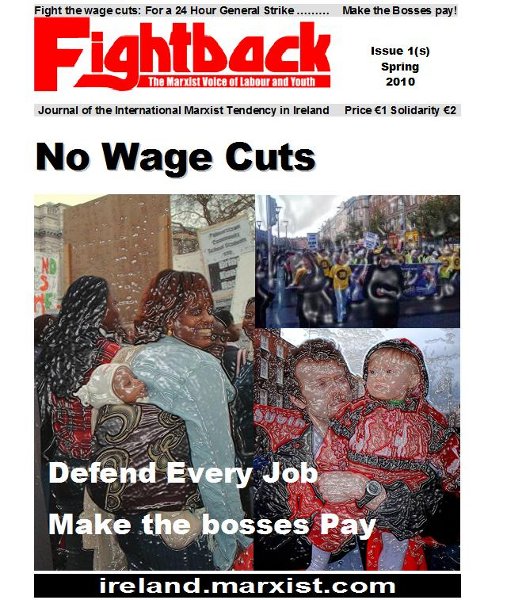
We are delighted to announce the publication of Fightback: the magazine of the International Marxist Tendency in Ireland. The first edition of the magazine comes in two editions for the North and the South – they have different front and back pages and industrial material. The first edition is full colour and has 20 pages.

Ireland: Fightback - New Printed MagazineFightback is being launched at a crucial point in Irish history; the North is at an impasse with the main parties Sinn Féin and the DUP under pressure from the dissident republicans on one side and the Traditional Unionist Voice on the other. Meanwhile, they face each other at Stormont administering a glorified County Council. There are huge cuts on the way which will have a dramatic effect at a time when 63% of jobs in the North are dependent on the state.

Meanwhile, South of the border, the collapse of the “Celtic Tiger” and the crisis in state funding means that the bourgeoisie and the Fianna Fáil and Green Party coalition are attempting to place a huge burden on the working class. The trade union leaders have come under huge pressures, as the working class have shown time and time again that they are prepared to struggle, but still they are vacillating and prevaricating over the failed policy of “Social Partnership”.

In July 2009 we launched the Fightback website. The response has been tremendous with regular readers from Dublin, Belfast, Derry, Cork, Galway, Limerick, Waterford and many other towns and even villages. We knew that there were a lot of people following In Defence of Marxism in Ireland. Dublin is one of the top 5 cities in the world for hits on that site. We are confident that the magazine will be well received.

You can subscribe to Fightback or make a donation to €2,000 fighting fund that we have launched through Ireland@marxist.com Ireland@marxist.comThis e-mail address is being protected from spam bots, you need JavaScript enabled to view it This e-mail address is being protected from spambots. You need JavaScript enabled to view it

The cost of subscription is €8 including P&P for the Republic £7 for the North for 4 issues.

Solidarity price is €12 or £12

Rest of the world €15 or £15

Subscriptions can also be purchased online with a credit card through Wellred.