There was no one to vote for in the first round, and there will be nobody to vote for in the second round! Lots will get sucked into "voting against Le Pen." But it's either a working class vote (and there's no genuine workers candidate in any sense of the term), or a vote for capitalism. It's not who you're against, it's what you're for. If Macron wins, it will be Le Pen next time, since there are no capitalist solutions.
And a note:
Unlike Trump, Le Pen has fascist credentials, although she's been moving her party to the center-right. But fascism is not merely an electoral party, it's a mass movement of the middle classes, using lumpen elements as it's battering ram, against the trade unions and workers parties. It's a movement for saving capitalism masked in anti-capitalist rhetoric.
In relationship to the government, fascism conquers peacefully, but in relationship to the working class, Jews and other scapegoated elements it uses intense violence before it comes to power. We're not seeing anything like this in France today.
Written by Greg Oxley (French Communist Party, Paris 10th arrondissement) Tuesday, 14 December 2010
In October we witnessed a massive mobilisation of the French workers and youth against Sarkozy's attacks on pensions. All the potential was there for the government to be defeated. The overwhelming majority of the population supported the protests. So what was missing? We are publishing an a analysis by the French Marxists of La Riposte to explain what happened and why it happened.
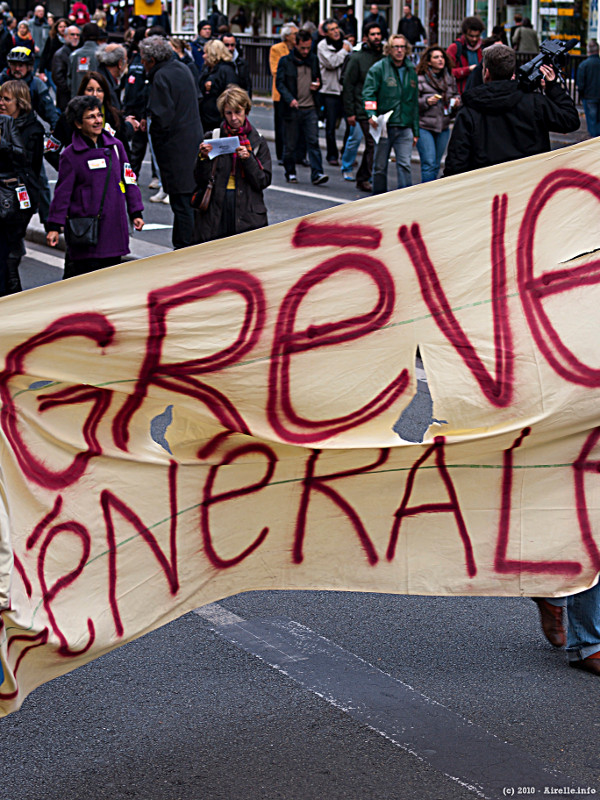
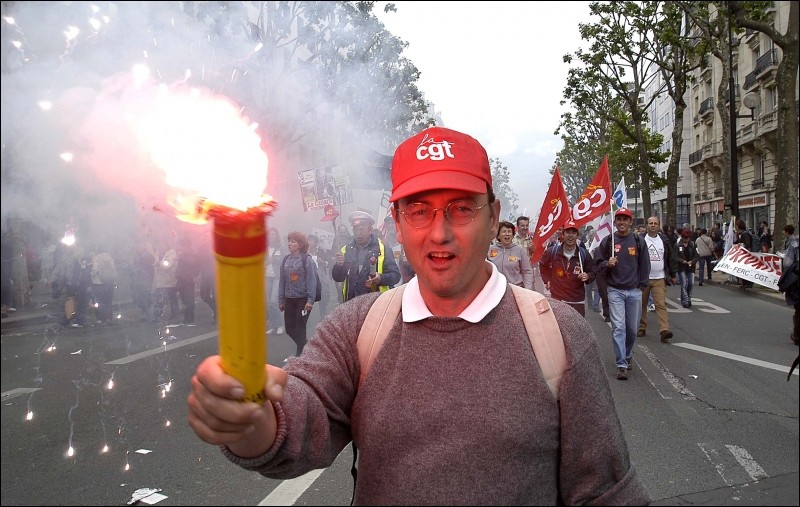
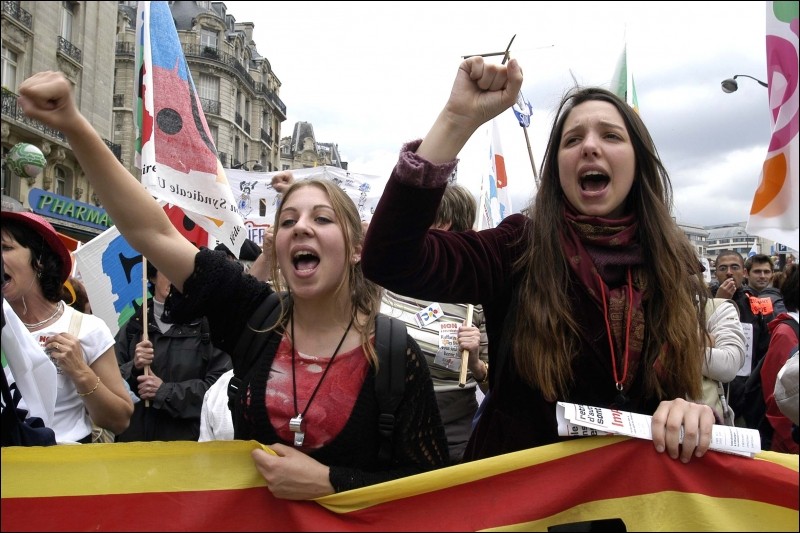
The struggle against the attack on pensions showed that the immense majority of the population are opposed to this counter-reform. The participation in the main days of mobilisation was as many as 3.5 million demonstrators. Alongside these day-long mobilisations, a numbers of indefinite strikes took place around the country. “Small” demonstrations - of between two and three thousand people - took place in many small, provincial towns, where as much as a quarter of the local population were on the streets. Across the country school and university students leapt into action. These mobilisations were often accompanied by walk-outs by employees in local businesses, hospitals, public administration, and schools. The country was in turmoil.
At the height of the demonstrations the opinion polls showed that 70% of the population supported them. This support was often active, as shown by the statement of Marcel Croquefer, CGT (Confédération Générale du Travail) representative at the Flandres de Dunkerque refinery: “We received thousands of euros from workers in small businesses, teachers, people working in the theatre, people working in the Lille Regional offices, who spontaneously sent us money saying: ‘If I go on strike it won’t change a thing. But you lot, you can’t fail!”
In the middle of October 60% of those surveyed responded favourably to a “radicalisation” of the movement. This figure took away from the government any possibility of claiming to act in the name of a so-called “silent majority.” The mass of the population knew full well that the reform was a socially regressive measure seriously against their interests.
The destruction of pensions affects practically everyone, except the rich. But beyond the question of pensions this movement revealed a deep discontent within French society. All the anger accumulated over the course of the last years has started to come to the surface. Yes, the law was passed. But the right will pay for this “victory” with the reinforcement of the feeling of injustice that burns in the hearts of millions of people, and adds to the combustible material in the foundations of the capitalist system. Sooner or later, this material will explode. For the moment, the union militants, students, school students, the activists in the Communist Party and other political formations involved in this struggle are going to reflect on its lessons.
The Power of the Working Class
The first of these lessons is the vast potential power of the working class. We insist on this point because it is of absolutely crucial importance in the fight against capitalism. The strike in the refineries and fuel depots provided solid proof of this power. When you think that workers in only one sector of the economy, if they stay on strike, can bring the capitalist economy to its knees, you realise the huge power that is concentrated in the hands of the workers in this country, as in all countries of the industrialised world. Nothing happens without their consent.
Employees form part of the “means of production” which the capitalists own and from which they make their fortunes. Man and machine form an inseparable whole, a unified mechanism, so to speak. However, despite their best efforts, the capitalists have not succeeded in reducing workers to the rank of simple automatons. The workers’ position gives them the power to suspend, partially or totally, the functioning of the infernal machine of capitalist exploitation, by way of a strike. Despite all the learned theories about the supposed disappearance of the working class, the fact is that because of the increased sophistication of the techniques of production and exchange, which create a greater interdependence between the different branches of the economy, the workers have never had so much power concentrated in their hands. The problem is that they are not aware of it, for the most part. Helping the workers become aware of this power - that constitutes the key to their future emancipation - is one of the most important tasks that the labour and communist movement must take upon itself in the months and years to come.
Like the big strike in 1995 or the struggle against the CPE, this struggle has created a new generation of militants. At the same time the “old-timers,” sometimes disheartened by so much deception and defeat, are revived and emboldened. Hundreds of thousands of workers and youth participated in militant action for the first time in their lives. This struggle will leave its mark on the workers' movement. However, it still resulted in a defeat. We must try to understand the reasons why.
The role of leadership
The government was frightened by the growth of power of the movement. Certainly, in the first instance, the perspective of a series of “days of action” did not worry them. They counted on these 24-hour mobilisations gradually running out of steam. They were pleased with the “moderation” and “responsible” attitude of the union leadership. But with the strikes in the ports and refineries, with what happened in Marseilles, in Le Havre, with the increase of “spontaneous” actions, of blockades, of indefinite strikes, and eventually the perspective of a massive movement into action by the youth, the government started to seriously become worried. From then on the whole of the government, media and repressive machinery was put into motion.
Disinformation, the forced breaking up of blockades by the police, the use of agents provocateurs, the repression of demonstrators and school students, the “preventative” closure of universities by the police (for example at the Sorbonne on 26th October): all this showed that we faced an implacable adversary, armed with a well thought-out, centralised and concerted strategy, and using every method at its disposal in order to achieve its ends. In contrast, on our side the fight had a disparate character. Different detachments of those opposed to the reform advanced in a disorganised fashion. We lacked a co-ordinated, collective strategy for the struggle. This situation can be explained in the most part by the behaviour of the union leadership.
From the start the aims and tactics envisaged by the union leadership were very limited. By means of 24-hour mobilisations they endeavoured to convince the government into opening negotiations. This position amounted to tacitly accepting, in principle, that our pensions would deteriorate, since it is clear that any “negotiation” with Sarkozy could not have led to any improvement in our pensions. Besides, this stance left the government the possibility of putting an end to the movement by simply refusing to negotiate. The government’s strategy consisted of letting the successive days of mobilisation go ahead, introducing some minor modifications prepared in advance, and then adopting the basic essentials of the reform. At no moment did the leaderships of FO (Force Ouvrière), the CFDT(Confédération Française Démocratique du Travail), and even the CGT encourage the indefinite strike movements. And they did nothing to push the generalisation of the indefinite strikes that developed after 12th October.
Thibault [leader of the CGT] limited himself to the idea that extension of strikes had to be “decided from the bottom,” which is obvious since you cannot get workers to go on strike without their permission. This stance amounted to abdicating all responsibility for leading the struggle, with the calling of days of action that, on their own, were not enough and could not inflict a defeat on Sarkozy. They said to workers “go on strike if you want, when you want, it’s for you to deal with,” without any attempt to reinforce, generalise, and co-ordinate the strikes taking place in order to maximise their impact and improve the chances of winning the battle. This amounts to leaving different sectors on strike to manage for themselves and, finally this assisted in their isolation and defeat.
As for Chérèque [leader of the CFDT], he actively looked to limit the duration and scope of the movement. He approved of the forcible opening by the police of striking refineries and fuel depots. Immediately the return to work began in the refineries, on the railways, and among the refuse workers. He held hands with the government and MEDEF [French employers' association], proposing to them negotiations on “the employment of young people and the elderly,” finally offering to “turn the page” on the pension reform dispute. These negotiations, of course, came to nothing, or at least nothing positive. For workers organised in the CFDT the lessons of this struggle are clear: if they want their leaders to be anything else but a “fifth column” in the labour movement for the bosses and the government, then they have to get rid of Chérèque and co. The problem poses itself in the same terms in the FO, only with Mailly and company instead of Chérèque.
Struggle for Socialism!
The battle against the pension reform was lost, but this is not just any battle. In drawing the lessons from our defeats, we prepare ourselves for future victories. However, the reality of the capitalist system is that these victories can only be temporary, as long as the banks and the principle levers of the economy remain the property of the capitalists. If the pension reform had been repelled this time it would have been made the order of the day for a later date. The capitalist system is, from now on, not only incapable of progress, but even of guaranteeing the gains of the past.
By seeing their rights and their benefits scorned and destroyed, by seeing their living conditions get worse month after month, year after year, the workers will come to the conclusion that partial and sporadic struggles will not be enough, neither will changes in government that don’t change a thing about the system that oppresses them. They will come to the conclusion that there is no other solution other than the overthrow of the established order, that is to say their complete emancipation from the straitjacket of capitalism.
French workers and students continued their inspiring strikes in Thursday, as the movement comes to a critical point.
The government is under pressure from the strikes, street protests and riots. The sharpest issue is petrol supplies.
The strikes at all 12 of France’s refineries and its two biggest methane terminals, plus the blockades of refineries and depots, have led to the closure of around a third of the country’s petrol stations.
The school half term holidays begin tomorrow, a time when traditionally many French people travel for holidays, and this will further stretch supplies.
On several occasions right wing president Nicolas Sarkozy has sent in riot police to smash blockades of petrol depots, refineries and airports. But the actions have frequently resumed after they have left.
For parts of yesterday demonstrators cut off Roissy and Orly airports near Paris, and airports in Nantes, Toulouse, and Clermont-Ferrand.
Police today opened up Marseille airport after hundreds of striking refinery workers had cut it off access earlier this morning. But strikes mean the docks in the city are still not open to tankers—52 are lying off coast.
Union leaders meet tonight to agree further moves. Speaking in advance of the gathering, Bernard Thibault, secretary general of the CGT union, called for a new day of protests next week.
"The government remains intransigent. We need to continue with massive action as soon as next week," he said. "We will ask the unions for strong action that will allow people to stop work and go on to the streets."
Yesterday school students continued to blockade over 600 secondary schools as well as six universities. Police violence against school students continued in several places—particularly Paris and Lyon.
The French Interior Ministry said 245 people were arrested yesterday, taking the tally to almost 2,000 since 12 October.
The state is threatening huge penalties against those who stand in its way. Bosses threatened blockading refinery workers with five year prison sentences. School students who participate in schools that are not their own have been told by the authorities that they could face £35,000 fines and three years imprisonment.
But the repression is sometimes rebounding on the bosses.
Gerald Foreau, secretary of the CGT union, says, “In Rennes about 60 students blocked the entrance to the STAR bus deport one morning earlier this week..
“Riot police arrived around 9:30am and, although it was a very calm situation with students and drivers talking to one another, riot police started using batons and tear gas.
“Drivers, outraged by the violence of the riot police, held an impromtu mass meetring and voted 95 percent for an immediate strike. We have also put in complaints about 50 drivers affected by the gas.”
Strikers at the EDF state electricity firm have begun to turn off power to municipalities where Sarkozy’s UMP party is in office. They are also cutting off power to regional police headquarters.
In several areas, particularly in the south of the country, bin workers, catering and nursery workers are on continuous strikes.
The big issue now is whether the union leaders will maintain and escalate the strikes. They need to turn the screw on Sarkozy, not surrender.
Some union leaders have argued that once the bill is passed – which will happen in the next few days – that the battle will be virtually over as it will have “legitimacy”.
But the CPE laws which attacked youth in 2006 were repealed weeks after they went through parliament because of continuing strikes and protests.
The mood to fight is there. Tuesday’s demonstrations reached new levels in many cities – 240,000 in Marseille, 140,000 in Bordeaux, 50,000 in Rennes, 45,000 in Lyon.
Around 70 percent of the population back the protests and strikes, and there is strong enthusiasm for the continuous strikes among the workers involved. New initiatives are springing up daily. In Le Havre, for example, trade unionists from different unions meet every night, discuss and publish a joint strike bulletin.
But union leaders are not encouraging and developing the action.
It will take huge pressure from below. But it’s still possible to win.
Through their general assemblies, workers in key sectors of the economy are pressing for all-out strike action to begin on the 12th. This is the case in the railways and road transport, in the electrical industry, in the chemical industry (including Total oil industry workers), in ports and docks, in the television and radio sector, and in several branches of the public services, including teachers. Furthermore, school students and universities are starting to move into action. In Rodez thousands of school students took to the streets in solidarity with the struggle against the pension reform, but also to express their hostility to “Sarkozism”. A similar movement broke out in Toulouse. The port of Marseille is already paralysed by strike action....
In France in September there were two days of strikes, each with around three million people, demonstrating against the French government’s new pension Bill. Fifteen days later, on 2nd October, another demonstration took place with new social layers joining in. As the demonstrations were on a Saturday this allowed people who can’t go on strike to express their rejection of the pension scheme. Again, there were about three million demonstrators all over France. The strength of the protest has therefore remained intact, and a new phase has opened up with the proposal of unlimited strikes for the next national day of action which is to take place on Tuesday 12th October....
Workers and youth protest in Paris, France in May 2003 , photo Paul Mattsson (Click to enlarge)
LITTLE MORE than 24 hours after the second round of regional elections in France, strike action began on the railways, ushering in a day of action and protests in 80 cities across the country.
Clare Doyle, Committee for a Workers' International (CWI)
23 March was agreed on by the eight major trade union organisations to demonstrate mounting hostility to the government's policies on jobs, pensions, working conditions and the cost of living. Mobilisation from on top was poor, but anger and hatred against Sarkozy has reached boiling point.
He and his government have pushed ahead with attacks on the railway workers, universities, high schools, post office etc. Only in some cases, where widespread opposition has developed, has he been forced to step back.
There was a record abstention of over half the electorate in the first round, especially in the poor and working class areas.
As Le Monde wrote on Monday 22 March, this expressed "a deep disappointment with politics and with the head of state". The paper's front page headline was "After the electoral punishment, the third round (of) social (battle)?"
Alex Rouillard of Gauche Révolutionnaire (GR - CWI, France) commented: "After driving a steam-roller over so many rights and conditions of workers - old and young - Sarkozy is hated. His unpopularity has never been greater.
"He may be forced to reshuffle his cabinet and even retreat a little, but his aim is to make the working class pay for the bankers' and bosses' crisis".
Socialist Party benefits
Workers and youth protest in Paris, France in May 2003, photo Paul Mattsson (Click to enlarge)
The hostility to Sarkozy benefited the French 'Socialist' Party considerably. It had been reeling badly after poor performances in previous national and European elections. This time they got their highest score since 1981. The SP and their allies in the second round got 53.8% to 35.4% for Sarkozy's camp.
Together with the Greens, the SP ended up in control of 21 out of the 22 regions of France.
But the SP has a record in government of implementing far-reaching attacks on workers and widespread privatisation. Its leader, Martine Aubry, now said to be preparing to challenge Sarkozy in the 2012 presidential election, was the first to propose raising the retirement age.
The far right National Front (FN) also benefited from the anti-Sarkozy protest vote. In Le Pen's (FN leader) region it got 24% and 9% overall. It got more than 17% on average in the regions where it stood.
This has not yet brought them to the level they reached in 1995 but shows a real potential danger of reaction gaining ground.
The new Left Party, a split from the Socialist Party, with its vague promises of a fight against the right, apparently fared a bit better.
In 17 regions, they were involved in the Left Front (alliance between the Left Party, the PCF - communists - and a rightwing split from the ex-LCR) which, in the first round, got about 6% on average on a national level, around the same as the 6.5% they won in last year's European Parliament vote.
But the Left Front's subsequent alliances with the Socialist Party and others means they will be faced with the question of whether they will be involved locally in implementing cuts dictated by central government policies in a time of capitalist crisis.
The crisis and the left
Cecile, of Gauche Revolutionaire, France, the sister party of the Socialist Party in England and Wales, addresses the European Committee for a Workers' International school, photo Bob Severn
France has a widening budget gap and an €11 billion deficit in the state pension fund which, under capitalism, means more demands for austerity measures.
This crisis, and the need for generalised mass workers' struggle against it, should have meant that the New Anti-capitalist Party (NPA), first time out in regional elections, would fare well.
Unemployment now exceeds 10%. Millions of workers and young people have already been involved in battles over jobs, education, and pensions in the recent period.
Yet the NPA could muster only 2.5% of the vote in the first round, far less than what they got in the 2009 European elections (4.88%).
Only in one area - Limousin - did it pass the 10% barrier and have candidates in the second round. Without any distinct programme, it got two councillors (along with three for the Communist Party and one for the Left Party).
The NPA nationally had entered the fray in total confusion over tactics - with three different positions in relation to alliances with other parties. Gauche Révolutionnaire argued, along with others on the national committee who formed Platform B, for an independent fight in the elections on a real programme of working class struggle, to build support for the party as well as attract votes away from the right and the pro-capitalist Socialist Party.
Others wanted an alliance with the Socialist Party from the beginning and a third grouping wanted 'technical' alliances for the second round.
After referendums in the party last December showed much more support for position B than anticipated, the leadership of the NPA decided on a position of the party in each region deciding on its own programme and tactics. A recipe for chaos and ineffectiveness.
There was the additional factor in the election of the party in Vaucluse choosing to put forward a young woman who wears the veil. Before and after the election, she became the victim of considerable attacks inside and outside the party.
Disgracefully, she has even become, for some, a scapegoat for the poor showing of the NPA in the elections.
"The coming national meeting of the NPA leadership this weekend will see the left around platform B pushing harder for clear fighting policies", commented Alex. "The Right will attempt to blame the left for the poor showing but will have difficulty."
By the executive committee of the New Anti-Capitalist Party
March 14, 2010 -- Paris -- Two major lessons emerge from the first round of the regional elections.
The magnitude of abstention by millions of youth, workers and the unemployed, who mostly wished to register their rejection of the political parties that have alternated in power and that are responsible for aggravating their conditions of life.
The vigor of the rejection of the right and President Nicholas Sarkozy's government -- accomplices of big investors and the richest classes, who have made the majority of the population pay the cost of the crisis and who are destroying public services and social gains -- fuelled the upsurge of the Socialist Party (PS) and Europe Écologie [Greens].
This rejection of the right allowed the PS and its allies, which have been governing 20 regions since 2004, not to be punished for their record.
Moreover, the campaign for the just completed first round was vitiated by the wave of disturbing racism from which the National Front (FN) greatly benefitted.
We thank the women and men who voted for the New Anti-Capitalist Party (NPA) lists or the unity lists in which the NPA participated. Overall, our electoral results* are disappointing even though the results of some of our lists seem to be promising. We will analyse these facts and their causes in greater detail in coming days.
For next Sunday (March 21), we call on the voters to confirm and amplify the results of the first round by inflicting the greatest possible defeat on the lists supported by Sarkozy and [his right-wing Union for a Popular Movement] UMP. Punishing the right is an absolute necessity, even though we think that the left-wing majorities to come will be no better defence against the politics of Sarkozy than they have been for the last several years. However, punishing the right in the elections will not be enough to block its politics.
Just like what's happening in Greece, under a socialist government, it is likely to get worse in coming weeks. Pay for their crisis? No way! Like the front of youth, workers, the unemployed and the retired in Greece, we must prepare for the third round, which is social!
The 23rd of March has to become the first stage of convergence of struggles for pensions, wages and the prohibition of layoffs. And it's around these demands we wish to build the broadest unity against the right, the bosses and the bankers.
March 15, 2010 -- The Daily (Maybe) -- On March 14, the French regional elections saw the ruling right wing UMP take a beating and the Socialist Party (PS) extend its already extensive reach across French regional governments. The elections shine a light on exactly how unpopular Sarkozy’s government has become. The right were determined to make this election about national identity and Islam, and the vote was conducted in the context of proposed laws to ban the burka. While playing the race card backfired for Sarkozy the dangerous game that the right were playing stoked the fascist vote and saw the National Front (FN) resurrected, gaining 12%*.
The FN's campaign focused on the "danger" that Islam poses to France and, as Sarkozy has just found out, if you encourage people to be racists they will vote for the down-the-line racists.
The results had added significance for the FN as long-time leader Jean-Marie Le Pen is 81 and is expected to step down from the party's leadership soon. The regional elections were an opportunity for potential leaders to jockey for position and Le Pen's daughter, Marine, who is already an MEP, has emerged as the likely successor.
The election's Islamophobic rhetoric spilled over into direct action with dozens of pig-masked protesters raiding a restaurant last week for the "offense" of selling halal burgers. Commenting on Sarkozy’s tactics Greens leader Daniel Cohn-Bendit pointed to the FN rise and said, "Bravo Mr. Sarkozy, here's the result." However the story was not one sided and the French left, which has not always been strong on these issues, were able to confront these racist ideas with mixed success. The New Anti-Capitalist Party ran a hijab-wearing candidate to national uproar and most parties of the left refused to compromise with the anti-Islam mood.
The Greens (Europe Écologie) ran a very clear anti-racist campaign and saw their vote skyrocket, leaving them as the nation's third party. It's clear that while French society is seeing a rise in racism, there is a powerful countertrend of anti-racism.
Martine Aubry, leader of the victorious Socialist Party, stressed that “the French sent a clear and strong message. They today expressed their refusal to see a divided France”. That may be overstating the case, but certainly Sarkozy’s poor performance is a real victory for the left.
The rise of Greens was not wholly unexpected -- as the Greens first won third place last year at the European elections -- but its impressive result of 13%*, including more than 20% in Paris, is a massive leap forward from the last regional elections six years ago in 2004 where the Greens polled just 2%*.
When the second round of voting takes place next Sunday, March 21, this puts the left in a formidable position because the Greens explicitly position themselves as a party of the left and take part in Socialist Party-led coalitions. Negotiations have already begun between the PS and the Greens for joint lists in the second round elections which will see unprecedented Green representation. This means that while the left won 20 of the 22 French regions last time they are in position to extend that already impressive hold on regional government.
However, one of the headlines of the election is the record low turnout, with over half the electorate refusing to cast their vote. A closer look at the Socialist Party support sees that it has had a successful night because its vote collapsed less spectacularly than Sarkozy’s vote rather than because of some revival in its fortunes.
The Socialist Party has been riven with splits and rows over the last few years that saw some leading members leave the party. Likewise Sarkozy's leadership has been consistently rocked by internal rows and disaffection –- including court cases and high profile walkouts. However, unlike the PS, Sarkozy has no potential coalition partners on the right with the FN adamant that it will not lend him support in the second round.
With the centre parties losing ground and the good results for the Greens and the FN it's clear that French society is becoming increasingly polarised, a pattern we've seen recently in a number of elections in Europe. However, the parties of the far left, which stood on a number of unity tickets, did not significantly benefit from the collapse of the centre. The left vote was, as usual, split –- but this time between left unity coalitions. The New Anti-Capitalist Party (NPA), whose most recognisable figure Olivier Besancenot was the highest-polling far left candidate at the last presidential election, polled a disappointing 2%*.
Much of the press attention was focused on the fact that one NPA region selected a young female activist who wears the hijab. The party’s leadership were supportive of their candidate but there is no doubt that this was a controversial decision both inside and outside of the party.
The NPA were outshone by the “Face of the Left” (Front de gauche), a coalition between disaffected Socialist Party members, Communists and some smaller parties. It polled a more respectable 6.2%*, however both parties will no doubt be disappointed with the results.
What all this means for French politics is clear -– that the future is unclear. With racism on the rise and the FN renewal of fortunes, the threat of the far right is still very much present. However the right-wing government is unloved and faces opposition both at the ballot box and in the streets.
It's quite possible that this period could see the Socialist Party put its troubles behind it and go on to win the presidency at the next election, but nothing is certain both because of threats to their right and to their left.
Although those coalitions to the Socialist Party's left did not perform very well at this election, their vote did not collapse either and they may still be able to capitalise on the problems of the centre. Certainly the extraordinary rise of the Greens' vote shows that French voters are willing to look to alternatives and to oppose the growing tide of racism.
French elections – first thoughts
By Liam Mac Uaid
March 15, 2010 -- Mac Uaid -- French Sarkozy took a well heralded pummelling in the first round of the French regional elections and some of the lessons from France are likely to apply in the upcoming British polls.
A few things leap out from the raw figures. The first is that lots of people decided not to vote.
According to one poll cited in Libération 53.5% of voters abstained. The New Anti-Capitalist Party (NPA), which scored a modest 2%, suggests reasonably enough that it was young people, workers and the unemployed who stayed at home.
The second is the strength of the far right. The Front National won 11.7%* of the vote dispelling any fantasy that it's a spent force. The racist and Islamophobic undercurrent which ran throughout the pre-election period must have benefited Le Pen. On the other side of the coin, Europe Ecologie (EE) won 13.3%* making it the third-largest force after the UMP and the Socialist Party (PS).
The combined results of the anti-Sarkozy forces PS (30%*), EE (13%*), Front de gauche (6.2%*) and the NPA and LO’s combined 3.3%* tally up to a serious rejection of Sarkozy's project. However, the third lesson, which we can take from the NPA's relatively weak performance, is that offered a choice between an explicitly capitalist party and even a neoliberalised social-democratic party working-class voters will, in the first instance, return to social democracy rather than taking the more radical new option.
As Greece shows, having a social-democratic government offers very little protection at all when the International Monetary Fund and the European Union start demanding pension cuts, wage reductions and job losses. A lot of PS voters are heading for a hangover. The question then becomes one of offering a political expression for their inevitable disillusionment when the PS comes into office.
[Liam Mac Uaid is an editor of the British socialist newspaper, Socialist Resistance.]
Morning Star: Dissatisfied French voters deal slap to Sarkozy
March 15, 2010 -- Morning Star -- French voters have dealt President Nicolas Sarkozy and his conservative administration a resounding slap by favouring left-wing candidates in the first round of regional elections, according to official results.
With more than 96 per cent of votes counted, the opposition centre-left Socialist Party was frontrunner with around 30 per cent* of the vote.
Mr Sarkozy's Gaullist Union for a Popular Movement (UMP) was in second place with around 27 per cent*, while Europe Ecologie garnered 12.5 per cent* of the vote.
The far-right National Front took 11.5 per cent*.
The Left Front, which unites the French Communist Party, the Left Party and smaller groupings, won about six per cent*.
Together, candidates from the Socialist Party, Europe Ecology and the Left Front were just shy of 50 per cent* of the vote.
Socialist Party leader Martine Aubry described the result as "encouraging."
In casting their ballots, the French "wanted most of all to express their wish for a more just and stronger France", Ms Aubry said.
The Socialists, who already control 20 of the 22 regions of mainland France, have begun horse-trading with the Greens and the left in a bid to present unified slates of candidates in this Sunday's decisive second round.
The centre-left Socialists and their allies are now on track to score a grand slam on March 21 by winning every one of metropolitan France's 22 regions.
Though the campaign had focused on regional concerns such as roads and local jobs, the vote was seen by many as a referendum on Mr Sarkozy's sweeping pro-business reforms.
Voter turnout was at a record low of about 48 per cent, 10 points lower than in the last regional election six years ago.
Prime Minister Francois Fillon of the UMP insisted that the high abstention rate "does not permit us to draw any conclusions of national relevance" and stressed that "nothing has been decided for the second round".
But political analyst Roland Cayrol said: "The French people want to punish the governing powers. Members of the governing right attribute this score to the abstentions but, in reality, the success of the left is indisputable.".
Second round to the Socialist Party and allies
March 22, 2010 -- Le Monde reports: "The Left obtained 59% of the votes in six metropolitan regions where it dueled with the Right, according to TNS-Sofres/Logica. In 12 regions where there were triangle races joined by the National Front, the Socialist Party and its allies scored 49%, against 33.5% for the Right and 17.5% for the National Front" ("La gauche confirme son succès, l'Alsace reste à droite," 21 March 2010). The Right held on to Alsace and captured Réunion. The abstention rate is estimated to be between 49% and 49.5% this time, slightly lower than in the first round (53.6%), but much higher than in the second round of the 2004 regional elections (34.32%).
Nicolas Sarkozy is working with François Fillon, the Prime Minister, on revamping the Cabinet
Charles Bremner, Paris
President Sarkozy fired a key minister last night in a move designed to quell rebellion within his party after its defeat in regional elections on Sunday.
In a cabinet reshuffle Xavier Darcos, 63, his Labour Minister, paid the price for a personal defeat in Aquitaine that left the President’s Union for a Popular Movement (UMP) holding only one of the 22 main French regions.
Mr Darcos had the task of executing Mr Sarkozy’s promise to raise retirement age this summer. Protest against that unpopular move will be at the heart of a long-scheduled day of stoppages and demonstrations by public sector workers today. Mr Darcos was replaced by Éric Woerth, the Budget Minister and a freemarket Conservative.
Mr Sarkozy, who is looking vulnerable before the campaign for the 2012 presidential election, plans to win back core right-wing supporters who were confused when he embraced some left-wing ideas and personalities.
To quell possible mutiny in his camp he also brought into the Cabinet François Baroin, a former minister and protégé of the former President Jacques Chirac. The appointment of Mr Baroin, 44, as Budget Minister may help to defuse attempts to mount an anti-Sarkozy movement by Dominique de Villepin, the former Prime Minister under Mr Chirac.
While François Fillon, the Prime Minister, worked with Mr Sarkozy on revamping the Cabinet yesterday, Mr de Villepin declared war. He is to create a new party to oppose him in the presidential election, his aides announced.
Jean-Pierre Raffarin, another rival and former Prime Minister, urged Mr Sarkozy to slow his reforms and called for a party confidence vote in them. One senator, Jean-Louis Masson of the Moselle, asked whether Mr Sarkozy was the right man to represent the UMP in the next campaign.
Mr Sarkozy’s team acknowledged that voters had signalled unhappiness by handing a victory to the Socialists and Greens in Sunday’s elections. The UMP held on only in Alsace, winning 36 per cent of the national vote compared with 54 per cent for the Socialists and their allies.
Some commentators questioned the wisdom of moving right to satisfy Mr Sarkozy’s core voters, while he has alienated many of the Centre and former left-wing voters who backed him in 2007. Left-wing media revelled in France’s swing on Sunday but Socialists avoided sounding triumphant. Martine Aubry, the leader, called for realism in the knowledge that the party is still far from winning national power.
The election opened the way to party feuding because it gave new life to Ségolène Royal, Ms Aubry’s chief rival and the former presidential candidate.
After winning 60 per cent of the vote in Poitou-Charentes, her western base, Ms Royal made clear that she wants to become the party’s candidate in 2012. At least three others are seeking the nomination, which is to be decided in a primary vote next year.
The far-right National Front of Jean-Marie Le Pen also returned to life, winning 17 per cent of the vote in the 12 regions where it took part in the run-off. Marine Le Pen, the leader’s daughter and lieutenant, won 22 per cent of the vote in the Nord-Pas de Calais.
Claude Guéant, Mr Sarkozy’s chief of staff, called the results “a big wake-up call for quick and effective action” to tackle unemployment and repair the economy.
Mr Fillon, 56, who is holding on to his post despite tension with the President, said: “We have not been convincing.”
An opinion poll yesterday showed that 50 per cent of the country wants no let-up in Mr Sarkozy’s reforms.