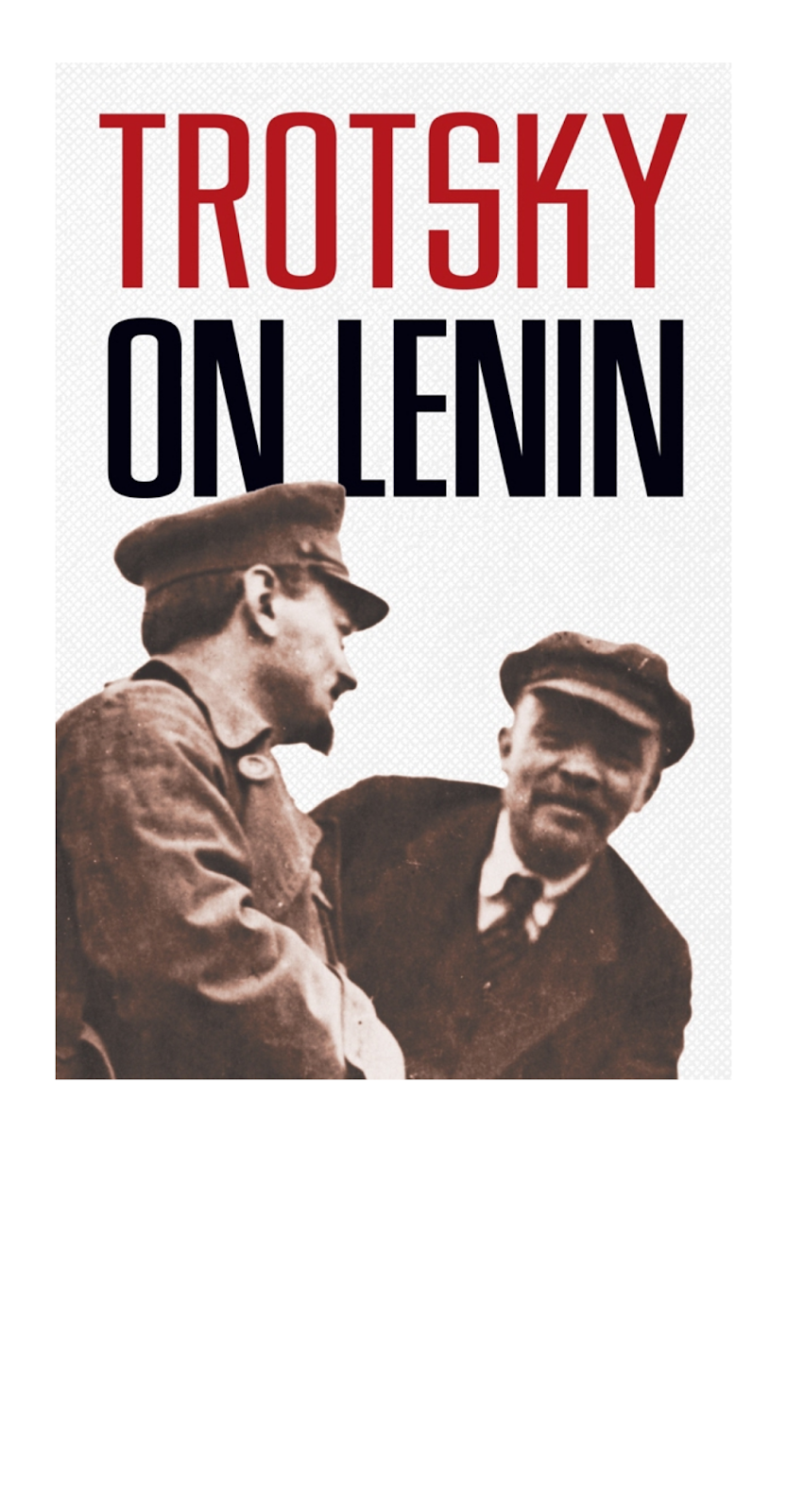
Trotsky on Lenin (Haymarket Books) combines Trotsky's early rough draft of a projected three-volume life of the Bolshevik leader with a reprint of On Lenin, a 1924 collection of reminiscences.
Haymarket publishes a few interesting books each year. Very few contribute to a reader's fundamental grounding in Marxism. Most titles on their list tail the latest fads in petty bourgeois thinking.
Every left-wing publisher must daydream about finding its own lode, like Verso did with Benedict Anderson's Imagined Communities. (Like Gramsci's Prison Notebooks, Imagined Communities is fundamentally innocuous: it can be taken any way the instructor wishes to spin it.) Trotsky on Lenin will not be such a money-spinner for Haymarket. (The same cannot be said for books by communist revolutionaries published to arm workers today who want to find a way to end the dog-eat-dog carnage of the dictatorship of capital.)
* * *
Trotsky on Lenin is fundamentally a fragment marketed for the sake of novelty. Its look at tsarist society, and the radicalization of youth repelled by it, makes for interesting reading, but it cannot provide the whole story.
Why prefatory material by initial translator Max Eastman, an avowed and virulent anticommunist at the time he introduced Trotsky on Lenin, was made available without response or context by Haymarket is another question. Editor Maurice Friedberg, however, seems to be an excellent compliment to late-career Eastman. At best he is a self-satisfied political ignoramus:
[....] Trotsky's biography is not the work of a scholar; indeed, many pages of it are frankly nothing but conjecture and read like an old-fashioned vie romanisée . In relating his story, Trotsky is unswerving in his admiration for Lenin. Adulation for his hero is coupled with scorn and venom for his idol's critics. The book is often dogmatic and bristles with hatred for Lenin's ideological opponents, particularly those who seemed to doubt any of the basic premises of Marxism. Trotsky seems to me in places to despise objectivity and to ridicule those whose Marxist faith is so weak that it must be reinforced by reason. He is equally disdainful, in his own words, of "self-satisfied ignoramuses and well-read mediocrities." He has no patience for democratic "frills," which to him are a sham and an excuse for an unwillingness to serve the Communist cause honestly. None of this detracts at all from the value of the book. And, as if to compensate for what his biography fails to reveal about Lenin, Trotsky reveals much about himself and about the spirit of the movement they both created.
As indicated above, half the length of Trotsky on Lenin is a reprint of the 1924 pamphlet On Lenin. In this collection, it is prefaced with a potted comparison essay see-sawing between the careers of Lenin and Trotsky. Editor Lionel Kochan does attempt a political explanation of the shifting international fortunes of the communist movement in 1923-24: noting the defeat of the German revolution, Lenin's terminal decline, and Trotsky's growing isolation.
Trotsky's relative isolation and his relationship to Lenin can also be seen and understood in the perspective of his Jewish origin. The latter was certainly not the condition of the former, but they were equally certainly connected. Trotsky, like the other radical Jews of his generation inside and outside Russia, e.g., Luxemburg, Victor Adler, Martov, Otto Bauer, not only, of course, scorned Judaism as a religion, but also saw no prospect of a separate Jewish existence, for which the only solution lay in social revolution, assimilation and an allegiance to internationalism. "Disdain and even a moral nausea"—this is the way in which Trotsky describes his reaction to nationalism. "My Marxist education deepened this feeling, and changed my attitude to that of an active internationalism. My life in so many countries, my acquaintance with so many different languages, political systems and cultures, only helped me to absorb that internationalism into my very flesh and blood." So far as Russia itself was concerned, although those Marxists of Jewish origin were frequently at political odds with each other, they shared the important negative characteristic of hailing from outside the densely populated areas of the Jewish Pale of Settlement in the Western provinces of the Empire.1 Trotsky himself was born in a village in the Ukraine and attended school in Odessa; Martov was born in Constantinople and taken to Odessa at the age of four; Kamenev was born in Moscow and educated at Vilna and Tiflis; Zinoviev was born in Elizavetgrad (former province of Kherson).
But it was not sufficient for these men and their like to be subjectively internationalists; it was also necessary to be accepted as such. In this Trotsky was less successful and the fact of his Jewish origin took an inescapable part in his career. It was precisely for this reason, for example, that Trotsky was deputed by Lenin to lead the assault on the Bund —the Jewish Marxist party—at the Second (London) Congress of the Russian Social Democratic Party in 1903. It was, in part, due to precisely the same factor that Trotsky found himself, in 1917, Commissar for foreign and not domestic affairs; and it was, of course, only because of his origin that the weapon of anti-semitism could be used against him in the struggle for power that followed Lenin's death. Internationalism, however sincerely adhered to, did not, in short, give the answer to Trotsky's ambivalent position. On the contrary, it may even have contributed to his isolation, as it certainly did to his downfall.
In general terms it is clear enough that during the decade or so before 1917 Lenin's ascendancy amongst the Bolsheviks expressed itself, in terms of personality, in the gradual movement of the more theoretical and speculative intellects amongst the Russian Marxists into the ranks of Menshevism or some intermediate grouping (e.g., Plekhanov, Martov) or even further to the right (Struve). The process of moulding the Bolsheviks into a force able to make a bid for power necessarily required a responsive instrument, i.e., one responsive to Lenin's views. Of course, this did not prevent or inhibit the most intense controversy inside the party. But it was for the most part within the framework set by the current political situation—tactics in 1917, to accept or reject Brest-Litovsk, the role of the trade unions, etc. In effect, however, the party had lost a considerable degree of freedom in discussion. New tasks obviously required a new approach. There is nothing surprising in this. The more earnestly that actual political tasks confronted the Bolsheviks, the more narrowly did controversy have to content itself with seeking means to perform those tasks.
What is significant is that this process was accompanied, inevitably, by a change in personnel of a type necessarily uncongenial to a cosmopolitan intellectual of Jewish origins, as exemplified in Trotsky. Of course, it would be absurd to identify cosmopolitanism and intellectuality solely with those Bolsheviks of Jewish origin. But it would be equally absurd to claim that the activity of these latter did not give the party a special flavor compounded of these attributes.
Their elimination can be observed, for example, through a scrutiny of those 17 members of the Central Committee elected after 1920 for the first time.2 They included only one Jew (Karl Radek) though over one-third were of non-Russian extraction. Almost three-quarters were of peasant stock and over 40% had had only an elementary education. As against this, the members of earlier Central Committees were distinguished by a greater proportion of men of middle-class origin, with a higher educational attainment and a higher proportion of Jews amongst the large number of those of non-Russian extraction. This was a representative picture of the personnel elected to the seven central committees formed between May 1917 and March–April 1922. The same over-all analysis is also derived from an examination of a larger sample of leading Bolsheviks. It has been shown that two separate generations of Bolsheviks can be said to have reached political maturity in the years between 1917 and 1922. There was that generation born between 1868 and 1874 (40) and that born between 1883 and 1891 (103). Again, pronounced differences separate the two groups in terms of ethnic origin, social background, and educational attainment. Thus, in the first group, dominance is claimed by those who were of non-Russian extraction, came from a middle-class background and enjoyed a higher or secondary education. There was in fact none with an elementary education.
The younger group, on the other hand, contained a higher proportional representation of Russians, of lower-class background with an elementary education. This change did not affect the central leadership of the party (i.e., those eight party members who sat in at least six of the seven Central Committees elected between 1917 and 1922). But it did appear in the Central Committee as a whole, and it is embodied in Stalin "the prototype and, at the same time, the forerunner of the 'new men.'"3 Both Stalin and Trotsky were born in 1879. But whereas, by 1924 say, the one belonged to the future, the other belonged to the past.
This is the past that Trotsky seeks to re-capture and in so doing, to establish his credentials as an Old Bolshevik, although he only joined the party in 1917 and had spent the previous decade in opposition to it. He idealizes Lenin, he harks back to their days in common harness, he portrays his dependence on Lenin—"my master," he calls him in his autobiography. To no avail. The Central Committee was progressively shedding its international-revolutionary character....
* * *