Mu

Mu
Showing posts with label James P. Cannon. Show all posts

Saturday, November 6, 2021

How the program of the Bolshevik Revolution took root in the US – The Militant
How the program of the Bolshevik Revolution took root in the US

November 15, 2021
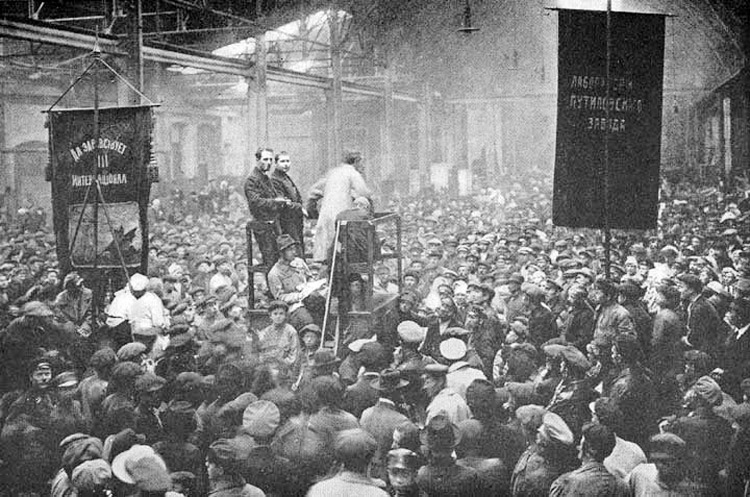
Meeting of factory committee during 1917 Russian Revolution. The victory of the Bolshevik-led socialist revolution inspired millions to build communist parties worldwide, including in U.S. Workers founded party here with “perspective of revolution in this country,” said James P. Cannon.

The First Ten Years of American Communism: Report of a Participant by James P. Cannon is one of Pathfinder’s Books of the Month for November. The 1917 Bolshevik Revolution in Russia inspired revolutionary-minded workers worldwide. Cannon, one of many won to the Russian Revolution’s example, helped found the Communist Party in the U.S. He describes how the Communist International led by V.I. Lenin and Leon Trotsky helped them. He also tells how the counterrevolution carried out against Lenin’s proletarian internationalist course by the bureaucratic caste led by Joseph Stalin helped corrupt the U.S. party and destroy its revolutionary heart. Cannon remained true to the Bolshevik program and traditions and was a founding leader of the Socialist Workers Party. This excerpt from Cannon’s introduction describes the early days. Copyright © 1962 by Pathfinder Press. Reprinted by permission.

BY JAMES P. CANNON

In its later evolution the Communist Party has written such a consistent record of cynical treachery and lying deception that few can believe it was ever any different. A quarter of a century of Stalinism has worked mightily to obliterate the honorable record of American communism in its pioneer days.

Yet the party wrote such a chapter too, and the young militants of the new generation ought to know about it and claim it for their own. It belongs to them. The first six years of American communism — 1918-1923 — represent a heroic period from which all future revolutionary movements in this country will be the lineal descendants. There is no getting away from that. The revolutionist who would deny it is simply renouncing his own ancestry. That’s where he came from, and without it he would not be. …

From 1917 to 1919 the life of the left wing of the Socialist Party — out of which the first troops of American communism were assembled — was governed primarily by international events and influences. Two “outside” factors, namely, the First World War and the Russian Revolution, created the issues which deepened the division between the left and the right in the American SP; and the theoretical formulation of these issues by the Russian Bolsheviks and the Comintern gave the left wing its program.

The factional struggle of this period occurred along clearly defined lines of political principle. The left wing, which had previously fought as a theoretically uncertain and somewhat heterogeneous minority, was armed with the great ideas of the Bolsheviks and unified on a new foundation. The left wing as a whole clashed with the traditional leadership of the SP over the most basic issues of doctrine, as they had been put to the test in the war and the Russian Revolution.

Leaving aside all the mistakes and excesses of the left-wing leaders, personal antagonisms engendered in the fight, etc., the lines of principle which separated them from the old leadership of the Socialist Party were clearly drawn. The split of 1919, resulting in the formal constitution of the communist movement as an independent party, was a split over international issues of principle in the broadest and clearest sense of the term. …

As a matter of fact, in the modern world, internationalism is not an outside influence at all. The whole is not foreign to its parts. America, especially since 1914, has been a part of the “One World” and a very big part indeed. In reacting to events in other countries, America also reacts upon them. There is no such thing as “the international situation” outside and apart from this country. And the American communist movement, in all its reactions to international influences, was never free from the simultaneous influence of its national environment.

The causal factors which brought the Communist Party into being in the first place were both national and international. The same holds true for its later evolution at every stage. American communism, at the moment of its birth, represented a fusion of the Russian Revolution with a native movement of American radicalism. It is not correct to say that “everything came from Russia.” The ideas of the Russian Revolution needed a given social environment to take root in, and receptive people to cultivate them; as far as we know, the Russian Revolution did not create a Communist Party on the moon.

International events and ideas were the predominating influence in bringing the American Communist Party into existence, but these events and ideas needed human instruments. These were provided by the native movement of American revolutionists which had grown up before the Russian Revolution out of the class struggle in the United States. …

Objective circumstances are powerful, but not all-powerful. The status quo in normal times works to compel conformity, but this law is not automatic and does not work universally. Otherwise, there would never be any rebels and dissenters, no human agencies preparing social changes, and the world would never move forward.

There are exceptions, and the exceptions become revolutionists long before the great majority recognize the necessity and the certainty of social change. These exceptions are the historically conscious elements, the vanguard of the class who make up the vanguard party. The act of becoming a revolutionist and joining the revolutionary party is a conscious act of revolt against objective circumstances of the moment and the expression of a will to change them. …

This was demonstrated when the Second International, which collapsed so ignominiously in the First World War, nevertheless provided the forces, out of its own ranks, for the new parties and the new International. Some socialists remained socialists; not everybody capitulated and betrayed. From the Russian party, in the first place, from the German party, and from every other Socialist Party in the entire world, uncorrupted socialists, who simply remained true to themselves, stood up against the degeneration of the old organizations and began to build the new. Even the Socialist Party of the United States, that ugly duckling of the Second International, which really wasn’t much of a party, furnished cadres not undeserving of mention in this honorable company.


How the program of the Bolshevik Revolution took root in the US – The Militant

Thursday, December 13, 2018

Continuity of struggle for a proletarian party

…. An essential part of the strategic line of march toward the establishment of a workers and farmers government in the United States is the fight for the transformation of the industrial unions—the most powerful existing organizations of the working class—into revolutionary instruments of class struggle for the interests of the exploited and oppressed.

During the long postwar period of capitalist expansion, political conditions in the United States stood in the way of effective revolutionary work by socialists in the industrial unions. The political and economic situation that opened in the mid-1970s made it possible once again for communists to advance this fight from within the industrial unions. This dictated a sharp turn. The SWP decided to get a large and stable majority of its members into the industrial unions and to build national fractions of its members in these unions.

Without such a turn to the industrial unions a retreat from the struggle for a proletarian party would have been unavoidable. The party’s internationalism, its political homogeneity and centralization, and its revolutionary centralist character would have been eroded. The working-class composition of its milieu, its membership, and its leadership would have been diluted instead of strengthened. It would have become more white and anglo. There would have been even greater pressure on party members who are female to retreat from the demands of political leadership and lose their political self-confidence. The party would have been more susceptible to the pressures of a growing economic and social crisis and war preparations—pressures originating in the bourgeoisie and transmitted through various petty-bourgeois layers and organizations. It would have been more vulnerable to cliquism and permanent factionalism, and therefore less democratic. If a revolutionary proletarian party does not base its membership in the industrial working class and industrial unions when it is politically possible to do so, this inevitably results in the erosion of its program. 

http://www.themilitant.com/2008/7205/720549.html

*   *   *

(Continuity of struggle for a proletarian party)

Excerpt:

Counterrevolution in Soviet Union

By the mid-1920s, however, the wave of revolutionary upheavals in other countries that followed the Russian Revolution had been defeated. The worker Bolsheviks, forged in the party built by Vladimir Lenin, the central leader of the 1917 Russian Revolution, were exhausted by the first world war and then the 1918-20 civil war. These objective conditions helped promote the growth of petty-bourgeois, bureaucratic layers in the Soviet government and Communist Party, led by Joseph Stalin, mainly concerned with guaranteeing their privileged positions and life style.

Stalin reversed Lenin’s revolutionary internationalist course and replaced it with the narrow, nationalist perspective of the bureaucratic caste in the government and party. He imposed a change in the CPs around the world, transforming them from organizations seeking to carry out socialist revolutions to instruments of Soviet foreign policy, carrying out dictates from the Kremlin and working to pressure their own capitalist classes to accept Moscow’s offer of collaboration to dampen workers’ resistance.

A minority within the CPs fought to maintain a genuine Marxist course. They were eventually expelled. In the United States, they went on to form the Communist League.

The following decade brought much opportunity for the workers in the Communist League to recruit, as labor radicalized under the blows of the Great Depression. Up to this time the great mass of workers were unorganized. But beginning in 1933, millions of workers began participating in strikes and organizing drives across the country. The massive strike wave culminated in the formation of the Congress of Industrial Organizations in 1936, which became a social movement, pressing for government action to bring relief from depression conditions. This upsurge wrested major gains for the working class in the face of attacks from the bosses and their government.

Essential to the most important battles in the ’30s was the leadership initiative of rank-and-file unionists who fought for independent working-class action. Revolutionary class-conscious leadership was decisive in some of the most successful battles, such as the Teamsters strikes in Minneapolis and subsequent organizing drive throughout the Upper Midwest, from which many of the best militants were recruited to the Communist League. (See “The 1930s Minneapolis Teamsters rebellion” in the October 20 Militant).

A series of fusions between the Communist League and other revolutionary-minded forces in the succeeding years led to the foundation of the Socialist Workers Party in 1938. U.S. imperialism’s drive toward war in the late 1930s precipitated a deep political fight within the SWP. A petty-bourgeois layer within the party bent to bourgeois pressure and rejected many of the party’s longstanding Marxist principles. They abandoned defense of the Soviet Union against imperialist attack and rejected fundamental norms of party organization.

This layer split from the party in early 1940. Though the split took a large number of members, the party emerged on a stronger proletarian footing. The record of this political fight is contained in the books The Struggle for a Proletarian Party by James P. Cannon and In Defense of Marxism by Leon Trotsky.

For the next few years the party continued to focus its work in the industrial union movement. But over the course of the following decades, industrial unions receded from their central place in politics. The failure of the union officialdom to mobilize labor in broader political struggles—to organize the unorganized in the South and elsewhere, or to fight for independent working-class politics—led to stagnation in the union movement.

In the late 1950s and early 1960s the SWP concentrated its activity on the explosive social struggles by Black workers against segregation and on the openings presented by the Cuban Revolution. These were soon to be followed by the massive opposition to the war in Vietnam, the rise of the women’s liberation movement, and other social and political struggles that attracted young people looking for an alternative to the capitalist system. Out of these movements many youth joined the communist movement. 

Turn to industry
A turning point in working-class politics arrived with the 1974-75 economic recession, which was the deepest since 1937-38 and the first downturn since then that was worldwide in scope. This downward slide prompted the bosses and their government to qualitatively accelerate their attacks on workers’ standard of living.

In light of this, the Socialist Workers Party prepared itself for the opportunities that would come with the inevitable working-class resistance that the ruling-class assaults would produce. In 1978, the SWP decided to initiate a turn to the industrial unions, organizing the big majority of its members and leaders to get jobs in industry and center their activity there and in the industrial unions. “Our turn has to do with what is changing in the American working class,” states the report adopted by the party’s 1979 convention. “When our kind of party has the opportunity to go to the weightiest and most powerfully organized sections of our class and do political work, we have to do it.”

Since the party’s turn to industry, the experience of the workers’ movement has illustrated its correctness. While the sharp battles that will materialize in response to the assaults by the ruling class lie ahead, we can already see the signs of initial resistance as more and more workers seek to use union power to defend themselves from layoffs, speedup, lack of safety, and declining real wages. As the consequences of the capitalist economic and social crisis bear down harder, the most class-conscious workers will be won to the communist movement.

http://www.themilitant.com/2008/7247/724736.html

"Methods" of leadership

From Chapter 12. The ‘Clique’ and the ‘Leader Cult’

....The Stalinist bureaucracy represents privileged social groupings which have appeared for the first time in history on the basis of a workers’ state. The Marxists alone—that is, the Trotskyists—found the key to the real mystery of Stalinism. They first revealed its social base. Then they demonstrated that its privileges and special interests collide irreconcilably with the interests of the masses in their march toward socialism. In order to serve their special interests the Stalinist bureaucracy was compelled to introduce a line of policy which contradicted the program and tradition of the party. In order to impose such policy upon the party and upon the country, they were compelled to suppress party democracy, to force their line through by means of bureaucratic violence, and to concentrate all power in the party apparatus.

But the conflicts of class interests in the country, and the numerous rivalries and conflicts of interest between the various privileged groups, found a distorted expression in factional struggles within the apparatus itself. This unsettled the regime and created possibilities for the intervention of the party rank and file, and of the working mass in general. The Left Opposition for a time made its way through just such fissures in the apparatus and threatened its overthrow. This demonstrated to the bureaucracy the iron necessity of a still narrower concentration of power. The conflicting privileged groups required a means for the arbitration and regulation of their conflicts without the intervention of the masses, and in such a way as to unite them all against the masses. Out of this necessity, after the revolutionary wing of the party had been annihilated, emerged the single, all-powerful leader, the arbitrator, the Soviet Bonaparte, Stalin.

Stalin thus appears as a “leader” of an entirely different type from Lenin, who also enjoyed exceptional authority, and one who arrived at his position by an entirely different practice. Lenin, the Marxist, the revolutionist, truly expressed the interests of the masses and maintained his position by the consent and even the love of the most conscious section of the proletariat. Lenin consequently leaned upon the masses and required party democracy to mobilise their support against the privileged elements within the country and in the party. Stalin, the revisionist, the betrayer of the revolution, came to his position not by the voluntary will of the masses but in a struggle of the privileged groups against them. Stalin is not the “leader” because the people “love” him; it is obligatory to “love” him because he is the dictatorial power, the Soviet Bonaparte, whose prestige must be artificially inflated and promoted in order to strengthen his position as the arbitrator, defender and best representative of the privileged elements in the population. If anyone disagrees, there is the GPU to convince him.

All the “methods” of Stalinism grew from the necessities of an unstable and highly privileged bureaucracy which cannot maintain itself by other methods, and dares not permit democratic procedures that would permit the masses to intervene. As for the Stalinist bureaucracies in the parties of the Comintern, they are simply the extensions of the Russian social phenomenon, its foreign agents. The main social base of the bureaucratic gang in the American Communist Party is in the Soviet Union. That explains the peculiarities which distinguish it from the bureaucracies of the trade union movement, the reformist political parties, etc....

--Struggle for a Proletarian Party by James P. Cannon

Turning the party in the right direction

From 13. The Proletarian Orientation

....Our basic problem still remains, as stated there, to “turn our faces in the right direction. That means, first of all, to turn our backs on the pessimists and calamity howlers, the soul-sick intellectuals and tired radicals who whine and dawdle around the fringes of the movement and even, to a certain extent, infest our ranks.” I still think that “most contemptible of all are those who seek to cover their desertion and retreat by hurling newly invented ‘ideological’ disagreements with Marxism over their shoulders. Taken altogether they are an unattractive and uninspiring aggregation. It is nothing less than a monstrous travesty to consider them as in any way reflecting the movement of workers’ emancipation which, by its very nature, is alien to all pessimism and defeatist tendencies. It is criminal folly to waste time or even to argue the question with these runaway boys and heralds of defeat before the battle.”

--Struggle for a Proletarian Party by James P. Cannon

The proletarian party and the petty bourgeois intellectual

(This.)

…. For the proletarian revolutionist the party is the concentrated expression of his life purpose, and he is bound to it for life and death. He preaches and practices party patriotism, because he knows that his socialist ideal cannot be realized without the party. In his eyes the crime of crimes is disloyalty or irresponsibility toward the party. The proletarian revolutionist is proud of his party. He defends it before the world on all occasions. The proletarian revolutionist is a disciplined man, since the party cannot exist as a combat organization without discipline. When he finds himself in the minority, he loyally submits to the decision of the party and carries out its decisions, while he awaits new events to verify the disputes or new opportunities to discuss them again.

The petty-bourgeois attitude toward the party, which Burnham represents, is the opposite of all this. The petty-bourgeois character of the opposition is shown in their attitude toward the party, their conception of the party, even in their method of complaining and whining about the “grievances,” as unfailingly as in their light-minded attitude toward our program, our doctrine, and our tradition.

The petty-bourgeois intellectual, who wants to teach and guide the labor movement without participating in it, feels only loose ties to the party and is always full of “grievances” against it. The moment his toes are stepped on, or he is rebuffed, he forgets all about the interests of the movement and remembers only that his feelings have been hurt; the revolution may be important, but the wounded vanity of a petty-bourgeois intellectual is more important. He is all for discipline when he is laying down the law to others, but as soon as he finds himself in a minority, he begins to deliver ultimatums and threats of split to the party majority. 

http://www.themilitant.com/2007/7131/713149.html