Mu

Mu
Showing posts with label Ernest Mandel. Show all posts

Monday, December 16, 2019

Reading notes on Part Two of The meaning of the Second World War by Ernest Mandel [Verso: 1986]


The meaning of the Second World War

by Ernest Mandel

Verso: 1986


Part Two:  Events and Results


Chapter 10: The Opening Gambit In Europe


....During the interlude of the drole-de-guerre, Hitler feverishly prepared the offensive against France, based upon the brilliant strategic plan by von Manstein and Guderian. Instead of trying to encircle the French armies in Eastern France (as was done success­ fully in 1870 and tried unsuccessfully with the Schlieffen plan in 1914), the Wehrmacht would attempt to encircle them in the centre of the front by a bold breakthrough at Sedan and a quick rush for the English Channel. General Gamelin walked right into the trap by sending his crack mobile divisions into Holland and Belgium on 10 May 1940. The result was not a foregone conclusion, since the actual German superiority of forces was slight.

But the German gamble paid off because of superiority in strategic conception and rapidity of military execution. 


....What stood between [Hitler] and final victory in the West was not so much the Expeditionary Corps under Lord G ort, miraculously repatriated from Dunkirk, but the Royal Air Force and the Royal Navy


....RAF fought over its own territory, had a superior information and communications system (radar played a key role here) and employed better tactics


....By 13 November 1940 the Luftwaffe had lost 1733 airplanes in the Battle of Britain out of the 2,200 it had committed to the battle. By the end of March 1941, the losses rose to 2,265 planes, with 8,000 pilots or other flying personnel either killed, wounded or missing. In contrast, the RAF lost 915 planes up to November 1940. What really saved Britain was Hitler's determination not to limit himself to a purely European war but to go for world hegemony - i.e. to attack the Soviet Union. 


....Hitler's obsession with the conquest of the Ukraine (which made sense from the viewpoint of the more aggressive sectors of German imperialism), and a nagging doubt about the USSR's real industrial strength, explains the concentration of efforts on Eastern Europe and the Soviet Union. For him, as for Roosevelt, the Mediterranean and the Near East were not of such great strategic importance.


....For the British bourgeoisie, the loss of Egypt and Middle Eastern oil would have meant as much as losing the British homeland, for the homeland would come next. So the Mediterranean became British imperialism 's main theatre of war and would remain so for three years.


....a basic rule of war was demonstrated: the more battles are fought which do not end the war, the more the marginal cost of partial victories weighs upon the final outcome. German imperialism won an easy victory in Norway, but its navy's losses in that war made Operation Sea Lion both materially and psychologically impossible without a prior defeat of the RAF. Holland was over­ come in four days and Crete taken in seven, but the loss of para­ troops and glider planes made a similar approach to Malta impossible.  The victory against Poland was easy, but the two hundred or so Polish pilots who escaped to Britain may well have made the difference between victory and defeat for Fighter Command in September 1940


Chapter 11: The Unfolding World Battle


....Germany's attack on the Soviet Union not only endowed the war with a new geographical dimension; it partially modified its social character as well. For whilst it is true that the German imperialists were out to plunder other countries, seizing mines, factories, banks almost ubiquitously, this transfer of ownership affected other capitalists. In the case of the USSR, by contrast, the property to be plundered was not capitalist but collectively owned. Hence the intended appropriation involved a social counter-revolution on a gigantic scale. A parallel can be drawn here with armies of the European monarchies in 1793 which, had they defeated the French revolutionary army, would have restored the ancien regime-i.e. the social and economic privileges of the nobility and clergy - except that in 1941 it would have been a foreign nobility.


....Stalin found himself in a position to divert a significant proportion of battle-hardened Soviet forces from the Far East after receiving authoritative information that Japan would remain neutral in the German-Soviet war.  The successful defence of Moscow was thus intimately linked to the attack on Pearl Harbor.

    Hitler had been stung by the news of the Soviet-Japanese Neutrality Pact, coming as it did so soon after the formulation of Barbarossa.


....If the Soviet-Japanese non-aggression pact seems reasonable in the given circumstances, the positive military alliance between the Soviet Union and Britain of July 1941, subsequently joined by the United States, appears to be another matter altogether. Why should one imperialist power ally itself with a workers' state against another imperialist power? Today, with Soviet Union having become a world power, doubt as to the wisdom of that decision is proportionately greater in the bourgeois camp. It certainly came as a shock to Hitler, who was incredulous for several weeks. In the conjuncture, however, it made sense - a case of choosing the lesser evil. Unwilling to fight the war on the European continent, the British and Americans saw the Alliance as one that would simultaneously weaken both Germany and the Soviet Union, after which they would come in for mopping-up operations. To ensure that the U S SR would bear the brunt of German aggression without collapsing under it, the two countries offered material aid.


....one should add that Churchill was not completely unconstrained in his decision to extend support to the Soviet Union after 22 June 1941. Refusal to come to her aid or an attitude of studied neutrality would have provoked enormous opposition, especially in the working class. Furthermore, at that point in time it was not at all clear how Britain could win the war without the gigantic Soviet effort in the East; the whole situation of national unity could have been imperiled by an incorrect decision - and Churchill was lucid enough not to make such a mistake.


Chapter 12: Towards The Climax


....To their military and economic pressure the Americans now added a political dimension: condemnation of the policy of colonialism practised by Western imperialist states, which was perceived by the US public as one of the main causes of defeat in the Far East. This defeat had been astonishingly rapid. By the end of January 1942 the British and Australian defence units had retreated from the Malay peninsula into Singapore, only to surrender themselves in mid-February to General Yamashita. Hong Kong, the symbol of global British commercial interests, and Singapore, the very heart of the Empire's defence system in the Far East, were now both in Japanese hands. Then, at the start of April, the Philippines were taken - a heavy blow to the American pride. By mid-May nearly all of Burma was under Japanese occupation. The Burma road to China was now cut and only the expensive air route across the Himalayas remained for the supply of China and the American forces there. British India was threatened in turn. This series of great Japanese successes represented a major turning-point in the history of Asia, which no subsequent defeat would completely erase; for once the West was humbled by the East. Only the American victory at Midway checked Japan's military momentum.


....The collapse of British power in the Far East was not just a question of the Empire's weakness there. After all, Japan had managed to conquer this huge area with less than 200,000 men. (In comparison, the British Imperial Army lost 140,000 soldiers at Singapore, most of whom became prisoners of war.) Rather, the defeat indicated the subject peoples' unwillingness to fight for the British cause. The Japanese victories reflected the decomposition of the political and social fabric of British Imperial rule. 


....Churchill, full of venom towards the movement for Indian independence, and also partly out of sheer racialist prejudice, decided against any help to alleviate the mass sufferings. Under these circumstances, Gandhi and Nehru thought it wiser to channel mass indignation through the movement of civil disobedience than risk losing control over popular forces to a more radical nationalist leadership or even a revolutionary one. 


....the Western Allies' ability to maintain themselves in the Mediterranean crucially depended on the Red Army's determination to block the German drive to the oil fields of Baku. For, if successful, it would not only have ensured plentiful fuel supplies for the German war machine (and throughout the war oil was the Achilles' heel of the Wehrmacht) but would also have lined up Turkey and Iran behind Germany, thus changing the whole geopolitical balance between the  Mediterranean and India to Britain's disadvantage. 


....1942 was the year in which the Soviet Union once again came to the verge of defeat. At the end of 1941 Stalin, intoxicated by the successful repulse of the German advance on Moscow, became convinced that the Red Army would break the enemy in the new year. At his insistence Stavka almost immediately adopted a plan for an all-out counter-offensive which was to strike simultaneously at the three Germ an Army Groups (North, South and Centre) along a thousand-mile front. The scale of the proposed operation was incompatible with current Soviet resources of skilled man­power and materiel. In addition, it was strategically unsound: both Zhukov and Voznesensky, then in charge of the war economy, were against it. They proved correct. Once the initial surprise wore off, the German commanders were able to stabilise the front line, leaving the Red Army with no strategic superiority anywhere at the end of March. Worse was to follow. 


....Stalin was once again able to override his generals' proposals in favour of his own policy of 'simultaneous attack and defence' - i.e. a policy of generalised confusion.


Chapter 13: The Decisive Turning-Points


....In early November 1942 the Western Allies began their landing in French North Africa. In February 1943 Japanese expansion in the Pacific was halted by the US Navy. In the same month Germany's advance came to an end with the Red Army's victory at Stalingrad. Thus, within a few months the Second World War turned to the advantage of the Allies. They had now conquered the initiative and would not lose it again. Battles at Tunis, Kursk and Saipan rounded out the turn.


....The  downfall of Mussolini and the withdraw al of Germ an troops from the Balkans would enable, for the first time since 1938, the reemergence of a sector of the European working class - in Italy, Yugoslavia and Greece - as an autonomous protagonist in the global drama.


....Now the time of Blitzkrieg was over. The moment had come for confrontations between ever greater concentrations of mechanised weapons - in the first place, tanks and airplanes - and their production and utilization on the battlefields with maximum efficiency and tactical skill. Goebbels formula of total war now became a reality: total war replaced Blitzkrieg to the inevitable and progressive disadvantage of Germany and Japan.


....The question of who would be recognised as French spokesman in this 'liberated' territory of France had significant implications vis-a-vis the future legitimacy and role of a reconstituted French state. Giraud had many qualifications in American eyes: he was anti-communist, anti-German and anti-British. In contrast, de Gaulle's close involvement with London and his ambition - and potential - to represent the French nation made him highly suspect to Washington. T e difference between Giraud and de Gaulle, between the United States and Great Britain, also centered on the question of whether France would be weak or strong after the war, ie. whether a capitalist Europe would be pro-American or relatively independent of the USA. T e British bourgeoisie clearly understood at this point that Britain would not be equal in power or influence to the USA and the USSR and therefore sought to constitute a kind of West European bloc. 


....the decisive element was the long resistance of the Stalingrad defenders. It was this resistance which depleted German reserves and gave Stavka the necessary time to plan and organize in minute detail the encirclement of the Sixth Army. That resistance in turn clearly reflected a social phenomenon: the soldiers' and workers' superiority in urban, house-to-house or barricade fighting. Already, during the Spanish Civil War, a similar observation could be made of the battles of Barcelona and Madrid in 1936. Chuikov, the commander of the Soviet Sixty-Second Army, which formed the backbone of Stalingrad's defence, would later w rite: 'City fighting is a special kind of fighting . . . . The buildings in the city act like breakwaters. They broke up the advancing enemy formations and made their forces go along the streets . . . . The troops defending the city learned to allow German tanks to come right on top of them - under the guns of the anti-tank artillery and anti-tank riflemen; in  this way they invariably cut off infantry from the tanks and destroyed the enemy's organized battle formation.'


....The Japanese high command sacrificed tremendous resources at unimportant points of the peripheral war, obstinately refusing to cut their losses and withdraw to the inner line of defence. A fundamental split between the army and the navy supervened. The army's priority was to cover its positions in Indonesia and the Philippines through offensive operations in New Guinea. The Imperial Navy, on the other hand, was preoccupied with defenceof its great naval base at Truk Island, covered by its strongholds in the Solomons. These differences over strategy paralysed the Japanese high command for a fatal six months. 

    A similar difference in strategic conception arose between General MacArthur and Admiral Nimitz. MacArthur favoured concentrating all efforts upon the reconquest of the Philippines - in the final analysis, for political reasons. He understood the discredit suffered by the Army - and Western imperialism in general - as a result of the crushing defeats of early 1942. He was afraid that without a spectacular victory there the Philippines would be permanently lost to the USA. Nimitz, on the other hand, understood that the Japanese were capable of tremendous defensive efforts in strongholds like Rabual, Singapore, Indonesia and the Philippines, and wanted to bypass them through island hopping, aiming straight at the Japanese homeland. In the end both commanders were allowed to follow their favoured course, with a two-pronged attack towards Japan, but with the US Navy carrying the main burden of the military roll-back.


Chapter 14: The War of Attrition


.... the reserves which the Axis powers could mobilise were much larger than initially assumed. Their previous conquests had provided them with a lot of space from which to withdraw before the war could hit directly at their homelands. Withdraw they did, but rather slowly, in good order and - at least in the case of the Wehrmacht - with a deal of military skill. 


....Their class interest was confronted with a real dilemma: how to liquidate fascism whilst preserving the foundations of the bourgeois state, i.e. their political class rule, indispensable for neutralising or, if necessary, confronting mass mobilisations and the threat of revolution. 


[Allied bombing of German cities] ..... Stubborn persistence - if not indignation - rather than demoralisation, was the net effect of the resulting wholesale destruction and massive losses imposed on defenceless civilians. The only demoralisation occurred inside the Luftwaffe (particularly affecting Goering and his immediate cronies) and, to a lesser extent, inside the High Command, where the failure to adequately protect vital war industries was recognized as a harbinger of defeat. The second objective, that of forcing Germany to its knees by destroying specific sectors of the war industry (in the first place, synthetic oil, synthetic rubber and ball bearings), could probably have met with great success had the British and American air forces concentrated on these targets, instead of conducting inhuman raids on the civilian populations of large cities, like the incendiary bomb attacks on Cologne, Hamburg and, later, Dresden.


Chapter 15: The Final Onslaught


....The Anglo-American landing in Normandy on 6 June 1944; the August 1944 and January 1945 offensives of the Red Army which brought it from the Dniester to the Danube and from the Vistula to the Oder, respectively, capturing Hitler's industrial base in Silesia; and the conquest of the Philippines between the Battle of the Leyte Gulf and the landing in the Lingayen Bay (November 1944February 1945) - these opened the final onslaught on the homelands of German and Japanese imperialism which would culminate in their collapse in May and August 1945. All these offensives ended in crushing defeats for the foes of the Allied powers. 


....The immediate purpose of the German Ardennes offensive was logistical: to capture Liege and Antwerp and, with them, huge Allied supply dumps, in the first instance oil, of which the Wehrmacht and the Luftwaffe were already desperately short. As for the broader strategic objective, this was based on the hope that the internal contradictions of the Allied camp, and especially the prospect of Soviet occupation of Eastern and Central Europe, would convince the Anglo-Americans to go for a separate peace. 


....German tactical victories were, in reality, huge political defeats. The battles of Arnhem and of the Ardennes confirmed that military victories are not ends in themselves, but means of obtaining political goals which must be clearly understood and prioritised. The same applies, mutatis mutandis, to Kesselring's successful resistance against the Allies' attempts to effect a break­ through in Italy. Contrary to an opinion expressed by many experts, including General MacArthur, the Italian front was far from being a military 'diversion', i.e. a squandering of forces on a secondary theatre of war which might have been better employed in France or the Pacific. Given the existing superiority of the Allied armies on these two fronts, the diversion to them of the thirty Allied divisions stationed in Italy would not have made any difference to the outcome of the war. But the successful breakthrough of these divisions in the spring, summer and autumn of 1944 towards the Po valley and, from there, through the Ljubljana gap would have changed the map of Europe. Anglo-American forces would have arrived in Budapest, Vienna and Prague much earlier than the Red Army.


....a terrible tragedy evolved further to the North on the main Minsk-Berlin axis. Spurred on by the ambiguous appeals of Red Army commanders, motivated by the desire to liberate their capital by their own efforts and to establish a more favourable balance of forces for the London-based Polish government-in-exile vis-a-vis the Lublin regime set up by Stalin, and also anxious to obtain the maximum amount of weapons for self-defence against ongoing repression by the NKVD, the Polish underground Armija Krajowa (dominated by the social-democratic PPS rather than by bourgeois reactionaries) rose in Warsaw against the German occupation forces when the Soviet army reached the Vistula. The uprising was based upon a doubly-incorrect assumption: that the Red Army would join, or at least help, them (Stalin had promised this when meeting Mikolayczik the first day of the uprising - a promise he repeated in a telegram sent to Churchill on15 August 1944); and that the Wehrmacht had been decisively weakened along the Vistula. In fact, the Wehrmacht assembled a still impressive force to counter both the Red Army's drive and the Warsaw insurrection. And Stalin blocked all help to Warsaw, letting the Germans do the dirty work of liquidating the Armija Krajowa he would otherwise have had to do himself. As a result of that double miscalculation, the uprising was crushed by the Nazis, in spite of the heroism of the combatants. Their butchers took a terrible revenge: 'After two months of merciless fighting, sixty-two days of unending horror and atrocity, with 15,000 men of the 30 to 40,000 of the Armija Krajowa dead, the population forcibly evacuated or murdered on the spot, 150,000 to 200,000 civilians immolated out of one million, the dead entombed in the ruins and the wounded lying untended on the roads or suffering their last agonies in cellars, surrender could no longer be delayed. On October 2(1944) the fighting ceased: the Poles were collected for deportation or extinction in the gas chambers, after which the Germans bent to the maniacal labour of levelling Warsaw to the ground.' The Red Army's halt at the Vistula lasted five months. 


....A detailed, sometimes moving narrative of what happened in Japan prior to the dropping of the atomic bombs, of the peace overtures already under way, of the utter falsity of the thesis of the 'risk of one million American dead' (recently rehashed by Nixon) is provided in The Day Man Lost: 'At night, while the rest of the people huddled hungry in bombed out dwellings, those in power entertained one another at luxurious dinner parties, parties that often turned into nightlong orgies. It is hardly surprising that yamatodamashi was on the wane. This increasing demoralisation of the people was what chiefly preoccupied Prince Konoye who feared that if, or when, Japan lost the war, the masses would turn to communism as a panacea. . . . The only way to retain the (old imperialist) system . . . was to terminate the war as swiftly and painlessly as possible.


....By the time the atomic bomb was dropped on Japanese cities, the Americans had already clarified for their own benefit and also, where appropriate, for that of their wartime 'friends', the three basic postulates of their policy towards defeated Japan: that the occupation of the Japanese mainland would be a purely American affair; that the occupying power would retain the Emperor as a 'symbol of authority'; and that a Japan sympathetic to the United States was desirable to check the Soviet presence in Asia. As in Western Europe so also in the Far East, the USA sought to prevent any transfer of power to the local Resistance: the General Order No. 1 ensured that the collapse of Japanese power in Korea, the Philippines, the Dutch East Indies and Indochina would not benefit the resurgent nationalist and Communist Left. However, since only actual occupation would guarantee the fulfillment of American aims, the USA made peace with the archaic forces of colonialism or corrupt conservatism in order to restore the desirable status quo ante helium now everywhere in its death throes. Washington's global policy in the Far East met with little opposition in Moscow and it was the Chinese Revolution that decisively altered the geopolitical balance in Asia against US design.


....where [the German ruling class] stood militarily was not determined solely by force of arms: several miscalculations by the imperialist and bourgeois powers led to the final outcome. The basic miscalculation was the German bourgeoisie's. Had it capitulated in the summer of 1944 or had the 20 July 1944 conspiracy against Hitler been successful the map of Europe would have been quite different today. When German historians and politicians, and some of their covert Anglo-Saxon brethren, blame Roosevelt's insistence on 'unconditional surrender' for the Red Army's occupation of Eastern Germany, Czechoslovakia and Hungary, it is a typical case of cutting one's nose to spite one's face. After all, what was involved was their own property and state power. Bourgeois political and military leaders who end up losing half of their state through pride, or because they hope against all the evidence to regain through last-minute political upheavals what they have lost on the battlefield are simply a bunch of incompetents who do not defend their class interests properly.


This is not to say that the 'unconditional surrender' formula was a wise one from the stand-point of the Allies (neither Churchill nor Stalin were in favour of it). It certainly prolonged the war by generating in the German High Command (though less so amongst big capital) a certain psychological resistance to suing for peace. But in the first place it prolonged the war at the expense of the German bourgeoisie, which should have known better. After all, the remnants of the Third Reich under Admiral Doenitz ultimately did surrender unconditionally in May 1945. Would it not have been wiser, from their own point of view, to have done so in the summer of 1944, when there was still not a single soldier and especially no Russians on German soil?


Chapter 16:  The Outcome


....Bourgeois political and  military leaders who end up losing half of their state through pride, or because they hope - against all the evidence - to regain through last-minute political upheavals what they have lost on the battlefield are simply a bunch of incompetents who do not defend their class interests properly.


....the German bourgeoisie should lay the blame where it belongs: on its own political blindness - for sure, Hitler's in the first place, but also that of all its main military commanders and of most of its political representatives as well.


Behind that blindness lay typical imperialist arrogance - refusal to acknowledge defeat and the stubborn clinging to the hope of a last-minute 'political miracle', i.e. the hope that the inevitable cold war' would transform itself into a new 'hot war' between Western imperialism and the U SSR before the 'hot war' with Germany was over. Such obstinacy was that of reckless gamblers, characteristic of broad layers of German imperialism 's leading personnel since its inception (for historical reasons which have been explained many times). 


....The US, on the other hand, pursued its policy of excluding not only its class enemy, but also its closest ally, Britain. Admiral King, one of main American strategists, was not the only one to oppose all aid from the Royal Navy in the 'mopping up' operations against Japan. Britain was excluded from sharing in the occupation of Japan, and in the Middle East Truman did not intervene solely to stop Stalin: what followed was a rapid substitution of the USA for Britain as the regional hegemonic power. If the way in which World War Two reshaped the map of Europe and the Far East was largely decided on the battlefield, and not on the conference tables at Yalta and Potsdam, military-diplomatic realpolitik was disrupted and partially neturalized by the irruption of independent class forces onto the political area - class forces, that is, not controlled by Big Power military commands or governments. The most telling case is that of Yugoslavia. 


....In Indonesia and Indochina, all manoeuvres by imperialism and the Kremlin to restrict the huge national liberation movements to the horizon of 'reformed' colonial empires failed. Long wars ensued which, in the case of Indochina, would eventually develop into socialist revolution, and, in the case of Indonesia, end in bloody defeat. In China especially, imperialism and the Soviet bureaucracy showed themselves unable to contain or suppress peasant uprisings in the Northern plains and to halt a civil war which would result in the victory of the Chinese Revolution.


Chapter 18 The Legacy


....Powerful as it was, US imperialism could not single-handed simultaneously confront the Soviet Union, the process of permanent revolution in the colonial and semi-colonial countries, and a periodically restive and explosive working class in several imperialist countries, with its own manpower and military resources. It needed allies and it had to cultivate them, in the first place financially. As a result, US imperialism saw the law of uneven and combined development assert itself for the first time against the United States.

When the US launched the reconstruction and consolidation of West German and Japanese imperialism (just as it had previously assisted in the reconstruction and consolidation of their French and Italian counterparts), it initiated a process which, as a consequence of the defeat and destruction these powers had suffered, offered them the possibility of achieving faster growth in average industrial labour productivity and a more modern industrial profile than the USA itself. Thus the build-up of the American military machine also performed the function of pressurizing the US 's reluctant allies not to overstep certain bounds of financial, commercial and industrial autonomy within the alliance a function which was itself gradually undermined by a change in the financial and industrial balance of forces to the detriment of US imperialism. So in spite of American military hegemony, the 'reign of the dollar' and predominant American ownership/control of multinational corporations did not last longer than twenty years after World War II. And if one bears in mind the growth in Soviet industrial and military power, which broke the American monopoly on nuclear weapons and the means to deliver them in the 1950s, the 'American Century' scarcely lasted for more than a decade. Bretton Woods, the reign of the dollar, the reign of US-controlled multinational corporations, did enable American and world capitalism to avoid economic collapse on the scale of the Great Depression after 1945-48. But they were gradually eroded, eventually leading to the long depression which commenced at the end of the 1960s and the beginning of the 1970s....




Sunday, December 15, 2019

Reading notes on Chapter 9 of The meaning of the Second World War by Ernest Mandel [Verso: 1986]


The meaning of the Second World War

by Ernest Mandel

Verso: 1986


Chapter 9 Ideology 


....British imperialism and its allies in the minor European imperialist countries, the main ideological weapon was antifascism. By playing upon the British and European masses' justified hatred of Hitler's and other fascist regimes' suppression of the labour movement encroachments upon vital workers' rights and freedoms and crimes against humanity such propaganda by and large succeeded in subordinating basic class antagonisms between capital and wage labour to the priority of defeating the Nazis. The imperialist character of the British, French and American states, their continuing exploitation and oppression of hundreds of millions of human beings in the colonial empires, the wholesale denial of elementary human rights therein, was successfully effaced by that propaganda — or at least pushed into the background. The complicity of social-democracy, the trade-union bureaucracy and the international Communist apparatus was vital to the effectiveness of that campaign. With the exception of the CPs during the interlude of the Hitler-Stalin pact (when ugly concessions were made to German imperialist ideology), it was forthcoming.


....In the occupied territory of Europe, the phenomena of superexploitation and national oppression added a nationalist dimension to anti-fascist ideology, making it even more acceptable to the broad masses. In Britain, traditional nationalism and even chauvinism formed an element of the ideological campaign, but with minor effects on the working class (as the failure of Churchill's election campaign in 1945 would demonstrate)


.... the United States, where, in contrast to Europe, the absence of political class consciousness in the working class is an enduring characteristic of the political situation, the interplay of ideological motifs in government propaganda was less complex than in Britain or the rest of Europe. Militant anti-fascism, and a cruder version of the 'war-for-freedom' theme than Churchill's or de Gaulle's, were indeed prevalent. But they were hamstrung by such palpable realities as anti-Black racism in the South and, increasingly, in the North too. Moreover, traditional populist 'anti-colonialism' made it difficult for the Roosevelt administration to cover up wholesale for the continuous denial of political rights and self-determination in the British and French colonies. So straightforward nationalism, in the first place anti-Japanese nationalism fuelled by popular indignation against Tokyo's 'day of infamy' at Pearl Harbor, became the main ingredient in Washington's war propaganda. The world would learn that it was not possible to step on the toes of Innocent Virtuous Red-blooded White Americans without unleashing a mighty boomerang effect the world, and not only the Tempei, the Fuhrer and the comic-opera Duce. The message was received loud and clear, and largely accepted, at least inside the USA. It was rather more difficult to get it through overseas, although it was quite successful there too.


....Soviet bureaucracy tried to stick to the peculiar ideology that had emerged from the Thermidor: a mixture of crude, dogmatised and simplified 'Marxism- Leninism ', doctored and deform ed to suit the bureaucracy's specific interests; a no less crudely byzantine cult of Stalin (the soldiers and workers were literally called to fight and die 'for the Fatherland, for Stalin'); and a growing Great-Russian nationalism . Following German imperialist aggression, the Communist and pseudo-communist themes rapidly receded into the background, as, incidentally, did the Stalin cult at least until 1943. Russian nationalism more and more came to the fore, together with panslavism . This culminated in Stalin's Victory Manifesto of May 1945, which defined the victory as that of the Slav peoples in 'their century-old struggle against the Germanic peoples'. So much for the counter-revolutionary (Trotskyist?) formula of the Communist Manifesto, according to which the history of all societies is the history of class struggles, not the history of ethnic struggles. 


....Oppressed peoples' national consciousness emerged as a powerful mass phenomenon, partially channeled into the interests of the national bourgeoisie in the w orld's two main underdeveloped countries, China and India. Contrary to the nationalism of oppressor nations, this consciousness contains a progressive ingredient. It can unleash a progressive political dynamic. But when it takes the form of nationalism it also carries the seeds of reactionary class collaboration, potentially stifling the struggle of the workers and the poor peasants for political class independence and the defence of their material interests against their 'national' exploiters.


....emergence of mass nationalism in the Arab countries and the first example since the Mexican revolution of organised mass nationalism in Latin America, above all in Argentina with Peronism.


....the dominant ideology of Japanese imperialism was extreme chauvinist nationalism, with a growing ingredient of 'pro-Asian anti-white-power' demagogy. Demagogy, because the Japanese imperialists, if and when victorious, treated 'their' colonies' Asian peoples, if anything, worse than did the British, French, American or Dutch colonialists. 


....to what extent were they simply cowed, intimidated, terrorised and paralysed by atomisation into passive submission?


Nazi ideology, with its specific mixture of extreme chauvinism, anti-Communism, pseudo-socialist demagogy and racism (culminating in mass m urderers' anti-semitism) successfully welded together the bulk of the middle and upper class (including the officer corps), the traditionally non-organised (non-class conscious) minority of the working class and the declasse elements of all social classes. T his was never more, and probably less, than half of the German people early all commentators have treated Hitler's fanatic antisemitism leading to the Holocaust as beyond rational explanation - something totally different from all other ideologies of the twentieth century (i.e. the imperialist era). We do not think that such drastic historical exceptionalism can be empirically or logically sustained.


....once large groups of human beings are considered as intrinsically inferior as 'sub-human', as Untermenschen, as some species of animal then it only takes one more ideological-political step to deny them , not only the right to liberty and the pursuit of happiness, but the right to life itself. In the peculiar and increasingly destructive suicidal combination of 'perfect' local rationality and extreme global irrationality which characterises international capitalism, this step is frequently taken.


In other words, the seeds of the Holocaust are not to be found in traditional semi-feudal and petty-bourgeois anti-semitism - although, naturally, such anti-semitism among sectors of the Polish, U kranian, Baltic, Hungarian, and Russian petty bourgeoisie offered fertile ground for tolerating and aiding the Holocaust. This type of anti-sem itism led to pogroms, which were to the Nazi murderers what knives are to the atom bomb. The seeds of the gas chambers resided in the mass enslavement and killing of Blacks via the slave trade, in the wholesale extermination of the Central and South American Indians by the conquistadors. In such cases, the term genocide is fully justified: millions of men, women and children were killed just because they belonged to a supposedly 'inferior', 'subhuman' or 'wicked' collective group. It is true that these crimes of colonialism/imperialism occurred outside Europe. But it was precisely German imperialism's 'manifest destiny' to colonise Eastern Europe. The Nazis and the most extreme proponents of the imperialist doctrine of racial superiority by no means intended the enslavement and extermination only of the Jews; gypsies and sections of the Slav people figure on the same list. Most historians and other commentators conveniently forget that the first group of Untermenschen to be slaughtered in the gas chambers during the war were not Jews but ethnic Germans certified 'mentally insane': two hundred thousand of these (again, men, women and children) were exterminated in 1940-41 in Aktion T.


When we say that the germ of the Holocaust is to be found in colonialism's and imperialism's extreme racism, we do not mean that the germ inevitably and automatically produces the disease in its worst form. For that eventuality, racist madness has to be combined with the deadly partial rationality of the modern industrial system. Its efficiency must be supported by a servile civil service, by a consistent disregard of individual critical judgement as basically 'subversive' (Befehl ist Befehl) by thousand of passive executive agents (in fact: passive accomplices of crime); by the conquest of power by desperado-type political personnel of a specific bourgeoisie, and that class's readiness to let them exercise political power; by a frenzy of a va banque aggression unleashed, not only by these desperadoes, but also by significant sectors of big business itself; by cynical realpolitik leading to the worst blackmail and systematic state terrorism (Goering, Hitler and co. threatening to eradicate, successively, Prague, Rotterdam, London, Coventry lwir werden ihre Stadte ausradieren!': something which became credible only if such threats were occasionally implemented); by the gradual implementation of that state terrorism unleashing an implacable logic of its own; by a fetid substratum of unconscious guilt and shame, which had to be rationalised in spite (or better: in function) of monstrous crimes. The Holocaust only comes at the end of this long causal chain. But it can and must be explained through it. Indeed, those who understood the chain were able to foresee it .


....one should not forget that anti-semitism was widespread among most nationalist-conservative circles in France and Russia as well as in Germany, before and during World War I. It reached a paroxysm at the end of the war, during the revolutionary period. Extreme sentiments were expressed which Hitler had only to pick up and systematise....


....Explaining and understanding a crime does not imply any apology for it: the Holocaust the deliberate and systematic killing of six million men, women and children simply because of their ethnic origin — stands as a unique crime in mankind's sad criminal history. But what explaining and understanding does imply is that similar causes can have similar effects; analogous crimes could be repeated against other peoples if capitalism survives long enough to unleash the totality of its barbaric potential once again.


....Internationalist or even simply humanist consciousness were at a historical low-point so much so that many thought that an irreversible slide towards barbarism had already set in, Orwell's 1984 being the prototype of such premonition.


....The disappearance of the fascist dictatorships in Europe, and the victory of the Yugoslav and Chinese revolutions, were the clearest expressions of this modification in the global balance of class forces. The upsurge of the French and Italian labour movement in 1944-48; the landslide victory of the British Labour Party in 1945 ; the insurgency of national liberation movements throughout Asia which seriously weakened imperialism in the 1945-50 period - these must be added to them . Such upheavals ultimately made possible a limited and contradictory revival of working-class consciousness and genuine internationalism too, even if they had to start from a very low level.


Certain social forces and individuals saved humanity's and the international proletariat's honour during the Second World War. The Amsterdam workers launched a magnificent strike in February 1941 against the first anti-semitic measures of the Nazi occupation. The Yugoslav Communists built a proletarian brigade much to the fury of Stalin which succeeded in recruiting several thousand Italian, Austrian, Hungarian and German soldiers and volunteers into its ranks. The Danish resistance saved nearly all the Danish Jews from the Holocaust by transporting them overnight to Sweden. Small groups of Japanese leftists aided the Chinese guerrillas in Manchuria. An ex-militant of the Left Opposition, Lev Kopelev, succeeded in organising anti-fascist propaganda in the German language so efficiently that the German citadel of Grandenz surrendered without a fight to the Red Army. Having thus saved the lives of thousands of Soviet and German soldiers, he was promptly arrested and imprisoned by Stalin's NKVD for the hideous crime of 'cosmopolitanism '.20 A tiny group of European Communists under the leadership of Leopold Trepper set up an information network in occupied France and Belgium which was worth several divisions for the Red Army, according to expert opinion. After the liberation of France, Trepper travelled to Poland where he was promptly arrested by the NKVD and kept in jail for several years. Small groups of internationalist Communists, generally of Trotskyist conviction, combined anti-fascist resistance activity with a steadfast defence of working-class interests and a staunch internationalist attitude towards the individual German soldier and worker. Many of them paid with their lives for their stance, one much feared by the fascists.


....These were small exceptions. But they demonstrated that under the ashes heaped upon the workers' class consciousness by Noske, Hitler and Stalin, a spark remained. From that spark, new flames would arise. What these proletarian internationalists embodied was the conviction that the war could end otherwise than by the restoration of ruling-class power or the emergence of new bourgeois states; that it could end otherwise than by the total victory of either of the two coalitions; that it could lead to the spread of victorious popular socialist revolutions.

Reading notes on Chapter 8 of The meaning of the Second World War by Ernest Mandel [Verso: 1986]


The meaning of the Second World War

 by Ernest Mandel

Verso: 1986


Chapter 8 Science and Administration


....No more than contemporary science should contemporary weapons be reified. They possess no independent social momentum blindly imposing its 'will' on people. The atomic bomb or the computer have no 'will' of their own. The people who control them and are ready to use them have wills; and these wills are determined by powerful social interests. Their power over machines and weapons is a function of their power over other people. That is the message to be drawn from the Third Reich's relative success in developing sophisticated weapons, from Stalin's breakthrough in having Katyushkas put on the conveyor belt, from American imperialism's success in producing the atom bomb. A monopoly of decision-making by human 'experts' or attempts to stop scientific progress cannot prevent disastrous developments. The mass of the people genuinely in control of the means of production, in contrast, can. There is no 'inevitable sequence of events'.


....the terror of nuclear weapons has unleashed an international spirit of resistance to the madness of nuclear war. The struggle between those ready to unleash it and those ready to oppose it by all means necessary is not decided in advance in favour of the madmen. It will be decided politically by a clash of basic social forces, motivated not only by interest, but by conviction and moral stamina as well.


....Four radical innovations during WW II were directly stimulated by scientific research for military purposes: radar; sonar; the proximity fuse; and the atomic bomb .


....given the nature of contemporary armies, their size and complexity, the actual utilization of scientific-technological inventions in the war depended as much, if not more, on planning and production than on scientific discovery per se or even on the recognition of the importance and potential use of the discovery. That is why World War Two was not so much a 'wizard's war' (as Churchill claimed), as a war of administrators and planners, therewith reflecting the organizational implications of its being a conveyor-belt war. Keitel, Eisenhower, and also, to a large extent, Stalin were not so much strategists as administrators


....A given army could make a real breakthrough in weapons efficiency by correctly exploiting a new invention, but remain hamstrung by lack of the wherewithal to utilize it on a large scale. (The Luftwaffe, for example, was forced to keep half of its deadly ME 163s on the ground in the final phase of the war because of fuel shortages.)


....planning and administration of the utilization of scientific breakthroughs thus become a matter of synthetic judgement, of determining priorities, and weighing advantages and disadvantages before taking certain decisions. Once the decision has been made, however, it changes the overall situation and for some considerable time.


....differences between countries under bourgeois democracy and those under various types of dictatorship largely disappear in war conditions. It could be argued that Roosevelt and Churchill but especially Churchill actually enjoyed more power to impose such decisions than did Hitler, Tojo, Mussolini, or even Stalin. Centralised decision-taking is unavoidable given centralisation of economic and political power, it is not possible to delegate the authority to build a new type of airplane (say, a jet plane) to ten different authorities covering one hundred different factories.


....false choices made by a handful of people led to disasters from which millions suffered. The top decision-makers, confronted with a growing number of urgent choices, more and more depended on information and advice given by committees, and became overwhelmed by papers to be read. Thus they in turn were forced to delegate authority on matters seemingly of secondary importance, but which could decisively impede progress or even cause major setbacks. 


....Something that needs to be stressed is the lack of realism of those who argue that oppressive regimes are, by their very nature, unable to develop increasingly sophisticated weapons or seriously participate in the technological race. There is nothing in the record of the armaments industry during World War Two to warrant such an optimistic conclusion. On the contrary, qualitative breakthroughs in weapons' 'progress' occurred in all countries which had passed a certain threshold of industrial/scientific infrastructure. Those who establish alleged causal links between 'modern arms and free men', to quote the title of a once famous book by Vannevar Bush, seriously underestimate the capacity of any government, state, ruling class or stratum to mobilise over-specialised partial knowledge in pursuit of specific projects independently of its overall nature or of the 'immoral' global goals it pursues.


....the very nature of contemporary production, geared as it is to generalised (capitalist) or partial (postcapitalist) commodity production, puts a premium on achieving specific partial goals, irrespective of their global long-term impact on society or humankind as a whole.


Reading notes on Chapter 7 of The meaning of the Second World War by Ernest Mandel [Verso: 1986


The meaning of the Second World War

 by Ernest Mandel

Verso: 1986


Chapter 7 Logistics 


....America's top strategist, General Marshall, was to call the Second World War the automobile war. 

     The use of Paris taxis during the battle of the Marne notwithstanding, World War One had largely been a railway war.


....only the American and British armed forces became thoroughly motorized from 1942 onwards, to such an extent that the landing of one million soldiers in Normandy was accompanied by no less than 140,000 motorized vehicles (100,000 in the first eleven days alone). 


Japanese....lived on local supplies, causing increasing want among the local population and ultimately among the soldiers themselves.


The crucial battle of Guadalcanal was lost mainly as a result of insufficient food; the Japanese troops had to survive for weeks on a diet of wild berries and herbs. The Imperial Navy, unable to bring enough ships to its outposts, tried to have supplies transported in cylinders towed across the sea. These efforts bore meagre fruit: of the 1,500 cylinders launched in this way, only some 300 actually reached the beaches. 


Soviet... agriculture in deep crisis ....terms of trade between industry and agriculture now changed in the peasants' favour, but the increased paper money revenue of the village brought no significant increase in agricultural production. The soldiers of the Red Army were inadequately fed, and tended to compensate by procuring food en route. 


Germany... progressive plundering of local resources caused near-starvation, especially in the food-deficient areas of the Balkans; inmates of the ghettos were literally starved to death ; hundreds of thousands of Soviet prisoners of war met with the same fate.


....Axis lost the war in Egypt essentially because of the unresolved logistical problems, above all the inability to cut the supply lines of the British Eighth Army in the Mediterranean and their own acute shortage of oil, ammunition and spare parts for tanks.


....American armed forces enjoyed nearly unlimited supplies. Roosevelt deliberately opted in favour of conducting a 'rich man's war'. German and Soviet commentators, but also British officers and men especially in the Far East mocked the GIs as 'soldiers of comfort', thereby making a virtue of necessity. Each American division consumed 720 tons of supplies a day, against barely 200 for its German counterpart. While the enormous logistical infrastructure of the US army, navy and air force tended to clog up supply lines, often interfering with the actual conduct of the war itself, it nevertheless brought about a steady increase in the armed forces' efficiency and preserved morale among soldiers fighting far from a home never threatened by invasion. Indeed, this 'policy of comfort' was socially indispensable and paid off for the American ruling class.


....Japan started the Pacific war in order to attain the rich raw materials of South East Asia required for the maintenance of its war machine in China. Although it controlled them until August 1945, it could not deliver them to its war industry after 1942. The battle of the Pacific turned out to be a key battle of the war, reflecting its global character.


.... The importance of food during the war transformed the position of at least one country: the formally neutral Argentina. The longer the war dragged on, the higher food prices rose on the world market and the stronger became Argentina's position as a main source of wheat and meat. The Argentinian bourgeoisie was able to build up a reservoir of foreign currency with these windfall profits, thereby achieving a prerequisite for the industrialization and capital accumulation relatively independent of imperialist control which became the basis for the Peronist regime. The millions of victims of the great Bengali famine and Argentina's sudden enrichment graphically confirm the link between world war and world market, irrespective of whether those who benefited or suffered from it were formally involved in the hostilities.


Friday, December 13, 2019

Reading notes for Chapter 6 of The meaning of the Second World War by Ernest Mandel [Verso: 1986]


The meaning of the Second World War

by Ernest Mandel

Verso: 1986


Chapter 6 Weapons


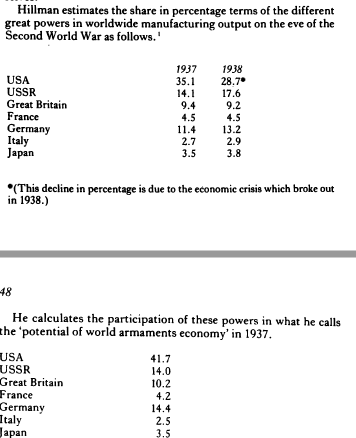
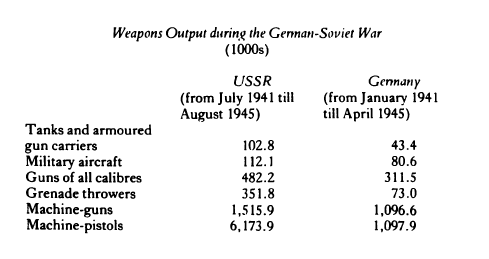
....Germany and Japan were overwhelmed by the sheer superiority of America's industrial capacity. The Wehrmacht had used 2,700 tanks on the Western front in May 1940, 3,350 in its invasion of the USSR in June 1941. The US government decided to produce 45,000 tanks in 1942 and 75,000 in 1943. Germany's annual airplane production amounted to around 11.000 in 1940 and 1941. The US government decided to build 43.000 airplanes in 1942 and 100,000 in 1942. Its output of merchant ships rose from 1 million BRT in 1941 to 7 million in 1943 and 10 million in 1944. The German and Japanese governments made desperate efforts to overcome this handicap after Stalingrad and Midway respectively.


....quantity of weapons produced in Germany and Japan could not catch up with the American conveyor belt, let alone the combined output of the USA, the USSR and Britain. Under the guidance of Albert Speer and in a context of increased war effort from the second half of 1942, Germany concentrated instead on trying to beat the enemy with qualitatively superior weapons rather than to overwhelm him through sheer quantity.


....Japan's attempt at producing qualitatively superior weapons largely failed, although the navy maintained its advance in the field of sea and air torpedoes, probably the most efficient used on either side throughout the war. 


[Submarine warfare]....the 'pack' tactics - attacks on convoys by many submarines, But while inflicting a lot of damage, in the end they did not stop the transatlantic flow of goods thanks to the massive use of antisubmarine aircraft, sonar and other sophisticated means of submarine detection, and especially the amazing achievements of the US naval yards, which built new ships considerably faster than Doenitz could sink the old ones.


....According to some estimates, over thirty per cent of the soldiers who died in battle were killed by artillery. The hollow charge and the proximity fuse were the two big innovations in this field introduced by the German and American army respectively.


....aid extended by the USA through Lend Lease and otherwise to all its allies was relatively small: some fifteen per cent of its military output and an even smaller percentage of its food production.


....detonator of the third technological revolution, three of whose main components - the electronic calculating machine (out of which grew the computer), nuclear energy and automation, - actually originated in weapons production.

....improvement in communications systems, in the first place in the use of two-way radio transmission and radiotelephony

....most revolutionary advance in weapons production was of course the development of the atomic bomb at the end of the war


Thursday, December 12, 2019

Reading notes on Chapter 4 of The meaning of the Second World War by Ernest Mandel [1986]


The meaning of the Second World War

by Ernest Mandel

Verso: 1986


Chapter 4 Resources


World wars ....result from the operation of the law of uneven development, that is, from the contradiction between the tendency of the industrial-financial balance of imperialist forces to undergo periodic modification (through the upsurge of specific bourgeois classes previously retarded in their development) and the tendency for the division of the world into spheres of influence to remain frozen for a longer period. This last division is reflected in military naval build-up, in international alliances and preferential trade, custom and monetary systems which change much more slowly than the industrial-financial relationship of forces in and of themselves.


....German military-industrial establishment had embarked systematically on a huge programme of stockpiling vital raw materials before the start of the war. Indeed, this had become one of the essential aspects of war preparations.3 Once war had begun, and after the signing of the Molotov-Ribbentrop pact, important additions came from, or via, the Soviet Union itself.4 Ianthe second place, the same establishment had systematically organized the substitution of chemical raw materials (above all synthetic rubber and oil), generally drawn from coal, for natural ones, which it knew it would lack in case of a prolonged war. These preparations were quite successful, although they made the resources vulnerable to concentrated aerial attack. In the third place, military conquest and long-term occupation of specific territories gave the German war machine access to riches it could neither produce nor afford to buy. To mention one example: by occupying France, Germany acquired a stock of natural gasoline larger than the whole annual production of synthetic oil in German factories. The German High Command, and Hitler personally, were absolutely obsessed with this aspect of direct physical plunder, and on several occasions modified basic military priorities in line with thatobjective.5 In the fourth place, military strength enabled Germany to blackmail neutral powers into 'selling' raw materials either against increasingly valueless paper currency or by exchange in the form of barter. The outstanding example of this was Swedish iron ore, but Turkish chrome and Portuguese wolfram also featured.6Henri Michel has summarized Sweden's collaboration with the Third Reich thus: 'From 1940 onwards, and throughout the war, Sweden supplied Germany with virtually all the iron-ore that it did not process itself, or some 9 million tons a year. After initial objections, it allowed the Wehrmacht to dispatch or withdraw troops and equipment across its territory by rail, or through its coastal waters. Between July and December 1940, 130,000 moved across Sweden in this fashion, in both directions, and more than500 wagons. By the time that a whole German division, with guns and baggage, travelled through Sweden to the Finnish lines against the Soviet Union in June 1941, Swedish neutrality was scarcely more than a fiction, as Nazi aircraft flew freely through its airspace.


....Japan, the 1941-2 offensive had the single important goal of reaching Indonesian oil and bauxite, Malaysian rubber and tin, and Indochinese, Thai and Burmese rice, so as to create the large and stable pool of raw-material resources required for a long war against China, the USA and Britain. Thereafter, the transportation of these materials to the homeland, hence the need to keep the sea-lanes between Singapore and Yokohama/Kobe open, became the key medium-term military objective of Japanese imperialism.


....To produce tanks and airplanes you need machine-tools, steel and aluminum; and to produce these you need other machine-tools, iron ore, coke, bauxite, oil or coal.


....The problem of the manpower needed both for a monstrous growth in the armed forces, and for the industry capable of supplying them with a steady flow of more and more sophisticated weapons, became a growing source of crisis and a subject of agonizing choices for all major powers during WWII - with the exception of the USA.