
The network “Re-enforce the French Communist Party, Revive Marxism” is founded!
Tuesday, 09 February 2010
On January 30th a successful meeting was held in Paris to launch a network of PCF members who want to struggle to bring back the ideas of Marxism into the French Communist Party. Lessons of the past were discussed and conclusions drawn on what are now the next steps that need taking. Speaking at the meeting was also Alan Woods, editor of Marxist.com and a comrade representing the Marxists in the Italian PRC.
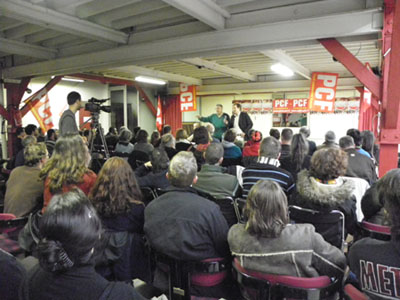 A hundred and twenty communist activists and sympathisers attended the meeting giving birth to the network “Re-enforce the French Communist Party, Revive Marxism” on Saturday, January 30th, in Paris. There were comrades from all over France: Finistère, Haute-Garonne, Deux-Sèvres, Gard, Allier, Aisne, Seine-Maritime, Territory of Belfort, Meuse and most departments from Ile de France. The atmosphere and the debates were excellent.
The crisis of capitalism and the relevance of Marxism today
The afternoon was split into three separate sessions interrupted with breaks. Alan Woods, editor of marxist.com and founder of the international “Hands off Venezuela!” campaign, opened the meeting with an overview of “the crisis of capitalism and the relevance of Marxism” in a quite humorous manner: “Welcome to the funerals! Marxism is dead! Communism is dead! How do I know? I know it because I read it every day in the newspapers; I hear it every day on the radio; I watch it every day on television.” Then he recalled what Joseph Goebbels, Hitler’s Minister of Propaganda, used to say: “if you lie, don’t say a small lie; say a huge lie, the coarsest, the roughest possible. And repeat it again and again; it will be accepted eventually,” That’s exactly what the media and the pro-capitalist intellectuals do. Day after day, they keep saying that communism and Marxism are obsolete.
Alan emphasised the bankruptcy of the bourgeois economists. For years, they have been explaining that the crisis of capitalism was over, that the economic cycle had been abolished. And here we are, facing the largest crisis since the thirties. “It’s not only a crisis of credit,” as Alan explained, “it’s a classical crisis of overproduction. There are too many goods, too many productive forces compared to the demand. Even the bourgeois economists have got to admit it. Actually, they don’t talk about ‘overproduction’; that would sound too Marxist. They talk about ‘overcapacity’, but it is exactly the same thing.”
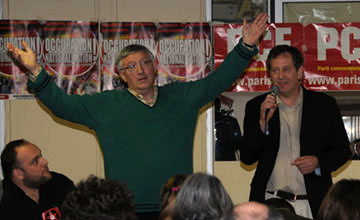
In the debate that followed, a communist activist from Iran, Bijan Rastegar, emphasised the extraordinary importance of the events taking place at the moment in Iran: “If Ahmadinejad’s regime falls, there will be revolutionary consequences all over the region.” Allain Duguet, CP activist in Alès, in the department of Gard, intervened to say how pleased he was about having such a meeting and to encourage all the activists to hold similar meetings all over the country. Among the contributors, we must note also one ‘ultra-left’ who reproached the Iranian demonstrators for shouting “Allah is great” during the demonstrations, and then made people laugh when he encouraged all the communists there to leave the PCF! During his conclusion, Alan answered him explaining that there are many Muslims in Iran, which probably explains the religious slogans during the demonstrations. Then he added, “we must speak to the real working class, the working class of this world, and not to an imaginary, ‘perfect’ working class, or the working class on Planet Mars, that we would have, by the way, most difficulty in contacting”. Alan in his concluding remarks called on all the comrades present to help us in our work to strengthen the PCF and arm it with a Marxist programme and politics.
The future of the PCF: Marxism or reformism
The second session was introduced by Jerôme Metellus, member of the PCF and its Marxist wing, La Riposte. He spoke about the politics, the programme and the prospects of the party. After describing briefly Sarkosy’s reactionary politics, which have multiplied the effects of the crisis, Jerôme stressed the fact that this situation poses the PCF with big responsibilities: “We think that the PCF can and must play a major part in the struggle to put an end to the capitalist system.” He added, “I quite realise that this idea is not very fashionable. Whenever the PCF is mentioned, either in the press or on television, it is nearly always to announce its imminent death. When this idea comes from our opponents, from the media and from our intellectual bourgeois, it is normal. They play their roles. The real problem is that this idea has gained ground in the tops of the party itself. Many of our leaders think that Communism is ‘obsolete’, that we have to ‘invent something different’. But what? We don’t know: it’s still in the process of being invented!”
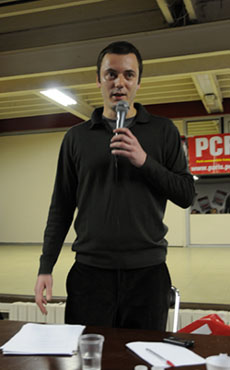
“So the history of the party is linked with the ebb and flow of the class struggle”, Jerôme summed up. “However, the links between the class struggle and the evolution of the party are not automatic or mechanical. The politics of the leaders plays a major part. For example, between 1995 and 2007, France witnessed a few massive mobilizations: the big strike of December 1995, the demonstrations against the war in Iraq, the 2003 struggle to defend pensions, the struggle against the CPE, many massive school and university students’ mobilizations, among others. But, in the same period, the PCF declined even further. The problem was not to be found in the conditions, but in the party itself: in the wrong politics of its leadership.
Finally, Jerôme explained the need to boost the discussion about the fundamental ideas of Marxism, within the party. “That must be the first task of this network we are founding today. Every time La Riposte has organised a meeting about one of the aspects of Marxist theory, the comrades of the party have been very enthusiastic. We have to multiply these types of meetings. Everywhere the Communists must take up this kind of work. Electoral deadlines and tactical questions linked to elections take up too much time and space in the internal discussions within our party, to the detriment of discussions on the ideas, the programme, and on the most important developments of the class struggle on a world scale. How many branches of the party have taken up the events in Iran or in Venezuela on the agenda of their meetings? Very few! We must correct this. Let’s not forget that Communism is in essence internationalist.”
Jerôme concluded by encouraging the comrades to set up the network, to expand it and turn it outwards – and encourage the best comrades to engage in this task in order to revive the ideas of Marxism inside the party.
During the discussion that followed Jerôme’s speech, different questions were raised: the need to nationalise the banks, the impact of the collapse of the USSR on the Communist movement, the role of the mayors, councillors and MP’s of the party, etc. Two comrades intervened to criticise the growing gap between the rank-and-file of the party and its elected officials. To this Jerôme answered: “This is a general concern, in the party. Many officials of the party – not all of them, fortunately – play a disproportionate role in the party. And there is a general feeling, among the rank-and-file members that we have very little control on the comrades elected to state positions. This must change.”
The PRC and the struggle against Berlusconi
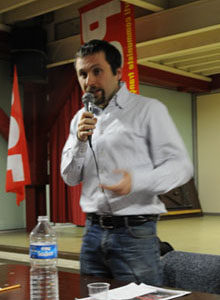
Our comrades of FalceMartello played a decisive role in the left turn in the PRC during the last congress of the party, in July 2008. Paolo Ferrero, the new general secretary of the party, gained a majority when he committed himself to putting an end to the liquidation of the PRC – and to asserting that the PRC rejected any kind of alliance with the Democratic Party (PD), a pro-capitalist party born out of the PDS (social-democrats) and a “centre” party lead by former Christian Democrats and other representatives of Italian capitalism. A year and a half later, Paolo Ferrero abandoned the position adopted at the 2008 congress. On the one hand, he is speeding up the process of liquidation of the PRC by trying to set up a “federation” with a conglomerate of small organizations, all to the right of the PRC. On the other hand, the leadership of the party has entered a political alliance with the Democrat Party, for the upcoming regional elections. “This policy has been very badly received by the rank-and-file of the party. Comrades who had come back to the party in 2008, are now leaving again. But the final word on this questions has not been said. Opposition to this turn to the right will grow stronger within the ranks of the party, and the FalceMarcello comrades will play their part in it.”
Finally, some “closing remarks” were made by Greg Oxley, member of the PCF in Paris and editor of La Riposte. He said that after the big success of this meeting, we must all strive to develop the influence of these ideas in the party and among its sympathisers. He quoted Lenin’s slogan: “patiently explain!” Then we all sang the Internationale and Avanti Popolo.
The meeting was full of enthusiasm. Now, we must build this network “Reinforce the PCF, Revive Marxism” in every region of France. The comrades must take up this task and organise similar meetings in different branches of the party. There is no time to lose. Forward to the victory of the Marxist ideas and programme!

I'm confused as to why they are entering the PCF. What about the New Anti-Capitalist Party?
ReplyDeleteIt got more votes in the last election than the PCF, and is multi-tendency anyhow. The PCF seems to be riddled with revisionism, and is a leninist model party with a single line.
Why would not help build a "united front" Worker's Party like NPA. It makes a lot more sense.