Mu

Mu

Monday, November 8, 2021

Lukács, Brecht, and Adorno: the 'Aesthetics and Politics' debate

Reading notes on: Marxist Literary and Cultural Theory by David Anshen (2017)


* * *


In this section Anshen briefly discusses the debate whose literary discussion was later published as Aesthetics and Politics (New Left Books, 1977).


DEBATE(S) ON FORM AS POLITICS AMONG THE IDEOLOGICAL CRITICS


Lukács


[....]For Lukács, the answer to an increasingly complicated state of affairs where knowledge of the totality of social relations becomes increasingly difficult finds a partial solution in realism as both the content and form of literature. This led to an overstated, extreme dismissal of modernism as being too close to the 'appearances' of social life rather than literature serving to highlight the truth of society residing in a total picture that becomes increasingly difficult to perceive. In an odd way, modernism gets criticised for its mimetic and mirroring features, while realism receives praise for its dialectical critique of society.


[....]capturing appearances has been a literary virtue at least since Aristotle's defence of mimesis, which Lukács only sees as possible if characters are situated in a social context.


[....]and the correct dialectical unity of appearance and essence.


[....]To those who might argue that realism was a set of conventions and convictions that correspond to a certain moment in the birth of capitalism, Lukács points to the timeless nature of realism, which he exemplifies through the example of the admittedly masterful works of Thomas Mann.


[....]modernism implies the 'negation of history'


[....]to the degree that literature removes readers from the world, it clearly serves as an obstacle to politics. Modernism does often appear to deny humans the capacity for solidarity, class-consciousness, unity and the ability to situate events and problems within a historical structure that can be altered positively.


[....]Lukács's concerns that art not merely mimic the atomistic view of humans engendered by the dog-eat-dog existence of capitalist daily lifestyles and formal devices link to a worldview that promotes right-wing anti-humanism.


[....]Trotsky separated the politics of the novel from his appraisal of its aesthetic significance, something Lukács fails to do.


Brecht


[....]using art to 'render reality to men in a form they can master', while non-specific, leaves open multiple approaches to representation of a critical nature. This seems persuasive because Brecht historicises formal approaches and critical standards that the more absolute approach of Lukács seems to miss.


     In his famous writings on theatre and art such as 'The Modern Theatre is the Epic Theatre' (1930) and his 'A Short Organum for the Theatre' (1949), he lays out his conviction that Aristotelian conceptions of empathy, catharsis, identification, resolution and emotional transport based on the power of the plot render spectators passive and open to ideological manipulation. Instead, Brecht advocates formal techniques designed to facilitate active, involved debate and analysis by audiences rather than spoon-feeding perspectives to the spectators.


Adorno


      Theodor Adorno rejects and polemicises against both Lukács and Brecht.


[....]his doubt that art can meaningfully comment on or represent crimes seemingly unrepresentable in their horrors.


[....]negates content or remained extremely abstract and creates disharmonious and jarring aesthetic experiences. His models of valid art were the atonal music of Schoenberg, extremely abstract forms of visual art and high modernism.


[....]work of Beckett and Kafka become examples of a modern kind of form of 'realism' in Adorno's polemics with Lukács. In a world where alienation reigns supreme, fragmented existence becomes realism.


[....]differences in this three-way debate revolve around what positive functions literature can play in an increasingly mediated, complex, confusing, disempowering and alienating existence where human subjects increasingly experience life, in the common analysis of all three, as isolated individuals.


[....]as Lukács and Brecht both recognise, along with Adorno, that the common condition that dominates modern social life forces individuals into a narrow, ideological zone of existence, then art that wishes to critique life must address such conditions both formally and as content.


[....]To attempt to represent characters in a social condition, as Lukács advocates, ignores the goal of representing conditions that block awareness of the interconnection of the individual with the network of increasingly abstract economic networks that shape life. On the other hand, in Adorno's view, the depiction of disorienting, shocking and seemingly exaggerated experiences in a subjective and often confusing form, as we find in Kafka or Beckett, remains the only meaningful form for art. It allows the 'autonomous art' a space for authentic political and aesthetic critique in a world that increasingly limits such space.


[....]Once again, for good or bad, the refuge of aesthetes becomes, to paraphrase James Joyce, silence and cunning.


[....]many Marxists look to the politics of form without any particular partisanship for an exclusive method.


Jay

8 November 2021


Sunday, November 7, 2021

The failure of Marcuse, Adorno, and Horkheimer

….The petty-bourgeois intellectuals are introspective by nature. They mistake their own emotions, their uncertainties, their fears, and their own egoistic concern about their personal fate for the sentiments and movements of the great masses. They measure the world's agony by their own inconsequential aches and pains.


James P. Cannon, 1940. The Struggle for a Proletarian Party


* * *


Reading notes on: Marxist Literary and Cultural Theory by David Anshen (2017)


* * *

Chapter Two: Major Marxists' Approaches to Literature and Culture


IDEOLOGICAL CRITICISM OR THE CRITICISM OF IDEOLOGY


Eagleton [Marxist Literary Theory] recognises that the drowning of independent perspectives in the USSR leads to the next series of thinkers affected by and largely hesitant towards Soviet-style orthodoxy. What he terms 'ideological criticism' refers to a group of extremely sophisticated thinkers that dominated Marxist literary criticism until the present day….


Rather than primarily taking Marxist analysis as reducible to simple and direct sociological explanations of particular authors and their texts, which, at times, leads to biographical, historical, or political studies that reduce works of art, effectively, into direct political statements, these theorists saw the literary as more autonomous….


….it is possible to find the material history which produces a work of art somehow inscribed in its very texture and structure, in the shape of its sentences or its play of narrative viewpoints, in its choice of a metrical scheme or its rhetorical devices (Marxist Literary Theory 11)'.


….and after the World War II....  generally pursued Marxism almost entirely through the lens of culture rather than paying attention to political strategy for revolution


….attention to the importance of consciousness, particularly the importance of class consciousness or the search for an explanation of its absence.


….an almost ahistorical pattern that concerns the centrality of ideology and politically presents either an almost messianic confidence in the potential of the proletariat as it become class conscious, or, conversely, shows a deep pessimism concerning a perceived convergence of fascism, Stalinism and liberal democracy, destroying hope for change. This prognosis, in turn, leads to aestheticism as a substitute for revolution, seen as foregone for the immediate future, possibly for centuries.


….these issues are 'superstructures' or social and cultural realms, not the directly economic.


….exclusive attention to culture and ideology tends toward extreme optimism, or pessimism, or some strange mixture of the two.


….Lukács goes so far as to write, 'When the worker knows himself as a commodity his knowledge is practical. That is to say, this knowledge brings about an objective structural change in…. the object of knowledge' [italics in original] (169). Now, to be fair, Lukács stresses that such knowledge is an eminently practical affair, but he does lapse into a kind of equation of consciousness and practical activity that at times ignores the complex tasks of building a Marxist party that may determine whether 'objective structural change' takes place. For Marxism, knowledge in itself cannot change reality.


….literary analysis focused around the very centrality of the problems of alienation and reification and how this manifests in literary products and indeed all of human existence. However, to simplify his point, perhaps unfairly, if the issue of 'structural change' derives merely from class-consciousness, understood as intellectual realisation of and by the proletariat of their nature as an oppressed class, why have there been so many violent difficulties and failures when workers have attempted socialism?


This emphasis on the centrality of ideas may explain why the 'ideological' Marxist critics oscillate between extreme pessimism and optimism….


….Lukács's work attained enormous influence beyond the arguably skewed or simplified conceptions he offers....  History and Class Consciousness....  stressing the importance of the way that commodity relations, that is, the buying and selling of greater and greater amounts of products, including humans as wage-labourers, shapes and permeates the totality (a key term for Lukács) of our 'inner' and 'outer life'....By 'inner life', he refers to the psyche, mind, consciousness, feelings and attitudes towards oneself and others, which includes alienation and the transformation of human experiences under the impact of capitalism displacing traditional pre-modern conditions. By 'outer life', Lukács means the sum total of the institutions, social relations, legal relations, economic conditions, 'superstructure' and externally imposed conditions that impact on humans and society….


Commodity fetishism....  involves the confusion of symbols, such as money, for the real-life conditions and human labour power that generates all economic value.


….involves the confusion of symbols, such as money, for the real-life conditions and human labour power that generates all economic value.


….Money, which is abstract labour power, appears as a personified deity that strikes everything in its path.


….Lukács develops an extremely influential theory of capitalist ideology straight out of Marx. Indeed, seeing cultural products as paralleling the formal, structural, and even economic features of capitalist commodity relations, first developed by Lukács in his 1923 work, becomes one major approach to Marxist literary theory that continues to this day among leading contemporary Marxist literary theorists such as Fredric Jameson and Terry Eagleton. For example, many critics have noted that commodity relations in late capitalism involves the competitive and often international struggle to sell goods and services generally produced in mass standardised form for larger and more depersonalised markets in which the humans involved in producing goods are often far removed from those consuming them. This creates an almost mystical, abstract and impersonal relation to the products of human labour. This feature of capitalism can be detected in the ways in which impersonal economic forces like stock and bond markets, currency trading, debt, etc., can suddenly lead to the displacement or evaporation of jobs or social services and there is literally no individual that can be held accountable.


….parallels and explains the features of contemporary and Modernist literature and art, which also often abstracts from particular human features and can be noted for depicting fragmented, subjective, and at times confused and confusing social relations.


….we see a diminishing clarity – according to more traditional standards – in the depiction of human life and existence.


….Jameson conceives of postmodernism as our increasing inability, due to the new super-globalised, so-called 'post-industrial' capitalist economy, to 'think historically' or in terms of any relationship between our fragmented individual subjectivities and the set of economic and social relations that actually determine our existence. Jameson, in effect, updates Lukács' analysis to the more extreme forms of artistic productions encountered in the present.


….direct clear connection between an individual and their social setting gets increasingly called into question.


….homology between aesthetic forms or what the Marxist critic Raymond Williams termed 'structures of feelings' and the increasing deeper…. depersonalisation of modern life arguably gets worse in what has been termed 'postmodernism'.


….novels of early capitalism largely feature individuals who face conflicts and through their distinct individual choices successfully overcome difficulties. The coming-of-age novel, the bildungsroman, represented a major subgenre of the novel concerned with young people (generally men) who overcome poverty and other obstacles and eventually make their way in the world.


….To a Lukács-influenced critic such as Lucien Goldmann in his work Towards a Sociology of the Novel (1964), the important feature to note early in the genre of novels concerns the individualistic attitude placed among various features that determine the protagonists' psychology and social development.


….one might view such characters as 'homologous' or structurally similar to the features of the bourgeois individual of early capitalism who (supposedly) freely chooses in the marketplace and whose social networks are primarily personal, direct and tied to individual freedom of choice.


In early capitalism....  Characterised as realism (which is both an aesthetic movement claiming to reproduce life in a realistic manner through certain conventions and conceptions of human psychology and a goal for writers to imitate the world in a convincing way), these works of literature distinguish themselves from, say, Romanticism, mythology or folk tales in their avoidance of mystical or supernatural events and their goal of situating characters in situations where their development links to clear causal determinations that result from their personality and the choices they make.


….Goldmann points to the 'New Novelists', a series of novels and novelists beginning in 1960s France, who focus on detailed descriptions of the world of objects to the exclusion of characters with a developed inner psychology. Prominent 'New Novelists' include Alain Robbe-Grillet, Marguerite Duras and Natalie Sarraute, and their work is known for its hostility to the traditional psychology seen as bourgeois individualism. Goldmann attempts to explain this literary trend as based on movement away from the type of individualised characters with a unique inner psychology that characterises early novels in the history of the genre. Such early novels are characterised by the similar features of novelistic characterisation and the explicit ideology of free individuals that accompanied the development of capitalism.


….Goldmann makes a fairly convincing argument that the modern novel transforms from paying attention to characters with an inner psychology that determines their fate based on the choices they make, to more abstract and interchangeable characters who increasingly face a world of events and situations growing beyond their control.


….considering the characters in Dickens' novels such as Pip from Great Expectations (1861) and contrasting them to the characters in William Faulkner's Modernist classic The Sound and the Fury (1929), with Benjy the autistic, schizophrenic or mentally deficient narrator of large sections of the novel. In Dickens, events remain comprehensible, to readers and characters alike, and derive from choices and attitudes of the protagonists. In Faulkner's novel, an effort of reconstruction remains necessary to make any sense of the depicted events.


….such transformations derive not from formal innovations considered as immanent to the novel but rather from sociological and economic transformations in the spread of capitalist values and capitalist social conditions. As humans face more impersonal, abstract and alienating experiences of life and growing distance from the economic processes that increasingly dictate their 'inner' and 'outer' worlds, the old mode of storytelling transforms accordingly.


….consider the prescience of Herman Melville's short story, 'Bartleby the Scrivener: A Story of Wall Street' (1853) that depicts a character, Bartleby, who presents a complete enigma to the narrator, a Wall Street lawyer, who oversees the copying of legal documents. Bartleby engages in the rote, repetitive work typical of early capitalism. However, he possesses an almost postmodern sensibility. Over time, the mysterious Bartleby refuses to carry out orders with the famous refrain, 'I prefer not to.' He remains a complete blank slate, a character with an imperceptible personality who rebels against the meaninglessness of repetitive labour….


….He sticks to the words 'I prefer not to' with all their ambiguity as a wish or statement of desire, not a clear refusal of authority, until the forces of private property place him in jail where he dies, rremaining an enigma to the narrator and readers alike.


….he remains the ghost in the machine, the semihuman labourer who rebels unto death and seems to predict a new type of subjectivity in the face of the increasingly formal relationship between proletarians and capital as capitalism intrudes into greater realms of human existence.


….what such analysis allows is a Marxist explanation for the transformation of character types and situations in the literature of mature capitalism.


….many Marxist critics have noted these features in the transformation from realist literature and art to modernist and postmodernist works with the latter attenuating, almost completely, the role of the individual and their capacity to affect their environment.


….another major thinker in the tradition of ideological criticism who remains influential and also alternates between the extremes of hope and despair is Walter Benjamin.


….Marxist literary scholar Michael Sprinker in his essay 'The Grand Hotel Abyss', makes a compelling argument situating Benjamin in response to views that asserted the automatic, inevitable victory of the proletariat, promoting passivity even in the face of growing fascism while also maintaining, sometimes simultaneously, that socialism remained impossible until fully developed capitalism went into a major economic crisis.


….The fact that the great Marxist theorist of allegory and symbolism, Walter Benjamin, felt compelled to employ such devices in his political analysis contains much irony but also testifies to the power of Stalinism and reformism to compel Marxists to utilise the literary in order to talk about Marxism.


….Sprinker, sympathetic but critical of Benjamin, writes:


Is it plausible that 'every second of time is the strait gate through which the Messiah might enter'? Does every moment in history present a revolutionary opportunity, as Benjamin thought?

    The experience of the proletariat during the last one hundred and fifty years argues otherwise. Dutifully aware of the great heroism of the Communards, and mindful of the example the Commune offered for the classless society of the future, Marx nonetheless judged the insurrection sternly: it was illtimed and doomed to failure; the forces arrayed against it were too powerful. Both Lenin and Trotsky would come to similar conclusions concerning the failed Revolution of 1905—which is not to say that this failure was devoid of future significance. (135)


The point Sprinker articulates, drawing upon the examples of the Paris Commune (when workers rose up in Paris at the end of the nineteenth century and took power until they were militarily suppressed and murdered on a mass scale) and the 1905 revolution in Russia (when workers participated in a revolution but were temporarily defeated until the famous October revolution of 1917) discusses Benjamin's admirable but mistaken approach to fighting against theories that leave out the necessity for determined revolutionary struggle and preparation of the kind advocated by Sprinker and Lenin (who also sharply condemned voluntarism and fatalism). Benjamin's assertion of revolutionary possibilities seems valuable in the face of a political approach that completely ignores the human and subjective factor during extreme economic crisis, but becomes more confused when he promotes the idea that objective factors will automatically solve the problems of war, depression and fascism.


….The alternative of either extreme voluntarism or fatalism, for Sprinker, remains 'only patient, sustained preparation for the moment when state power might be seized' (136). This sympathetically critiques the apocalyptic language and strategy implied by Benjamin's essay on history. However, what remains fascinating is the mixture of theological and symbolic images combined with political and social analysis.


….illustrates one aspect that often recurs with ideological critics and their employment or attention to the poetic and the literary – such features serve as a substitute or a displacement for political conditions that blocked direct, open political action and discussion or debate.


….If ideological critics may have felt a triumphalist spirit in their attitudes, at times there was an opposing tendency, often among the same individuals, toward extreme pessimism. The two main figures in the Frankfurt school, Theodor Adorno and Herbert Marcuse, developed increasingly pessimistic views about the possibilities of social revolution. In both cases they largely turned to a complete discounting of the revolutionary potential of the working class, and in the case of Adorno, virtually any political resistance at all. Adorno went so far in his dismissal and pessimism of political resistance that he opposed the student movement of the 1960s and its opposition to the Vietnam War 


In his book One Dimensional Man (1964), Herbert Marcuse claims that the industrial working class in the richest capitalist countries, particularly the United States, no longer represent a force of negation and opposition to capitalism but rather find themselves assimilated almost completely into the system. Writing about the 'integration' of the working class into the capitalist system he claims, 'they no longer appear to be agents of historical transformation' (xlv). He goes further and comes close to denying any future class struggle....


….appears to be predicated on extrapolating from a given moment of capitalist prosperity and harmony, roughly the 1950s till the 1970s, when the first signs of post-war prosperity ending manifested themselves. However, Marcuse seems to have drawn the conclusion that the traditional contradictions of capitalism and the cycle of crisis and growth (growth built upon wars, new imperialist ventures, or breaking the working class through fascism and other defeats) ended permanently.


….Marcuse to draw, arguably, unwarranted and very pessimistic political conclusions in relation to social transformation, based on relatively short-term conditions.


….Marcuse remained convinced of the utter irrationality and destructiveness of capitalism, even if no easy, viable revolutionary force seemed possible.


….placed their revolutionary hopes of the peoples of the third world engaged in struggle against imperialism and neo-colonialism; at the same time, under Marcuse's influence such would-be revolutionaries looked to various racial and ethnic groups and disaffected elements in capitalist society, including social outcasts such as, at times, criminal elements including motorcycle gangs such as the Hell's Angels.


….What the New Left rejected, in common with Marcuse, was any revolutionary potential for the industrial working class, particularly in the US and Europe.


….the 'concentration of radical politics in active minorities, mainly among the young middle-class intelligentsia and among the ghetto populations' (51).


We should note that the rebellion against the 'commodity form of men and things' echoes the central points about alienation, commodity fetishism, and reification that we saw introduced as a major feature of Marxist analysis by Lukács….


….Marcuse also drew the conclusion that aesthetics, art and cultural innovation represented a frail but real hope for challenging the capitalist system.


….a permanent middle class (which hardly exists anymore but seemed permanent….)


….the beautiful in this culture, against its all too sublimated, segregated, orderly, harmonious forms.


'The rebellious music, literature, art are thus easily absorbed and shaped by the market….


….market—rendered harmless' (47). So art remains a form of resistance, but a weak one.


….Marcuse shifted his views on the revolutionary political potential of art, or at least what he emphasises about it, several times in his career. While always viewing art as containing some liberating, 'desublimating' features (that is, removing us from the channelling of our life force and Eros into what he terms the 'performance principle', referring to an unnecessary amount of discipline and renunciation of joy due to modern capitalist principles)....


'Unlike the truth of theory, the beauty of art is compatible with the bad present [….] In a world without happiness, however, happiness cannot but be a consolation: the consolation of a beautiful moment in an interminable chain of misfortune' (Negations 118).


….Marcuse argues that art serves the function of providing an 'affirmation' of unjust societies.


….in the authentic works, the affirmation does not cancel the indictment: reconciliation and hope still preserve the memory of things past' (10).


….defends the revolutionary value of great works of art, defined as 'by the content having become form' (8) and argues that art 'is committed to an emancipation of sensibility, imagination, and reason in all spheres' (9). Such an optimistic view of art seems to replace the traditional Marxist view that places revolutionary struggle by the working class at the centre of liberation with aesthetics instead serving that role. Art becomes an expression of revolution for a non-revolutionary situation.


….the question hinged around what types of art, if any, could still play a critical role in society.


….most negative vision of Western culture ever penned within the Marxist tradition in their 1947 work Dialectic of Enlightenment.


….attack on the 'culture industry', referring to the set of capitalist institutions that produce and sell movies, books, TV programmes and other forms of popular culture to the masses as commodities with profit as the motivating force and dictating principle.


….lose virtually all real critical principles in their analysis. They argue that the majority of forms of entertainment that working people and most individuals consume function purely to dumb down and ideologically enslave the masses. As they put it:


[…] culture now impresses the same stamp on everything. Films, radio and magazines make up a system which is uniform in every part. […] The result is a circle of manipulation and retroactive need in which the unity of the system grows ever stronger. […] The need which might resist central control has already been suppressed by the control of the individual consciousness. (120–21)


They go on to specifically attack popular culture, and reject entire aesthetic mediums like film, popular music including jazz, and almost the entirety of literature or art, of any kind, available to the masses. As they explain, 'What is new is not that it is a commodity, but that today it deliberately admits it is one; that art renounces its own autonomy and proudly takes its place among consumption goods […]' (157).


….the analysis seems strangely onesided


….the profit motive leads to standardised, unoriginal products. Today, more so than ever, the production of cultural objects takes a form similar, in their example, to the production of cars on an assembly line. However, this is not the end of the story.


….strongly one-sided and therefore undialectical nature of their analysis.


….Adorno and Horkheimer's analysis removes contradictions by seeing art as purely ideological and devoid of critical or artistic potential, seemingly forever. To put it simply, they see art as merely rubbish designed to enslave and sedate the masses. Besides, the flip side of this thesis presents common people as mere passive recipients of whatever simplistic junk the masters of culture throw our way – although to be fair to these thinkers, they do stress their conviction that the choices of the marketplace are illusory.


….incongruous with the Marxist conviction that the proletariat will restructure society in a more ethical, humane and cultured way than the savage conditions we inherit from centuries of bourgeois rule and thousands of years of class rule.


….this attack upon films, music and literature took place in 1947. Within a decade or so, powerful and convincing analysis claimed hidden artistic virtue for these mediums that had been previously overlooked as art. Film, music and literature developed greatly and a real claim can be made that these artistic mediums went through a renaissance.


….Adorno's lifelong disdain and hatred for jazz music as simplistic – a view few musicologists hold today. Indeed, in literature while many popular bestsellers used boilerplate formulas, similar to the negative pronouncements of Adorno and Horkheimer, it seems absurd to consign literature as a whole, in the present, to the dustbin of history. This is particularly true since novels became increasingly cosmopolitan, critical in content and often formally adventurous, while simultaneously achieving bestseller status.


….to note the increasing capitalist nature of cultural products, as Adorno and Horkheimer did, should not lead to the shortsighted and one-sided conclusion that meaningful art is therefore dead. Indeed, even commodities are not merely commodities since, as Marx points out in Capital, they presuppose a use or use-value as a precondition to serving as items that are bought and sold.


….Adorno and Horkheimer denied virtually any remaining value and autonomy to art


….relatively short-term stabilisation of capitalism in the richest capitalist nations that came out of World War II as victors led to long-term prognoses about the changing function of art and politics. Marcuse remained relatively positive while Adorno and Horkheimer became increasingly negative. But they all seem blinded by the horrors of fascism, war and the post-World War II temporary and relative stabilisation of capitalism.


….both seemingly opposite views (art as substitute for politics, and art as completely void) appear similarly shortsighted in the face of the present moment where art has neither saved us spiritually nor become completely ideological and useless. Rather, at the present time, it appears politics comes to the fore again.


Jay

7 November 2021


Saturday, November 6, 2021

How the program of the Bolshevik Revolution took root in the US – The Militant

How the program of the Bolshevik Revolution took root in the US

November 15, 2021
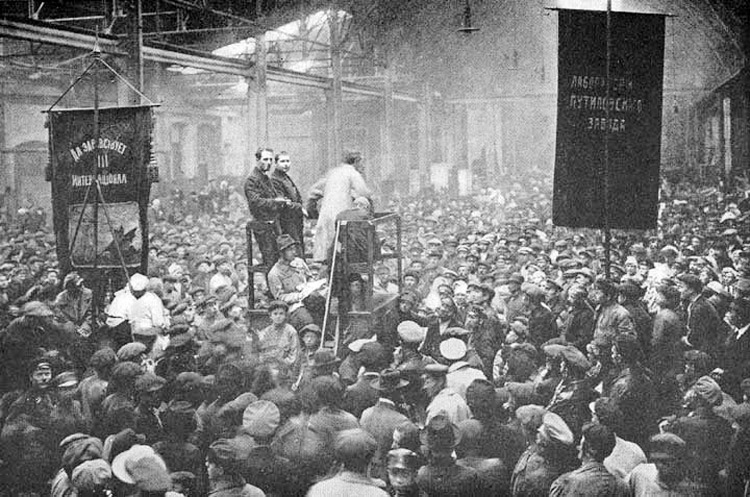
Meeting of factory committee during 1917 Russian Revolution. The victory of the Bolshevik-led socialist revolution inspired millions to build communist parties worldwide, including in U.S. Workers founded party here with “perspective of revolution in this country,” said James P. Cannon.

The First Ten Years of American Communism: Report of a Participant by James P. Cannon is one of Pathfinder’s Books of the Month for November. The 1917 Bolshevik Revolution in Russia inspired revolutionary-minded workers worldwide. Cannon, one of many won to the Russian Revolution’s example, helped found the Communist Party in the U.S. He describes how the Communist International led by V.I. Lenin and Leon Trotsky helped them. He also tells how the counterrevolution carried out against Lenin’s proletarian internationalist course by the bureaucratic caste led by Joseph Stalin helped corrupt the U.S. party and destroy its revolutionary heart. Cannon remained true to the Bolshevik program and traditions and was a founding leader of the Socialist Workers Party. This excerpt from Cannon’s introduction describes the early days. Copyright © 1962 by Pathfinder Press. Reprinted by permission.

BY JAMES P. CANNON

In its later evolution the Communist Party has written such a consistent record of cynical treachery and lying deception that few can believe it was ever any different. A quarter of a century of Stalinism has worked mightily to obliterate the honorable record of American communism in its pioneer days.

Yet the party wrote such a chapter too, and the young militants of the new generation ought to know about it and claim it for their own. It belongs to them. The first six years of American communism — 1918-1923 — represent a heroic period from which all future revolutionary movements in this country will be the lineal descendants. There is no getting away from that. The revolutionist who would deny it is simply renouncing his own ancestry. That’s where he came from, and without it he would not be. …

From 1917 to 1919 the life of the left wing of the Socialist Party — out of which the first troops of American communism were assembled — was governed primarily by international events and influences. Two “outside” factors, namely, the First World War and the Russian Revolution, created the issues which deepened the division between the left and the right in the American SP; and the theoretical formulation of these issues by the Russian Bolsheviks and the Comintern gave the left wing its program.

The factional struggle of this period occurred along clearly defined lines of political principle. The left wing, which had previously fought as a theoretically uncertain and somewhat heterogeneous minority, was armed with the great ideas of the Bolsheviks and unified on a new foundation. The left wing as a whole clashed with the traditional leadership of the SP over the most basic issues of doctrine, as they had been put to the test in the war and the Russian Revolution.

Leaving aside all the mistakes and excesses of the left-wing leaders, personal antagonisms engendered in the fight, etc., the lines of principle which separated them from the old leadership of the Socialist Party were clearly drawn. The split of 1919, resulting in the formal constitution of the communist movement as an independent party, was a split over international issues of principle in the broadest and clearest sense of the term. …

As a matter of fact, in the modern world, internationalism is not an outside influence at all. The whole is not foreign to its parts. America, especially since 1914, has been a part of the “One World” and a very big part indeed. In reacting to events in other countries, America also reacts upon them. There is no such thing as “the international situation” outside and apart from this country. And the American communist movement, in all its reactions to international influences, was never free from the simultaneous influence of its national environment.

The causal factors which brought the Communist Party into being in the first place were both national and international. The same holds true for its later evolution at every stage. American communism, at the moment of its birth, represented a fusion of the Russian Revolution with a native movement of American radicalism. It is not correct to say that “everything came from Russia.” The ideas of the Russian Revolution needed a given social environment to take root in, and receptive people to cultivate them; as far as we know, the Russian Revolution did not create a Communist Party on the moon.

International events and ideas were the predominating influence in bringing the American Communist Party into existence, but these events and ideas needed human instruments. These were provided by the native movement of American revolutionists which had grown up before the Russian Revolution out of the class struggle in the United States. …

Objective circumstances are powerful, but not all-powerful. The status quo in normal times works to compel conformity, but this law is not automatic and does not work universally. Otherwise, there would never be any rebels and dissenters, no human agencies preparing social changes, and the world would never move forward.

There are exceptions, and the exceptions become revolutionists long before the great majority recognize the necessity and the certainty of social change. These exceptions are the historically conscious elements, the vanguard of the class who make up the vanguard party. The act of becoming a revolutionist and joining the revolutionary party is a conscious act of revolt against objective circumstances of the moment and the expression of a will to change them. …

This was demonstrated when the Second International, which collapsed so ignominiously in the First World War, nevertheless provided the forces, out of its own ranks, for the new parties and the new International. Some socialists remained socialists; not everybody capitulated and betrayed. From the Russian party, in the first place, from the German party, and from every other Socialist Party in the entire world, uncorrupted socialists, who simply remained true to themselves, stood up against the degeneration of the old organizations and began to build the new. Even the Socialist Party of the United States, that ugly duckling of the Second International, which really wasn’t much of a party, furnished cadres not undeserving of mention in this honorable company.


How the program of the Bolshevik Revolution took root in the US – The Militant

Cuban Revolution vs. US capitalism – The Militant

"There is no COVID-19 vaccine mandate in Cuba. Yet by the time you read this some 73% of the population will be fully vaccinated and over 90% will have at least one dose, one of the highest rates in the world..."


Cuban Revolution vs. US capitalism – The Militant

Friday, November 5, 2021

"To give the New Critics their due"

Reading notes on: Marxist Literary and Cultural Theory by David Anshen (2017)


* * *


Chapter Two: Major Marxists' Approaches to Literature and Culture 


THE EFFORT TO DEVELOP A MARXIST THEORY OF ART


....before we consider the need for applying Marxist theory to literature, we shall consider the closest thing opposite to a Marxist approach, the anti-political literary critical approach, New Criticism or American formalism, largely dominant in the United States from the 1940s till the 1960s. This critical approach argued that interpretation of the poetic should confine itself to the text and must avoid the world beyond the poem or text. The motivation and approach of New Criticism is summarised by Cleanth Brooks, an advocate who argues '[…] the primary concern of criticism is […] the kind of whole which the literary work forms or fails to form' and insists that 'literature is not a surrogate for religion' (798). In denying any compatibility between literature and religion, Brooks targets any reading of art for ethics or values, including political, social or traditional ethical questions as concerns for literary critics. Brooks and other New Critics explicitly challenged historical approaches to literature, denying any connection between the text and its unity (unity comprising the basic aesthetic principle in their eyes), and the life conditions of the author, especially denying the relevance of any political context. The audience and social environment were also viewed as inappropriate areas of inquiry for criticism. Brooks claims 'the kind of audience [Alexander] Pope had did not condition the kind of poetry that he wrote' (798). This argument that Alexander Pope remained uninfluenced by the reception and treatment he might receive by the public in reaction to his poetry seems questionable, to say the least. A more significant omission by New Criticism is the lack of consideration about how history might have shaped the content and forms of poetry over time.


....they find a unique function for themselves in the academic division of labour.


....to avoid even explicit politics only happens in certain political situations and what constitutes politics derives from historically determined conceptions of the political.


....it is fairly certain that the poet Milton, for example, connected religion, poetry, and politics and that the development of Protestantism was, however it conceived itself, connected with the early development of capitalism.


....to give the New Critics their due, they raised the rigorous question of what makes things 'literary' or 'poetic'


....Victor Shklovsky, in his essay 'Art as Technique' (1917), argues that things and social relations appear normal due to their everyday familiarity, becoming 'habitual' and 'automatic' (778) in perception. Artistic phenomena 'defamiliarised' these everyday objects, thereby also negating automatic responses to the world around us....


THE EFFORT TO DEVELOP A MARXIST THEORY OF ART


http://jayrothermel.blogspot.com/2021/11/anshen-on-defamiliarization-shklovsky.html


CONCEPTUAL APPROACHES TO CATEGORISING MARXIST LITERARY THEORY


http://jayrothermel.blogspot.com/2021/11/how-art-arises-in-human-history.html


http://jayrothermel.blogspot.com/2021/11/anshen-on-walter-benjamin.html


Jay

5 November 2021


"Society is key": Notes on Chapter One on Anshen's Marxist Literary and Cultural Theory (2017)

Reading notes on: Marxist Literary and Cultural Theory by David Anshen (2017)


* * *


1. The Basics of Marxism and Marxist Literary Theory


INTRODUCTION: THE SPECIFICITY OF MARXISM FOR LITERARY AND CULTURAL ANALYSIS AT THE PRESENT TIME


....literature and the world are interconnected.


....Marxist approaches have gone the furthest, in my view, in exploring the complex and variable nature of the connection between literature and the world.


....The same economic determinants that block our understanding can become the basis of our understanding.


....historicise the object and methodology of analysis while necessarily retaining the conviction that cultural interpretation can be true, valid and reflective of reality, provided one recognises that significant changes in reality continually unfold and that the class structure and resulting life practices obscure reality while posing contradictions that reveal hidden or undeveloped truths.


....Marxism aims to start with the real economic and social foundations that literature, culture and all social life ultimately remain determined by.


....all texts maintain a relationship to social reality which remains marked, in one form or another, by the reality of class divisions and class struggle present sharply in the antagonistic social order of capitalism, or previous class societies. Whether we look at a literary text from the point of view of its production, its inherent features as a text, or its reception, a Marxist approach situates the work within determinate parameters of social reality.


....economic and historical relations shape, on some level and in some form, the nature of culture and its artistic products


....for readers interested in learning 'how to read like a Marxist', the task is complicated because there is no single approach or precise methodology to guide the process. This book aims to show that Marxist literary theory is not some infallible guide but rather a series of questions and concerns based on the premises of Marxism to approach literature.


....note the importance placed by Marxist literary criticism on the series of symbolic and linguistic encounters that permeate daily life.


....All of capitalist society treats itself as natural, timeless, rational and eternal; however when one reads critically and learns to recognise the ways that language, emotion and affect are generated by layers of hidden or obscured meaning, the same lessons can be extrapolated to all conditions of life.


WHY WE MUST RETURN TO MARXISM: THE END OF THE END OF MARXISM


....in the face of a decaying society, the ability to read well and critically becomes more important.


....knowledge derives from existing material reality and social conditions, not mere speculation.


LITERATURE AS A REFLECTION OF OUR TIMES AND BEYOND


....suggests that contemporary culture seems partially aware that capitalism falters on the edge of crisis, and many welcome change. In this sense, Marxists sometimes describe cultural patterns as 'symptomatic' of underlying sea changes in economic and political conditions.


....Marxism, therefore, inherently involves the task of interpretation. This suggests the critical methods of Marxism that help interpret society have much to say about understanding concrete manifestations of culture.


....whether considering form or content, this generally requires probing beneath appearances and often discovering the central issues of Marxism as implicit subjects of the text.


....such realities, although partially hidden, appear more often than the casual eye detects. Just as Freud detects that desire often needs to hide itself, Marxism anticipates that antagonistic social realities conceal themselves when possible.


MARXISM RETURNS TO AN 'ANCIENT QUARREL': DOES ART PROMOTE CRITICAL THINKING OR DOES IT DECEIVE US?


....grappling with Marxism and its categories, particularly in relation to creative products, provides real truths about the world.


....art and its power transcends a precise historical period, with all its biases and ideology, more easily than, say, politics or jurisprudence, which necessarily protect clear particular class interests.


....ideas are shaped and formed by the dominant class and its values combining with material daily practices tied to the structure of a given society.


....to the degree that Marxism adopts the standpoint of the proletariat, the class in contradiction with the existing structure of society, new ideas become possible. In literary analysis proper, critics can draw attention to moments in culture where the mechanisms of ideology lower their guard.


....Marxism detects a glimpse beyond the confines of daily existence in literature and other products of the imagination. The fictional and the playful provide an opportunity for individuals to speculate, consider, critique and philosophise....


Aristotle....  defends the cognitive and political value of art when he argues that tragedy, with a well-constructed plot, attains higher ethical and philosophical status than history because 'the historian narrates events that have actually happened, whereas the poet writes about things that might possibly occur. Poetry is therefore more philosophical and more significant than history, for poetry is more concerned with the universal and history more with the particular'


....Plato argues that art stirs the emotions, confusing the audience and thereby misleading spectators to act in ways that the rulers of society and the traditions of propriety deem inadmissible.


....in an unjust world (like our own) his description of art's force to unleash and destroy 'unity' and create conflicting emotions promoting 'strife' provides justification for the poetic to Marxists, based on valuing the very features Plato describes as negative.


....relishes the kind of disruption of normal behaviour that Plato fears.


....the Plato/Aristotle dispute anticipates one of the central dividing lines amongst Marxist literary theory.


....Is the poetic that stirs the mind and the emotions valuable, or not to be trusted?


'copy of a copy'


....Plato argues that exposure to representations creates a situation where appearances or imitations are mistaken for reality.


....audiences viewing representations or performances are swept up by the power of the illusion and confuse the nature of fiction leading to the likelihood of applying mistaken judgments to the world.


....warn that when we lose ourselves in the aesthetic we remain susceptible to ideological manipulation. Worse than that, for some critics, particularly Marxists influenced by contemporary theoretical approaches such as poststructuralism or deconstruction, a dangerous illusion emerges that literature or language actually mirrors the world in a clear and simple way.


....he distrusted Aristotelian theatre for reasons that seem distinctly Platonic; identification with fictional characters leads away from reality, and substitutes simple 'culinary' or 'narcotic' pleasures for those spectators who lose arts relation to the world, thereby dulling their critical sensibility.


....fear of art, particularly when it purports to describe reality


....As the Marxist philosopher Louis Althusser, who takes the claims of this strand of Marxism and theory the furthest, argues in his work Reading Capital (1968), 'the distinction between the real object and the object of knowledge implies the disappearance of the ideological […] myth of a one-to-one correspondence between the terms of these two orders' (47).


....Don Quixote effect, where ideological images of reality, derived from literature and cultural representations, confuse the masses about the nature of society.


....The myths Barthes critiques deceive the masses by a process of confusing representations for reality, in ways that echo Plato's concerns, despite a historical separation of over two thousand years. He later coined the term 'reality effect' to denote literary devices producing deceptive 'effects' that simulate reality to lure readers into confusing politically motivated fiction (ideology) with reality.


....even seemingly innocuous or liberal humanist works of art can contain hidden dangers.


....the apolitical or heartwarming often turns out more political and guilty than expected.


....warn that when we lose ourselves in the aesthetic we remain susceptible to ideological manipulation. Worse than that, for some critics, particularly Marxists influenced by contemporary theoretical approaches such as poststructuralism or deconstruction, a dangerous illusion emerges that literature or language actually mirrors the world in a clear and simple way.


HISTORICAL AND DIALECTICAL MATERIALISM, EXPLAINED


     Marxists recognise that science remains limited not just by social conditions but also by the incredibly complex nature of reality, from access to an absolute truth. That, however, does not lead to epistemological relativism (the position that knowledge does not exist except as a social construct). Truth exists, for Marxists, but it is not absolute, timeless, eternal or fixed; rather it is learned in social practice through a movement of abstract and concrete levels of thought and social investigation. Reality only gets constituted in the mind through human interaction on existing conditions that transform reality through labour, but scientific thinking presupposes reality beyond consciousness. Science, understood broadly as incorporating the struggle to think rationally, to access truth through reason and striving for evidence and coherence as a guide to understanding, remains the strongest weapon in the human intellectual arsenal. For Marxists the scientific approach is constituted by and offers a form of knowledge that allows us to focus upon the real conditions facing real humans in the real world.

     Other-worldly speculations and mystical accounts of events, on the other hand, lead away from clarity of purpose and grasping real truth in thought, according to the traditional Marxist view. Ironically, religion and idealism claim both absolute truth and the inability of humans to access it through a rational method. Marxism denies absolute truth while holding onto the possibility of accurate thinking. The sense of valuing scientific approaches explains Marx and Engels referring to their approach, in contrast to other socialist and communist forces, as 'scientific socialism'. The stress upon rationality and reason also implies that when examining literary works, there can be a real basis for understanding the social relationship between the imaginary and the real, at least potentially and within a given moment in time. This must be stressed because Marxism is often falsely equated with two opposing charges: it is a macro-theory that is unfalsifiable and supposedly explains everything and that it is pure historical relativism in which all values remain arbitrary. Both claims misunderstand the materialist theory of history and the nature of the Marxist theory of cultural production. Indeed, both charges actually apply more to anti-Marxist approaches. Marxism aims to provide practical and timely truths that aid the struggle of the oppressed while recognising all values and concepts are socially constructed within objective historical parameters.

     For Marxists, religion, like fiction, remains an illusion, but there is a necessary truth in the illusion....


....Marx aims to direct attention at removing unnecessary forms of suffering that derive from an irrational world by creating new conditions that promote rational understanding and action. This involves a radical rupture with traditional methods of thought. But clearly, religion, like art, corresponds to a real lack and social need in reality.


....Marx's complex attitude towards religion overlaps with attitudes towards art, entertainment and pleasure.


....Marx views religious faith as a surrogate for humane social conditions. These hopes and desires then transmit into the realm of the imaginary, and this prefigures, compensates for, and blocks real joyous conditions.


....materialism is based on the scientific conviction that reality and nature derive from matter or substance that evolves, transforms and changes form.


....critics of Marxism claim its theory is reductive and determinist when Marxism has never offered such an impoverished and simplistic explanation for human behaviour as much mainstream scientific discourse, which often looks for a scientific 'quick-fix' explanation for complex social issues, such as a genetic explanation for homosexuality, among many other examples.

Dialectics, or dialectical thinking, attempts, in thought, to capture the continuity and changes in reality that first became deeply obvious in the French revolution and its aftermath.


....Dialectical materialism suggests that, unlike a machine, which changes in absolutely mechanical and fairly predictable patterns, reality, particularly social reality, changes in ways that move at a faster or slower tempo than expected at times. In other words, 'historical time', to use Walter Benjamin's phrase, must be distinguished from chronological time.


....dialectical logic notices the impurity of categories as absolute identities.


....complexity of reality in its change and development becomes obscured.


....The logical 'rule' that explains how opposites can contain elements of each other is termed by Engels and other Marxists as the law of the unity or interpenetration of opposites.


....opposing categories or identities contain elements of each other.


....dialectical view of Zola's ideology and writing allows for appreciation, distinction, and the need to evaluate the different ideological and political meaning and effects of his writing. The identity of Zola's output contains divergent and even contrary elements and a too-quick evaluation of the individual makes critics one-sided and inaccurate. The goal of evaluating the political implications of Zola's writing must avoid all-or-nothing judgments.


....all that exists goes through a process of developments, through tensions and contradictions that ultimately change form. Dialectics attempts to capture the changing nature of reality that bursts into radical transformations, often seemingly out of nowhere. Engels defined the second aspect or law of dialectical logic thus – 'transformations of quantity become quality'. This means that a slow, almost invisible accretion of changes in quantity (say number of strikes or the unemployment rate or the adding of a third member to a Greek chorus) can suddenly transform into a new situation (revolution or a proper Greek tragedy). All those who argue, for example, that capitalism remains powerful, given appearances, and therefore will last forever, fall prey to what dialecticians might term 'the worship of the accomplished fact'.


....inversion of conditions, which at some point involved a series of quantitative changes (diminishing military power, levels of obedience, diminishing respect for authority and so on) that developed until the identity of the powerful tyrant and his empire crumbled and faded.


....the second law of dialectics, the 'transformation of quantity (or quality) into its opposite'.


....third law, the 'negation of the negation' recognises that forces defeating an existing reality, over time, develop contradictions that then must be ultimately overcome.


MARXISM AND ITS IMPLICATIONS FOR LITERARY AND CULTURAL PRODUCTS


     As Terry Eagleton explains in the introduction to the anthology he co-edits, Marxist Literary Theory (1996): '[…] the relation between literary works and forms of social consciousness […] has also involved some subtle epistemological reflections: is art reflection, displacement, projection, refraction, transformation, reproduction, production? Is it an embodiment of social ideology or a critique of it? Or does it […] critically 'distantiate' that ideology while remaining caught up in its logic?' (11).


.....Historical materialism contrasts with other theories of history in several key ways. First, theories that assert 'great men' make history, separate from broad social forces, get rejected. The individual always operates in a context. However, Marxism does not rule out any role for the individual or subjective factors in historical development (we can consider the role of Lenin or Fidel Castro in helping to facilitate revolutions in their nations as highly significant). But historical materialism asserts that the general thrust of the totality of political, economic, technological and social conditions combined with class struggle remain decisive in shaping the broad contours of history.


.....Different works, genres and aesthetic movements may operate differently.


....common patterns suggest causal factors that, theoretically, can be discerned.


....Marxist approaches can be comprehensible, logical and reducible to straightforward propositions.


Marxism does not exclusively discuss capitalism....


....any theory that asserts pure contingency or randomness in history (while Marxists don't deny that such factors play a role) fails to explain the many continuities and common features of human history that can be detected. We often find similar patterns of social development in divergent places when similar conditions prevail.


....The history of art also demonstrates common patterns across space and time.


....Friedrich Nietzsche's approach to history, which has gained adherents through the influence of Michel Foucault, Heidegger, and others, stands in stark contrast to the Marxist views. Throughout his writings, Nietzsche understands history in two broad interrelated ways: first, as articulated originally in his On the Genealogy of Morality (1887); then, throughout his entire work including the posthumous publication of notebooks, Nietzsche argues that history and morality are constructs and the arena in which the 'will to power' of powerful individuals creates values disguised as universal features such as the concept of good. Instead, these represent strong individuals influencing and shaping history with their power and needs which they have the 'will' to promote. The second way that Nietzsche understands history concerns the argument that historical categories, conditions or claims for truth are mere disguised heuristic devices (concepts, such as truth or morality, which have no reality outside of language and in Nietzsche's view, serve established power structures and modes) designed to promote an illusory sense of meaning. Nietzsche's framework, while serving perhaps to unmask the neutrality claimed in some historical or literary analysis ultimately diverges from Marxism and devolves into irrationalism.


....promoting the claims of the rulers to superior will and overestimating the ability of the powerful to construct historical myths and fables, unchecked and at command. Marxism rejects Nietzsche's view that the oppressed are weak-minded, easily deceived 'slaves' who accept naïve conceptions of history and power.


....Nietzsche's nominalism, or belief that words have no real referrent but serve merely to mask differences under a conceptual label falsely taken as 'things', underestimates the real, determining power of forces such as the profit motive, or the market, in the capitalist system, which prove their reality when workers lose their jobs due to such allegedly unreal 'concepts' as falling rates of profit.


....if history as history ultimately remains rational then the search for valid meaning and truth in relation to literature also remains possible....


    As the Marxist George Novack puts it in his work Understanding History (1968):


It is not elites but the many-membered body of the people who have sustained history, switched it in new directions at critical turning points, and lifted humanity upward step by step.


....Novack quotes Engels defining historical materialism as: 


[…] that view of the course of history which seeks the ultimate cause and the great moving power of all historical events in the economic development of society, in the changes in the modes of production and exchange, in the consequent division of society into distinct classes, and in the struggles of these classes against one another. (qtd. in Novack 29)


....similar forces also should, at least on some level, shape the products of history, including cultural products. Whether discussing modes of cultural production (painting, sculpture, architecture or literary texts), literary genres (broadly or narrowly understood), artistic practices and movements, exemplary artists, or great individual works, there remains a key relationship to historical, technological, material and social conditions and life practices.


....Enlightenment thought and its evolution into modern liberalism also contrasts with Marxist approaches to historical determination.


....conviction that reason and correct thinking can overcome the problems of society. Enlightenment thinkers believed that reason and rationality could overcome traditional authority that had been invested in religious obscurantism and long-term, unexamined social practices.


....American Declaration of Independence required struggle in the realm of ideas but also in revolutionary struggle that took a violent form.


....Althusser rightly, from a Marxist point of view, challenged such a view as to how ideas dominate minds by suggesting such explanations remain in the realm of ideas and ignore 'material existence' (1265) or the life practices of individuals. In addition to the lack of materialist credentials such ideas offer, they share much in common with conspiracy theories, which Marxists reject out of hand. Such irrational explanations describe history as the result of secret groups of bad individuals who plot behind the scenes to deceive the masses. The problem with such ideas is that, in contrast to historical materialism, they cannot explain why people are so easily manipulated. Do people just believe what they are told even when the individuals telling them how to look at the world clearly do not share common interests? Are humans just sponges for whatever authorities present? Obviously, sometimes deception does work to blind people to social realities. But this explanation reduces to the tautology that people are confused when they are confused. It also allows the systematic nature of oppression to be obscured; if we can only find the cabal, the secret elite, all will be well.


MARXISM AND THE PRODUCTION OF IDEAS


....Ideas and long-held assumptions shift in pace with social transformations. This suggests that ideas, in themselves, do not remain uncontaminated by broader shifts in society.


HISTORICAL MATERIALISM


....Historical materialism does not concern itself merely with history in the grand sense. It also provides a theory of how ideas, conceptions, viewpoints and cultural conceptions derive from the economic base and material practices of a given condition of life.


....that 'from the numerous national and local literatures there arises a world literature'. For Marx and Engels the material transformations in technology and trade, generated by capitalism in its relentless quest for profits, inadvertently produces a new material basis for literature and sharing of ideas. This is seen as a positive for the oppressed that can share ideas and culture. The internet and the World Wide Web and the opportunities generated for quick and easy transmission of ideas offer new possibilities in this direction.


....who we are and what we believe gets shaped by real-life conditions


....Daily life builds upon economic processes and 'definite relations that are indispensable and independent of their will' (Marx, qtd. in Eagleton and Milne 31).


....broadly and indirectly to modes of writing, genres, styles, literary approaches and individual works of literature and the imagination. We will look at this question more closely in the following section.


MARX'S BASE/SUPERSTRUCTURE MODEL


     In Contribution, Marx writes: 'In the social production of their existence, men inevitably enter into definite relations, which are […] independent of their will, namely, relations of production appropriate to a definitive stage in the development of their material forces of production' (20).

     This suggests both that these 'definite relations' and 'forces of production' are knowable and open to analysis. They can be empirically verifiable and judged as sociological or technological facts because they are material, not conceptual. Marx continues:


....The totality of these relations of production constitutes the economic structure of society, the real foundation, on which arises a legal and political superstructure and to which correspond definite forms of social consciousness. The mode of production of material life conditions the general process of social, political, and intellectual life. It is not the consciousness of men that determines their existence, but their social existence that determines their consciousness.


....varieties of a given mode of production are not as relative as often appears. Social conditions and the economic and technological base dictate real potential situations.


The Human Costs of the Failure of the Market


....Marx's base/superstructure model, which metaphorically describes society like a building or pyramid built upon foundations in real material, objective economic processes that lay the basis for higher, abstract and theoretical realms of ideas, it provides a conceptual starting point for the historical materialist theory of how ideas develop out of prior material conditions. Marx distinguishes between economic 'conditions of production which can be determined with the precision of natural science' (21) and the more ambiguous and subjective 'legal, political, religious, artistic or philosophic – in short ideological forms in which men become conscious of this conflict and fight it out' (21).


....They offer the chance for men or classes to 'become conscious and fight it out'.


....prior to and alongside the direct struggle for power, a war of values ensues. This 'cultural war', as rightist forces in the US dub their effort to undermine expanded conceptions of humanity and solidarity that developed out of the social movements of the 1960s and beyond, determines the relative strength of rival class forces.


....But we can formulate an approach to literature derived from basic points of Marxism and then consider some of the major efforts to elaborate a more fully developed theory.


A BASIC DEFINITION OF A MARXIST APPROACH TO LITERARY THEORY


Society is key....


....Marxism uncovers relations between cultural expression and modes of life shaped by conflicts that operate in societies divided socially and economically by classes. Indeed, for Marxism, the use of the term 'society' without attention to class divisions is an abstraction since class divisions operate in all societies since the dissolution of communal tribal societies and the rise of agriculture and economic surpluses beyond mere subsistence.


....The Marxist wager remains that if the working class as a class can only free itself by universal emancipation and has no interests in forms of property that can be privately owned, then its rise is the dissolution of class society in general.


....'There is no royal road to science, and only those who do not dread the fatiguing climb of its steep paths have a chance of gaining its luminous summits'


....Marx's base/superstructure model, which metaphorically describes society like a building or pyramid built upon foundations in real material, objective economic processes that lay the basis for higher, abstract and theoretical realms of ideas, it provides a conceptual starting point for the historical materialist theory of how ideas develop out of prior material conditions. Marx distinguishes between economic 'conditions of production which can be determined with the precision of natural science' (21) and the more ambiguous and subjective 'legal, political, religious, artistic or philosophic – in short ideological forms in which men become conscious of this conflict and fight it out' (21).


....They offer the chance for men or classes to 'become conscious and fight it out'.


....prior to and alongside the direct struggle for power, a war of values ensues. This 'cultural war', as rightist forces in the US dub their effort to undermine expanded conceptions of humanity and solidarity that developed out of the social movements of the 1960s and beyond, determines the relative strength of rival class forces.


....But we can formulate an approach to literature derived from basic points of Marxism and then consider some of the major efforts to elaborate a more fully developed theory.


Jay

5 November 2021