Mu

Mu

Sunday, November 28, 2010

Glenn Beck's blindness to U.S. class reality

Beck’s Countless Lies about America & the Founding Fathers


On January 22nd 2010, another hardened reactionary tried to attack the history of leftism and Marxism and (surprise) managed to bring nothing new to the table at all. Shock jock Glenn Beck, an admitted alcoholic and former cocaine addict, has made a career out of appealing to the most lunatic fringe of the right-wing. Even so, this week he finally managed to outdo himself, even after the time he said Obama was “a racist” and had a “deep-seated hatred for white people or the white culture.” Revolutionary Holocaust: Live Free or Die begins oddly—with white X-Files font letters against a crackling static background. What this has to do with or why this is the least bit appropriate for the subject matter Beck tackles is anyone’s guess. As we shall see though, this is symbolic for the entire presentation, which, while clever, is the same hodgepodge of anti-communist views that we have all seen and heard a thousand times before.

A good question for Glenn Beck: why is such radical anti-communism necessary today if communism is discredited, dead, and buried? If communism is supposedly dead in the water, a footnote of history, and so on, and if capitalism is truly the greatest system, then why is it that we are facing a wave of anti-communist hysteria not seen since the Cold War? Mr. Beck, it might do you well to remember that hysteria and desperation are signs of weakness…and liars.

No matter how hard he tries, Glenn Beck cannot sell his line about how “this story has never been told.” Horror stories about communism have been told since before communists ever came to power in the first place. The opening of the secret Soviet archives actually reveals that these claims were in fact ridiculously exaggerated, not worse, than previously claimed.

So, what are his intentions here? Many things all at once—among them licking the boots of the bourgeoisie and re-packaging old and debunked lies. We shall tackle them one by one using our own sources and information. The complete transcript of Beck’s program is available here until further notice: http://www.foxnews.com/story/0,2933,583732,00.html.

Because of the length of his program, we have decided to break this presentation up into several parts. For right now, we will content ourselves with refuting the introduction to his program.
We invite you to stay tuned for a little series of our own.

Beck’s Thesis
Glenn Beck’s allegedly “groundbreaking” exposé of “progressives,” whom he conveniently lumps together, is by no means new or groundbreaking at all. Revolutionary Holocaust seeks to establish a link between Joseph Stalin and communism on one side, and Adolf Hitler and Nazism on the other. While doing this it also seeks to talk about the reign of Mao Zedong in China, along with a segment about liberal icon Che Guevara.
This same “thesis” of fascism and communism being almost exactly the same or at least sharing fundamental similarities, has been repeated for us endlessly since we were kids. For Beck to champion this as a “new and groundbreaking” idea is either foolish or stunningly arrogant. It has been the dominant narrative shoved down our throats since the publication of The Origins of Totalitarianism in 1951 by Hannah Arendt. For a closer look at this laughable “theory,” look here: http://theredphoenix.wordpress.com/2009/09…otalitarianism/

Thomas Jefferson, George Washington, & Slave-Owning Freedom
The video begins with Glenn Beck praising the United States of America and its associated American Dream. “The story of America,” he pines, staring into the camera with his intellectual glasses on, “is really one of self-reliance and optimism, and profound faith.” He continues to milk this image for all its worth, bringing up the merits of the US Constitution and the Founding Fathers.

Glenn Beck has willfully ignored the history of the American Revolution. The spirit of the American Founding Fathers is only a myth and not a reality.

First, the Constitution of the United States was not set up by “the” people or any sort of popular democracy, but by financial autocrats. White males with property were the only ones allowed to vote under the system that men such as George Washington (the richest man in America), James Madison (owned enormous slave plantations), John Hancock (a rich merchant), Benjamin Franklin (a wealthy printer) and others aimed to set up. Of the 55 men who gathered to write the Constitution in 1787, most were lawyers and men of enormous wealth, making their fortunes in landowning, slave trading, manufacturing or shipping. Half loaned money out for interest, 40 held government bonds.
Regarding the writing of the Constitution:
“The manufacturers needed protective tariffs; the moneylenders wanted to stop the use of paper money to pay off debts; the land speculators wanted protection as they invaded Indian lands; slaveowners needed federals security against slave revolts and runaways; bondholders wanted a government able to raise money by nationwide taxation, to pay off those bonds” (1).

Governments are not neutral. They reflect the economic interests of the dominant class, expressed in America as men such as the Founding Fathers. The Constitution protects “life, liberty, or property” and little else in reality. Women, Blacks, Indians and poor whites were not mentioned, but the defense of private property was.
The clause about the “freedom of speech” was soon enough violated, as it is today, by clauses such as the Sedition Act of 1789, which was a response to the French and Irish Revolutions. It forbid under law the practice of writing or saying anything “false, scandalous and malicious” against the United States government, the Congress or the President. It is not immediately apparent that anyone’s “liberty” should be left to a government run by the rich and powerful.

Despite this, Beck says that “[…] those seeking a different path than the ones the founders settled on realized the only way to really defeat the Constitution was for the people to stop reading it.” He then insists that the Constitution, through its supposed system of check and balances, “kept dogs at bay” for 200 years. Despite this Utopian dream, the Founding Fathers were not men seeking a “balance” in society, and certainly didn’t believe that all men were created equal. If they wanted any sort of balance, it was between the wealthy, and not between such groups as Indians and whites, blacks and whites, men and women, boss and worker, or rich and poor, slave and slaveowner, and certainly not property owner and the propertyless.

Friday, November 26, 2010

Marxist thought is thriving

Marxism 2010: fixing a broken system

In the wake of the financial crisis Marxist thought is thriving, and in London leading names are discussing turning ideas into action

Alex Callinicos
    Slavoj Žižek
    Slavoj Žižek: one of the speakers at the Marxism 2010 festival. Photograph: Graeme Robertson

    The death of Ken Coates last weekend silenced yet another strong and distinguished voice on the radical left. The past year or so has taken from us some of the most outstanding Marxist intellectuals of the 1968 generation – Giovanni Arrighi, Jerry Cohen, Peter Gowan, and, particularly painful for me, Chris Harman and Daniel Bensaïd. In the supposedly ideology-free world of the Con-Lib coalition, it would be tempting to conclude that these individual disappearances are representative of a much broader decline of Marxism as an intellectual and political tradition.

    Nothing could be further from the truth. Even the constitutionally myopic financial markets are beginning to wake up to the fact that capitalism is very badly broken. The Keynesian economist Paul Krugman wrote a few days ago: "We are now, I fear, in the early stages of a third depression," following those of the late 19th century and of the 1930s. Marx described his own intellectual project as the critique of political economy: Marxism therefore lives or dies by its ability to make sense of the dynamics of capitalism and to offer a way out of it.

    And Marxist political economists have indeed been, in the forefront, analysing the causes and tracing the trajectory of the global crisis. Just over the past year Chris Harman's Zombie Capitalism, David Harvey's The Enigma of Capital, and my own Bonfire of Illusions have presented overviews. Costas Lapavitsas and the Research on Money and Finance group of young scholars based at the School of Oriental and African Studies in London have led the way in explaining the eurozone crisis and offering radical alternative policies for countries such as Greece.

    This research activity has been accompanied by a renewal of interest in Marxism among the young that is now very visible in the English-speaking academy. When David Harvey visited London in April to launch his new book, he spoke to half a dozen meetings packed with audiences in their hundreds. One of them was at my own university, King's College London, hardly a traditional centre of revolution. The meeting was co-sponsored by the thriving King's group reading Marx's Capital, which also helped to organise last November a debate on the future of capitalism between Martin Wolf of the Financial Times and myself.

    The journal Historical Materialism, set up by a group of young scholars in the mid-1990s, has been one of the main drivers of the academic revival of Marxism. Its annual conference in London every November now attracts more than 500 participants and has spun off North American counterparts in Toronto and New York.

    But Marxism has, of course, always been about the effort not simply to develop better theories but to relate them to emancipatory political practice, as the lives of engaged intellectuals such as Coates, Harman, and Bensaïd bear witness. London, as it happens, provides an important venue for this effort. The five-day Marxism 2010 festival takes place in central London, starting today.

    Organised by the Socialist Workers party, this forum for socialist ideas has been held every year since 1977 and expects to have more than 4,000 participants this year. There should be plenty of intellectual fireworks – Tariq Ali on Islamophobia, Slavoj Žižek, John Holloway and me on the idea of communism, Hester Eisenstein, Judith Orr, and Nina Power on the new sexism, along with a gallery of leftwing talent – Tony Benn, Eamonn McCann, Gareth Peirce, Steven Rose, Michael Rosen, Sheila Rowbotham, and the Guardian's Gary Younge.

    But running through the sessions will be a more practical intent as well. As austerity sweeps through Europe, the Con-Lib coalition now seems intent on reinventing the sado-monetarism of the 1980s on a scale undreamt of even by Margaret Thatcher. The Marxist left is thriving intellectually. The real test it faces is political: can it help to develop effective resistance to the coalition's plans to devastate the public sector and the poor? Events in Greece show how neoliberal shock therapy can provoke social rebellion. The real future of Marxism depends on the scale on which these revolts develop and on the political direction they take.

"when the real world seems as though it's becoming a dystopia."


20 Essential Works of Utopian Fiction

Posted on by admin


Every amateur philosopher has dreamed about what they perceive as a utopian society. It's fascinating to think about a world without the ills we experience today and how perpetually imperfect humans would achieve such an existence. Utopian fiction does just that, enabling readers to travel to a world that will never truly exist. Below is a list of the 20 essential works of the genre. Each are an excellent read when the real world seems as though it's becoming a dystopia.
  1. Utopia, by Thomas More: More's 16th century masterpiece builds a framework for what he viewed as an ideal society; one that is both communal and democratic. The fictional island of Utopia is governed by concepts that were considered unthinkable at the time the book was written but are taken for granted today, such as religious tolerance.
  2. The Commonwealth of Oceana, by James Harrington: Harrington describes in detail a utopian land named "Oceana" that features an enhanced version of 17th century England's government. His mission was to evoke discussion related to change, though the book was originally censored by Oliver Cromwell and its suggestions were ignored by leaders.
  3. Candide, by Voltaire: During his travels to South America, the protagonist finds the utopian city of El Dorado, which is devoid of poverty, crime and prisons. Its citizens live in perfect equality and benefit from rich culture and a superior educational system. It's quite different from the harsh realities of 18th century Europe, in which people must figuratively cultivate their gardens in order to deal with the harsh world, according to Voltaire.
  4. The History of Rasselas, Prince of Abissinia, by Samuel Johnson: In a world that's obsessed with the pursuit of happiness, Johnson's novella attempts to find the root of the it. The protagonist Rasselas escapes the boredom of constant contentment and travels with his sister and a philosopher, learning that happiness isn't easily achieved.
  5. The Millennium, by Upton Sinclair: In the year 2000, the ruling class of America's hardcore capitalistic society lives in unnecessary excess, causing an accident that kills all but 11 people in the world. Those survivors were raised in privilege and thus struggle to build a new capitalistic society, eventually constructing a successful utopian communist society instead.
  6. News from Nowhere, by William Morris: Another excellent utopian read in which a man is transported from the 1890s to the 21st century, where capitalism no longer rules society and equality has been achieved. The world is less high-tech and work is done for its own sake. Written during a time when many where romanticizing over the virtues of socialism.
  7. The Coming Race, by Edward Bulwer-Lytton: An underground race known as the Vril-ya is discovered by a man from the 19th century. The Vril-ya people possess an energy source called Vril that heals, alters and destroys, enabling them to enhance their way of life. However, the seemingly perfect society is boringly predictable and it's neighbored by a primitive, animal-like race that hasn't evolved.
  8. Looking Backward, by Edward Bellamy: A Boston man falls asleep in 1887 — the time the book was written — and awakens in the year 2000, finding his city as a prosperous utopia devoid of poverty and the ills that plagued society more than 100 years earlier. The ideas brought forth in the book remain relevant today.
  9. A Crystal Age, by WH Hudson: Despite being transported into a peaceful and pastoral society, a young man is unable to find fulfillment, falling in love but failing to adapt to the matriarchal tradition. Readers will be surprised by the gritty and challenging ending.
  10. A Modern Utopia, by HG Wells: In Wells' utopia, national boundaries cease to exist, but competition remains. People have the freedom and time to pursue activities that make them happy. Inequality lingers as the dumb and anti-social are cast away from normal people. Overall, it's a unique look at a society that reflects our own, combining ideas from other utopian works.
  11. Men Like Gods, HG Wells: The World of Utopia is quite different from Victorian England. It has evolved from an Earth-like period known as the "Days of Confusion" and now has a socialist work government and advanced science. A group of English transplants are confused by the selflessness exhibited by the inhabitants, as it conflicts with everything they were indoctrinated to believe in their native land.
  12. Last and First Men, by Olaf Stapledon: Utopias and dystopias are created and explored by Stapledon, as he imagines society from the present to the distant future. The ways in which different segments evolve varies; some do better than others. The book is highly imaginative and entirely wrong, but it left a lasting impression, inventing concepts later used by numerous science fiction writers.
  13. Star Maker, by Olaf Stapledon: This is somewhat of a sequel to Last and First Men — this too was a precursor to the science fiction genre. A man is bestowed with the ability to travel through time and observe the creation and evolution of different life forms, including the peaks of their existences well into the future.
  14. Lost Horizon, by James Hilton: Plane crash survivors in Tibet encounter a utopian civilization in Shangri-La that differs from their own. The protagonist meets with the Head Lama, learns about the history of his surroundings and is given the secret to the monk's longevity. He ultimately discovers there's much more to life than he previously realized.
  15. Walden Two, by BF Skinner: Skinner, a behavioral psychologist, imagines a community in which equality, cooperation and relationships are valued to the highest degree. Told from the perspective of an outsider professor, a detailed description is provided pertaining to the commune's unique practices, which include behavioral-engineering.
  16. Island, by Aldous Huxley: Huxley's final novel reflects his lifetime of thoughts on society as he cultivates a practical island utopia called Pala that heavily subscribes to the values of Buddhism. A man sent to secure an oil contract soon realizes that the island must be saved from the civilization that promises to ravage it.
  17. Ecotopia, by Ernest Callenbach: Northern California and the Pacific Northwest are transformed into a futuristic ecotopia by Callenbach, who established a new genre with this book. His new egalitarian society is characterized by a renewed reliance on nature and an authentic do-it-yourself spirit that seems to have diminished in modern America.
  18. Herland, by Charlotte Perkins Gilman: A society run entirely by women is free of war and conflict. And although it may seem that Gilman is portraying men as destroyers of the world, that's not her purpose. The books is about exploring the capabilities of women outside of their traditional gender role, when they don't exist simply to please men.
  19. Mizora: A World of Women, by Mary E. Bradley Lane: Lane creates another world without men where the ills of modern society have vanished — the cities are clean, pollution isn't a problem, peace has been achieved, no prisons are in operation and educators are the heroes. This book predates Herland, making it the first feminist utopian work.
  20. The Probability Broach, by L. Neil Smith: Smith authors a work of utopian fiction that doesn't revolve around communal living, but rather libertarianism. A detective is thrown into a society in which selfishness is valued and personal responsibility is a necessary characteristic. Unlike some other works in the genre, it's more than just a lecture on the way people ought to live.

1917: illuminating the road ahead


The 1917 Russian Revolution and 21st century socialism

[The following is an abridged version of a talk presented to a Sydney Direct Action forum on November 6. Doug Lorimer is a member of the national executive of the Revolutionary Socialist Party.]

Waving a copy of Lenin’s book The State and Revolution, Venezuelan President Hugo Chavez told the 772 delegates assembled on November 21, 2009, for the opening session of the First Extraordinary Congress of the United Socialist Party of Venezuela that he agreed with the book’s central message: that it is necessary “to create a new revolutionary state from below that is a real mechanism for the construction of socialism of the 21st century”. Chavez recommended that the delegates read Lenin’s book as a theoretical guide for how to accomplish this task.

The State and Revolution is perhaps the most famous of Lenin’s writings. Written during the revolutionary events of 1917, it takes the form of an extensive commentary on the works of Marx and Engels on the Marxist theory of the state and the tasks of the proletarian revolution. Its central message is the necessity for the working class to create its own class organisation of state power in order to replace the capitalist social order with socialism, a classless society of associated producers

Russian capitalism

At the beginning of the First World War, tsarist Russia was the world’s sixth largest national producer of industrial goods, and like the other major industrial powers at the beginning of the 20th century, it had entered capitalism’s imperialist stage, in which the various branches of production are dominated by monopolistic associations of capitalists, by a small number of big capitalist corporations - what US bourgeois commentators have subsequently called “corporate capitalism”. The rate of monopolisation in industry and banking in Russia was higher than in France and Britain, being behind only Germany and the US.

In his 1917 book Imperialism, the Highest Stage of Capitalism, Lenin observed that Russia was a country “where modern capitalist imperialism is enmeshed … in a particularly close network of pre-capitalist relations”. While tsarist Russia had entered the war as an imperialist power, with imperialist goals, 80% of its population were peasants. Serfdom, which held the peasantry in bondage to the aristocratic owners of large estates, had been annulled only 56 years earlier, in 1861. Its abolition remained more juridical than real. The great majority of peasants remained landless and crushed by debts to the big landowners.

Russia was also a major colonial power, having an empire that, in population, was the third largest in the world — after Britain’s and France’s. Russia’s colonial possessions, however, were not overseas territories, but countries on its borders on the Baltic Sea, in eastern Europe and in central Asia. Since the great majority of the populations within Russia’s colonial empire also consisted of peasants, the struggle for their national liberation was closely tied to the peasants’ struggle for land.

1905 and the army

In a January 1917 lecture in Zurich on the 1905 revolutionary upsurge in Russia, Lenin said that the combination of advanced capitalist industry with the serf-like exploitation of the peasantry had determined the peculiarity of this upsurge, which he later described as a “dress rehearsal” for the successful October 1917 revolution. Lenin pointed out that the 1905 revolution “was a bourgeois-democratic revolution since its immediate aim … was a democratic republic, the eight-hour [work] day and confiscation of the immense estates of the nobility — all the measures the French bourgeois revolution in 1792-93 had almost completely achieved. At the same time, the [1905] Russian revolution was also a proletarian revolution, not only in the sense that the proletariat was the leading force, the vanguard of the movement, but also in the sense that a specifically proletarian weapon of struggle — the strike — was the principal means of bringing the masses into motion and the most characteristic phenomenon in the wavelike rise of decisive events.”

Lenin went on in his lecture to observe that in 1905 the “combination of the proletarian mass strikes in the cities with the peasant movement in the rural areas was sufficient to shake the ‘firmest’ and last prop of tsarism. I refer to the army.” Elaborating on this key point, Lenin said: “The workers and peasants in military uniform were the soul of the [military] mutinies. The movement spread to all sections of the people, and for the first time in Russia’s history involved the majority of the exploited. But what it lacked was, on the one hand, persistence and determination among the masses — they were too much afflicted with the malady of trustfulness — and, on the other, organisation of revolutionary [socialist] workers in military uniform … At any rate, the history of the Russian revolution, like the history of the Paris Commune of 1871, teaches us the incontrovertible lesson that militarism can never and under no circumstances be defeated and destroyed, except by a victorious struggle of one section of the national army against the other section.”

Soviets

Due to rising discontent among the workers and peasants with Russia’s participation in the first inter-imperialist war, in February 1917 a mass worker-soldier revolt in the then capital of St Petersburg (at the time named Petrograd) brought down the tsar’s regime. It was replaced by an unelected Provisional Government made up of liberal politicians within the tsarist regime’s advisory legislature (the Duma). The worker-soldier revolt also led to the formation of a potential alternative government, the elected soviets (councils) of workers’ and soldiers’ delegates, supplemented by factory-based workers’ militias, The Red Guards.

The refusal of the Provisional Government to withdraw Russia from the imperialist war and to implement a radical agrarian reform enabled the Russian Marxists organised in the Bolshevik Party headed by Lenin to win a majority in the soviets of the two main urban and industrial centres, Petrograd and Moscow. On November 6, 1917, the Petrograd soviet organised a mass-supported insurrection that overthrew the Provisional Government. The next day, the Petrograd soviet handed over power to the All-Russia Congress of Soviets, which elected a new cabinet, the Soviet of People’s Commissars, headed by Lenin.

The new Soviet regime, officially designated the Workers and Peasants’ Government, began with measures to meet the immediate needs of the workers and peasants - withdrawal from the war; support for active peasant participation in abolishing the semi-feudal landed estates; support for the right of national self-determination for the non-Russian nations within the now dissolved Russian Empire; and workers’ control over the capitalist managers of industrial production. The latter measure was seen as a transitional step toward the creation of a workers’ administration of industry when the new government was ready to take over the ownership of industry.

However, the Russian capitalists and big landowners soon resorted to full-scale civil war. Beginning in the northern summer of 1918, Britain, France, Japan and the US invaded Russia with 155,000 of their own and allied troops. The invading armies provided material support to the counter-revolutionary White armies organised by the Russian capitalists, former tsarist generals and the former owners of the landed estates. Increasing industrial sabotage by the capitalists forced the Soviet government to carry out sweeping nationalisations of industry under a crude centralised administration that at least could supply the needs of the Workers’ and Peasants’ Red Army.

Economic policy

After the Soviet regime won the 1918-20 civil war, a substantial retreat from this emergency policy, known as “War Communism”, became necessary. The New Economic Policy involved major concessions to market relations and the leasing of smaller industrial enterprises to Russian owners of capital and the formation of joint ventures between the Soviet state and foreign capitalists. Theses on the NEP adopted by the 1922 congress of the Bolshevik-initiated Communist International recognised that such a policy was not something peculiar to the conditions of Soviet Russia coming out of the civil war. The theses stated: “It is perfectly clear that a lengthy epoch must necessarily elapse between the capitalist regime and complete socialism; and that during this epoch the proletariat must, by making use of the methods and organisational forms of capitalist circulation (money, exchanges, banks, commercial calculation), assert an ever increasing control of the market, centralising and unifying it and thereby, in the final analysis, abolishing the market in order to replace it by a centralised plan…”

At the time of the initiation of the NEP inApril 1921, Lenin advised the Communists of the newly formed Soviet republics of the Caucasus to “refrain from copying our tactics”. He noted: “Oil, manganese, coal … and copper are some of your immense mineral resources. You have every possibility to develop an extensive policy of concessions and trade with foreign countries … This must be done on a wide scale, with firmness, skill and circumspection, and it must be utilised to the utmost for improving the condition of the workers and peasants, and for enlisting the intelligentsia in the work of economic construction. What the republics of the Caucasus can and must do … is to effect a slower, more cautious and more systematic transition to socialism.” Lenin added, “We fought to make the first breach in the wall of world capitalism. The breach has been made … You, Comrades Communists of the Caucasus, have no need to force a breach ... You must … learn to build the new with greater caution and more method.”

This is the general approach that the Venezuelan working people’s government headed by President Hugo Chavez has taken in its efforts to build a “socialism of the 21st century”. Chavez had led an uprising in 1992 by 6000 soldiers against the neoliberal policies imposed on Venezuela by US imperialism and Venezuela’s capitalist government. He won the 1998 presidential election with 56% of the popular vote.

Building mass movement

With Venezuela lacking the vibrant mass social movements that exist in many other Latin American countries, Chavez’s first act as president in February 1999 was to launch Plan Bolivar 2000, which aimed at creating a joint civilian-military mass movement for social change. It united the country’s 60,000 military personnel with the civilian poor in an effort to tackle some of the economic and social needs of urban poor neighbourhoods, such as building water supply and sewage systems, and repairing roads.

In 2001, Chavez began a campaign to bring the country’s nominally state-owned oil company, PDVSA, under his government in order to use its revenues to eradicate poverty rather than enrich US oil corporations and Venezuela’s capitalist oligarchy. On April 11, 2002, a US-backed military coup was led by army commander in chief, General Efrain Vasquez. Chavez was taken prisoner, held incommunicado, and an employer-military dictatorship installed. This was headed by Pedro Carmona, chief of the Fedecameras employers federation, who immediately closed down the National Assembly and the Supreme Court, repealed the hydrocarbon law and ordered the police to shoot any protesters. During the coup hundreds of Chavez supporters were rounded up and imprisoned.

Prior to the coup, the growing confrontation over who would control PDVSA had begun to radicalise the political outlook of the masses, including the junior officers and ranks of the army, who had been recruited among the families of the poor majority. Against the coup, hundreds of thousands of poor people poured out of the neighbourhoods and surrounded the presidential palace and military barracks. The armed forces split along class lines. A soldier-civilian poor mass insurrection smashed the capitalist-led coup regime on April 13 and restored Chavez as president. In the months that followed, the Chavez government dismissed from the armed forces 70 generals and admirals and 340 other military officers who had supported the coup.

Free of capitalist control

While in form the defeat of the coup meant simply the restoration of the Chavez government, in content it meant that the government now rested on armed forces that were independent of the capitalist class’s control. From then on, Venezuela had a government that had the capacity to act in the interests of the working people. Through what is now referred to by the Chavistas as the “April Revolution”, the working people of Venezuela had won the battle for democracy.

The reliability of this new state power to act in the interests of the working people was demonstrated a few months later, when the capitalist oligarchy launched a “strike” within PDVSA in an attempt to cripple the country economically and force the Chavez working people’s government out of power. In December 2002 the top capitalist managers of PDVSA sabotaged the company, reducing oil production from 3 million barrels a day to 150,000. They were joined by 18,000 middle and lower managers and well-paid technicians.

Five days after the bosses’ lockout began, more than 2 million workers and small farmers from across the country flooded the streets of Caracas to support the Chavez government. The lockout was broken by a government-directed campaign waged by oil production workers and an army purged of its pro-capitalist officers. They took control of PDVSA installations and restarted its refineries. By the end of January 2003, the Chavez government had taken control of PDVSA, which in revenue terms was Venezuela’s and Latin America’s largest company. Nearly all of the 18,000 managers and highly paid technicians involved in the sabotage were sacked.

Social gains

Taking control of PDVSA transformed the reach of the government. PDVSA not only had massive revenues, but its staff and offices also provided the working people’s government with the equivalent of a new civil service to administer government programs. With assistance from the Cuban socialist state, the Chavez government’s “social missions” have brought substantial social gains to Venezuela’s working people - the eradication of illiteracy; a 49% reduction of the number living in poverty; a 63% reduction in unemployment; the highest minimum wage in Latin America; free education through university level and a doubling in the number of students; an expanded free health system with 10 times the number of primary health professionals and five times the number of clinics as before; improved nutrition through the setting up of 15,000 subsidised food markets. Some 2.5 million hectares, or 40% of privately owned landed estates, have been expropriated and turned over to agricultural cooperatives.

Since the expropriation of PDVSA, the Chavez government has gone on to take over the commanding heights of the economy. According to the US State Department website’s February 2010 Background Note on Venezuela: “The Venezuelan government dominates the economy. The state oil company, PDVSA, controls the petroleum sector. Government companies control the electricity sector and important parts of the telecommunications and media sectors. In 2008, the government nationalised cement and steel producers, as well as select companies in the milk and meat distribution sectors. In 2009 it nationalised assets in the oil (including assets owned by US oil services companies), chemicals, tourism, agribusiness (including a processed rice plant owned by a US company), retail, and banking industries.”

Popular power

While the Chavez government still operates within the formal framework of the capitalist parliamentary system with its inherent bureaucratism, it is promoting the growth of an alternative system of popular power: the communal councils, which each organise 200-400 families, number more than 20,000. They bring direct democracy into daily life.

Chavez understands that socialism cannot be brought about by government decree. It requires the prior development of the class consciousness, political organisation and administrative skills of the working class. This is why Chavez has given special attention to building the United Socialist Party of Venezuela as the voluntary mass political force necessary to carry through the transition to socialism. His government has also sought to promote workers’ control of the newly nationalised enterprises, despite the opposition of the pro-government UNT trade union federation, which until July this year falsely saw the setting up of workers’ councils in factories as a threat to the unions. This year the government has promoted public discussion of a new labour law that aims to introduce workers’ control into both state-owned and private enterprises.

Also, the role of communal councils is to be strengthened, beginning on the city-wide level. In February, Chavez wrote in his weekly newspaper column: “The time has come for communities to assume the powers of state, which will lead administratively to the total transformation of the Venezuelan state and socially to the real exercise of sovereignty by society through communal powers”. He has argued: “The Bolivarian Militia, as well as community councils, are expressions of the new communal state, an integral part of the new structure of the communal power we are building.” The Bolivarian Militia now numbers 120,000 workers, small farmers and students.

Chavez has also argued that “the best and most radically democratic of the options for defeating bureaucracy and corruption is the construction of a communal state”. As Lenin observed in The State and Revolution, referring to Marx’s writings on the 1871 Paris Commune, the communal state was the political form “at last discovered” by the revolutionary proletarian movement within which the emancipation of labour could be achieved. This is the theoretical foundation and line of march that guided the Bolshevik Revolution in Russia and today is guiding the Bolivarian socialist revolution in Venezuela.

Struggle of the Sahrawi people

Western Sahara: The uprising in El Aayiún – our position
Written by Communist League of Action in Morocco
Thursday, 25 November 2010

The recent dramatic events involving Sahrawi protestors near the city of El Aayiún, with ordinary poor people fighting off the armed security forces, which led to death of around a dozen people, the wounding of several hundreds and the arrest of more than one hundred, highlight the plight of the Sahrawi people. Here we publish and account and an analysis of the events by Moroccan Marxists.

Introduction by Jordi Martorell

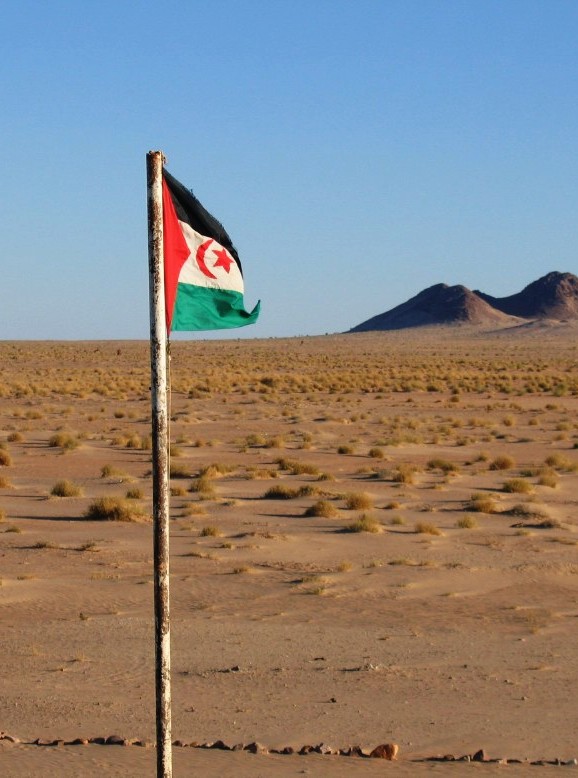
Flag of the Saharawi Arab Democratic Republic. Photo: Western Sahara Project
Flag of the Saharawi Arab Democratic Republic. Photo: Western Sahara ProjectOn November 8, Moroccan forces attacked the Gdim Izik protest camp, outside the city of El Aayiún in the Western Sahara, and razed it to the ground. The camp had been set up around a whole series of social demands (houses, jobs, etc) and generally to demand a say in the use of the Western Sahara resources by its population. Up to 20,000 people lived in the camp when it was destroyed by Moroccan forces.

We publish here a statement by the Communist League of Action, the Moroccan section of the International Marxist Tendency. The comrades take a correct internationalist position on this question, expressing solidarity with the demands of the Sahrawi protestors and defending the right of self-determination for the Sahrawi people. This position goes against the chauvinist position of the Moroccan left which for decades has capitulated to the Monarchy on this and other issues.

The Gdim Izik protest camp which was not organised by the Polisario leadership and took them by surprise, was also a reflection of the tiredness of the Sahrawi people with the endless UN sponsored negotiations and talks about the future of the Western Sahara. These talks have been going on for nearly twenty years now and have led nowhere. It is also significant that the fact that the protest camp was centred on social issues created the conditions for the movement to link up with the Moroccan workers and youth who are also fighting for similar issues and break down the national chauvinism fomented by the Moroccan regime.

This is really the only way forward for the Sahrawi people. The imperialist powers, mainly the US and France, support Morocco, which is a key ally amongst the Arab countries. The guerrilla war conducted by the Polisario for 15 ended in a stale-mate which led to the peace talks sponsored by the UN. After that followed 20 years of talks which have led nowhere. There is an understandable feeling of frustration and growing anger amongst the Sahrawis and some are agitating for a resumption of guerrilla war. We have the duty to warn that such a tactic would also lead nowhere.

The only solution way forward for the struggle of the Sahrawi people is a mass movement combining national demands with social demands, which has a conscious orientation of linking up with the struggle of the Moroccan workers and youth. Unless the Sahrawis managed to break the national unity in Morocco along class lines, they will never achieve national liberation. The situation in Morocco is ripe for such a strategy to find an echo. In the last few years we have seen repeated uprisings and mass movements in different parts of Morocco (during the attack on Gaza, the Sidi Ifni intifada, etc). This is the only realistic perspective for the struggle of the Sahrawi people.

The brutal repression of the Gdim Izik protest camp shows how afraid the Moroccan regime is of a protest of this kind, precisely because of its potential of spreading to Morocco itself. As the comrades of the Communist League of Action make clear, this does not mean that we take a pacifist point of view. On the contrary, the brutal repression of the Moroccan regime needs to be resisted, but the resistance should be based on the mass struggle. Self-defence committees should be created based on and under the control of the masses organised through democratic committees of action.

Finally, we should denounce the stinking hypocrisy of the Spanish right wing Popular Party, which has come out “in favour of the Sahrawis” and against the Moroccan regime. This is the party which is the inheritor to the Franco regime in Spain and which continues its tradition of the most brutal oppression of the democratic rights of the nationalities in the Spanish State. This is the party that when in power in 2002, organised a ridiculous imperialist conflict with Morocco over the uninhabited island of Perejil (Laila), off the coast of Morocco, with the only intention of asserting its rights as a former imperial power. This is the party that has a racist attitude towards Moroccan and other immigrants in Spain, which they want to keep illegal so as to better exploit them as cheap labour and use them as scapegoats for the crisis of the capitalist system. They are no friends of the Sahrawi people and they should not be allowed to pose as such by the solidarity movement.

Together with the report and the statement by the comrades of the Moroccan Communist Action League, see also the document The struggle of the Saharawis, history and perspectives, originally written in 2002, which provides a Marxist analysis of the question of the Western Sahara.


Chronology of events

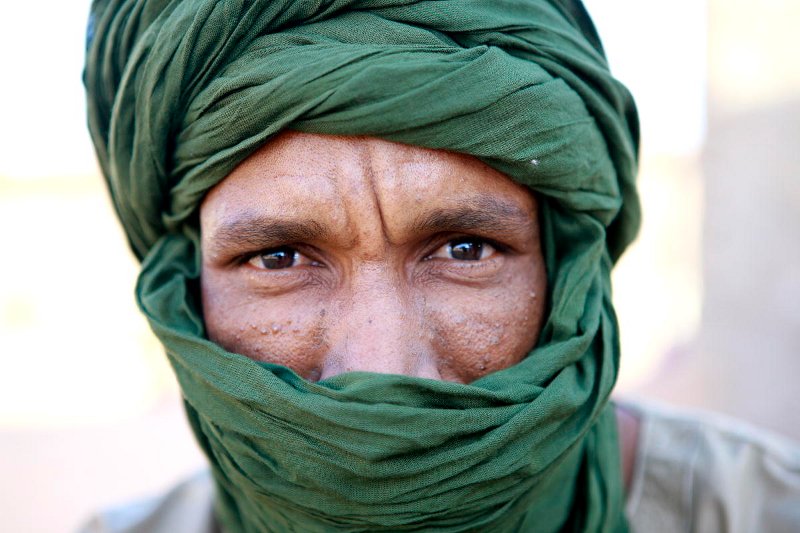
Sahrawi Refugee. Photo: UN Photo/Martine Perret
Sahrawi Refugee. Photo: UN Photo/Martine PerretThe protest movement was launched on October 10, after a group of families and young Sahrawis announced the setting up of a camp in an area about 12 km outside the city of El Aayiún, called "Gdim Izik". In the beginning, the number of tents was not more than 30 and the authorities did not pay much attention to it. But soon thousands of protesters joined the camp, bringing within a few days the number of tents to thousands - more than 6000 tents - housing about 7,000 households, and nearly 20,000 protesters. Most of them were former residents of the shanty town of Al-Wahda.

These men and women, who have suffered from neglect for many years, stood up to fight for their legitimate demands. They faced the ongoing repression and disregard for each protest movement by the military barracks surrounding the city and a media blackout by the official media and even the "independent" media.

A left-wing activist told the Moroccan magazine Tel Quel that there had been an "accumulation of anger for months", and that "protesters had tried initially to sensitize the city officials, knocking on several doors, but to no avail. No one wanted to listen to them." One of the protesters and told the Spanish newspaper El Pais: "We will continue our struggle until we achieve our legitimate demands to live in dignity in our homeland."

What is truly impressive is the high degree of organisation shown by the protesters. They formed a committee to oversee the running of the camp, made up of nine people: eight men and one woman, all under forty years of age, most of whom are unemployed. Protesters have been able to organise the camp with a commission to collect refuse, one to guard the camp, another to regulate the distribution of water, food and to keep morale, as well as a health care commission, etc.

The reaction of the Moroccan State

First the Moroccan regime, with the help of tribal elders, tried to achieve the dismantling of the camp by making promises - after they had realised the movement was spreading like wildfire and there were attempts to establish similar camps to the east of Smara, and the same thing by some people in Tarfaya, Boujdour, etc. They attempted to open channels of dialogue because the situation had become a severe embarrassment and questions were being raised among citizens, both in Morocco and in the rest of the Western Sahara, many of whom face similar problems. The Moroccan Interior Minister personally oversaw the talks. The Moroccan state made a series of promises to the protesters, such as the distribution of 600 lots of land to some of the widows, as well as cards for National Reconstruction, and promised to resolve all the problems of the protestors, on condition that the camp should be dismantled, and at the same launched a massive propaganda campaign around these offers in the bourgeois media.

But none of this achieved the desired effect. The protesters rejected the attempt by the authorities to divide them and insisted on resolving all problems before any dismantling of the camp. Faced with this resilience the Moroccan regime mobilised thousands of troops and the Auxiliary Forces and the police and laid siege to the camp. They engaged in constant provocations against the protestors and terrorised them by constantly flying helicopters over the camp, erecting barriers surrounding the camp, and the setting up checkpoints on the outskirts of the camp. Their aim was to prevent the Sahrawi and solidarity activists from reaching the camp and cut it off from supplies. The Spanish paper El Pais reported how "this blockade led to lack of food and drinking water and the spread of diseases."

After the failure of its manoeuvres, the only option left open to the Moroccan regime was brutal repression. The camp had already been in place for ten days and was growing stronger by the day. In this context Mohammed VI made a speech on November 6, 2010. His message was clear: "We will not tolerate the enemies of territorial integrity, whether from inside or outside the nation." This was the green light from the supreme authority of the country and the commander of the armed forces, to use any methods necessary to dismantle the camp.

That is what happened, after the state media spread the "news" that the Sahrawi had dismantled the camp, and that only a small band remained made up of those who were working for the agenda of the "Polisario" and Algeria. At about six o'clock on the morning of November 8, thousands of forces of repression armed with weapons attacked the protesters. Some witnesses reported to the media that the intervention against the "Gdim Izik" camp was carried out by mixed squads of infantry, under cover of water cannons and with the use of heavy smoke grenades and rubber bullets. Faced with this attack, the youth of the camp defended themselves with any means at their disposal, stones and knives.

The streets of El Aayiún rose up to defend the protesters, and the city witnessed civil disobedience for two days, on 7 and 8 November. Then for the first time since the beginning of the protest, the Sahrawis raised the flags of the Sahrawi Republic, and the protesters were fighting with Molotov cocktails and bottles of gas, while the repressive forces used rubber bullets and tear gas. The youth also organised barricades on all roads and burned tyres to cut off the roads to the security forces. Many banks and shops and the headquarters of the government institutions were attacked, as well as El Aayiún's regional TV channel, which was burned down and the Moroccan flag was brought down and the Sahrawi flag was hoisted. The forces of repression declared a night curfew in various parts of the city. The major points of clashes were in Smara Street - a main street in the city - in addition to other streets, Kaskikima, Ras Al Khaimah, Matar, Tan Tan and Amal, etc.

These confrontations left several dead and wounded on both sides, but it is difficult to determine the toll due to conflicting news from different sources. While the Maghreb Arab new agency announced that the death toll was 12, including 10 from the security forces, the Polisario Front media confirms that the number was 11 Sahrawi citizens dead and 723 others injured in varying degrees of severity, in addition to 159 missing.

The President of the El Aayiún branch of the Moroccan Association for Human Rights, Hammoudi Iekiled, underlined the difficulty in ascertaining whether there were further deaths, or "a campaign of widespread arbitrary arrests" in a number of districts in the city of El Aayiún. It was also difficult to ascertain the number of detainees. Up until now, the Moroccan Minister of Interior has released a statement saying that he would be bringing "in the first stage 77 elements to justice, transferring six of them to the military court, and 64 more are pending investigation, and he decided to release seven others." He pointed out that "13 members from among them had prior convictions." He added that he "would, in a second stage transfer 36 others to the court," bringing the number of detainees the Moroccan regime has declared to 113.

Solidarity

This movement of protest and the crackdown that followed created a great wave of solidarity at home and abroad. On Wednesday, some workers from the Boukraa phosphate mine expressed their solidarity with the protesters, and raised in one of their meetings slogans such as, “the wealth of the Sahara for the Sahrawis”. According to some international media, on Thursday, some young people formed a committee in solidarity with the protesters in Sidi Ifni.

Other Sahrawi cities also witnessed other initiatives, as in Smara, Dakhla, etc. but these attempts failed because of the intervention of the forces of repression. Also there were solidarity demonstrations in several Spanish cities.

The position of the Moroccan parties and the media

In the wake of these events the paper of the USFP (Socialist Party) has published an article entitled: "The Algerian media: absolute bias and falsification of the facts". From the headline you can guess the content. On its part, the Political Bureau of the Party of Progress and Socialism (former Communist Party) has stated that "it is necessary to respond firmly to all the actions, internal and external, which come at a suspicious time, aimed at undermining the unity and stability of the country, through the exploitation of the demands of normal social demands by the separatists causing chaos and threatening public order."

The National Union of the Moroccan Press has also denounced what it calls "the acts of destruction of the El Aayiún regional channel at the hands of men armed with swords and knives."According to a statement issued by the union, the latter strongly condemns what happened and considers it to be a criminal offence that cannot be tolerated. However, the union preferred to remain silent, of course, about the actions of the Moroccan authorities.

Hypocrisy of imperialism and the Algerian regime

Faced with this situation, the position of imperialism, including Spanish imperialism, has been to watch and do nothing. Last Monday, speaking from the Bolivian capital, the Spanish Foreign Minister, Trinidad Jiménez, declared that, "It is premature to take any official position on the ‘events of Laayounne’, in view of the contradictory news coming from the parties in conflict” and she emphasized the need for “restraint and a return to calm and to focus on the informal negotiations that began in New York which will bring calm to the region."

Meanwhile, the Spanish Prime Minister Jose Luis Rodriguez Zapatero during the meeting of the Executive Committee of the PSOE, said that Spain needs to take a balanced position between the parties in the conflict in Western Sahara, in order to maintain excellent relations with Morocco, and be consistent with the role of United Nations mediator for the Sahara, stressing that it was impossible for Spain to abandon Morocco, which is a link between the East and West.

In turn, the Secretary-General of the PSOE, during the meeting, emphasised that it was premature to take a final position on official events of El Aayiún, before knowing the full truth and the outcome of the process of dismantling of the Gdim Izik camp.

The Algerian regime has found in the events an opportunity to express "solidarity" with the struggles of the Saharawi people and to "denounce" repression, etc. This is hypocritical manoeuvre as it attempts to gain some legitimacy amongst the Algerian masses who are sympathetic to the Sahrawi people and to put some pressure on the Moroccan regime. Meanwhile it continues the same dictatorial repression of the masses of the Algerian people and imposes hunger and oppression on them.

The United Nations, typically, has limited itself to demand from both parties, in the words of the official spokesman of the Secretary-General, "to exercise restraint" and prudishly pointed out that "the intervention of Morocco in the protest camp" might spoil the talks between the parties.

It is worth mentioning the involvement of a number of newspapers and the Spanish media who have distorted the facts and data and published false pictures about the events.

Our position

First of all we cannot but express our complete solidarity with the demands of the Sahrawi protesters, the right to work, decent and adequate housing, and our principled defence of the right of the Saharawi people to self-determination, and we stress once again that in doing so we are not in collaboration with the "external enemy" or want the breakup of "our motherland" into smaller entities, or the other slanders we are accused of by our enemies. However, we do so as a defence of a fundamental right of the peoples, that is, the democratic right to self-determination, the right to choose separation or unity without force or coercion by anyone.

We must be clear in this context that we are fighting for an international socialist federation, for the abolition of the borders between the peoples of the world, and at the same time we oppose forced unity: the compulsory union between master and slave, the unity which brings together the oppressed nation and the oppressor nation by force and iron and fire.

The outbreak of the recent protests on the basis of demands such as housing, employment, etc., show the correctness of the position of the Marxists about the need and the possibility of unifying the struggle of the Sahrawi people and the Moroccan people and the rest of the peoples of the Maghreb region on the basis of class, far from a narrow-minded nationalist point of view, for the abolition of capitalism and independence from imperialism. It is a striking demonstration of the bankruptcy of the tactic of individual terrorism and guerrilla struggle, and nationalist separation, on the basis of which the Polisario Front has been built, and marks the beginning of a new phase.

The brutal repression experienced by the camp demonstrates that it is in the interests of the Sahrawi people to contribute to the struggle of the working class of Morocco for the overthrow of the dictatorship in Morocco.

The serious deterioration witnessed in the battle of the protesters, thanks to the infiltration of criminal elements engaged in acts of vandalism, and even resorting to slaughter and urinating on corpses with the defamation of the dead, etc., are all proof of the need to organise the movement on the basis of committees of struggle elected under the control of the masses.

Of course, we do not equate the violence of the aggressor, the Moroccan state, and that of the victim, the Saharawi people. We do not equate the violence of the executioner and the victim, but we do reject the methods and programmes of individual terrorism which attempts to substitute itself for the revolutionary struggle of the masses. We do not do so from a pacifist perspective, but because we consider these methods as counter-productive and not valid in the struggle for socialism, because they discredit the revolutionary and liberation struggle. These methods only serve the reactionary forces on both sides.

Source: marxy.com

See also: The struggle of the Saharawis, history and perspectives (June, 2002)

Nigeria: illuminating the road ahead

Nigerian Political Crisis: Can Electoral Reform come to rescue?


Trotsky once wrote, the capitalist regimes toboggan to disaster with their eyes closed. This statement perfectly describes the political situation in Nigeria. As we have stated several times before, the objective conditions require to maintain ongoing bourgeois democracy has completely eroded few years ago; it has become a mere empty shell, a corpse waiting to be buried. It is an apparatus that is incapable of living and yet unwilling to die. So as to artificially extend its lifespan beyond its limit, the present regime has been clinging on anything on its way. The recent casualty of this clinging game is electoral reforms.

With electoral reform demand, the leadership of Nigerian trade unions had finally found a common ground upon which they can ally with the liberal bourgeois, the imperialists and consequently further strengthen their collaborationist policies. Electoral reform has been pushed to the forefront of all other more important issues. It has afforded the Labour leadership to abandon temporarily the struggle for better wages for workers, for struggle against deregulation of oil sectors and other struggle for better conditions for working people. In full alliance with US, UK etc and a section of Nigerian Bourgeoisies, the leadership of Nigerian trade unions is presently asserting that all the 50 years suffering of Nigerian masses under the domination of Nigerian ruling class can only be addressed by the miracle of sound electoral reforms. How much fairness and justice can our electoral system, that is based on the present social economic systems being managed by inept, inefficient and mafia ruling class like ours guarantee?

Can Nigeria social economic arrangement guarantee fair electoral systems?

Soludo(Former CBN Governor) once said in Governor’s address of 2008: “Less than 20% of African households own bank accounts or have access to financial services. Nigeria has a highly unequal income distribution profile: about 8% of those that have access to financial services own about 90% of the available deposits.”

In a country with over 70% of the population living below poverty line and in 2000, the World Health Organization ranked the Nigerian health system in 187th place out of 191 countries evaluated. According to UNDP, life expectancy in Nigeria has declined to 43 years (2006) from 47 in 1990. In contrast, life expectancy in Malaysia, which attained nationhood at the same time as Nigeria, has now reached 70 years. Over 50,000 Nigerian women die from childbirth every year (equivalent to a plane carrying 140 people crashing every single day). Nigeria accounts for 10% of the world’s maternal deaths in childbirth whereas the country represents 2% of the world’s population. One in five Nigerian children dies before his/her 5th birthday. About a million Nigerian children die of preventable causes every year. So, how much democratic right can this arrangement grant ordinary people? Ever diminishing minority who has cornered an exorbitant amount of our collective wealth can only maintain itself through imposition. Anybody hoping for this minority to just willingly and cheaply let-go of their power and privileges is just naïve and feeble minded. If this minority plays with any iota of democratic right for the masses, they understand correctly that within a twinkle of an eye, they will be defeated and all their means of livelihood collapsed along with their privileges. The last thing they will allow is a free, fair and conclusive electoral process. The unfolding event going on in Venezuela hunts them like ghost.

What needs to be done?

Nigerian ruling class is presently in a very terrible and weak position and can promise anything to the masses so as to buy more time to prepare for a more vicious attack against Nigerian masses. While promising heaven and earth, Nigerian ruling class keeps instructing the military to keep a watchful eyes on the situation and should not miss any available opportunity to strike and forcefully continue with all the ongoing anti-people policies. An extremely corrupt, inept and absolutely inefficient Nigerian ruling class has lost the entire social base, it is presently incapable of freely requesting a renew mandate from Nigerian masses. What is presently sustaining them now in Government is the compromising action of reformist leadership of Nigerian main trade union centers. This explains why 500 Million naira bribe given to the NLC and TUC leadership by the Government is very timely and necessary. It is payment for the job well done.

The leadership of the main trade union centers in Nigeria deliberately turns their back to the party (Labour Party) that they themselves formed and are always prepared to enter into any form of alliance with any section of Nigerian ruling class just to keep their own career moving. Had it been that Nigerian working class is lucky enough to have a more responsible and courageous leadership at this material point in time, with a very little effort, Nigerian workers would have cheaply pushed away this parasitic and thieving Nigerian ruling class and establish Workers Government. Is not enough to continue crying over spill water; the urgent task before the Nigerian working class is to double the pressure on their leadership to reclaim the Labour Party and sharpen it up with a socialist program, in the interest of Nigerian masses. Of what essence is a perfect and ideal electoral system, when Nigerian workers do not have their own political party to contest? Which of the existing main parties can genuinely mobilize the mass majority of Nigerians to come out en-masse to vote? Which of them is capable of defending people’s vote if eventually voted and rig out? We need to continuously ask ourselves, which of them if in Government worth our trouble? All main parties have the same program and policies, they will all continue with drastic cut in social spending; health facilities will keep declining, public education will be worsening, poverty will increase because they all support deregulation, privatization and wage cut and wage freezing.

Do we need to be reminded, that when over 10,000 bank workers were sacked, all parliamentarians unanimously, irrespective of party affiliations, voted in support of this? They all voted for deregulations, for cut in spending on education and health and most unfortunately, they are all uniformly corrupt, inept and mafia-like in their action and outlook. The solution to the problem has obviously gone far beyond mere electoral reforms; we need a radical break from the past and existing electoral systems that places a tiny minority over the head of overwhelming majority. The first pre-condition towards this is the political party of our own under a courageous leadership resting on the shoulder of Nigerian working class.

In defense of Engels


Engels’ Marxism


John Rees


A strange thing has happened to the reputation of Frederick Engels in the 100 years since his death. For the vast majority of that time both Engels’ allies and his enemies agreed that he was Marx’s alter ego. Indeed, the very expression “alter ego” was Marx’s own description of his relationship to Engels. Most commentators and virtually all Marxists thought that a lifetime of common work, the undeniable and almost undisturbed years of close personal and political co-operation, spoke for themselves. [1]

But by the 1960s that easy certainty was faced with a sustained challenge. The first cracks in the Cold War consensus were beginning to appear. The growth of CND, the rise of the New Left and, later, opposition to the Vietnam War inevitably produced an enormous increase in interest in radical ideas in general and Marxist ideas, or what passed for Marxist ideas, in particular. This process necessarily led to a reaction against the stifling conformity of reformism and the oppressive legacy of Stalinism. Much of what was said and written marked a rebirth of interest in the genuine Marxist tradition and delivered a long-delayed blow to the reformist and Stalinist traditions.

Yet the reaction against Stalinism was also shaped by Stalinism, in two senses. Firstly, some of those reacting to Stalinism got no further than adopting another variant of Stalinism, either Maoism, or Third Worldism or the ‘reform Communism’ that came to dominate the Western European Communist Parties. Secondly, even those who broke completely with Stalinism tended to confuse elements of the genuine Marxist tradition with the economic determinism characteristic of Stalinism.

All this led to altered perceptions of the Marxist inheritance. Perhaps inevitably, critics began to search the writings of the founders of Marxism for the seeds of Stalinism and failures of reformism. Many of these developments particularly affected students and so fuelled the expansion of academic Marxism. They also coincided with the wider availability of Marx’s early ‘humanist’ writings. A new consensus emerged, both in academic circles and among many on the left, about the nature of Engels’ thought.


The critics of Engels

One of the first studies to systematically assert a cleavage between Marx’s ideas and those of Engels was George Lichtheim’s Marxism: an Historical and Critical Study, first published in 1961. [2] Lichtheim insisted that in Marx’s vision “critical thought was validated by revolutionary action”, but in Engels’ scheme “there now appeared a cast-iron system of ‘laws’ from which the inevitability of socialism could be deduced with almost mathematical certainty ... the ‘goal’ was transferred from the here-and-now of conscious activity to a horizon so distant as to be almost invisible.” [3]

For Marx, Lichtheim claims, “the only nature relevant to the understanding of history was human nature.” Engels therefore broke with Marx when he argued that “historical evolution is an aspect of general (natural) evolution and basically subject to the same ‘laws’.” [4] This meant that Engels had appropriated Hegel’s heritage quite differently to Marx. Marx had taken from Hegel the importance of self conscious activity in the making of history. In contrast “what really fascinates” Engels “is Hegel’s determinism: his ability to make it appear that nature (and history) follow a pre-ordained course”. [5] Such a drastic recasting of Marxism inevitably had political consequences:

... determinism in thought making for dogmatism in action. The cast-iron certainty which Engels imported into Marxist thinking found its counterpart at the political level in an unshakable conviction that the stars in their courses were promoting the victory of socialism. [6]

Consequently, Engels, Kautsky – the leading thinker of the Second International – “and the orthodox school in general” transformed Marxism “from the vision of a unique breakthrough into a doctrine of a casaully determined process analogous to the scheme of Darwinian evolution”. [7]

Lichtheim’s book rehearses many of the themes that were to become so familiar in other work published over the following 20 years: that Engels replaced Marx’s notion of conscious activity with an empiricist notion of science, that he mistakenly extended Marxism so that it covered the natural as well as the social world, that this inevitably drew him into deterministic and reductionist formulations and that these in turn led him at the end of his life to endorse a reformist political practice on the part of the German Social Democratic Party. And not for the last time the revolutionary, humanist Marx was counterposed to the reformist, determinist Engels by a writer such as Lichtheim who was an opponent of Marxism in theory and a convinced reformist in practice.

After Lichtheim the deluge. Alfred Schmidt’s otherwise more careful and interesting book, The Concept of Nature in Marx, first published in German in 1962, argued that “where Engels passed beyond Marx’s conception of the relation between nature and social history, he relapsed into a dogmatic metaphysic”. [8] Schmidt also saw a departure from the concerns of the early Marx: “For Engels, nature and man are not united primarily through historical practice; man appears only as a product of evolution and a passive reflection of the process of nature, not however as a productive force”. [9] By adopting this approach Engels also abandoned Marx’s view of how consciousness is formed:

The movement of thought in Marx is by no means limited to a mere mirroring of the factual. The uncritical reproduction of existing relationships in consciousness has precisely an ideological character for Marx. [10]

So Schmidt believed that where Marx saw ideas formed in interaction with the material world Engels saw only a crude reflection of the outside world in the brains of human beings, a vulgar “copy theory” of consciousness. By 1969 Lucio Colletti could question, almost in passing:

how far this distortion of Marx’s thought by Kautsky and Plekhanov ...was already prepared, if only in embryo, in some aspects of Engels’s work; and how in general the search for the most general laws of development in nature and history made these attempts a preconstitution of the contamination with Hegelianism and Darwinism. [11]

He went on to argue that Engels’ influence on the leaders of the Second International was partly a result of “the place given in Engels’ work to philosophical-cosmological development, ‘the philosophy of nature’, in other words, the ‘extension’ of historical materialism into ‘dialectical materialism’.” [12]

In books as diverse as John Lewis’s The Marxism of Marx (1972), Shlomo Avineri’s widely read textbook The Social and Political Thought of Karl Marx (1970) and Leszek Kolakowski’s sophisticated and profoundly anti-Marxist Main Currents of Marxism (1978) it became an article of faith that Engels had distorted Marx. [13]

Even authors Paul Walton and Andrew Gamble, who were sympathetic to Marxism at the time they wrote From Alienation to Surplus Value (1972), could conclude that:

[Engels] seems debarred from understanding the real premises of Marx’s method because he seeks to make Marxism an objective science on the model of the natural sciences... he tries to establish the truth of historical materialism by treating human interaction as analogous to the interaction of chemical particles. [14]

For Gareth Stedman Jones, influenced by Louis Althusser’s structuralism, it was Engels’ “inability adequately to think through the novelty of historical materialism as a science” which “led him to an understandable attempt to fill in the gaps with philosophy – the Hegelian philosophy of his youth”. This not only led to a “lack of any theory of the political instance of social formations” but to Engels embracing “a dangerous implication of the Hegelian theory of knowledge – that everything in reality is, in principle at least, already known”. Thus Engels “unintentionally converted the infant science of historical materialism into the appearance of a finished system, a corpus of absolute knowledge which encompassed the whole of empirical reality”. [15]

By the early 1970s the pattern was fully established – Engels was the villain. And it did not seem to matter what political or theoretical position a writer set out from – the neo-Kantianism of Colletti, the humanism of Avineri or Schmidt, the Althusserianism of New Left Review contributors – the destination was always the same: Engels was at the root of whatever was wrong with Marxism. With few exceptions, [16] the argument against Engels had now become a virtual orthodoxy, perhaps best summarised in Norman Levine’s The Tragic Deception: Marx contra Engels (1975) and Terrell Carver’s Marx and Engels, the Intellectual Relationship (1983). Levine states the anti-Engels orthodoxy in its bare essentials:

Engels’ materialism ... was a cold, unremitting, and remorseless system. Men had little impact on fashioning the course of development of history and nature. Rather than being the subject of history, men were basically the passive objects of unrelenting external forces ... Engels’ materialism was mechanistic. [17]

Naturally, for Levine, it followed that “Engels continuously affirmed the copy theory of knowledge ... there was absolutely no variance, no difference between our comprehension of the external world and the external world itself.” [18]

Engels’ grave error lay in “making the laws of nature themselves dialectical ... something which Marx himself never attempted”. [19] Engels “was a unilinear evolutionist” [20] for whom “causality ... meant additive sequence” [21] and from whose thought “the notion of human praxis was absent”. Consequently:

Engels’ thought moved from a mechanistic materialist view of the universe to a deterministic view of human history ... it was Engels, not Marx, who was the originator of economic determinism. [22]

Carver’s work is more qualified and careful in its argument, but it arrives at similar conclusions. [23] Engels was led to “incorporating the causal laws of physical science and taking them as a model for a covertly academic study of history, ‘thought’ and, somewhat implausibly, current politics”. [24]

There are many more writers who have argued that Engels was responsible for transforming Marxism into a crude, deterministic philosophy of nature which led to the reformism of the Second International and even Stalinism. To those already quoted could be added Richard Gunn in Marxism Today, Jeff Coulter in Socialist Register, Frederick Bender’s The Betrayal of Marx, Z.A. Jordan’s The Evolution of Dialectical Materialism and many others. [25] These authors combine different elements of the argument in different ways, and few agree on all the arguments used against Engels, but they say little new.

There are two ways of examining these claims. One is to look at the record of Marx and Engels’ partnership. The second is to study the works in which, both jointly and separately, they elaborated their ideas.

The unity of Marx and Engels’ thought

The most remarkable aspect of the view that there was a fundamental divergence between Marx’s theory and Engels’ thought is that it ignores the evidence of their lifelong partnership. Some considerable intellectual contortion is necessary to overcome the elementary biographical facts of Marx and Engels’ lives. For Terrell Carver “the intellectual relationship between the two living men, however, was very much the story of what they accomplished independently”. These accomplishments “were by no means theoretically coincident”. After Marx’s death “Engels moved into an all-powerful role” in which he “invented dialectics and reconstructed Marx’s life and works accordingly”. [26] Nor is Carver alone in this kind of assertion. It is common coin among Engels’ critics to insist that he codified Marxism as a rigid dialectical philosophy either without Marx’s explicit approval or after his death. Norman Levine argues:

The height of Engels’ career corresponded with the termination of Marx’s life. It is, therefore, entirely consistent that five of Engels’ major works were published in the years closely preceding Marx’s death, or after the termination of Marx’s life. Anti-Dühring appeared in 1878, Socialism: Scientific and Utopian [sic] in 1882, The Origin of the Family, Private Property and the State in 1884, and Ludwig Feuerbach and the End of Classical German Philosophy in 1888. The Dialectics of Nature was first published in 1927 by Riazanov, although the manuscript itself appears to have been completed by 1882. [27]

Levine makes a more extraordinary claim when he attempts to answer the obvious question of “why basic intellectual differences between the two men did not come to the surface as tangible and real, articulated and acknowledged dispute”. This is a question to which no convincing reply is easily available. Levine’s answer takes us into the ghost world of “the psychological meaning the friendship had for each”. In this realm “Engels chose to tie himself” to Marx because Marx “would also build a place of fame and renown in time for him”; and Marx needed Engels because “Marx did not find the professional and emotional support he needed from his wife”. [28] But if we leave the territory of Mills and Boon and return to the world of Marx and Engels a very different picture reveals itself.

The first and most striking point about Marx and Engels’ relationship is the strength of the foundations on which it rested. In the 1840s both men arrived at what would later be known as the historical materialist view of the world. But it is by no means the case that Engels simply followed where Marx led. On the vitally important strategic question of the attitude which the pair took to the trade unions it was Engels who blazed the trail. And the entire content of Marx and Engels’ joint work, The Communist Manifesto, was first outlined by Engels alone in Principles of Communism.

On economic questions Engels led the way, even though Marx’s later work in Capital was the decisive contribution. Marx was still extracting himself from the coils of Hegelian philosophy when Engels wrote his Outlines of a Critique of Political Economy. Not only was this the spur to Marx’s own 40 year immersion in economic analysis, it was also the immediate inspiration for Marx’s own transition to a fully materialist class analysis, a process recorded in his Economic and Philosophical Manuscripts of 1844. Indeed, Marx thought Engels’ work “brilliant” and Capital itself carries the subtitle A Critique of Political Economy. Even Carver admits that “Marx’s manuscript notes on Engels’ essay prefigured the course of his lifework” and that “Marx’s Capital was in effect a much elaborated specification of the contradiction discussed by Engels in his Outlines”. [29]

Having arrived at a common outlook, Marx and Engels jointly authored two key works which elaborated their views, The Holy Family and The German Ideology. They struggled together to win the organisation they were both involved in, the League of the Just, to their ideas, transforming it into the Communist League. The Communist Manifesto was issued in its name. They went on to fight together in the 1848 revolutions – in Engels’ case literally revolver in hand, on the barricades. This then was the foundation of Marx and Engels’ partnership, forged by intense, common intellectual and practical, political work.

The start of Marx’s exile in England and Engels’ life in Manchester unavoidably altered the pattern of their joint work, but it did not end it. Partly, Marx and Engels chose to specialise in different areas. Partly also this differentiation was forced on them by the economic circumstance of Marx’s poverty and Engels’ decision to support his friend while Marx worked on what became Capital. But these new circumstances did not break the intellectual and political trust between them. When Marx had to write articles for newspapers in order to earn some money he never hesitated to put his name to articles which were, in fact, written by Engels.

In the long gestation of Capital Engels was Marx’s constant adviser, either in their almost daily exchange of letters or in conversation when they paid each other visits. Marx consulted Engels on everything from the correct German translation for “gigs” to rent theory, constant and variable capital, surplus value and exploitation. In August 1862 Marx implored Engels to visit him:

I have overthrown so many old views in my critique [i.e. Capital] that I would at least like to consult you over a few points. Writing about the rubbish is tedious for you and me. [30]

Constant collaboration continued at every stage of the writing of Capital up to and including the reading of the proofs, which Marx largely entrusted to Engels. Even the presentation of Capital bears Engels’ mark. Looking at the proofs, Engels advised Marx that the dialectical points might be made more historically and that Marx had made “a great mistake” in not following the pattern of Hegel’s Encyclopedia with its short sections and many sub-headings. [31] Marx followed this advice, but ignored other suggestions, “to proceed dialectically in this regard also”, as he joked to Engels in reply. Nevertheless, he insisted, “your satisfaction up to now is more important to me than anything the rest of the world may say of it”. [32] At the end of it all Marx was in no doubt about his debt to Engels. He wrote:

Without you, I would never have been able to bring the work to completion, and I assure you, it has always weighed on my conscience like an Alp that you have dissipated your splendid energy and let it rust on commercial matters, principally on my account, and into the bargain, still had to participate vicariously in all my minor troubles. [33]

In this Marx was undoubtedly right, and not just about his debt to Engels. He was right in his assessment of the terrible cost to Engels’ intellectual output during the years in which he worked in Manchester. Although he never complained, Engels knew it too – as is confirmed by the image left to us by Marx’s daughter of Engels joyously coming home from the factory after his last day’s work. When Engels was able to retire he could once again publish major works.

Levine argues that Marx’s death left Engels free to publish his distorted version of Marxism. But even the chronology of publication which Levine gives undermines his own argument. Anti-Dühring was not only published during Marx’s lifetime, the whole project was Marx’s idea. Moreover, Engels read the entire manuscript to Marx and Marx himself wrote one of the chapters on economics. The idea behind the book was to give a defence of Marx’s ideas, so it is hardly likely that such an obviously programmatic statement of his views would have been published without his complete agreement. As Engels noted, “it was self-understood between us that this exposition of mine should not be issued without his knowledge”. [34] Socialism, Utopian and Scientific was extracted from Anti-Dühring and also published before Marx’s death. The Origin of the Family, Private Property and the State appeared after Marx’s death, but was composed by Engels using the ethnographical notebooks which Marx had written. Ludwig Feuerbach was also published after Marx died but, as if to stress the continuity of the ideas expressed in it with the views of Marx and Engels’ first writings, Engels published Marx’s newly discovered Theses on Feuerbach as an appendix. Engels obviously saw no contradiction between the “humanist” young Marx and the “determinist” older Engels, otherwise he would scarcely have risked such a course, going so far as to describe the Theses as “the brilliant germ” of historical materialism.

Finally, The Dialectics of Nature, which is often used to support distortions of Engels’ work, was never intended for publication and actually bore the inscription, “All this to be revised”, almost as if it were a warning to those who were to take every last word as a finished, polished formulation. Nevertheless, the broad sweep of Engels’ intention was clear from Anti-Dühring, which was written at the same time.

On the key issue of whether Marx endorsed the idea of a dialectic in nature there can be little doubt. In Anti-Dühring Engels specifically quoted Marx’s Capital to this effect: “Here, as in natural science, is shown the correctness of the law discovered by Hegel in his Logic, that merely quantitative changes beyond a certain point pass into qualitative differences.” [35] And Marx goes on to say in a footnote that: “the molecular theory of modern chemistry ... rests on no other law”. [36] Marx himself had earlier drawn Engels’ attention to these passages in Capital, explicitly stating his belief that dialectical laws were in evidence in natural science: “in that text I quote Hegel’s discovery regarding the law that merely quantitative changes turn into qualitative changes and state that it holds good alike in history and natural science”. [37] Also in Capital Marx described exchange relations as operating like “a determining law of nature”. And, despite Carver’s claim that Engels’ admiration for Darwin is evidence of his inclination toward the model of natural science, Marx shared Engels’ assessment: “Darwin’s book is very important and it suits me well that it supports the class struggle in history from the point of view of natural science.” [38]

So the idea that Marx and Engels developed along separate theoretical paths finds little support in the biographical evidence. Naturally, the rough division of labour which they evolved led to different emphases. Equally naturally, they stressed different aspects of the theory depending on whether they were arguing against empiricists or idealists, system builders or vulgar economists, anarchists or reformists. But in all essentials they were at one. Perhaps nothing conveys this fact as forcefully as the testimony of Laura Marx’s husband, Paul Lafargue:

Engels was, so to speak, a member of the Marx family. Marx’s daughters called him their second father: He was Marx’s alter ego ...

... From their youth they developed together and parallel to each other, lived in intimate fellowship of ideas and feelings and shared the same revolutionary agitation: as long as they lived together they worked in common ... But after the defeat of the 1848 Revolution Engels had to go to Manchester, while Marx was to remain in London. Even so, they continued their common intellectual life by writing to each other almost daily ... As soon as Engels was able to free himself from his work he hurried from, Manchester to London, where he set up his home only ten minutes away from his dear Marx. From 1870 to the death of his friend, not a day went by but the two men saw each other, sometimes at one’s house, sometimes at the other’s ...

Marx appreciated Engels’ opinion more than anybody else’s, for Engels was the man he considered capable of being his collaborator. For him Engels was his whole audience. No effort could have been too great for Marx to convince Engels and win him over to his idea. For instance, I have seen him read whole volumes over and over to find the fact which he needed to change Engels’ opinion on some secondary point ... It was a triumph for Marx to bring Engels round to his opinion.

Marx was proud of Engels. He took pleasure in enumerating to me all his moral and intellectual qualities ... He admired the versatility of his knowledge and was alarmed that the slightest thing should befall him ... [39]

Marx and Engels were inevitably prey to the limitations of their age. They could not foresee all that natural science would achieve or the problems that would arise in the course of the next century of class struggle. But it is their joint legacy, as the content of their work also demonstrates, on which modern socialism rests.