Mu

Mu

Sunday, February 28, 2010

Latest in campus cultural critique (CCC)


Cool Capitalism

by Jim McGuigan (Pluto Press, £15.99)
Tuesday 23 February 2010

Despite the title's mimicry of the ubiquitous Coca-Cola logo, the capitalism detailed in Jim McGuigan's latest book is the real one of very hot and - where it deems it necessary - incandescent capitalism.

So it is fortunate that McGuigan introduces us to the origins of "cool" before his comprehensive study begins.

As one who insists, quite mischievously, on the original meaning of the word I found this introduction both invaluable and entertaining.

There follow just under 300 pages examining not only superficial details but many of the underlying principles of the capitalist system with McGuigan exposing the ostensibly equitable "fair day's wage" lie as concealing "a systematically unequal relation between capital and labour."

Fairly, and accurately, this truth is attributed to Marx.

McGuigan is professor of cultural analysis at Loughborough University and that is evident in his detailed catalogue of modern critics of capitalism.

Recent developments of an anti-capitalist trend in Latin America are dealt with honestly.

But some might want to take issue with reporting in the Guardian and New Statesman on that region being described as "left of centre."

That's a judgement which some readers of this paper might reasonably jibe at.

Be the shell game...

Move your money…

Few pieces in the 23-year history of LBO have attracted as much hostile correspondence as “Web of nonsense” in #119. It was a critique of the mode of thought, almost foundational to a brand of populism on both the left and the right, “that sees the problems of capitalism—like the polarization of rich and poor and the system’s vulnerability to periodic crises—as primarily financial in origin.” While this tendency has a long history, and pervades a lot of the pseudo-radical tradition in the U.S., it always achieves special prominence at the time of financial crises.

To reprise for a moment before taking on a fresh eruption of the syndrome: capitalism is a system organized around money. Almost nothing is undertaken in the realm of production for reasons other than the accumulation of money. As the money accumulates, something must be done with it, which is why financial wealth expands over time. But even though that financial wealth often seems to inhabit a world of its own, it is ultimately connected to what Wall Street calls the “real” sector. For example, all the mortgage securities that caused the recent mischief were ultimately connected to one of the most basic needs of all, shelter. There is no way to separate neatly the monetary from the real. The social problem emanating from the securitization of mortgages isn’t only the increasingly baroque development of financial assets but also the commodification of the house and its transformation into a speculative asset. Which is why populist financial reforms can’t take you very far: they address symptoms, not pathogens.

Bust a move

But that never stops people from trying. The latest populist spasm is Arianna Huffington’s “Move Your Money” campaign, which would have those of us with money in large banks move it to small ones. This touches on another foundational populist fantasy: that virtue and size are inversely related. Her website, which thrives on the unpaid labor of hundreds of eager contributors, even provides a helpful list of convenient local banks if you enter your zip code.

What’s wrong with this scheme? Several things. First, many small banks have more money than they can profitably invest locally. As Barbara Garson shows in her wonderful book, Money Makes the World Go Around, the portion of her book advance she deposited in tiny upstate New York bank was probably lent via the fed funds market to Chase, where it entered the global circuit of capital. This is not at all uncommon. Money is fungible, protean, and highly mobile even when it looks locally rooted. That very mutability is part of what makes money so valuable: it’s the ideal form of general wealth that can instantly be turned into caviar, lodging, Swedish massage, or shares of Google.

The point can be further developed by looking at some of the banks that Huffington’s site recommends. Entering LBO’s zipcode, 11238, into their helpful little machine yields several suggested receptacles for one’s savings. One, the black-owned Carver Federal Savings Bank, is a major financer of the gentrification of predominantly black neighborhoods in Brooklyn and Queens. As those neighborhoods get richer, Carver boasts, it’s partnering with Merrill Lynch (a subsidiary of the Bank of America) to offer wealth management services to the flusher new residents. Another suggestion, Apple Savings Bank, has about three-quarters of its assets in securities like U.S. Treasury bonds, not local loans. They don’t come much bigger than the U.S. Treasury. And a third, New York Community Bank, which even features that precious word in its name, financed a private equity group that bought up a lot of apartment buildings in New York in the hope of squeezing out the rent-regulated tenants and replacing them with more lucrative ones paying market rents. With the real estate bust, the PE firm is having trouble servicing its debts, and the residents of its buildings are suffering as services are cut further.

Yes there are some decent places to park your money, like community development credit unions. But there’s only so much they can do with their holdings. There’s no way they could accommodate even a small fraction of our near-$8 trillion in bank deposits without turning to Treasury bonds or Merrill Lynch wealth management services. Getting banks under control is a matter of politics, not individual portfolio allocation decisions.

Move your money and it’s still money.

Ireland: "Revolution is never practical - until the hour of revolution strikes"


Socialism and the long struggle for Irish freedom


We are publishing here a speech given by Phil Mitchinson at the 2005 International Marxist school in Barcelona. Dealing with the history of the centuries old struggle for freedom in Ireland, and the part played in that history by republicanism and socialism, as well as the political developments that have led to the current impasse. Phil, who died tragically in 2006 at the age of 38 would have celebrated his 42nd Birthday on 25th February. His commitment to the revolutionary ideas of Marxism and his boundless optimism were an inspiration to the lucky few who knew him well. Phil needs no monument, his ideas and his spirit are testament enough. Phil was instrumental in the pioneering work that made this website possible and for that we are eternally grateful. We will finish what he started.

“An Irish Republic, the only purely political change in Ireland worth crossing the street for will never be realised except by a revolutionary party that proceeds upon the premise that the capitalist and the landlord classes in town and country in Ireland are criminal accomplices with the British government, in the enslavement and subjection of the nation. Such a revolutionary party must be socialist, and from socialism alone can the salvation of Ireland come.”

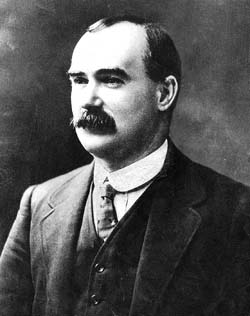
James Connolly
These words written by James Connolly almost one hundred years ago contain the basis of the perspectives and tasks of the struggle in Ireland. The idea that the national liberation of Ireland, its freedom from British imperialism - and consequently today Ireland’s reunification, can only be achieved by the revolutionary struggle of the working class for socialism - is repeated a thousand times in the writings of James Connolly – the greatest Marxist born in the islands of Ireland and Britain – who, just seven years after these lines were written gave his life in the cause of that struggle. Wounded in the Easter rising of 1916 and so unable to stand he was strapped to a chair by the army of British imperialism and shot dead.

I could easily fill the next hour or more reading extracts from Connolly’s writings –

“only the working class remain as the incorruptible inheritors of the struggle for freedom in Ireland”, “The cause of labour is the cause of Ireland, and the cause of Ireland is the cause of labour, the two cannot be dissevered” – and it would be worthwhile. All comrades should read Connolly. Here we find the most modern ideas, ideas that are more relevant today than ever. It is our duty to rescue those ideas from the clutches of the nationalists who have twisted and distorted the memory of Connolly and buried him beneath Dublin statues and street names.

In the same way in his own day Connolly struggled to rescue the ideas of that great revolutionary democrat Wolfe Tone, leader of the United Irishmen, who, one hundred years before Connolly, drew the following conclusion:

“Our freedom must be had at all hazards. If the men of property will not help us they must fall; we will free ourselves by the aid of that large and respectable class of the community – the men of no property.”

Writing about Wolfe Tone, and unwittingly about himself, Connolly said “apostles of freedom are ever idolised when dead yet crucified when living.”

Four years ago I had the privilege of speaking at an international school on the life and ideas of James Connolly. At that meeting there was no-one present from Ireland. Today we are delighted to welcome two comrades here as visitors from the Irish Republican Socialist Party, Johnny from Strabane and Neil from Cork.

Of course our International does not yet have a section in Ireland. For my part, I am with Connolly when he wrote,

“a real socialist movement can only be born of struggle, of uncompromising affirmation of the faith that is in us. Such a movement infallibly gathers to it every element of rebellion and progress, and in the midst of the storm and stress of struggle solidifies into a real revolutionary force.”

I believe that there is now an historic opportunity to construct out of the crisis of Irish republicanism, out of the impasse of Irish capitalism and out of the Irish workers’movement just such a revolutionary party as Connolly demanded.

That is a struggle “worth crossing the street for.”

There is no alternative. Just read what passes for analysis in the bourgeois press – the Manchester Guardian or the Belfast Telegraph attempt to explain the latest failed attempt at devolution (The Good Friday Agreement and Strormont) in terms of psychology and personality, of Gerry Adams and Ian Paisley. Or worse they blame the ‘stubbornness’ and ‘moodiness’ of the Irish as a national characteristic!

The inability of capitalism – of the Irish and British ruling classes – to solve the problems of Ireland cannot be explained away by national insults, nor the whims of sectarian politicians.

In these terms either the problems of Ireland can never be solved – ‘it’s in their nature’, the self-justification of those with no answer. Or, all that is needed is to change the leaders of the sectarian parties – the fantasy and illusion of those utopians who believe the GFA and Stormont can be revived once the ageing Ian Paisley dies.

It is not Paisley, nor Adams, nor any individual sectarian politician, but sectarianism, that poison which British imperialism injected into the veins of Ireland; that Frankenstein’s monster to which they gave life, and are now powerless to stop, which prevents capitalism from solving the Irish question. The inability of that system to provide jobs, houses, healthcare and education for all, continues to spread that poison – which in turn is the lifeblood of the sectarian politicians – even into the ranks of the one class in Irish society able to solve both the national and social questions – the working class.

Now, it is impossible to understand the situation in Ireland outside of the context of its whole historical development, and the entire world situation.

Fifteen years ago amidst imperialism’s euphoria at the fall of Stalinism, they deluded themselves into believing they could solve the national question in Palestine, for example, and in Ireland. Instead, the changing balance of forces internationally served to violently shake up international relations and world politics. Rather than being solved the national question reasserted itself – their efforts in Palestine and Ireland ending in tragedy and farce.

In the case of the former Yugoslavia imperialism reopened wounds and caused wars on the continent of Europe for the first time in half a century.

It is against this new international background of war and profound instability that we must see the so-called peace process in Ireland and the perspectives for the Irish working class.

Above all when dealing with the national question we have to be concrete – which working class, with what history and tradition, in what concrete circumstances? As Connolly explained in his pamphlet Erin’s Hope, “The interests of labour all over the world are identical, it is true, but it is also true that each country had better work out its own salvation on the lines most congenial to its own people.”

In other words it is not enough simply to call for workers’ unity – of course, Protestant and Catholic workers have more in common with each other than with Irish bankers, or British industrialists, or with Adams and Paisley. As true as this is on its own it is no more use than standing on a street corner in Barcelona or London or Paris and declaring the need for the working class to overthrow capitalism. If this was all that was required to make a revolution it would have succeeded long ago.

As Marxists we have to get to grips with the outlook of the Irish working class as it is and not as we might like it to be, in the real, concrete situation. To grasp the direction in which events are moving, in order to intervene and build our movement.

The 31st August 1994 marked a turning point in Irish politics with the declaration of an unconditional ceasefire by the Provisional IRA. For 25 years the Provisional IRA fought an armed struggle with the declared aim of driving out British imperialism and reuniting the island of Ireland. With more than 3000 dead on all sides not one single step has been taken in that direction – on the contrary quite a few strides have been taken further away.

This represents a crushing defeat for the policy that Marxism has always called individual terrorism, a campaign of bombings and assassinations, which could not defeat British imperialism in centuries.

The Provisional IRA have been forced to follow up their cease-fire with a statement confirming “the complete cessation of violence” and that their arms are “beyond use” and they will go still further in the coming months, desperate to rescue the Good Friday Agreement.

But it will never be enough for Paisley. Paisley and co. have one policy – fear. ‘You see’ they say ‘If the Provisional IRA are willing to do this the British government must have promised them something.’

Two thirds of Unionists in a Belfast Telegraph poll now oppose the Good Friday Agreement. In the annual violence around Orange Order marches, or in the results of the recent elections, we see a clear indication of the opposition of a Protestant majority even to the shadow of concessions. They would not accept one step in the direction of becoming an oppressed minority in a united capitalist Ireland, which could not provide them with jobs, decent houses, hospitals and schools.

Of course, British imperialism has no such plan – much though they might like to disentangle themselves from the whole costly, destabilising mess that they have created. They have given a few concessions, released a few prisoners; changed the name of the RUC to the PSNI. In turn Sinn Fein sell these meagre concessions and the hysterical reaction of Paisley and co. to gain support. But in reality Adams and McGuiness have swapped their lofty ideals for ministerial portfolios in a parliament that never meets.

It is ironic that for decades before the Good Friday Agreement the so-called centre ground of Unionism and Nationalism, the UUP and the SDLP, held a majority. The degree to which Stormont has entrenched sectarianism is in part demonstrated by the fact that the DUP and Sinn Fein now have the majority ensuring that Stormont cannot meet and the Good Friday Agreement cannot work.

After nearly 30 years of armed struggle the Provisional IRA and their strategy has been defeated and the goal of a united Ireland is further away than ever.

Instead of peace there are peace walls; segregation in housing and jobs has increased; and Stormont has constitutionalised Partition and the leaders of Sinn Fein have accepted it. The Nationalist bourgeoisie in the south long ago abandoned any claim on the north.

The Loyalist paramilitaries bear a heavy responsibility for widening the sectarian divide, the tactics of the Provisional IRA also mean they share a heavy burden of responsibility. But in the first place it is necessary to place the ultimate responsibility where it rightfully belongs – at the feet of British imperialism.

Ireland was England’s first colony and experienced the vicious cruelty of the Anglo-Saxon ruling class long before the peoples of Africa and Asia. From the twelfth century onwards the Irish nation was devastated by a series of wars of conquest – the economy was wrecked, the people reduced to starvation, and their language and culture destroyed.

Centuries of brutal oppression under English rule bred a fierce spirit of revolt and repeated uprisings. The whole history of these struggles is dominated by the courage of the people’s struggles on the one hand, and by the betrayal of those struggles at every turn by the bourgeois nationalist leaders on the other.

It is no accident, therefore, that without ever referring to Trotsky’s phrase the Permanent Revolution, nevertheless, we find exactly the same conclusion running through all the writings of James Connolly. Namely, that the bourgeoisie in the modern epoch is incapable of solving the tasks of the national democratic revolution. That the leadership of that revolution has passed to “the men (and women) of no property”, to the “incorruptible inheritors of the fight for freedom”, the working class, who will not stop at its boundaries but must carry on to the tasks of the socialist revolution.

In 1899, for example, Connolly wrote:

“ The nationalism of men who desire to retain the present social system is not the fruit of a natural growth but is an ugly abortion, the abortive product of an attempt to create a rebellious movement in favour of political freedom among men contented to remain industrial slaves. It is an attempt to create a revolutionary movement towards freedom and to entrust the conduct of the movement to a class desirous of enforcing the social subjection of the men they are professing to lead… It professes to believe that the class grinding us down to industrial slavery can at the same moment be leading us forward to national liberty”

(Apologies to the translators)

When Herbert Asquith’s Liberal government was forced to accept the idea of Home Rule for Ireland, on the eve of the First World War, Lord Carson mobilised a mass Protestant force to oppose it. British army officers refused to carry out the Liberal government’s orders, and the Tories and Unionists joined together to force the government to abandon the plan. They feared that Home Rule would mean the end of their power and privileges.

During the First World War the Irish bourgeois Nationalist leaders supported their British masters and sent their Irish Volunteers to die at the front on behalf of British imperialism. As an aside, Connolly wrote a scathing piece of propaganda attacking Nationalist leader John Redmond:

“Full stem ahead,
John Redmond said
That everything was well chum
Home Rule will come
When you are dead, and buried out in Belgium!”

The abandonment of Home Rule and then the First World War prepared the way for the Easter Rising of 1916. Now that would require an entire discussion in itself. In brief Connolly joined forces with nationalist elements to stage an uprising against British imperialism – that rising was betrayed by the bourgeois and petit-bourgeois nationalists and then put down with great savagery by the British army. They tied the wounded Connolly to a chair and shot him.

The mass revulsion that followed led inexorably to the war of independence from 1919-21.

At every stage of the Irish liberation struggle, the national question has been inextricably linked to social problems. The Irish bourgeois nationalists have consistently betrayed the movement to further their narrow, class interests.

At bottom the national question is a class question. The emancipation of the Irish people can only be won through the emancipation of the working class, which has no class interest in national or religious oppression. As Connolly insisted, the national and social liberation of Ireland are bound together – only the working class can achieve both, the capitalist class are capable of neither.

In 1921, threatened by social revolution the British ruling class cynically carved up the living body of Ireland, proposing a treaty – accepted by the majority of the Irish Nationalist leaders – to separate the north, and a bloody civil war followed in the south.

Connolly had warned before his death that any attempt at such a Partition would lead to “a carnival of reaction” undermining the growing unity of the working class.

Four northern counties with Protestant majorities (Armagh, Down, Derry and Antrim) were lumped together with two with Catholic majorities (Fermanagh and Tyrone) to create an unstable, artificial statelet.

The south of Ireland at this time was predominantly agricultural – the bulk of industry was in the north where the Protestant working class had shown its revolutionary colours in the period following the First World War. In truth the southern bourgeoisie was just as terrified of the northern working class as the Protestant bourgeoisie was. They saw the creation of this northern statelet as an opportunity to rid themselves of the ‘godless Protestants and communists.’

The southern bourgeoisie has consistently demonstrated its lack of interest in reuniting Ireland – they supported its division in the first place.

British imperialism feared social revolution in Ireland. They had economic interests in the north; the Protestant landlords were linked to the British Tories; and imperialism had strategic naval and military interests there.

Partition led to the creation of a reactionary state based on Protestant superiority. For more than 50 years Catholics were systematically discriminated against in housing and employment. There was formal democracy, but the autonomous parliament – Stormont – with its guaranteed, in-built Protestant majority was effectively ‘a Protestant Parliament for a Protestant People.’

The so-called police, the RUC and the hated ‘B’ Specials were Protestant forces. This fostered bitterness and anger in the Catholic population – it was meant to. The deliberate sowing of national and religious hatred between Catholic and Protestant in Ireland is yet another crime of British imperialism.

In order to defeat revolutionary struggle in Ireland the British ruling class perfected the tactic of divide and rule they would later use in India and Palestine.

Yet there is nothing natural or insurmountable in this. The unity of workers in struggle runs like a red thread through all of Irish history. The first great movement for Irish independence, the revolutionary movement of the United Irishmen was led by Wolfe Tone, who came from a Protestant background.

Before world war one, the great workers’ leader James Larkin led the united movement of Catholic and Protestant workers in the great Belfast Strike of 1907.

The heroic Dublin workers locked out in 1913 received support from Protestant workers in Ireland and in Britain. In 1919 the predominantly Protestant Belfast workers organised wave after wave of strikes.

The 1930s saw united struggles against unemployment.

There was the 1977 firefighters strike… there are many other examples.

In 2002 we saw the magnificent one-day general strike, with over 100,000 workers on the streets, against sectarianism, following the murder of postal worker Daniel McColgan by loyalist paramilitaries.

Despite the crushing pressure of sectarianism the trade unions remain the only mass organisations not divided on sectarian lines, and moreover are linked to the unions in the south and in Britain.

But we must not have an idealised view. The trade unions do not exist in a vacuum, they too have been affected, particularly by the segregation of workplaces which has accelerated in the last ten years (and I’ll come back to this if there’s time)

Nevertheless with almost a quarter of a million members the trade unions are by far the most powerful force in Irish society. They represent the basic workers’ organisations for overcoming sectarian division and promoting working class unity in common struggles for jobs, wages, pensions, against discrimination and oppression.

At each stage as workers have moved towards unity, the sectarians of all shades have intervened to prevent it. The Orange Order for example was established to oppose the revolutionary United Irishmen, in 1795, and their struggle for independence which was inspired by the French Revolution. There’s no time to go into it but it was supposed to be to celebrate the victory of William of Orange at the Battle of the Boyne on July 12th 1690 (hence the name and the date of the Orange marches)…

There’s not enough time either to go into the Civil Rights movement of 1968-69 (which again was influenced by the events in France in May 1968). The attacks by Loyalist bigots on civil rights marchers initially created a wave of sympathy for the marchers amongst Protestant workers.

But the Loyalists were able to play on those fears of swapping places with an oppressed Catholic minority, not least because the civil rights leaders, whilst advancing progressive, democratic demands, did so within the restrictive boundaries of capitalism. As one of the leaders, Bernadette Devlin, commented drawing the same conclusion, “More jobs for Catholics meant less jobs for Protestants.”

There is a stark lesson here. Once one abandons the class position of Connolly, one enters onto a slippery slope to disaster.

The petit-bourgeois leaders of Sinn Fein paid lip service to the idea of socialism, but only in the dim and distant future, after the question of the border is settled. First a capitalist united Ireland, and then, sometime in the sweet by and by, socialism. The sects all followed suit acting as cheerleaders for the Provisional IRA and Sinn Fein for decades. The SWP, remember called for British troops to be sent in in the first place, to protect the Catholic population! (Thanks to these types the image of republicanism internationally is equated with the Provisional IRA, no reference was made to the socialist wing of republicanism, the IRSP.)

They wrote off the Protestant working class as one reactionary mass – comparisons were made with whites in South Africa. Of course Catholics were discriminated against, but the Protestant working class are hardly a pampered elite living a life on luxury.

Only a class programme could reach them, can build unity, the unity of the working class needed to unite Ireland under the rule of the working class. Trying to bomb them into minority status in an Ireland of poverty and unemployment, a capitalist Ireland could not. On the contrary that only served to drive a section of the Protestant population into the arms of reactionary loyalism.

So, a capitalist united Ireland was never going to be possible on this basis. It could only lead to a civil war that British imperialism could not permit (not least because it would spill over into Glasgow, Liverpool and elsewhere.)

The idea that the Irish working class should put aside the struggle for socialism until the border was removed was only a variant of the Stalinist “two-stage theory”, which has such terrible results in Spain in the 1930s, in Iraq, Palestine and elsewhere. (This stages theory was opposed by the Republican Socialists from the beginning, by the way.)

Well, on a capitalist basis they have demonstrably failed, not just in theory, but in practice, to solve the border question. On the contrary the results of the last thirty years has been to ratify partition in the Good Friday Agreement and to entrench sectarianism.

It should now be clear, as it was to Connolly, that only the united action of the working class mobilised to overthrow the bankrupt capitalism of the south, the north and Britain can begin to solve the national question in Ireland.

Everywhere, and not least in Ireland, we must oppose the failed ‘stages’ theory with Trotsky’s Permanent Revolution. In Ireland, in particular, we must oppose it with Connolly’s ideas (I was going to read another quote here but there is no time, the comrades will have to read Connolly themselves)

Connolly’s idea that the struggle for national liberation and the struggle for socialism are inseparable and only the working class can achieve them.

The Irish bourgeoisie in the south and their shadows in the Nationalist leaders in the north are no more able to solve the problems of Ireland than British imperialism precisely because all of them remain within the confines of capitalism.

British imperialism would like to be able to get themselves out of the mess they have created in Ireland, yet in unleashing sectarianism they have ensured they cannot. They have been trying for decades. Following the Second World War Britain dominated the south economically – just as Connolly had predicted – without direct control, and, at the same time, the ports and industry of the north diminished in importance to them.

(We could have a whole discussion on the evolution of the south - from De Valera’s attempts at isolation to the opening up of the market; the role of foreign direct investment, EU funding and, above all, the increasing exploitation of the working class to explain the so-called Celtic Tiger; and why new class battles are being prepared there too.)

From the 1950s onwards the existence of the border had become a costly barrier to the more thorough exploitation of Ireland by capitalism. For the first time in the mid-1960s talks began between Irish Prime Minister Sean Lemass and Ulster Unionist leader Terence O’Neill to try to find a capitalist solution. Now four decades later those talks are no further forward.

The Good Friday Agreement finds it roots here in the 50s and 60s and British imperialism’s first attempts to secure a deal between sectarian politicians, which continued through the Sunningdale agreement of 1973-4; the Anglo-Irish agreement under Thatcher in the 80s; up to the present episode of a Stormont devolution suspended in limbo.

Meanwhile, the IRA’s ‘border campaign’ of the 1950s was a complete failure, and in the 1960s the leadership decided to abandon the armed struggle. At that time the IRA leadership was in the hands of a Stalinist tendency. The decision to abandon armed struggle was a step forward or could have been, but the Stalinist leaders were moving in a reformist direction.

Now, Marxists oppose acts of individual terrorism not from a reformist or a pacifist standpoint. The task of the emancipation of the working class is the task of the working class themselves. In the words Connolly repeated a thousand times “peacefully if possible, by force if necessary”

Connolly organised an armed force, the Irish Citizens Army, the first Red Army in Europe. This was the armed wing of the mass movement, organised in the first place to defend workers against the attacks of scabs, and the bosses’ mobs who attacked strikers. The ICA was led by Connolly, and by Captain Jack White, a Protestant Ulsterman.

A prior condition for the victory of the socialist revolution is that the working class becomes conscious of its own power – not a wheel turns nor a lightbulb shines without their permission. To a large degree the ability to carry that revolution through peacefully depends on the unity of the working class. Therefore we base ourselves on Trotsky’s idea, that what is progressive is what raises the consciousness and self-consciousness of the working class – and whatever promotes unity – what is reactionary is what lowers the confidence of the workers in themselves, and what undermines their unity.

At the same time as the leaders of the IRA moved towards reformism, a hard-line, militarist faction, many on the right wing – backed and funded by a right wing faction of the southern Tory Party Fianna Fail – split away and formed the Provisional IRA.

They had no base in the north until money and arms from the south helped them to gain one. In the ebb of the civil rights movement, and especially after the massacre of 14 innocents on Bloody Sunday, radicalised groups of Catholic youth wanted arms to defend themselves. But the cupboard was bare, the Official IRA had none, mistakenly they had dumped them, and many of these youth flocked to the banner of the Provisional IRA instead. The Official IRA was outmanoeuvred.

Around this time there was a split to the left. It is almost a law, I know Alan has mentioned it before, that mass nationalist (and there is a comparison here with Republican) movements always tend to split along class lines at a certain stage.

Long standing IRA leader Seamus Costello formed the Irish Republican Socialist Party, they declared for Connolly, that the struggle for socialism and national liberation are inextricably bound together.

From the very beginning the new socialist wing of republicanism (in reality there had always been a socialist wing within republicanism) was beset by crises. Their leaders beginning with Costello himself, Miriam Daly, Ta Power, Gino Gallagher were assassinated either by the Officials, the state, or the Provisionals, or by criminal gangs. There was something here to frighten each of them.

This inevitably poisoned and distorted the development of the IRSM. They made many mistakes, as I think they are the first to admit, and they have also learned a great deal from them (the only way one can be sure of avoiding mistakes is by doing nothing). They played a heroic role in the 1980-81 hunger strikes. Three of their number gave their lives, Michael Devine. Patsy O’Hara and Kevin Lynch.

Many revolutionary youth have given their lives heroically in this struggle – and that includes those in the Provisionals as well as those from a socialist background.

Some of the more political youth, like the IRSP’s Ta Power studied Marx and Lenin in prison (his prison notebooks would be a valuable publication if that were possible). He also wrote what has come to be known as the ‘Ta Power Document’ which some of the comrades will have read on our website, calling for the supremacy of political struggle over military action, a turn from armed struggle to class struggle and socialist revolution and so on, the comrades should read it.

This brings us up to the present. Through the 1980s and 1990s Republican prisoners like the population as a whole were becoming war-weary. The Provisional IRA declared a ceasefire. This was the start of the so-called peace process – an attempt to share out responsibility for the implementation of a capitalist policy between the bloc of four sectarian parties, Sinn Fein, the SDLP, the UUP and the DUP, who between them poll 93% of the votes cast in elections.

The purpose from the point of view of British imperialism was to provide some stability to more effectively exploit the Irish working class in the name of profit, and to cut their expenditure on troops etc.

From every point of view this has been a dismal failure. It has solved nothing for the working class of the six counties. The Stormont Assembly only met long enough for its members to vote themselves a pay rise and more expenses. When it discussed policy there were no real differences between the four main parties, on privatisation, for example.

Now suspended for the fourth time, in reality it is dead. Oh, it can be resuscitated periodically perhaps (like any coma victim there is the danger of brain death, and ending in a persistent vegetative state, looking at them I fear it’s already too late for most) but as the promised solution it is dead.

This has created a new crisis in Republicanism. What now? Many, youth in particular will be asking themselves this question.

The descent into gangsterism by one section only exacerbates that crisis. The impact of the Northern Bank robbery and above all the murder of Robert McCartney has been to expose this criminal side. Paramilitary groups on both sides have been involved at one time or another in drug dealing, money laundering and protection rackets. This has gone on for years. The Loyalist gangs are currently engaged in a pernicious turf war along these lines.

Now the cover of political action has been removed to expose more of these criminal gangs.

Isolated from the mass movement there is an inevitable tendency towards lumpenism and banditry in terrorist style organisation. The Mafia, as I understand it, originated as a guerrilla struggle against the Bourbons in Sicily. The Triads were originally part of a Chinese Nationalist force. Now we have the ‘Ra-fia’.

Following the murder of Robert McCartney graffiti appeared in the staunchly Republican Short Strand Area saying “PIRA Scum Out”

This is an indication of the crisis confronting Republicanism, it is reminiscent of the period when the old Official IRA moved to reformism when graffiti on the walls read IRA – I Ran Away. There will be new splits and divisions in the next period. In the current environment there is not really the conditions for a new ‘militarist’ split. Some will be demoralised and lost. Others will be looking for a new way forward. As for a split to the left – that already happened with the socialist wing, which can grow in the next period.

Now Stormont can’t meet it’s back to direct rule from Westminster. This can only exacerbate the crisis facing the Provisionals and Sinn Fein; they have no way forward and are desperate to rescue the Assembly.

Amongst the youth in particular there will be huge possibilities for a revolutionary wing of republicanism – putting forward a revolutionary, class position, an internationalist position.

I have to come to a conclusion now. British imperialism has failed to solve the problem it created even with the best conditions, the best opportunity, it could hope for – an economic boom in the south and in Britain; the collapse of Stalinism; the failure and defeat of the tactics of the Provisional IRA – and the best they could manage was another failed episode of Stormont and a deepening of the sectarian divide which prevents unification on a capitalist basis.

None of the sectarian parties have any progressive role to play since their existence feeds on the continuation of the sectarian divide.

The Provisional Republican movement has been defeated. The petit-bourgeois Nationalist leaders of Sinn Fein demanded an All-Ireland Referendum, what they got instead was the abandonment of the south’s claim for 32 counties, the abandonment by the southern ruling class of the goal of a united Ireland, written into the constitution.

The south, the so-called Celtic Tiger has a big role to play but not the southern bourgeois. The movement of the working class in the south can play a vital part, as can movements of the workers in Britain, and indeed revolutionary movements internationally which have so inspired the movement in Ireland in the past. The revolution in Venezuela can play a big part.

To get back to the point: British imperialism has no answer; the sectarian parties have no answer; the Irish bourgeoisie has no answer; the petit bourgeois nationalist leaders have no answer… you see a pattern emerging here. As Sherlock Holmes used to say once you have eliminated all other possibilities whatever you are left with, no matter how improbable, must be the answer.

Only the working class can free Ireland from British imperialism and free themselves from capitalist exploitation at the same time.

The task of revolutionaries in Ireland today is – Back to Connolly!

The task is to promote workers’ unity, with a class programme in the trade unions.

Oh, the usual suspects will criticise us that our answer is always “the only answer is socialism” – that we aren’t practical, that we are utopians.

The impact of the poison of sectarianism and the enfeeblement of capitalism makes this solution far from simple. Let’s just look at a couple of facts. According to the Northern Ireland Housing Executive in 1994 3000 people moved into areas overwhelmingly made up of the other religious background – buoyed no doubt by the prospect of peace. By 1996 this trend had already reversed with 6000 moving into areas predominantly of ‘their own’ background.

The 2001 census shows 66 percent living in areas either 90 percent plus Protestant or 90 percent plus Catholic.

Just 5 percent of the workforce located in Protestant areas are Catholic, and just 8 percent are Protestant in workplaces located in ‘Catholic areas’.

Catholics remain twice as likely to be unemployed as Protestants and the figure rises to three and a half times if you are a woman. That’s according to the government’s Labour Force Survey.

These are just a few examples, together with the “peace lines” that divide working class streets and estates, which demonstrate that workers’ unity is far from simple, it is not the easy option, but it is the only option.

It’s not simple but it is not utopian either. On January 18th, 2002, the one-day general strike of Protestant and Catholic workers against the sectarian killing of postal worker Daniel McColgan, with 100,000 on the streets shows the clear potential for workers’ unity.

There are many class issues, economic issues, and political issues – the anti-war movement for example – around which unity can be built. Defending the Venezuelan revolution can play an important role, our campaign on this question has gained support from Republican Socialists, and has begun to gain a wider echo.

Against the background of impasse in Ireland, movements of the working class in the south, in the north, in Britain, and revolutionary movements internationally, there will be a tremendous and historic opportunity to build the revolutionary party that Connolly referred to in my opening remarks, and I want to finish with Connolly too. He answered all the cynics who would denounce us as utopian and not ‘practical’ in advance when he wrote:

"Revolution is never practical - until the hour of revolution strikes. Then it alone is practical, and all the efforts of the conservatives and compromisers become the most visionary and futile of human imaginings. For that hour let us work, think and hope. For that hour let us pawn our present ease in hopes of a glorious redemption: For that hour let us prepare the hosts of labour with intelligence sufficient to laugh at the nostrums dubbed practical by our slave-lords - practical for the perpetuation of our slavery: For the supreme crisis of human history let us watch like sentinels with weapons ever at the ready."

"Globalization" of what? And for whom?


Why is there still nationalism in an age of globalisation?
Ben Hillier 23 February 2010

Globalisation has been a seemingly unstoppable force. The world is a smaller place than it used to be. We have constantly been told that the global nature of the system has undermined the power of nations. Yet nationalism remains. In some cases it has become stronger. How do we account for this? And why should we resist it?

Globalisation

The world is undoubtedly more integrated and the people in it much closer than at any time in history. Capitalism has broken down barriers like no other system has been able to. In the last several decades the process has sped up.

It can be seen firstly in the way the basic act of producing goods and services for consumption has become a global task. Today, supply chains criss-cross the globe, bringing the labour and efforts of countless people together in the most staggering ways.

The basic components of pretty much any household item have travelled from all corners of the globe to reach us in our kitchens and lounge rooms. The reality is, our own toothbrush has travelled more of the world than most of us ever will.

Across the world, the share of imported inputs in manufacturing rose from less than 10 per cent in 1970 to around 30 per cent today. Trade as a share of GDP increased from 32 per cent to 47 per cent over the 15 years to 2005. Private capital flows tripled and foreign direct investment doubled as shares of world GDP.

The ratio of trade to GDP increased most markedly in developing economies, where the ratio of trade to GDP has risen rapidly from 47 per cent in 1990 to 70 per cent in 2007.

But simple economic data doesn’t capture the scale of world integration. Despite all the talk about different cultures and ways of life around the world, globalisation has seen a trend towards the formation of a global culture, where differences are eradicated.

Almost everywhere mass education systems have resulted in uniform curricula (with key exceptions like history) and graduates who can all speak not just the same national language – but increasingly “global languages” like English. Most strikingly, the language of mathematics is generally understood (to greater or lesser degrees) by all who complete their education.

The merging of culture is graphically illustrated by looking at the aspirations of young people. Across all parts of the world these are remarkably uniform. There would have to be pretty much no country on earth where teenagers aren’t singing into a makeshift microphone dreaming of “stardom” or of having a nice car.

In particular, popular music today on every continent retains a vestige of “cultural authenticity” mostly by means of people singing or rapping in their own language and having the occasional traditional instrument overlayed across the rest of the sounds. In every country on the planet, the standard is rap, hip hop, rock’n’roll and punk.

The same goes for the ways we organise our private lives. In Australia for example, we celebrate multiculturalism and talk about the great diversity of cultures. Yet here, a world of “different cultures” increasingly means simply “different food”. It might be a fun night out to indulge in some “traditional cuisine” from a restaurant, but the Iraqis, the Japanese and everyone else are now eating pasta like the rest of us.

Of course there are still specific differences in ways of life from region to region. But more and more they are latched onto as proof of a general difference which, with few exceptions, simply no longer exists.

The British Marxist Chris Harman wrote almost 20 years ago of how “patterns of consumption, styles of dress, forms of recreation, forms of sexual relations and the rest increasingly cut across the old cultural barriers. Languages remain different, but what they say is increasingly the same”.

With the advent of the internet and the development of communication technologies like mobile phones, this process has accelerated. The World Bank has reported that “at the end of 2007 there were about 1.1 billion fixed telephone lines and 3.3 billion mobile phone subscribers worldwide. Developing economies increased their share of mobile phone subscribers from about 30 per cent of the world total in 2000 to more than 50 per cent in 2004 and to about 70 per cent in 2007.”

It is now, by and large, easier and quicker to communicate with someone on the other side of the planet than it is to walk up the street to your neighbour’s house.

The economic basis for this phenomenon of merging cultures is the spread of capitalism. The capitalist system has subsumed all aspects of human existence under market relationships – that is true for almost every person on the planet.

Yet this isn’t the forging of “one planet, one people” as the saying goes. Increasingly there is the polarisation of the entire world into two peoples – two classes whose lived experiences are dramatically different.

As Harman again noted:

“As the forms of exploitation undertaken by ruling classes get more and more alike, so do their lifestyles and their culture. By the same token, as the humdrum everyday lives of the mass of people become ever more dependent on their ability to sell their labour power and fit into the tempo of work in the factory, mine or office, so their forms of recreation, culture and dress converge.”

So bosses all around the world have lavish lifestyles, wear the same diamond necklaces, the same expensive suits and Rolex watches, eat the same fine cuisine in expensive restaurants, attend the same conferences and sit in the same sections of airplanes and sporting stadiums.

Workers all around the world increasingly buy the same sorts of canned goods, wear the cheaper clothes made in the same cheaper locations, catch the same sorts of buses and work at the same sorts of jobs.

The basis of nationalism

This process was supposed to undermine nationalism. A world where businesses are multi-national, where international institutions have proliferated, where people are multilingual and where our ways of life converge was supposed to make nations somewhat irrelevant.

Yet nationalism remains a potent force. In fact in Australia it seems to have grown stronger, with more flags, more Southern Cross tattoos and more public displays of “national pride” every year.

There are a number of reasons for the continued existence of nationalism. Firstly, there is the role of the state in capitalism. In order to forge an integrated national market in both labour and goods to facilitate business, there has to be the unification of diverse geographical areas under common laws and regulations, ruled by a singular authority.

To facilitate the exploitation of workers by bosses within a territory, there has to be the creation of national allegiances. The imposition of a national language, the creation of national institutions and a national identity which can generate some level of loyalty on the part of workers toward their exploiters is crucial.

To maintain this unity, governments never cease in their attempts to strengthen the national identity and to shame those who get in the way of the ruling class’s project of making money. Hence WA Premier Colin Barnett’s labelling of striking Pilbara workers as “un-Australian”, and the constant invocation of the “Australian values” of mateship and a fair go. Who could possibly argue against mateship and a fair go? By implication, only people who are not Australians, who don’t really belong here.

So the capitalist state is by its very nature a nation state. Yet the strengthening of nationalism has, paradoxically, been facilitated by the very processes of globalisation which have been said to undermine the nation.

Globalisation and nationalism

Globalisation is not simply a natural process of economic and cultural integration. There are powerful and conscious national forces at work pushing globalisation. The major imperial powers have, through brute military force or through institutions like the International Monetary Fund (IMF), consciously reshaped countries, prying open borders to the flow of foreign capital and goods.

Iraq is a prime example – the “war for freedom and democracy” delivered freedom only to capitalists. Restrictions were removed from foreign companies and state-owned industry was gutted. Author Michael Schwartz quoted one US official bragging that “one well-stocked 7-Eleven could knock out 30 Iraqi stores; a Wal-Mart could take over the country”.

Haiti is another example. IMF structural adjustment programs allowed the US to dump its own food exports and destroy traditional agriculture. As American socialist Ashley Smith notes, this process

“undermined the ability of Haitian peasants to compete on the market. Dislocated peasants flooded into Port-au-Prince, swelling the population from 760,000 in the early 1980s to close to 3 million before the earthquake… As a result, hundreds of thousands were reduced to desperate poverty in the sprawling shantytowns.”

The specific examples are but instances of a general trend of major nations using “globalisation” as a front for their own interests. The World Bank itself has reported that high-income economies erect the greatest barriers to world trade and punish smaller nations that attempt to increase their share of manufacturing.

Reflecting this is the fact that high-income economies account for around 76 per cent of global manufacturing exports and receive 75 per cent of foreign direct investment inflows.

Globalisation then has a national bent. A free global market is often promoted as a way of generating wealth for the “world community”. But in practice, there can be very little freedom in a market dominated by capitalist interests. Globalisation has often been a very old fashioned process involving the subjugation of weak economies to the interests of imperial powers.

So while nationalism is a general feature associated with the way the capitalist system is organised on the basis of states, the processes associated with globalisation generate resentment among less powerful countries, which can heighten nationalist sentiment.

Just think of the movements in Latin America over the last decade, where Venezuelans and Bolivians have rallied behind their national flags against imperial economic domination.

Ideology, class and globalisation

The mass restructuring of the global economy has been part of a process in which the exploitation of workers has increased in the industrial heartlands of the world. Globalisation has class content.

In the US, for example, globalisation mostly hasn’t driven firms down to Mexico. It has meant firms moving from the unionised areas of the north to the southern states, where trade unions have much less of a presence and where wages can be pushed much lower.

The threat of globalisation, of jobs being lost overseas, is constantly used as a bargaining chip by employers in all countries to push down wages and increase profits.

So it is not just globalisation, but the idea of globalisation that is a powerful force in the hands of the national ruling class. They have the capacity to cry poor and claim that “we are all in it together”. They are just as buffeted by international forces as anyone, they say. Sacrifice is more important than ever if the country is to survive in rapidly changing globe.

In Australia the rallying calls to save “Aussie jobs” and “Aussie industry” from global economic competition – particularly competition from emerging Asia – is a constant. Workers are told it is up to us to make industry competitive by working harder and increasing productivity.

Yet there is a contradiction in this. If the national state has retreated or had its power undermined by the global system, then there is little to hope for in making demands on the government to ease the burdens of working life.

The mass privatisations and the deregulation of markets allows governments to say that basic things like public transport ticket prices, energy prices, wages and the like have nothing to do with them – the whole world is out of their control too.

Even some on the left agree with this assessment. Nigel Harris wrote more than a decade ago of:

“a structure which is now impelling integration on a scale which governments can only temporarily impede. It is this major material change which has destroyed the agenda of the left: using the state to fashion whatever domestic social reforms were proposed.”

Such a state of affairs really might spell the end of nationalism. The reality, however, is not so clear cut. Globalisation – insofar as it means the triumph of capitalism on a world scale and the creation of a global working class with similar conditions of life – is an unstoppable force. Yet insofar as globalisation means absolute subjection of the world working class to the vagaries of the market, it has been a conscious choice of the ruling class to overstate their own powerlessness.

So they try to have it two ways. On one hand, they promote nationalism to create a sense of unity between themselves and those they exploit. On the other, they try to convince us all that the nation has been fundamentally undermined. At the same time they tell us that globalisation is a force for good, but that we have to sacrifice for it.

The game is given away, though, every time the ruling class uses the state for their own benefit. The mass intervention of governments to save the global financial markets quickly showed just how much power nation states have when they actually want to use it.

Workers of the world unite!

Nationalism is a dead end for workers because it ties us to the very class that has an interest in promoting the market above the needs of humanity. Yet nationalism is an outgrowth of the way capitalism is organised. The forces of globalisation don’t necessarily undermine it, but often see that it is promoted.

The conditions of life for workers make us susceptible to it. Our experience of the world, despite globalisation, is still mediated through the prism of the nation. And the marketisation of everyday life creates more of a sense that we have no control over the world around us. Blind economic forces buffet us around as we try to eke out a living.

As the world comes to grips with the utter failure of globalised finance, nationalism continues to strengthen the hold of bosses over workers. In Australia, class struggle has declined as unions have acquiesced to the ruling class. The decrease in struggle has meant an increase in the sense of powerlessness. Nationalism has become more obvious, more flagrant partly because of this – we are more likely to listen to ruling-class propaganda when we don’t have a sense of our own power.

For the working class, squeezed by global capitalism on one side and by our own national ruling class on the other, there is only one way out: Seeing that the fundamental conflict is not between nation and global economy, but between the classes that make up every nation on the globe. When we fight against the economic forces that are lined up against us, we can regain some control, a sense of power over our lives and a sense of power over the world.

So to truly unite the population of the globe, to overcome both the narrow divisions of nation and the cultural limiting that occurs through turning the mass of humanity into wage slaves, requires class struggle within nations. It requires seeing that, despite the immense forces of global capitalism, the real enemy is still at home.

Hardt and Negri reviewed


Commonwealth

Book Review by Alex Callinicos, March 2010

Michael Hardt and Antonio Negri, Harvard University Press, £25.95

One of the landmark events in the rise of a new anti-capitalist movement ten years ago was the appearance of Michael Hardt and Toni Negri's book Empire. A remarkable bestseller for a long book written in fairly esoteric philosophical language, Empire sought to situate resistance to neoliberalism within the framework of the Marxist critique of capitalism and imperialism.

But Hardt and Negri argued that capitalism had changed since the days of Lenin and the other classical theorists of imperialism with the emergence of Empire, a new transnational network power into which nation-states were dissolving. Moreover, the class struggle was changing shape, as the working class was dispersed into a more amorphous multitude consisting of all those subject to capital.

Empire provoked an enormous debate and widespread criticism from other Marxists (me included). Hardt and Negri have sought to restate and develop their arguments in two subsequent books - Multitude, which appeared in 2004, and now Commonwealth, published late last year. Enthusiasts for Commonwealth - the great Marxist critic Fredric Jameson calls it the "last and richest of the Empire trilogy" - have suggested it gives greater political precision to Hardt and Negri's earlier, rather vague account of contemporary anti-capitalist struggle.

Certainly this is what they promise in the preface, which announces "The Becoming-Prince of the Multitude". The reference here is both to Machiavelli's Prince and to Gramsci's Prison Notebooks, where the revolutionary party is described as the "Modern Prince". The implication is that Commonwealth will show how the multitude becomes a collective political subject.

Hardt and Negri certainly acknowledge that this is a question that must be addressed: "Capitalist crisis does not proceed automatically to collapse... Political organisation is needed to cross the threshold and generate political events. The kairos - the opportune moment that ruptures the monotony and repetitiveness of chronological time - has to be grasped by a political subject."

But, alas, Hardt and Negri's prince never comes. They reject the idea of a vanguard party and Gramsci's theory of hegemony, according to which revolution requires a concentration of economic, political and ideological power. (Gramsci, incidentally, is subjected to a critical discussion that is, in the caricatures it seeks to perpetuate, by the standards of contemporary discussion, little short of a disgrace.)

Instead Hardt and Negri fall back on metaphors, arguing, for example, that different "fields of struggle" - workers, peasants, blacks, women, etc - "autonomously march forward on parallel paths". The closest that they come to justifying this approach is when they write, "If one can realistically establish the capacities for self-organisation and cooperation in people's daily lives, in their work, or more generally in social production, then the political capacity of the multitude ceases to be a question."

In other words, if the multitude is developing the collective capacity to manage society in production, then politics will look after itself. That this amounts to the most profound economic reductionism should be obvious. But it licenses the book's real focus on expanding the arguments of Multitude and especially the idea that capitalism is being transformed by "biopolitical" production, where what is produced consists of different kinds of immaterial services, including knowledge and emotions. Consequently, productivity is being driven increasingly by the creativity and cooperation of the multitude, which demotes capital to a parasitic and external role.

This analysis echoes themes of Negri's writing that go back to the 1970s. What is newest in Commonwealth is its take on the fashionable idea of the common. Hardt and Negri mean by this not merely the natural resources that capital seeks to appropriate, but also "the languages we create, the social practices we establish, the modes of sociality that define our relationships", which are both the means and the result of biopolitical production. Communism, they argue, is defined by the common, just as capitalism is by the private and socialism (which they identify in effect with statism) with the public.

It's not that there's nothing of merit in this analysis. Thus Commonwealth includes an interesting discussion of the contemporary metropolis. But it is compromised by an essentially Romantic conception of labour breaking free from capital's grip. Thus Hardt and Negri write, "Biopolitical production is not constrained by the logic of scarcity. It has the unique characteristic that it does not destroy the raw materials from which it produces wealth."

They have in mind, I think, someone creating on their computer ideas or images that anyone can use. But they ignore the energy consumed by both the computer and the creator. Any productive process depends on access to scarce resources. Similarly, Hardt and Negri argue that biopolitical production has transcended Marxist value theory since the value it creates is immeasurable: "How can you measure the value of an idea, an image, or a relationship?" Michael and Toni, have you never heard of Hollywood?

Commonwealth's heart is definitely in the right place. But it hugely underestimates the extent to which the logic of capital still rules the world - and therefore the effort of critical thinking and political organisation that will be required to break its hold.

Permanent revolution in our time


The Permanent Revolution today

Introduction to new Urdu edition of ‘Permanent Revolution’ by Leon Trotsky

Peter Taaffe

What relevance does Trotsky’s Theory of the Permanent Revolution have to the problems of the workers’ cause or the peasants’ (small farmers) movement today? After all, it was formulated more than 100 years ago during the first Russian revolution of 1905-07. The same kind of question could be posed – and it is – regarding the ideas of Marx and Engels, Lenin and Rosa Luxemburg. But no matter how ‘old’ is an idea – a method of analysis upon which mass action is based – if it more accurately describes the situation today than ‘new’ theories, it retains all its relevance in the modern era. This is particularly the case for the masses in the neo-colonial world – and especially today in the vital country of Pakistan with more than 200 million inhabitants – confronted as they are with all the terrible problems flowing from the incomplete capitalist-democratic revolution.

A similar situation as exists in Pakistan today confronted Russia also in the first two decades of the twentieth century. Russia had not completed the capitalist-democratic revolution: thoroughgoing land reform, purging of the countryside of feudal and semi-feudal remnants, unification of the country, the solution of the national question, and freedom from the domination of foreign imperialism. At the same time there was no democracy – the right to vote for a democratic parliament, a free press, trade union rights, etc. This system was crowned by the brutal, autocratic, age-old tsarist state. How to solve the capitalist-democratic revolution? This was the question of questions posed before the young Russian workers’ movement. The different theories exploring this issue were tested out in practice in the three Russian revolutions of 1905-1907, the February revolution of 1917 and the October 1917 revolution itself. The latter, for the first time in history, brought the working class to power and it remains to this day the most important single event in human history.

The bourgeois revolution

Both Lenin and Trotsky differed fundamentally from the Mensheviks (the original minority in the Russian Social-Democratic Labour Party) who believed the task of the working class in economically undeveloped countries such as Russia at that stage was to tail-end, give ‘critical support’, to the liberal capitalists in completing ‘their’ revolution. This was because they considered the liberal capitalists to be the main agents of the capitalist-democratic revolution. However, the belated development as a class of the capitalists – already revealed in 1848 by the German capitalists, who did not press through the German revolution at that stage – meant that they were incapable of completing this historic task.

Firstly, the capitalists invested in land and the landlords invested in industry and both were united, particularly in the modern era, to bank capital. Therefore any thoroughgoing bourgeois-democratic revolution would come up against the opposition not just of the landlords but also the capitalists themselves and their political representatives, the liberal capitalist parties. Above all, they were afraid that the masses, the main agency of change in all revolutions, including capitalist ones, inevitably pressed forward with their own demands, thereby challenging the position of the capitalists themselves. Even in the bourgeois French revolution of the eighteenth century, the plebeian sans-culottes (literally ‘without trousers’) were the main agency in clearing French society of all feudal rubbish. But they then went on to demand in 1793-94 measures in their own interests such as ‘maximum wages’ and ‘direct democracy’ which the newly empowered representatives of the bourgeoisie correctly understood as a threat. The sans-culottes were suppressed, first of all by the Directory and then by Bonaparte himself.

A similar, although even more pronounced, fear of the rising bourgeoisie in Germany occurred in the 1848 revolution. Then, the fear of the masses trumped the desire of the bourgeois to establish their own untrammelled political rule. Hence the compromise of the bourgeois and petty-bourgeois parties with feudalism and its representative, the monarchy. In the case of Germany, it took the intervention of Bismarck, basing himself on the Junkers – the former representatives of landlord-feudal reaction – to carry through belatedly the capitalist-democratic revolution ‘from above’ in the late nineteenth century. Even then, it was not fully completed and only the 1918 working-class revolution in passing following the First World War completed this process.

Lenin’s idea of the ‘Democratic Dictatorship’

Therefore, Lenin and Trotsky opposed the Menshevik idea that the liberal capitalists could carry though their own revolution in Russia. The capitalists had come onto the scene too late and were afraid of the masses. Arising from this, Lenin formulated his idea of the ‘dictatorship of the proletariat and the peasantry’. ‘Dictatorship’ for Lenin – as with Marx – meant the rule of a definite class. ‘Dictatorship of the working class’ meant the democratic rule of the working masses and not military rule or bonapartist ‘dictatorship’ over the masses, as opponents of Marxism argue. Because Stalinism – a one-party dictatorship of a bureaucratic elite resting on a planned economy – blighted the understanding of the masses, Marxism today does not use the term ‘dictatorship’. The phrase ‘workers’ democracy’ explains better Marx and Lenin’s idea today. Lenin’s idea was, in effect, a proposed democratic alliance of the working class and the peasantry as the main forces in a mass movement to complete the capitalist-democratic revolution. Trotsky agreed with Lenin that these were the only forces that could complete the process.

However, the weakness of Lenin’s formula was who would be the dominant force in such an alliance: the working class or the peasantry? Trotsky pointed out that history attests to the fact that the peasantry had never played an independent role. Scattered in the countryside with scarce access to the culture of the towns – with their literature, theatres, large collected populations – the peasants were always destined to seek for a leader in the urban areas. They could support the bourgeois, which would mean ultimately the betrayal of their own interests. This flowed from the foregoing fact that the capitalists could not complete thoroughgoing land reform benefiting the mass of the peasants. Or they could find a leader in the working class.

Lenin, in effect, left open which class would dominate in the alliance between the working class and the peasantry. His formula was an ‘algebraic formula’ and he left history to give it a concrete form. Trotsky went further than Lenin in his famous ‘Theory of the Permanent Revolution’. It was Karl Marx himself who first spoke about the ‘permanent’ character of the revolution drawing lessons from the 1848 revolutions. He wrote in 1850: “It is our interest and our task to make the revolution permanent until all the more or less propertied classes have been driven from their ruling positions.” But Trotsky went further and concluded that once having drawn the mass of the peasantry behind its banner and taken power, the working class would be compelled to go over to the socialist tasks, both on a national and an international scale.

This brilliantly anticipated the October 1917 revolution. The working class took power in Petrograd, the seat of the revolutionary upheavals of the time, and Moscow. They then made an appeal to the rural masses, initiated ‘land to the tillers’, which won over the peasantry. But the dispossessed landlords joined hands with the capitalists, both the ‘liberal’ and reactionary wings, in an attempt to try to snuff out the Russian revolution. The peasantry through the travails of the three-year civil war rallied behind the workers and their party, the Bolsheviks, because they came to understand in action that they were the only ones who would give them the land. Even the intervention of 21 imperialist armies, which reduced the revolution at one stage to the old province of Muscovy, around Petrograd and Moscow, could not stop the revolution triumphing.

Another feature of the theory is the idea of ‘combined and uneven development’, particularly as applied to underdeveloped countries even today. Russia itself prior to 1917 illustrated this phenomenon very clearly. It combined extreme backwardness in relations on the land – feudal, semi-feudal, etc – with the latest word in technique in industry, achieved largely through massive imperialist intervention by French and British capital. The consequences in Russia were the development of a young and dynamic working class organised in big factories alongside archaic economic and cultural forms. A similar development has taken place in other countries in the neo-colonial world since.

Attacks on the theory of permanent revolution

Therefore, the permanent revolution has been borne out, not just in the theory formulated over 100 years ago, but also in the triumphant action itself of the Russian revolution. But this has not prevented continued attacks both on the author of this idea and the idea itself. The bureaucracy that arose in Russia, following the isolation of the Russian revolution and personified by the figure of Stalin, launched an attack on this theory. In effect, they borrowed the Menshevik idea of ‘stages’. First, so this theory argues, must come the capitalist stage, followed some time in the future by the ‘socialist’ stage. In the first stage, the workers’ parties are compelled to give ‘critical support’ to the capitalist parties, particularly the liberals, up to and including support for and even participation in bourgeois liberal governments. This idea, when put into practice by Stalinist parties, without exception has led to unmitigated disasters, particularly in the neo-colonial world.

The Chinese revolution of 1925-27 had a greater possibility of victory under the banner of the working class and the young Chinese Communist Party than in Russia itself less than 10 years earlier. A working class super-exploited, kept at the level of pack animals, rose in one of the most magnificent movements in history, created a mass Communist Party and drew behind it the majority of the peasants in a war against landlordism and capitalism. Even though the masses had barely-formed trade unions, they also attempted to create soviets, workers and peasants’ councils, as the organ of the revolution in a movement which sought to emulate the Russian revolution. Unfortunately, the rising Stalinist bureaucracy in Russia itself determined that the rhythm of the Chinese revolution could continue only under the Menshevik baton, this time wielded by Stalin himself. The consequence of this led to support for the ‘radical’ Kuo Min-Tang of Chiang Kai-shek, including recognising it as a sympathising section of the Communist International. This ended in disaster. The revolution was drowned in blood and on its bones rose the monstrous dictatorship of Chiang Kai-shek.

This, by the way, gave a vision of what would have happened in Russia if the Mensheviks’ ideas had been followed in the revolution. It would have led, as in other situations, to an aborted revolution. General Kornilov, who was defeated in September 1917 (or a similar military figure) would have imposed a bloody dictatorship on the bones of the Russian revolution itself. This was prevented by the intervention of the Bolshevik party led by Lenin and Trotsky and their ideas. The disasters in the neo-colonial world, of Indonesia, of the setbacks in Vietnam following the Second World War and many others resulted from the Menshevik policy of ‘stages’ in the revolution, implemented by the Stalinists, in place of Trotsky’s clear ideas which were shared by Lenin in October 1917.

Yet despite this, there are some ‘Marxists’, who professed adherence in the past to the ideas of Trotsky, who now attack his theory of the permanent revolution. Others even support the idea of the ‘permanent revolution’ but in practice put forward a Menshevik position, supporting workers’ organisations participating in coalition governments with capitalist parties. In the first category of those who reject Trotsky are the two wings – which are separate organisations – of the now-disbanded Democratic Socialist Party (DSP) in Australia. They have gone to great lengths to attack Trotsky’s idea of the permanent revolution. In the process of attacking our pamphlet written in the 1970s, one of their leaders, Doug Lorimer, counterposed Lenin’s ‘democratic dictatorship of the proletariat and peasantry’ to Trotsky’s idea of the permanent revolution. To achieve this admittedly difficult task, he engaged in a policy of deception, consistent misquotation, half quotations of Trotsky’s ideas and innuendo which sought to counterpose to Trotsky Lenin’s ‘more correct’ idea of the ‘democratic dictatorship’.

He was not at all original in his endeavours as Karl Radek, once a leading member of the ‘Trotskyist’ Russian Left Opposition, after he capitulated and made his peace with Stalin, had also earlier attacked the theory of the permanent revolution. In answering him, Trotsky pointed out the Radek “did not pick up a single new argument against the theory of the permanent revolution”. He was, said Trotsky, an “epigone” (a slavish unthinking adherent) of the Stalinists. Lorimer acted in the same way. Speaking about the 1905 Russian revolution, Lorimer argued: “Lenin argued that the completion of the bourgeois-democratic revolution by an alliance of the workers and peasants, led by the Marxist party, would then enable the working class, in alliance with the poor, semi-proletarian majority of the peasantry, to pass uninterruptedly to the socialist revolution.”

But Lenin only occasionally mentioned about moving “uninterruptedly” towards the socialist revolution when he adhered to his “democratic dictatorship” idea. This idea of “uninterrupted” or “permanent” revolution had first been put forward by Trotsky in the book ‘Results and Prospects’. Lenin’s main idea was that the bourgeois-democratic revolution could have led to, could “stimulate” the revolution in western Europe, which would then come to the aid of the workers and peasants in Russia, and only then place ‘socialism’ on the agenda. If Lenin had consistently advanced the idea, as some like Lorimer have suggested, there would have been no fundamental differences between him and Trotsky on the revolution. But clearly Lenin envisaged a period of time, a development of society and the working class between the “democratic dictatorship of the proletariat and the peasantry” and their coming to power and socialism. There is nothing “uninterrupted” in this.

Role of the peasantry

Another legend perpetuated by the Stalinists and by some like the former DSP is that Trotsky “underestimated the peasantry”, believing that the working class alone could carry through the revolution in Russia. He was therefore against a real alliance of the peasantry with the working class. On the attempts to find a fundamental difference with Lenin, Trotsky wrote: “The devil can quote scripture to his purpose.” He admitted there were “gaps” in his original theory of the permanent revolution, published, it must be understood, in 1906. History, particularly the great experience of the February and October revolutions of 1917, filled in these “gaps” but in no way did they falsify Trotsky’s general idea but rather reinforced and strengthened it.

Look at the honesty with which Trotsky deals with the evolution of his ideas against the shameful misrepresentation of them by Stalin, later by Radek and other latter-day critics. He wrote in answer to Radek: “I do not at all want to say that my conception of the revolution follows, in all my writings, one and the same unswerving line…There are articles [of Trotsky] in which the episodic circumstances and even the episodic polemical exaggerations inevitable in struggle protrude into the foreground in violation of the strategic line. Thus, for example, articles can be found in which I express doubts about the future revolutionary role of the peasantry as a whole… and in connection with this refused to designate, especially during the imperialist war, the future Russian Revolution as ‘national,’ for I felt this designation to be ambiguous.” He goes on: “Let me also remark that Lenin – who never for a moment lost historical sight of the peasant question in all its gigantic historical magnitude and from whom we all learnt this – considered it uncertain even after the February revolution whether we should succeed in tearing the peasantry away from the bourgeois and drawing it after the proletariat.”

Lorimer said much in the past about Trotsky, in his early writings, looking towards an alliance between the working class and the poor peasants rather than the “peasantry as a whole”. Lenin himself sometimes spoke in the manner that Trotsky did of the proletariat linking up with the poorer layers in the villages, etc. But in 1917 the working class in the revolution led the peasantry to complete the bourgeois-democratic revolution but did not stop there. It then passed in an “uninterrupted” fashion to begin the socialist tasks in Russia and to spreads the revolution internationally.

Fantastical schemas have been worked up by the opponents of this theory that the October revolution was not a socialist revolution but represented the victory of the bourgeois-democratic revolution through the “democratic dictatorship of the proletariat and peasantry”. This was separated as the “first stage” (in accordance with the ‘two-stage’ theory) from the socialist revolution which was only carried through in the summer and autumn of 1918. This is a false, mechanistic idea which seeks to artificially separate the completion of the bourgeois-democratic revolution from socialist tasks. It is completely inaccurate when applied to October 1917. Moreover, it would be absolutely fatal if, as in the past, it was applied to the current situation existing in many of the countries in the neo-colonial world, including Pakistan.

China and Cuba

Some, like the former DSP, even argue that the Chinese and Cuban revolutions are a vindication of the original position of Lenin of the ‘democratic revolution’, of “first the democratic phase and then the socialist”. On the contrary, these revolutions were an affirmation of the correctness of Trotsky’s permanent revolution although in a caricatured form. A social revolution did indeed take place in China and Cuba (see ‘Cuba: Socialism and Democracy’ by Peter Taaffe) but not with the soviets and workers’ democracy of the 1917 Russian revolution. In China, a Maoist/Stalinist one-party regime was established from the outset, albeit with a planned economy. In Cuba, it is true that the revolution saw elements of workers’ control but not the full workers’ democracy of Russia. This limited the attraction of both revolutions – particularly to the working class internationally – which was not the same as the mesmeric effect of the Bolshevik revolution in the ‘Ten Days that Shook the World’.

Some even argue that there can be ‘independent’ peasant parties which can come together in a coalition government with the ‘workers’ parties’ to carry through the bourgeois revolution. Some even drag in isolated quotes from Lenin in which he suggests this: “A provisional revolutionary government is necessary… [The RSDLP] emphatically declares that it is permissible in principle for Social-Democrats to participate in a provisional revolutionary government (during the period of a democratic revolution, the period of struggle for a republic).” [V.I. Lenin, Two Tactics of Social-Democracy in the Democratic Revolution, Chapter 2.]

Commenting on this, Trotsky conceded that Lenin did indeed formulate an idea like this. But Trotsky described this as “incredible” and, moreover, contradicting everything that Lenin stood for subsequently, including in the period of the February revolution right up to the October revolution. Lenin in his ‘Letters from Afar” condemned even the slightest ‘critical’ support for the Provisional Government and demanded total class independence, both of the Bolshevik party and the working class. Moreover, the arguments of many such as Radek in his latter-day imitators like the DSP, the very history of Russia, attests to the fact that prior to 1917 there was no stable independent peasant party or parties.

It has been suggested that the Social Revolutionaries fell into this category of independent peasant parties. But all of these organisations claiming to represent the peasantry “as a whole” and existing in relatively stable periods then flew apart, divided along class lines – the upper layers looking towards the bourgeoisie, the lower layers merging and acting with the working class – in periods of social crisis. The Social Revolutionaries in 1917 reflected this. After February 1917 they were a prop of the bourgeois coalition together with the Mensheviks and opposed giving land to the peasants. In action, they were repudiated by the majority of the peasants. The Left Social Revolutionaries who split from the SRs, it is true, shared power for a short period with the Bolsheviks after the October revolution. They occupied a minority position compared to the Bolsheviks, which was not clearly envisaged in Lenin’s original idea of the democratic dictatorship of the proletariat and the peasantry. Trotsky, from the beginning, in his theory argued that the working class would dominate and lead the peasantry. Subsequently, the Left SRs separated from the government, which itself was a reflection of the growing class conflict at their base amongst the peasantry as well as an indication of their inchoate, middle-class character.

Pakistan and the permanent revolution today

What is the relevance of this to Pakistan and the neo-colonial world today? Firstly, where the mistaken ideas of Menshevism – the two-stage theory of the revolution – have been put into practice, it has resulted in catastrophe for every mass movement fighting for power. Secondly, the bourgeois-democratic revolution remains to be completed in Pakistan. The fact that feudal and semi-feudal relations dominate the countryside and, in a sense, the whole of society is something that is almost taken for granted by the working masses of Pakistan. There is no other country – even in the neo-colonial world – which demonstrates more the intractability, the impossibility, of the bourgeois solving the accumulated problems of their regime. Very few other countries have such a concentration of wealth in the hands of a feudal/semi-feudal ruling class of landlords and capitalists as does Pakistan. Twenty families, as is commonly understood by the mass of the Pakistani population, dominate society. The main political parties, the Pakistan Peoples’ Party (PPP) led by Asif Zardari, the Pakistan Muslim League (PML) of Nawaz Sharif, the army and the state machine, the overwhelming majority of large industrial and commercial combines and companies: all are dominated by this very narrow super-rich ruling class.

However, an additional special feature of feudal and semi-feudal Pakistan is the domination of the army, which has held a controlling hand right from the state’s inception over 60 years ago. It is an extreme example of the corrupt ‘crony capitalism’ which blights the ruling classes in the neo-colonial world and increasingly in the ‘developed’ world too. In 2007, a book demonstrating the colossal private business interests of the Pakistani military, ‘Military Incorporated’, was written by Dr Ayesha Siddiqua. She claimed that this internal military ‘empire’ could be worth as much as £10 billion. Officers run secret industrial conglomerates, manufacturing everything from corn flakes to cement and actually own 12 million acres of public land. The generals have ruled Pakistan directly for more than 30 of the 62 years since independence in 1947. They still control the government, despite the existence of ‘civilian rule’ in the last three years. There has not been one day of ‘peace’ in the country since then, highlighted by the assassination of Benazir Bhutto, the leader of the PPP, the catastrophe of Swat Valley – hard on the heels of the ‘Talibanisation’ of parts of Pakistan – and now the monstrous ‘suicide bombings’, which plague not just Afghanistan but Pakistan as well, even affecting the urban centres such as Lahore.

There is a false impression – particularly from abroad – that Pakistan, following Afghanistan, is in the unstoppable grip of the right-wing Islamic fundamentalists. Yet, as the Socialist Movement Pakistan (SMP) has pointed out, the fundamentalists have never had mass support up to now. Moreover, the mass, indiscriminate bombing campaign of the Taliban and other murderous terrorists is calculated to alienate the masses even further. At the same time, the indiscriminate counter-terrorism of sections of the Pakistani state and American imperialism armed with its ‘drones’ raining death from the sky can enrage the population and could drive them, at least temporarily, into the arms of the Taliban. However, the Taliban’s murderous rule in Swat, after the Pakistani state had negotiated a truce and withdrawn, was so vicious that the local population rose up against them. They had met with terrible repression from the Taliban. This led to the intervention of the army and a new pacification campaign against the Taliban, which in effect ripped up their previous agreement, signed only a matter of months before. This underlines the highly unstable, catastrophic position that is developing in Pakistan. In fact, so linked together is Afghanistan with Pakistan that they are now referred to as ‘AfPak’ by observers.

One thing is clear; the Pakistani army tops will never tamely adhere to imperialism’s plans in Afghanistan so long as there is no agreement between India and Pakistan, involving the issue of Kashmir. The Pakistani military considers Kashmir as part of its ‘hinterland’, a source of pressure on and a ‘buffer’ against India. Commenting on this, David Gardner wrote in the Financial Times: “Notwithstanding the offensive against the Pakistan Taliban in South Waziristan, the Pakistani military’s mindset has not fundamentally changed. They do not simply regard the jihadis as a greater security threat than India.” He goes on: “The army would need at least three times the troop strength it has deployed to take and hold South Waziristan. This operation looks more like an attempt to punish the Pakistan Taliban for straying off the reservation”! Compelled by its increased effectiveness, the army has recently been forced to go after the Pakistani Taliban, whereas it previously tolerated the Punjabi jihadis, Laskhar-i-Janghvi. Moreover it still supports and uses against India the original Kashmiri-orientated jihadi group, Laskhar-i-Taiba, thought to be behind November 2008’s bloody assault on Mumbai. Again, Gardner states: “The group’s mastermind, Hafiz Saeed, has a revolving door relationship with Pakistani jails.”

Pakistan, in effect, holds down half a million Indian troops in the valley of Kashmir with just a few thousand jihadis. Its support for the Afghan jihadis is based on the same reasoning, as a counter-weight – amongst other things – against India. India, for its part, is suspected of abetting insurgents in Pakistani Baluchistan. A top general commented: “Definitely we want Afghanistan to be the strategic depth of Pakistan.”

The national question in Pakistan

At the same time, the military has not given up hope of stepping in and once more openly seizing the reins of power in Pakistan. To this end, it has conducted a systematic unauthorised campaign of intervention in the political and judicial processes. Moreover, it has brutally repressed and ‘disappeared’ hundreds of its opponents in the rebellious state of Baluchistan. As Khalid Bhatti pointed out on the Committee for a Workers’ International (CWI) website in November 2009, the uprising in Baluchistan is more serious than that in the tribal areas. Although in the latter the Pakistani state has lost control to the Taliban, there is not a national opposition as such to the Pakistani state. Things stand differently in Baluchistan, which only adhered to the Pakistani ‘federation’ in 1969. As Khalid pointed out: “The majority of the people do not have any positive feelings towards the state. More and more young Baluchi people are taking up the armed struggle. The nationalist insurgency not only continues, but is expanding into more areas of the province.”

There are now numerous Baluchi armed insurgent groups fighting the Pakistani army. Unfortunately, ‘targeted killings’ have also taken place against non-Baluchis with three thousand non-Baluchi people losing their lives with thousands fleeing the province for fear of meeting a similar fate. By one estimate, 50,000 non-Baluchi families have so far emigrated from Baluchistan and thousands more have applied for transfers out of the region. The university remained closed for more than three months, there is growing sentiment for separation from Pakistan, with Baluchi nationalists claiming: “We want an independent Baluchistan as it was before 1948, when it was annexed by Pakistan through military force.” These sentiments are particularly strong amongst youth, with university students in the lead, and, as a symptom of the depth of the movement, with women playing a prominent role.

The Pakistan regime, however, is prepared to wade through as much blood as is necessary to hold onto this strategically important province. It is important not just for Pakistan but for all the regional powers, with the jockeying for influence by the US, China, Iran and Afghanistan with even the ‘footprint’ of India present in the area. It is important for its rich natural resources of energy, natural gas and minerals, for its fishing and also for the strategic importance of Gawadar, the newly-built port overlooking the Straits of Hormuz, at the entrance to the Persian Gulf and, therefore, a vital stopping-off point for naval vessels in the area. China, in particular, sees this facility as vital for its interests and is the reason why it contributed the lion’s share of the capital and labour to build the port.

Yet Baluchistan is just the most extreme expression of the brewing national discontent in the non-Punjabi provinces which make up the ‘federation’. Even in Sind, resentment at ‘Punjabi domination’ – in effect, the control exercised by the landlord-capitalists of the Punjab, especially in the army – is fuelled by the grinding and growing poverty throughout Sind and Pakistan as a whole. The national question forms a crucial aspect of Trotsky’s theory of the permanent revolution. Without Lenin’s position on the national question – defended and added to by Trotsky’s analysis of this issue in many countries and many situations – the Russian revolution would have been impossible. That is a thousand times more the case today, especially in the neo-colonial world and particularly given the multinational character of Pakistan.

Yet, unbelievably, the basic demand for the right of self-determination of the oppressed nationalities of Pakistan is, in practice, rejected by the alleged ‘Trotskyists’ in the present crisis-riven ‘Class Struggle’ tendency in Pakistan. Only the SMP has pursued a consistent, principled and sensitive position on this issue. It stands, as Lenin and Trotsky did, for the rights of all oppressed peoples, for equality and against discrimination on racial, ethnic, religious or national lines. This does not mean advocating the right of self-determination, including the right to secede, without taking into account the mood of the masses. It is the right of peoples in the distinct national areas of Pakistan outside of Punjab, and even in Punjab itself, to choose their own path.

The ideal position from the standpoint of the workers’ movement in Pakistan would be a socialist confederation. This would provide full rights of autonomy, allow all legitimate national rights, down to the elimination of the slightest expression of nationalism or national superiority of one ethnic or national group over another. However, if oppressed nationalities wished to separate from even a democratic workers’ state, then the workers’ movement must accept that, as Lenin consistently argued and, in effect, carried out in the case of Finland in 1918. ‘Class Struggle’, led up to now internationally by the Alan Woods group, has consistently opposed such a policy in Pakistan. This has alienated them from some of the best fighters and leaders of the oppressed workers and peasants in the non-Punjabi parts of the country, many of whom have consequently gravitated in the direction of the SMP.

Crisis in the International Marxist Tendency

At the same time, they have a totally false position of sticking to the so-called ‘traditional organisations of the working class’ – without taking into account the concrete circumstances as to whether these organisations still represent the working masses. This policy now lies in ruins as a big split has developed in the Woods ‘International’, the International Marxist Tendency (IMT), on the consequences of this amongst other issues. It has had disastrous consequences for their organisation in Pakistan, as shown by the voluminous documentation detailing the bureaucratic methods of the Woods group, which split from the CWI in 1991.

Very few class-conscious workers now entertain any illusions that the PPP – led by ‘Mr Fifty Per Cent’ Asif Zardari – remotely represents in practice the working masses and the poor farmers of Pakistan. It is flooded out with the influence of the feudals, both in the towns and the rural areas. It is a party which has opposed strikes, called for and tried to organise strike-breaking, of the telecoms workers, for instance. The position of the PPP from what it was under its founder Zulfikar Ali Bhutto, a ‘populist’ party capable of responding to the demands of the masses, has long gone. Therefore the same task is posed in Pakistan, as in other countries throughout the world, the development of a new mass party of the Pakistani workers and peasants, which the SMP has consistently argued for. The Woods group – which its leaders boasted was immune from the processes of ‘splits’ that allegedly condemned other organisations to ‘marginal’ influence in the workers’ movement – is seriously divided.

Ironically, it is on the very issues which formed the main ‘political’ reasons for their break from the CWI in 1992. Then it was the alleged existence of a ‘clique’ at the ‘top of the CWI’. This was rejected by 93% of the members of the British organisation and also by a majority of the CWI. Yet this is the same charge, in effect, now levelled against Alan Woods and his circle. There was absolutely no substance in this charge made by Woods and Co in 1992 about the CWI and its internal methods. The proof of this lies in the subsequent development of the national sections of the CWI with independent and thinking leaderships, capable of responding to the concrete circumstances in each country, which collaborates internationally but acts without waiting for ‘instructions’ from an international centre. The CWI operates on the basis of democratic centralism with full rights for all its members and sections with, in fact, a greater emphasis at this stage on the need for discussion and debate rather than the formal aspects of centralism.

The present split in the IMT has been kept under wraps – hidden from some of their members – up to the present time of writing. Yet all the political disputes in the CWI on a number of issues in the 1990s and the ‘noughties’ were public discussions, and documents were made public while the discussion was going on. Current debates are publically aired, for instance, in our journal ‘Socialism Today’ on such issues as China. This is done in order to allow all workers to see and, if needs be, to participate in the discussion of vital issues. Nothing like these democratic discussions takes place in the IMT.

An opposite picture is presented of the IMT, its internal life, its ideas and especially of its leadership in the incredible documents emanating from Pakistan, Spain and others who have fallen out with Woods and his closest circle. The Pakistani ‘dissidents’ around Manzoor Khan – the former PPP MP – paint a tragic picture of where Ted Grant and Alan Woods’s false position on the dogmatic insistence on undeviating work in the PPP and the ex-workers’ parties can lead. Manzoor justifies his opposition – on behalf of the PPP leadership – to strikes in Pakistan by wanting to remain in the PPP “at all costs”. Woods objected to this and promptly expelled Manzoor and his supporters. But a similar approach to that of Manzoor in Pakistan was adopted by Grant and Woods in Britain over our Militant MPs’ stand against the poll tax in 1991-92. We, the leadership and overwhelming majority of Militant (now the Socialist Party), stated that Terry Fields and Dave Nellist (our two MPs) could not pay the poll tax. This was because they and we had successfully urged millions of workers not to pay it and, faced with a similar situation, we declared they should take a similar principled stand. Grant and Woods argued that the MPs should pay as a means of staying inside the Labour Party!

Socialists were ‘dead’ outside of this ‘traditional organisation’, they argued, much as they had miseducated Manzoor and others in ‘Class Struggle’ in continued work in the PPP. We would have been ‘politically dead’ if the MPs and we had followed their advice. The Labour Party has since degenerated like the PPP into a bourgeois formation. Grant and Co were trapped in a false outmoded perception: that all political life of the working class was restricted to the Labour Party; to go outside meant ‘going over a cliff’. What is the result of this? They are insignificant in Britain while the Socialist Party has grown in numbers and influence. The same applies on an international scale with the IMT losing influence in many countries with Woods increasingly reduced to the role of a ‘benevolent advisor’ to Hugo Chávez in Venezuela. They reacted to the opportunist and indefensible actions of Manzoor – which was but the logical conclusion of their own ossified position on the ‘traditional organisations – by expelling him!

There are still sincere Marxists and Trotskyists within its ranks that we hope will cut through the thicket of lies and misrepresentations that have been particularly levelled by Alan Woods and his leading organising group against the CWI, its organisations, its leadership and its policies. A conscientious examination of the ideas of the CWI will, it is hoped, lead the best of these comrades to re-examine their past policies, and those of the CWI’s, and hopefully find a path back to a consistent Trotskyist position.

Socialist Movement Pakistan and the way forward for the masses

Genuine Trotskyism is destined to play a key role in the forthcoming battles of the Pakistani working class. And a vital aspect in the political armoury of the forces that will develop is the ideas and methods of Leon Trotsky, particularly his brilliant anticipation of the character of the revolution in the neo-colonial world, represented by the ideas of the permanent revolution, as outlined in this tremendous book. Despite the terrorism, the nationalism and ethnic divisions, the potential power of the Pakistani working class has also been visible in the number of strikes, mass demonstrations – including those in Baluchistan, of workers of all ethnic backgrounds and all religions – who march together in defence of workers’ organisations and their rights. The future of Pakistan is not in the hands of the mindless right-wing jihadis nor of American imperialism, nor of sectarian groupings but the mighty force of the Pakistani working class organised on socialist lines. The best hope for achieving this is in the ideas and methods of Leon Trotsky married to the contemporary analysis and programme of the Socialist Movement Pakistan.

The capitalist press speculates about another attempt of the military to seize power from the discredited ‘democratic’ politicians. But the alternative of Nawaz Sharif to that of the Zardari-dominated PPP is no real alternative at all. Nor is a coup – perhaps this time led by ‘colonels’ coming from a fundamentalist background – capable of offering a solution to the problems of Pakistan and the region. On the contrary, it conjures up a nightmare scenario of a fundamentalist or fundamentalist-backed regime, armed this time with nuclear weapons. This development, if it was to come about, would in no way represent the people of Pakistan because the fundamentalists have never received more than 10-15% of the vote in elections. Only a democratic and socialist road offers liberation from the nightmare of landlordism and capitalism for the long-suffering Pakistani masses. This book can help lay the basis for the emergence of a force that can lead them in this direction.