Mu

Mu

Saturday, August 28, 2021

Imperialist scorn, Cuban solidarity on display after earthquake in Haiti – The Militant
Imperialist scorn, Cuban solidarity on display after earthquake in Haiti

BY SETH GALINSKY
September 6, 2021
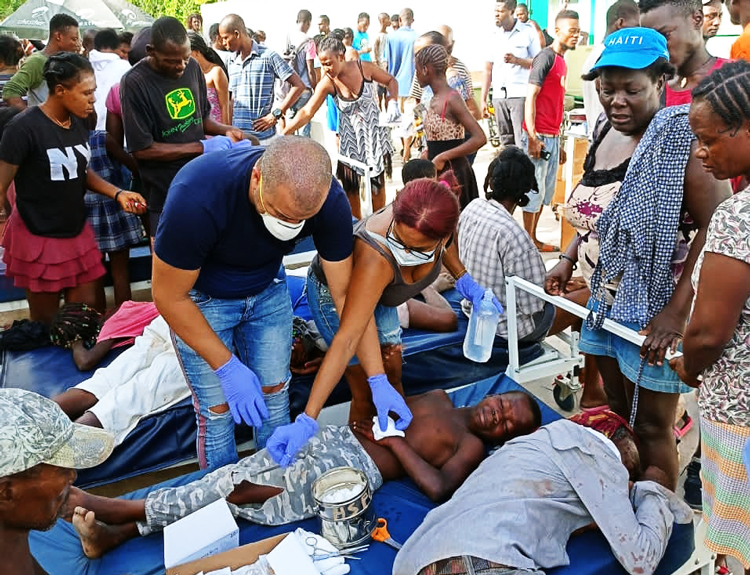
Volunteer Cuban health workers treat earthquake victims, other patients outside hospital in Corail, Haiti, Aug. 24. Cuban internationalists have worked continuously in Haiti for 22 years.
BRIGADA MÉDICA CUBANA EN HAITÍVolunteer Cuban health workers treat earthquake victims, other patients outside hospital in Corail, Haiti, Aug. 24. Cuban internationalists have worked continuously in Haiti for 22 years.

With more than 2,100 dead, over 12,000 injured and an estimated 136,000 families left homeless after an Aug. 14 earthquake that ravaged southwest Haiti, the trickle of international aid is nowhere near what is needed.

Just like in previous disasters there — including the 2010 earthquake that left about 300,000 dead and Hurricane Matthew in 2016 — the grossly inadequate aid shows that working people in Haiti don’t count for much in the eyes of the capitalist rulers in Washington and other imperialist powers. Despite the death toll from previous disasters, Washington and the succession of Haitian governments it has dominated haven’t improved the utterly inadequate health care available on the island.

The sharp exception is the internationalist aid from revolutionary Cuba, whose medical workers have provided care and health education in Haiti continuously since 1998, when it sent 350 volunteers in the wake of Hurricanes George and Mitch. To combat the spread of cholera introduced in Haiti by U.N. troops in 2010, the Cuban health care workers went house to house in the most isolated mountain regions, educating people about the necessary measures to prevent the spread of the disease.

Among thousands of Cuban medical volunteers providing health care all over the world, there are currently 253 doctors, nurses and other medical workers in Haiti, who will remain there as long as they are needed. This is a significant contribution in a country where there are at best 2,500 doctors, most in private practice and concentrated in wealthier neighborhoods.

Cuban internationalist medical workers already in the hardest hit earthquake zone began setting up makeshift hospitals and operating rooms. At the same time, they continue treating and aiding people across the country. Some of the volunteers are “sleeping in tents, like the more than 130,000 families who lost everything on Aug. 14,” reported Trabajadores, the weekly newspaper of the Central Organization of Cuban Workers.

For the last 22 years, these medical volunteers have collaborated closely with their Haitian colleagues and working people, including giving classes in the health centers and individual homes to raise consciousness about preventive medicine and sanitation.

Proud of Cuba’s socialist revolution

While the Cuban volunteers are scrupulous about not interfering in the internal politics in Haiti, they are proud of representing their socialist revolution.

We are “showing in practice the values of solidarity and humanism that the heroic guerrilla Ernesto Che Guevara has bequeathed to us,” reads a post on the Facebook page of Cuba’s mission in Haiti. Guevara was part of the Marxist leadership in Cuba that led workers and farmers to take power and subsequently served on internationalist missions to Congo and Bolivia.

The U.S. rulers and other opponents of the Cuban Revolution have been trying to stir up divisions in Cuba over the challenge the revolution faces in the midst of the COVID-19 pandemic and the tightening of the U.S. embargo. It’s a struggle for Cuba to get raw materials and syringes it needs to produce and administer its own vaccines.

Despite these obstacles, the Cuban government reported Aug. 24 it has now obtained supplies needed to inoculate everyone on the island and expects to have done so by the end of November.

“You are keeping medical brigades in other countries, as if there were doctors and medicine to spare” in Cuba, complained the editors of CiberCuba, a Spanish-based website, Aug. 23. “Everything is for propaganda, isn’t it?”

These counterrevolutionaries, who defend the dog-eat-dog morality of the capitalist market, are incapable of understanding that such solidarity is not “for propaganda,” but is in fact a product of working-class values that are the bedrock of a living socialist revolution. “We don’t offer what we have left over,” Cuban volunteers often explain. “We share what we have.”

What a difference from the so-called nonprofits, nongovernmental agencies and private companies that use the disaster in Haiti ostensibly to provide aid, but in fact to legitimize their operations and line their own pockets.

Working-class solidarity

In addition to the aid from the Cubans, workers and farmers in Haiti have turned to each other’s solidarity to get through the current crisis. “I have a friend who came from Port-au-Prince to bring me water and food and I shared that with my neighbors,” Marcel Francois told the press.

Dominican journalist Deisy Toussaint, who traveled by land from Port-au-Prince to Les Cayes, told channel 24 TV that she saw areas with homes totally destroyed, where five days after the quake no aid or rescue crews had arrived. “People told us they could hear people still alive under the rubble, and all they had were their hands to try to get them out.”

In the absence of any serious government response to the disaster, a handful of recent graduates from Haiti’s public medical school pooled their money for supplies and set up a clinic in Marceline.

More than 100 years of U.S. imperialist domination and superexploitation are perpetuating the miserable conditions working people confront in Haiti, ensuring natural disasters rapidly become social catastrophes.


Imperialist scorn, Cuban solidarity on display after earthquake in Haiti – The Militant

Earthquake, decades of US plunder brings social catastrophe in Haiti – The Militant

Earthquake, decades of US plunder brings social catastrophe in Haiti – The Militant

Saturday, August 21, 2021

Presidential election in Peru reflects rising class tensions – The Militant

Pedro Castillo, Peru’s newly elected president, took office July 28 in the midst of sharp political polarization and rising class tensions fed by a deepening economic and social crisis. Castillo, the candidate of Peru Libré (Free Peru), a party on the left of capitalist politics, defeated conservative Keiko Fujimori in a run-off by a razor-thin margin of 44,000 votes.

Fujimori and her ruling-class allies sought unsuccessfully to get the election results overturned. They and their imperialist allies in Washington claimed Castillo’s government was Marxist.

The change in government follows the deaths of more than 187,000 people from coronavirus, the world’s worst per capita death toll. Protests broke out in February after revelations that politicians and their relatives were given the COVID-19 vaccine months before the government began a public vaccination program.

Cuts on spending and the privatization of health care by previous governments have left working people with little or no access to medical care. In a country with a population of 32 million, there are only 276 mechanical ventilators, which are key to treating seriously ill coronavirus patients.

A quarter of Peru’s population lacks running water. Three out of four workers are self-employed in the “informal economy.” Many lost their family’s only source of income during strict COVID-related government lockdowns. While these forced many workers out of their jobs, it failed to contain infections. Some 10% more Peruvians now live in poverty than before the pandemic.

Castillo claims to be an ‘outsider’

Castillo, a former schoolteacher, union activist and small farmer, capitalized on long-simmering anger among working people. His campaign slogan, “No more poor people in a rich country,” helped him win votes, especially in the resource-rich southern Andes, where his promises to nationalize gas deposits and the mining industry got support.

Peru is one of the world’s top producers of copper, zinc, silver and gold, and has significant oil and natural gas resources. Around the world, mining companies are having some of the most profitable years on record, according to the Wall Street Journal. Profits for the top 40 mining companies are projected to be $118 billion in 2021 — up from $70 billion in 2020 and $61 billion in 2019. Meanwhile, governments in semicolonial countries like Peru, where mining is a key industry, face mounting debts to imperialist banks.

Under the government of Alberto Fujimori, conditions more favorable for capitalist investors in mining, oil, and logging operations were put in place in the 1990s. His regime suspended the constitution, tossed aside civil liberties and used brutal repression against its rivals. It also carried out widespread privatizations of banking and health care, cut subsidies and lifted price controls on basic necessities, ravaging the living standards of working people. These economic policies have been continued.

Top officials from the World Bank and International Monetary Fund lavished praise on Fujimori and every Peruvian government until now for managing the growth of the country’s capitalist economy at the expense of working people.

These policies also helped spawn a terrorist Maoist guerrilla force known as Sendero Luminoso, or Shining Path. This counterrevolutionary group was responsible for 12,000 killings, leading to brutal repression by the regime and further impoverishment of workers and peasants.

Alberto Fujimori, the father of Keiko Fujimori, is currently in prison after being convicted on corruption and murder charges. Largely supported by record high prices of commodities, Peru’s gross domestic product grew at an average annual rate of 5.6% between 2001 and 2016. But conditions for the majority of working people have been devastating.

Castillo is not the first bourgeois presidential candidate to run as an “outsider.” Nor is he the first to tap the hopes of working people, including indigenous populations long subject to discrimination, for greater control of the country’s resources. Ollanta Humala, elected in 2011, vowed to nationalize some industries, fight endemic corruption and excoriated the “neo-liberal model.”

Castillo’s campaign claims — touted in the capitalist media as a radical “socialist” agenda — rattled national and foreign investors. The value of the country’s currency, the sol, plunged after the election and inflation has risen. Since then, Castillo has reassured mining bosses that their interests are safe. He says he now favors “prudent” tax reforms instead.

“We are not Chavistas, we are not communists, we are not extremists,” Castillo said last month.

His government has taken Peru out of the Lima group of Latin American nations over that group’s calls for intervention to overturn the government of Venezuela. Peruvian Foreign Minister Héctor Béjar called July 30 for an end to Washington’s sanctions targeting the Nicolás Maduro government.

Castillo has backed off from his campaign call for a constitutional assembly to rewrite the 1993 charter written under Alberto Fujimori.

The need to replace the current constitution is presented by those on the left of capitalist politics in Peru as the main task ahead. They offer no program for mobilizing working people to fight for jobs, universal health care, greater control of production to protect land and labor, and other demands that can improve conditions.

These are the kinds of struggles, organized against the employers and their capitalist government, through which workers and farmers can chart a course forward. The best guide is the example of the Cuban Revolution, where Fidel Castro and the July 26 Movement led working people to take political power into their own hands and carry through a socialist revolution.


Presidential election in Peru reflects rising class tensions – The Militant

Defend, emulate Cuba’s socialist revolution! End US embargo! – The Militant

NEW YORK — Why does Cuba’s socialist revolution continue to live, fight and set an example worldwide more than 60 years after workers and farmers there took power? What makes class and social relations in Cuba so different from anywhere else in the world today?

Because 62 years ago the working people of Cuba were led by a Marxist leadership to make a socialist revolution, Martín Koppel and Róger Calero told a Militant Labor Forum here Aug. 14. Both are members of the Socialist Workers Party; Calero is the party’s candidate for mayor of New York.

“The revolutionary government was a new state power — workers power — that organized workers, farmers, youth and others,” Koppel said. “A socialist revolution is marked by a different kind of social relations, based on working-class solidarity, not capitalist competition.”

“There were two great socialist revolutions in the 20th century, one in Russia, the other in Cuba,” Koppel said, quoting from a letter sent by SWP National Secretary Jack Barnes to Cuban President Raúl Castro in November 2016 after the death of Fidel Castro (reprinted in this issue). In it Barnes noted that Castro’s “highest achievement was forging in struggle a revolutionary cadre, a communist cadre, capable of leading the workers and farmers of Cuba to establish the first free territory of the Americas and successfully defend it for more than five and a half decades” — now more than six! — “against the determination to destroy it by the mightiest and most brutal empire the world has known.”

The Cuban Revolution has been distinguished from the start by its proletarian internationalist record  — sending volunteer combatants to aid anti-imperialist struggles, or doctors and nurses to respond to earthquakes and hurricanes, and to combat Ebola and COVID-19.

“The U.S. rulers fear that workers and farmers around the world, including here in the United States, will follow the living example of Cuba’s socialist revolution,” Koppel said.

Transformation of social relations

The leadership of the Cuban Revolution instilled in working people confidence in their own capacities to transform and lead society, Koppel said. This transformation began during the revolutionary war itself, as the Rebel Army began to organize working people in liberated regions to take charge of health care, education, justice and agriculture.

In the days following the Jan. 1, 1959, popular insurrection that toppled the U.S.-backed dictatorship of Fulgencio Batista, the Rebel Army crossed the island and in every town along the way Castro spoke with crowds of workers and peasants to explain what they were fighting for.

Peasants were led to carry out a sweeping land reform. Workers “took more and more control of job conditions. They expropriated the capitalists’ factories, banks and big landholdings, and began to organize the economy to meet the needs of the majority, not the profits for a small exploiting class,” Koppel said. “Decisive steps were taken to outlaw racist discrimination, and to draw millions of women into economic, social and political activity.”

In 1961 an army of volunteer teachers, largely teenagers, spread across the countryside and wiped out illiteracy in a year, which also helped break down divisions between working people in city and country, Koppel said. That April the Cuban people defeated a U.S.-organized mercenary invasion in less than 72 hours.

As they were doing this, Koppel said, the Cuban leadership set out to “lend support to those around the world who were fighting to be free of imperialist oppression — from Algeria to Angola, a course of international solidarity that continues to this day.”

It’s these class relations, based on the expropriation of the capitalist exploiters and built over decades of promoting working-class consciousness, that make Cuba’s revolution different. This is why the U.S. rulers are determined to destroy it. And why it’s so important for working people the world over to defend it.

Cuba, like the rest of the world, is affected by the world capitalist economic crisis, Koppel said. The embargo imposed by Washington, and enforced on other countries, sharply limits Cuba’s access to the hard currency needed to buy food, fertilizer, fuel, medicine, spare parts, and other necessities. The embargo is compounded by the pandemic, which has decimated tourism, a major source of hard currency.

“Despite these challenges the Cuban government has sought to guarantee medical care and basic necessities to the population and to involve it in the process,” Calero said.

In response to a question from the audience, Koppel noted the collective response of the Cuban people to the pandemic. “No one has been left to fend for themselves,” he said. “And Cuba has now fully vaccinated a quarter of the population with their own extremely effective vaccine. They’ve done this while maintaining nearly 30,000 volunteer medical personnel around the world.”

On July 11 protests took place in Cuba “orchestrated by groups and individuals opposed to the revolution that receive funds from the U.S. government,” Calero said. “These groups took advantage of the hardships and effects of Washington’s sanctions that have been building up. Many people, including some who support the government, were drawn into the protests because they see no end to the difficulties they face.”

This is compounded by shattered illusions among some Cubans who had hoped that President Joseph Biden would reverse some of the most draconian restrictions of Washington’s punishing embargo.

But seeing the pressures in Cuba that are building up, the U.S. rulers have no intention of backing off their bipartisan effort to tighten the economic squeeze aimed at overthrowing the Cuban Revolution — an effort carried out by the previous 12 U.S. administrations since 1959.

Both open enemies of the revolution as well as liberals and “socialists” are part of the current political offensive against the Cuban Revolution, Calero said. He gave the example of Alexandria Ocasio-Cortez, the Democratic Party socialist congresswoman from New York, who calls for an end to the embargo while backing the recent U.S.-provoked protests in Cuba, repeating “the timeworn slanders that the Cuban government is a dictatorship that violates human rights.”

In the discussion one participant noted that among many in the U.S. who oppose the embargo there are those who say we should downplay the socialist revolution. They say this is the best way to win “progressive” politicians and businesses who might join in calling for ending aspects of the embargo for their own reasons, a strategy they argue is more likely to succeed. Behind this is their prejudice that “backward U.S. workers” can never be won to support a socialist revolution.

“The stronger the revolution is, the better the chances to force the U.S. rulers to back off their attacks on it,” Koppel said. “That’s the lesson of history.”

Defense of the Cuban Revolution is part of advancing the class struggle here, he said. “The best aid we can give to the Cuban people is to advance working-class struggles in the U.S.,” Calero said.

“The lessons of the Cuban Revolution and its Marxist leadership can’t be separated from the task of building a communist party here to lead the working class to power in the United States.”

“For young people and workers who are waking up to the crisis of capitalism today and want to do something about it, taking the time to study, absorb and use the lessons of the Cuban Revolution will prove decisive in who will win the class battles to come — the working class or the fascist thugs the capitalist rulers will unleash,” Calero said. That’s why the Socialist Workers Party spends so much time publishing and promoting study of books by leaders of the revolution.

Calero pointed to the efforts by the Cuban government and mass organizations to enable every Cuban — including those with physical and other disabilities—to participate actively in society and realize their full potential.  This includes everything from film programs for the blind to special steps, in face of the embargo, to ensure hearing aids and other equipment for those with special needs.

Human solidarity vs. barbarism

“It is the deeply ingrained sense of social solidarity and internationalism that underlies the Cuban people’s determination to defend the conquests of the revolution and to advance the social and political aspirations of working people around the world,” Calero said.

“Socialist revolution draws on human diversity. It seeks to provide human beings with the scientific and cultural advances that have accumulated over centuries of human activity, to allow for the development of every person to their fullest potential. This has been a guiding principle of the Cuban Revolution from the beginning.

“These values can only be produced by a socialist revolution. Values that millions of working people in the United States can recognize and be won to fight for,” Calero said.

Economic instability, war crises and class battles of major proportions lie ahead, he said. Pointing to midtown Manhattan with its boarded-up stores and thousands of homeless workers, he said, “That’s what Cuba was like for working people before the revolution, and what capitalism has to offer today.

“The Socialist Workers Party sees building a revolutionary working-class party in the United States as the central task in defense of the Cuban Revolution. We invite you to join us.”


Defend, emulate Cuba’s socialist revolution! End US embargo! – The Militant

‘Fidel belongs to the working people of the world’ – The Militant

The following letter was sent by Socialist Workers Party National Secretary Jack Barnes to Raúl Castro Ruz, first secretary of the Communist Party of Cuba, on Nov. 27, 2016, after the death two days earlier of Fidel Castro, his brother and central leader of Cuba’s socialist revolution.

There were two great socialist revolutions in the twentieth century, one in Russia, the other in Cuba. Neither was the product of a single individual. Both were the result of the operations of capitalism itself. But without the presence and political leadership of Vladimir Lenin and of Fidel Castro Ruz at decisive moments in those historic battles by working people, there is no reason to believe either revolution would have been victorious.

Apart from Lenin and Fidel, the history of the twentieth century — and the twenty-first — is unthinkable. Both of them, Marxist students of science and history, gave their lives to uprooting the dog-eat-dog exploitation, oppression and compulsion on which the capitalist world order depends and replacing it with a workers state, with new social and economic relations based on the liberating capacities of working people and the youth they inspire.

Fidel belongs to Cuba first and foremost, to the men and women of José Martí and Antonio Maceo. His highest achievement was forging in struggle a revolutionary cadre, a communist cadre, capable of leading the workers and farmers of Cuba to establish the first free territory of the Americas and successfully defend it for more than five and a half decades against the determination to destroy it by the mightiest and most brutal empire the world has known.

But Fidel belongs to the working people of the world as well. From Latin America and the Caribbean, to Africa and Asia, to North America and Europe, he showed us in action what proletarian internationalism means. During Cuba’s historic sixteen-year mission aiding the people of Angola and Namibia against apartheid South Africa and its promoters in Washington, Fidel demonstrated his unmatched political leadership on a world scale. He also proved, as the Rebel Army combatants of the Sierra knew well, that he was one of the toilers greatest military commanders ever.

All this is why Fidel became the most loved as well as the most hated, the most slandered man of our lifetimes.

As Fidel said in his farewell words to the Seventh Congress of the Communist Party of Cuba in April, “We all reach our turn.” He cannot be replaced, but his life work, Cuba’s socialist revolution — its example, and above all its ongoing march — stand as his monument. He needs no other.

For our part, members of the Socialist Workers Party and Young Socialists will continue to do everything in our power to publish and spread the truth about the Cuban Revolution and Fidel’s leadership, to make it known to working people in the United States and throughout the world. With unshakable confidence in the working class and its allies, we will continue to organize and act on the course Fidel uncompromisingly presented to the world in 1961, a month before the victorious battle of Playa Girón: “There will be a victorious revolution in the United States before a victorious counterrevolution in Cuba.”


‘Fidel belongs to the working people of the world’ – The Militant

Sunday, August 15, 2021

History of the Chinese CP: From revolutionary party to Stalinist betrayal to anti-working-class regime today – The Militant

....After Mao’s death, and a new round of purges, Deng Xiaoping emerged as CCP leader and charted a course to expand capitalist market relations in the 1980s. This led to a rapid expansion of Chinese industry, a huge growth of the working class and mounting conflicts between Beijing and Washington for markets and trade.

Deng, and Xi after him, maintained a dictatorial grip on power. Xi exalts the rule of the Han majority over China, running roughshod over national minorities like the Uyghurs. Union and other mass organizations are tightly controlled as agents of the regime.

The government has systematically crushed political rights in Hong Kong — as it has done for decades in the rest of China, including the slaughter of workers and youth demanding political rights in Tiananmen Square in 1989.

Xi and other CCP leaders fear the example of the protests in Hong Kong could spread among workers and farmers in China.

Working people there are a powerful social force that will make their mark on history. They will have the opportunity to build a party of their own — a party that merits the name communist — in the course of deepening class-struggle experiences and in response to advances in revolutionary struggles elsewhere in the world.

It will be forged in combat against the ruling Chinese “Communist Party” and the exploiting classes it defends.


Full:


History of the Chinese CP: From revolutionary party to Stalinist betrayal to anti-working-class regime today – The Militant

Saturday, August 7, 2021

Historical materialism is under ferocious attack today


Excerpt:

“Historical materialism is under ferocious attack today,” said Waters, “even though you may never hear that world outlook — one of the cornerstones of Marxism — mentioned by name.” The attacks are spearheaded not by the traditional centers of reaction, she added, but by privileged middle-class layers that many consider to be the “progressive” wing of liberal bourgeois democracy.

There is a concerted attempt to negate the scientific world outlook that has guided the revolutionary vanguard of the working class for 150 years and in its place to advance creation myths, fables, conspiracy theories, contempt for science and rejection of the cumulative cultural patrimony of humanity. This is what underlies much of what we know today as “culture wars,” Waters said.

“Culture wars are at bottom class wars, and they are deepening today above all because the class struggle is sharpening as the crisis of the world order brought into being by the workings of capitalism in the imperialist epoch advances — now accelerated by the COVID pandemic.”

This is the context within which communists carry out our political work today, Waters stressed, and that won’t change substantially until there are new labor struggles of a size and social weight that can demonstrate a different class road forward.

Citing Frederick Engels’ graveside tribute to Karl Marx in 1883, Waters noted, “Just as Darwin discovered the law of development of organic nature, so Marx discovered the law of development of human history: the simple fact … that mankind must first of all eat, drink, have shelter and clothing, before it can pursue politics, science, art, religion, etc.”

When Waters’ generation joined the SWP, she said, veterans of the communist movement “urged us to read and study, including works such as Engels’ The Origin of the Family, Private Property, and the State. They led us to become citizens of time and the world, to understand the ‘long view of history.’” Whatever our backgrounds, “we came to recognize and appreciate the diverse cumulative gains of humanity and to understand that communism will be built on the best of that culture.”

The New York Times  1619 Project was one of the examples of the political war on historical materialism addressed by Waters, as well as “cancel culture” and the counterrevolution on women’s rights represented by the campaign to deny the biological reality of two sexes.

The 1619 Project’s principal author, journalist Nicole Hannah-Jones, turns on its head the entire 500-year history of what is today the imperialist United States of America. At the center of her lead article she asserts the “belief, that black people were not merely enslaved but were a slave race, became the root of the endemic racism that we still cannot purge from this nation to this day.”

In other words, Waters noted, “she asserts that our history has been driven by an idea.” It has nothing to do with the fact that “the degree of economic development attained by a given people or during a given epoch form the foundation upon which the state institutions, the legal conceptions, art, and even the ideas on religion, of the people concerned have been evolved.” 

Waters noted that the entire piece by Hannah-Jones is a hymn to bourgeois democracy as embodying the highest of human “ideals,” which she claims Black people believe in more than any other segment of U.S. society.

Many of the facts of U.S. history referred to by Hannah-Jones, especially the meaning of the bloody counterrevolutionary crushing of post-Civil War Radical Reconstruction, are things the Socialist Workers Party has educated working people on for decades.

“Our job,” Waters said, “is to raise the discussion to a higher level and explain the unique character of black chattel slavery in the Americas, which didn’t arise out of pre-class society. On the contrary, it was grafted onto U.S. capitalist production for the world market and became a bigger and bigger obstacle to capitalist development, which depends on free wage-labor as the basis of capitalist production.”

Capitalism is the root of “systemic racism” in the U.S., not “white supremacy.”


Full:

SWP conference: Leading the working class to take power – The Militant