On the ninetieth anniversary of the founding of the Chinese Communist Party we begin the publication of a series of articles that trace the origins and subsequent development of this party, which has played a key role in world history. In this first part Dan Morley outlines the conditions in China that led to the foundation of the party as part of the Communist International. The founders of the party looked to the October revolution in Russia as their model, with the working class playing the leading role.
Today, July 1
st, 2011, the Chinese Communist Party (CCP) celebrates its 90
thanniversary. During this lengthy period it has played a decisive role in the most profound and dramatic changes in Chinese and world history. The struggles and heroic sacrifices of hundreds of millions of Chinese peasants and workers in the past expressed themselves through this party.
For these reasons we must rank the CCP as an important political force in world history. Marx asked even in 1853, “can mankind fulfil its destiny without a fundamental revolution in the social state of Asia?”
Today, however, how do we assess the role of the party in Chinese society, after all these decades and transformations that the party and China have undergone? Where is the CCP going? Before we can answer this question we must first look at the remarkable history of this party as it has intertwined with China’s over the past 90 years.
The Chinese revolution of 1949 (preceded by a botched revolution in 1925-7 in which the newly formed CCP played a key role) stands as one of the greatest proofs of the proposition that, in the final analysis, it is the development of the means of production which determines the political superstructure of a society. For despite the heavy weight of the Stalin led Communist International (Comintern) on the burgeoning Chinese revolution, which artificially imposed onto the CCP a false political line conjured up to suit the interests and prejudices of the Russian bureaucracy rather than the needs of the Chinese revolution, the victory of the Chinese revolution could only be delayed. Although it is true that the peculiar course of development that the CCP subsequently undertook under erroneous direction from Stalin, that is heavy bureaucratisation and the abandoning of the working class for the peasantry, profoundly altered the social and economic history of China, nevertheless the underlying and unavoidable trend, visible since the 1840s, of the economic development of China under pressure from imperialism, creating a powerful working class capable of expropriating capitalism, asserted itself in spite of and through the political mistakes of the Comintern in Russia. Such were the contradictions of capitalism in China that all the political errors and meddling from Stalin could not hold back the course of history.
Opium Wars and Imperial Humiliation
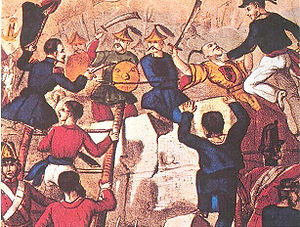
The period which preceded the founding of the CCP in 1921 was the re-entry of China onto the world stage and its subordination to imperialism, primarily British imperialism. China was on the inexorable path to social revolution ever since Britain dragged it into the world market by means of the gunboat in the criminal Opium Wars (1839-42 and 1856-60). Britain and its East India Company suffered a trade imbalance with China even then (some things never change!). The British used the battering ram of addictive opium, grown in India and sold illegally to the Chinese, to prise open the Chinese market. But as always, they needed the auxiliary force of guns to get the trade terms they desired. But blinded as ever by short sighted greed, the British could not understand the corrosive effect this trade was to have on Chinese society.
“Besides this immediate economical consequence, the bribery connected with opium smuggling has entirely demoralised the Chinese State officers in the Southern provinces. Just as the Emperor was wont to be considered the father of all China, so his officers were looked upon as sustaining the paternal relation to their respective districts. But this patriarchal authority, the only moral link embracing the vast machinery of the State, has gradually been corroded by the corruption of those officers, who have made great gains by conniving at opium smuggling” (Marx, Revolution in China and in Europe, 1853)
This violent (and narcotic!) entry of capitalism through the barrel of the British cannon really spelt the end for the Manchu Qing dynasty and traditional Chinese society, which was to meet its final doom in 1911. Marx was already speaking of the existence of the Chinese revolution in 1853, and its interdependence with the European revolution. The decisive question was, what would be the character of the revolution, what would Qing despotism be replaced with and by which social force? The crisis in Chinese society which British imperialism engendered, led directly to a revolutionary movement at this time, which Marx thought could even have sparked off a revolution in Europe, “it may seem a very strange, and a very paradoxical assertion that the next uprising of the people of Europe... may depend more probably on what is now passing in the Celestial Empire [China]... than on any other political cause that now exists” (Ibid). The Taiping Rebellion, as it was known, swept through China, leading to what is thought to be around 20 million deaths, the most violent civil war ever and possibly the most bloody war of the 19th Century. It threatened the very existence of the Chinese state thanks to the popularity of its programme – land socialisation, suppression of private trade and the abolition of foot binding. Its ranks were drawn from the peasantry and the town labourers. These class based demands were brought to the fore thanks precisely to the devastating economic impact of trade with Britain.
“The tribute to be paid to England after the unfortunate war of 1840 [i.e. the sanctions imposed onto China after its defeat in the 1st Opium War], the great unproductive consumption of opium, the drain of the precious metals by this trade, the destructive influence of foreign competition on native manufactures, the demoralised condition of the public administration, produced two things: the old taxation became more burdensome and harassing, and new taxation was added to the old. Thus in a decree of the Emperor, dated Peking, Jan. 5, 1853, we find orders given to the viceroys and governors of the southern provinces of Wuchang and Hanyang to remit and defer the payment of taxes, and especially not in any case to exact more than the regular amount; for otherwise, says the decree, ‘how will the poor people be able to bear it?’ ” (Ibid)
Capital, with its cheap goods and superior technology developed thousands of miles away in accordance with a completely different social environment, did not respect the millennia old settled structure of Chinese society; instead it violently shook it up with wanton disregard for the consequences.
“The widespread use of opium caused a flow of wealth from the countryside to the towns and led to an alarming contraction of the internal market. The silver shortage caused by the drain resulted in a 20 to 30 percent depreciation of the copper currency in common use and a sharp rise in the cost of living. Debased coinage came into use. Foreign cotton goods and other commodities drove Chinese handicrafts to the wall, especially in the Southern provinces. The weavers who had produced the 3,359,000 pieces of cloth exported in 1819 lost their means of livelihood when the exports dropped to 30,600 pieces in 1833 and almost to zero in the next three decades... The accumulative result of all these agencies of dissolution was mass pauperisation and the creation of a large floating population.” (Isaacs, The Tragedy of the Chinese Revolution)
So at this end of society the effects of imperialism were destructive, continually creating the social conditions and the foot soldiers for revolution and a new, modern China. These are the real beginnings of the Chinese Communist Party. But at the other end of society, the effects of this trade were profoundly conservative and even regressive. The wealth of British capitalism ‘trickled down’ to the old Chinese ruling class, leading to an exaggeration of feudal relations and a strengthening of feudal power backed up with British cannons.
“Among these merchants and officials, a new class took shape, the class of compradores, brokers for foreign capital on the Chinese market... The commanding economic positions the foreigners occupied blocked the channel of indigenous, independent capitalist development. The wealth accumulated by these Chinese merchants and officials went not into capitalist enterprise but back into land. Most of these individuals stemmed to begin with from the landed gentry and they used their money to increase their family holdings. This process visibly hastened the growth of large landed estates and the expropriation of smaller landholders... The profits went back not only into land purchase but into loans at usurious rates to the peasants, who increasingly had to borrow to bridge the gap between their decreasing incomes and their rising costs and taxes... the peasant could not adapt himself to the change. He was simply ruined by it... He not only could not produce enough to provide him with a surplus, but had to go into debt for fertilizer, for food to tide him over until harvest time, for seed, for the rental and use of implements. For these he mortgaged away not only his crop but his land... losing his land, he became a tenant. To the landlord he had to surrender 40 to 70 percent of his crop and a substantial additional percentage, often in special dues, gifts, and obligations preserved from the dim feudal past, including the duty of free labour on special occasions fixed by ancient tradition... This [landlord] class, vitally concerned with preserving all the inequalities on the land from which it profited, became one of the chief instruments of foreign penetration and control.” [Ibid]
No wonder millions of pauperised peasants and labourers for hire signed up to fight the regime. The Taiping Rebellion was accompanied with land seizures by peasants. Within its conquered areas attempts were apparently made to stimulate an internal market, agricultural production, develop exports and to suppress the opium trade. In other words, it bore signs of developing into a classic bourgeois revolution, whose main tasks should be to establish national sovereignty and a national market, and thoroughgoing agrarian reform, precisely those tasks most desperately needed in China at the time. But rather than develop in accordance with its own indigenous impulses, as an Asian edition of the same bourgeois revolutions that transformed Europe in previous centuries, Chinese history was pushed down a different course thanks to the existence of the world market and British and French guns. The Taiping Rebellion was bloodily defeated in 1864, after 14 years of struggle, thanks in large part to imperialist intervention. Military and naval forces under the control of General Charles Gordon (‘Chinese Gordon’) were decisive in winning key battles. But why would the British bourgeoisie wish to halt a potential bourgeois revolution like that which had brought themselves to power in their homeland? Because the rebellion’s threatening of the lucrative status quo, the threat of Chinese capitalism developing independently, and the threat of ending the opium trade, were threats to the most powerful actor on the world market, Britain. Thus the supranational character of a powerful imperialist nation halted and altered the national development of another.
So in the historical background to the Chinese revolution and the creation of the CCP, we find an enormous validation of the Marxist proposition that capitalism develops into a world market, which is “not a sum of national parts” but “a mighty and independent reality which has been created by the international division of labour”. The world market sped up but also truncated the development of China. Rather than repeat the history of England or France, having its own national revolution like theirs, China found itself as a part of an already existing world market. Marx considered the creation of the capitalist world market as having been achieved precisely with the inclusion of China in that market, “the particular task of bourgeois society is the establishment of the world market... as the world is round, this seems to have been completed by the colonisation of California and Australia and the opening up of China and Japan.” Thus the tasks of the Chinese revolution fell to the CCP as a particular phase of the world socialist revolution against the masters of this market, rather than as the task of establishing a Chinese national market.
Xinhai Revolution and the end of the Qing Dynasty
By the beginning of the 20
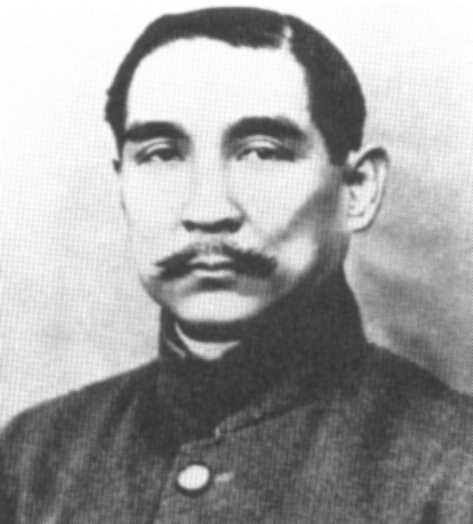
th century, dissatisfaction with the old regime and a burning desire for change were reaching boiling point. There was a ferment of discussion in the youth on how to revive, renew and modernise China. The moral corrosion and undermining of the traditional state apparatus led to enormous dissatisfaction amongst the mostly privileged youth who would previously have enrolled in the Imperial exams for entry into the state apparatus. At first the dominant idea in these layers was to reform the Chinese state so that it could be a constitutional monarchy or modern parliamentary system like Britain or the USA. But it became apparent that the old regime would not reform itself and was determined to cling to its power and privileges. As a result, various revolutionary organisations and journals proliferated, especially in the South and East of the country. By and large, these organisations set themselves the goal of overthrowing the Qing Dynasty and establishing a national Chinese republic. Socialist, and certainly Marxist ideas, had not yet really penetrated into Chinese society. From the perspective of posterity, two individuals and their respective organisations/journals stand out from the first decade of the 20
th century – Sun Yat Sen and the Tongmenghui (latterly the Guomindang or Kuomintang, the nationalist party still leading Taiwan), and Chen Duxiu and his
Anhui Common Speech Journal and
New Youth Magazine.
By 1911 these republican, bourgeois revolutionaries were in the ascendency and had conquered Wuchang in Central China after a failed uprising in Guangzhou (Canton). This is known as the Xinhai revolution. The ruling Qing Dynasty had rotted from within, so thorough was its decline that it could find no source of strength even in the nobility. In 1912, the Emperor abdicated and a republic was declared, and governments the world over recognised the new regime. It would appear that China had finally had its bourgeois revolution, and the task of establishing real sovereignty based on a Chinese national market and land reform could begin in haste. Yet only nine years later, the Chinese Communist Party was to be formed and within another four years, a second, far more comprehensive revolution would begin. Why?
In the bourgeois revolutions of England and France, the capitalist class stood at the head of the nation, leading a genuine ‘urban democracy’ that united behind it the labourers and semi-proletarians of the cities, and the peasants of the countryside, both of which were the ground troops of the revolution. Cromwell’s New Model Army was a democratic, revolutionary army composed of these elements. It directly carried out the revolution. The Xinhai revolution, on the other hand, although gaining the sympathy of the masses, was actually carried out largely by disaffected local gentry, military men and bureaucrats. Because its leadership did not want to challenge capitalism (and imperialism) it had little social impact, and whereas the likes of Cromwell and Robespierre were characterised by enormous courage and determination to carry through a thoroughgoing transformation, buoyed on by the masses, the leaders of the Xinhai revolution, Sun Yat Sen and others, ultimately were compromising and deferential both to the old regime and the imperial powers. This was because they were led by those gentry and bureaucrats who, as described above, had a vital interest in preserving the social status quo. In order to force the abdication of Emperor Puyi, rather than mobilise the masses throughout the country on a social programme to overthrow the regime, Sun Yat Sen, now President of the new Republic in the South, struck a deal with Yuan Shikai (who was appointed Prime Minister of the Imperial Cabinet by the Emperor) that if he could deliver the Emperor’s abdication, then Sun would resign and give the Presidency to Yuan. And the terms of the abdication and establishment of the Republic were as follows:
- The Qing Emperor remains and will be treated as a foreign monarch by the Republic’s Government.
- The Republic will allocate 4,000,000 Yuan each year for royal expenses.
- The emperor will remain in the Forbidden City until he can be transferred to Yiheyuan (the Summer Palace).
- Royal temple and tombs will be guarded and maintained.
- The expenses of Guangxu's tomb will be disbursed by the Republic.
- Royal employees will remain in the Forbidden City with the exception of eunuchs.
- Private property of the royal family will be protected by the Republic.
- Royal forces will be incorporated into the army of the Republic.
In other words, the revolution resolved itself into a change of personnel at the top. Following this, a tussle for power broke out at the top of the regime and Yuan Shikai attempted, unsuccessfully, to reinstate the monarchy (with himself as Emperor!). The republican government was completely split, ultimately because there was no real national bourgeois class behind it, rather it was based on feudal warlords lending it support, in whom power really lay. The degeneration of the revolution into local warlordism, the inability to form a real national government, and to solve burning social questions, in particular land reform, is proof that the bourgeois, national revolution, whose two main tasks are precisely the formation of a national government and market, and land reform, could not be completed without breaking from the social basis of capitalism in China at the time – the landlord/compradore bourgeois class. The gentry who had supported the revolution insofar as it stopped at the Emperor’s abdication had no interest in leading the development and modernisation of Chinese society, and instead merely saw an opportunity to strengthen their own local power in the absence of a strong national government. Hence the splintering of China into local fiefdoms after 1911.
It was the failure of this revolution that led to a radicalisation within the Chinese youth and, crucially, the nascent Chinese proletariat. There was a crisis of confidence in the idea of Western parliamentary democracy as the way out. In 1919, many still looked with hope to the Versailles peace negotiations after World War I. They hoped that the redrawing of the world map in accordance with Woodrow Wilson’s ideals of national self determination would liberate China from the humiliating burden of imperial domination without the need for internal strife and a violent struggle against the powerful West. But their hopes were dashed when China was betrayed. Despite having supported the Allies in the understanding that, in the event of an Allied victory, the Shandong peninsula would be returned to Chinese national sovereignty after having been controlled by Germany, the Treaty of Versailles actually handed over control of Shandong to Japan. This harsh lesson in imperialism sparked a mass movement of Chinese students known as the May 4th Movement.
Chen Duxiu
Above all the other members of the intelligentsia it was Chen Duxiu who understood the social question in the Chinese revolution. Whilst pushed into the background by the more ‘practical’ and political likes of Sun Yat Sen, Chen was founding and editing periodicals attempting to find a way out of China’s crisis. Whereas others reacted to imperial dominance either by advocating a return to traditional Confucian values as a means to escape the corrupting West, or alternatively the emulation of the Western political system, Chen sought a way to give the common, downtrodden Chinese people a voice and a way out. The
Anhui Common Speech Journal which he founded was devoted to finding a way to transform Chinese written language, and as a result Chinese culture and life as a whole. Of course the vast mass of Chinese people were excluded from official culture as they were illiterate, and the written language had an extremely formal, rigid and conservative structure, was governed by anachronistic rules, and bore little relation to vernacular Chinese as spoken by ordinary people. This is the equivalent of a campaign in medieval Europe for literature and church services to be given in the vernacular languages of the common people rather than Latin. Indeed the translation of things such as the Bible into English, German etc. from Latin, and the invention of the printing press, did contribute substantially to the Reformation and the general undermining of the feudal class.
In essence, what Chen was doing was beginning, amongst a layer of Chinese youth, a theoretical discussion on how to liberate the masses of downtrodden Chinese. And despite temporarily experimenting with numerous different ideas, Chen in his journals came to the conclusion that it was not by a return to the past that China would be liberated, but that a fundamental break with ossified feudal traditions and relations was necessary. And his journals were extremely popular, “no other Chinese intellectual had the prestige and authority among China’s youth that Chen Duxiu had on the eve of the May 4th Movement” (Lee Feigon, Chen Duxiu). It is estimated that his New Youth Magazine may have had a circulation of 200,000. As Lenin said, without revolutionary theory there can be no revolutionary movement. Just as the tumultuous theoretical debates within the Russian Social Democratic Labour Party (out of which the Bolsheviks came) laid the solid foundation for the successful taking of power in 1917, so Chen’s journals and student discussion circles in the period 1904-1921 were decisive in educating the young, founding cadres of the Chinese Communist Party.
As has been said, the Chinese Revolution had to be realised as part of a world socialist revolution, and not a national, bourgeois revolution, because China’s feudal ruling class was already tied by a thousand threads to the capitalist world market, preventing the emergence of any independent, national bourgeoisie to lead the fight against feudalism and imperialism. From the Marxist point of view, the dragging of China into the world market, albeit in such a destructive manner, is ultimately (and only ultimately) a progressive thing, because it led to the development of China’s productive forces, the creation of a Chinese proletariat, and made possible “a fundamental revolution in the social state of Asia”, i.e. the establishment of socialism in Asia, so that mankind could “fulfil its destiny” – the world revolution – as Marx said.
It is quite fashionable nowadays to accuse Marxist thought of really being just another edition of arrogant, Western imperialist thinking coming out of the Enlightenment. It is said that Marx had a patronising contempt for non-Europeans and thought it their rightful destiny to always follow the West. But the truth is that Marx defended the Chinese people against the outrageous crimes of the British capitalist class, and in his articles in the New York Daily Tribune he appealed not to ‘the West’ as one bloc, but to revolutionaries and proletarians in the West to oppose their own imperialist governments and solidarize with the Chinese people. Marx understood that the British government was reactionary, and so the results of the colonisation of China were only progressive insofar as they resulted in the downfall of the Chinese ruling class and the Western ruling class – hence his enthusiastic anticipation of a European revolution being sparked by one in China, as quoted above. Furthermore, when reading Marxist literature that describes as backward a nation such as China, this is not a racial slander on the Chinese people but a correct characterisation of the antiquated mode of production and the antiquated Chinese ruling class, rather than the Chinese people. This is proven by the historical fact that it was capitalist Western states, by force, which opened up and undermined China, and not the other way around. Only now is China competing on a more or less even capitalist basis with the West. That it may soon overtake the West is also proof that this is not in any way a ‘racial’ question. It is not that Marxism considers imperialist domination of one over the other right or good, or an expression of national superiority, but simply that imperialism is an unavoidable phase in history. That world history has borne witness to imperialism is an undeniable fact. Long term historical development is the only test for the validity of corresponding theories, not the ‘anti-orientalist’ professor’s study.
A New Class
By the early 20th Century something fundamentally new and of enormous historic significance was happening in China – a modern, urban working class and industry were developing. For imperialism has a dual expression – certainly, as we have shown for China, it truncates and distorts the development of colonised nations, upholds, strengthens and even exaggerates antiquated social relations and means of production. But it does so only so that it may incorporate the nation into the world market, making it a part of the world division of labour involving the most developed technology. The pauperisation of the rural population may strengthen the old landlord class, but it also creates a large pool of cheap labour, ideal for exploitation by the large quantities of capital passing through the trading cities. So while, as described above, we see an intensification of feudal exploitation and a decline in agricultural productivity to pre-colonial levels, we also see in China, side by side with this, an industry and working class developing in places like Shanghai and Guangzhou based on the latest capitalist technology and methods. This phenomenon Trotsky termed ‘combined and uneven development,
“the accumulation of wealth by this class [the compradore, landlord class] could not fail in the nature of things to stimulate efforts to compete with the foreigners on their own ground. Imperialism had destroyed the old economic base. It could hinder but not entirely prevent the erection of a new one... The first rice-cleaning mill was established in Shanghai in 1863. The Kiangnan shipyard was established in 1865. Seven years later the China Merchants Steam Navigation Company was organised to compete with the foreign monopoly in coastal and river shipping... A modern coal mine began operations at Kaiping in 1878, and in 1890 the first cotton-spinning and –weaving mill was built at Shanghai and the first Ironworks at Wuchang. Match factories and flour mills had followed by 1896. The industrialisation of China had begun.” (Isaacs, op cit.)
Of course these modern factories did not run themselves and required large numbers of no doubt former peasants, thrown off the land, to do the work. In particular it was the impulse given to Chinese industry by World War I that developed the working class that was in the next few years to lead the second Chinese revolution and join the newly formed CCP. Whereas previously China had known a long history of peasant revolts that could only result in the swapping of one ruling Dynasty for another, (the Taiping rebellion of 1850-64 might have been different were it not for the imperialist intervention) owing to the scattered and variegated peasantry’s dependence on the leadership of an urban class, this formation of a new urban class, just as exploited as the peasantry but with the capacity for revolutionary political leadership, meant that the potential now existed to do away with Dynastic, landlord and even bourgeois rule once and for all.
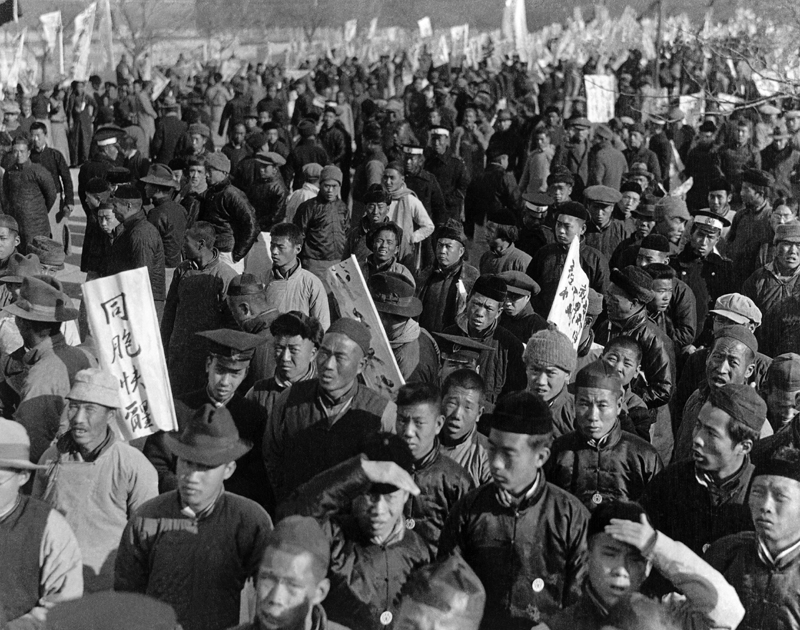
The power that the working class possesses, thanks to its socialised conditions of existence, shared interests and vital economic role, was first really expressed in China in the already mentioned May 4th Movement in 1919. Started by students, the anti-Japanese and Western protests received a powerful and hitherto unknown fillip from the Shanghainese working class,
“At the end of 1916 there were already nearly 1m industrial workers in China and their number nearly doubled by 1922. An army of nearly 200,000 Chinese labourers had been sent to Europe during the war. Many of them learned to read and write and, even more significantly, came in contact with European workers and the higher European standard of living. They returned with new ideas about man’s struggle to better his estate... These workers played a key role in the creation of new labour organisations, in which they formed a solid and energetic nucleus... Their strikes in Shanghai and other cities in 1919 more than anything else forced the release of student demonstrators arrested in Peking and hastened the resignation of the offending government officials.” (Ibid, our emphasis)
Despite being only 7 years after the Xinhai revolution that ended the Qing Dynasty, this decisive entry of the Chinese working class onto the stage of history sparked off a new revolution and gave an enormous impulse to revolutionary ideas. After all, the 1911 revolution had been an indubitable failure. A crucial factor in the second revolution, a subtle detail that was not understood by the Stalin/Zinoviev dominated Comintern, was that for all their fame for having led the anti-Qing revolution, the Guomindang were at the same time tarnished as a revolutionary force precisely because of their compromising role in 1911. They led the pre-working class revolution, but by 1919 the working class had changed everything, “the Kuomintang, heir to the party of the 1911 revolution, had fallen into sterile impotence.” (Ibid)
These two characteristics – the new class division in Chinese society and its link to Western revolutionary, socialist ideas, cried out for a political expression able to complete what the Guomindang had failed to do in 1911 – a revolution that would restore Chinese national sovereignty and really unite and modernise China.
In Europe, the merciless exposure of the illusions and limitations of the ‘Enlightenment’ ideals of the bourgeois revolution, in particular the illusion of harmonious progress, by the cold realities of capitalism, led to an explosion in pessimistic thought amongst the intelligentsia. The likes of Nietzsche questioned whether progress really ever existed and sought purely individual solutions to the soulless conditions of capitalism. This has its modern equivalent in ‘post-modernism’ and those who speak of the futility of collective struggle and the ‘end of ideology’ (whilst happily dishing out their own eclectic ideology!). In doing so they only prove their short sightedness, their contentment with the status quo (despite the pessimistic talk of ‘no progress’) and befuddlement in the face of the most superficial trends. Likewise the failure of the first Chinese revolution in 1911, and the brutal, inhuman reality of ‘modern’ and ‘advanced’ Western rule, caused many members of the Chinese intelligentsia to descend into pessimism, “reacting against what they saw as the hypocrisy of the West, many Chinese thinkers, like many Westerners of the time, began to question the value of progress... After a visit to Europe where he witnessed the devastation and demoralisation that had occurred as a result of the war, Liang [Qichao] returned to China in 1919 and denounced what he called “the dream of the omnipotence of science.” Liang and his associates insisted that the Chinese should respect their own civilisation by paying more attention to certain traditional “spiritual values.”” (Feigon, op cit.) Liang must have been left with his jaw on the floor when, immediately after making these statements, the Chinese working class gave him a lesson in how to restore Chinese dignity by borrowing ‘European’ methods of strike action to defeat the pro-Western government in 1919! Similarly, our 21st Century intellectuals must be dumbfounded by the good old revolutionary methods being rediscovered in the Arab world, Europe, and indeed China today.
Chen Duxiu on the other hand stood head and shoulders above other intellectuals of the time (apart from the other founders of the CCP such as Li Dazhao). Thanks to his decades in running journals dedicated to the revolutionary youth, always seeking a way out for China, Chen and his young followers had drawn the conclusion that traditional values were a part of the problem, (it was after all the traditional Chinese state, based on Confucian ideology, that had sold out to the ‘advanced’ West) and that new scientific ideas, ones not tainted by exploitative capitalism, were needed to liberate China, “Chen earlier had made the importance of science one of the focal points of his attacks... he was not willing to allow Liang to disparage Western scientific values. It was in this context that Chen, like many others who were disappointed with Western bourgeois democracy, began to take a second look at the Bolshevik Revolution.” (Ibid, our emphasis).
The Russian Revolution and the Founding of the CCP
The Russian Revolution had a profound effect on the consciousness of Chinese youth and workers, as elsewhere. It meant that the most forward thinking people would now look to Marxist ideas for a way forward, and not those of Liberalism. Having captured state power to enable the socialist reorganisation of society, the working class operates under a fundamentally different foreign policy to the capitalists. Instead of seeking to manoeuvre on the world stage to enhance their power at the expense of others, as any powerful national capitalist class must do, the working class must seek to extend their revolution across borders and extend active solidarity to workers elsewhere whenever they can, because that is the only way to consolidate and develop their own revolution. This principle has been witnessed very recently in the Arab Revolutions, and will also be crucial for the European working class in the present crisis. These are the principles on which the Communist International was founded, in the same year that the Chinese working class entered the stage:
“Internationalism is the subordination of the interests of the proletarian struggle in one nation to the interests of that struggle on an international scale, and the capability and readiness on the part of one nation which has gained a victory over the bourgeoisie of making the greatest national sacrifices for the overthrow of international capitalism.”
These noble words were put into practice in the same year, 1919, when the Soviet government enacted the Karakhan Manifesto, which relinquished the territories, rights and privileges that the Tsarist government had won from China in the past. In the context of the disgraceful handing of Shandong from German hands to the Japanese behind China’s back in the Versailles Treaty, along with all the other humiliations exacted from the Chinese people by the West, this act of the revolutionary Russian government must have had a massive impact on the Chinese at the time. Quite possibly it was this above all else that convinced many, in particular the followers of Chen Duxiu, to form the Chinese Communist Party and apply for affiliation to the Communist International in 1921.
By 1919 Chen’s
New Youth Magazine had been advocating a form of Marxism and other socialist ideas for some time. He wanted to form a political party using his base amongst the youth to change China. In the disciplined and revolutionary Bolshevik party that had led Russia’s revolution and was changing the whole world, he found what he decided was a suitable blueprint. Li Dazhao, the other outstanding founder of the CCP, had also embraced the Russian Revolution and formed a Marxist study group amongst students. He made contact with the Comintern and joined with Chen Duxiu and his numerous followers to make preparations for founding the Chinese Communist Party.
The Manifesto of the CCP was published in November 1920, 72 years after the founding manifesto of the Communist movement, and it openly declared right from the beginning the intention to lead the working class to power in a socialist revolution, marking a fundamental break with the hitherto dominant idea of the need to form a Western style bourgeois, parliamentary democracy in China,
“The first step toward realising our ideal society is to eradicate the present bourgeois system. That can only be done by forcefully overthrowing the capitalists’ state... The Communist Party will lead the revolutionary proletariat to struggle against the capitalists and seize political power from the hands of the capitalists, for it is that power that maintains the capitalist state; and it will place that power in the hands of the workers and peasants, just as the Russian Communists did in 1917.”
It is worth noting that this manifesto, and the coming documents of the First Congress in 1921, were drafted with the explicit aid of the Comintern leadership in Russia. Peng Shuzhi describes the process whereby the party was formed:
“The first Communist group in China was established in Shanghai in May 1920, with the help of Grigori Voitinski, the first representative sent to China by the Communist International under the leadership of Lenin and Trotsky... Two months after the establishment of the Shanghai Communist Group, a Socialist Youth Corps (SYC) was founded. The SYC recruited groups of young communists to be sent to study in Moscow. Beginning in August 1920, the Communist Group published a weekly organ, The Labourer. It was also responsible for spreading communist ideas among the workers and developing modern trade unions. By September, the famous New Youth monthly, edited by Chen Duxiu, became the organ of the Shanghai Communist Group and publicly advocated Marxism, while reporting on the true situation in Soviet Russia. Then, in November, the CG published a clandestine monthly, The Communist, in which Bolshevik ideas and revolutionary experience were introduced, along with writings about communist movements in other countries. This journal also printed the “Manifesto of the Communist International to the Workers of the World,” written by Trotsky, and Lenin’s report to the Second Congress of the Communist International... from about October 1920 other communist groups were set up in places like Beijing, Wuhan, Changsha, Guangzhou and Jinan.” (Peng Shuzhi, Introduction to Leon Trotsky on China).
Such was the extraordinarily rapid development of the party that would soon play such a decisive role in China. This speedy development was thanks largely to Chen Duxiu’s and others’ decades of preparatory work (the end result of the formation of the CCP they were of course unaware of at the time) and the earth shattering events in Russia in 1917. Without the formation of the Comintern there can be no doubt that the CCP would not have been formed, certainly not in such a timely fashion and with such a clear commitment to revolution. The founding programme of the CCP in 1921 is not only an immensely important historical document, but is still relevant to the needs of China today:
“Our party programme is as follows. (1) To overthrow the bourgeoisie with a revolutionary army of the proletariat and to rebuild the state with the toiling classes, until all class distinctions are abolished. (2) To introduce a dictatorship of the proletariat in order to achieve the goal of class struggle – an end to classes. (3) To destroy the system of bourgeois private property and to expropriate machines, land, factories, and the means of production, including semi-finished products. (4) To ally with the Third International.”