Mu

Mu

Tuesday, February 1, 2011

Philosophy

http://pubs.socialistreviewindex.org.uk/isj99/thomas.htm

Philosophy and the masses

A review of Stathis Kouvelakis, Philosophy and Revolution: From Kant to Marx (Verso, 2003), £17

MARK THOMAS

Is Marxism simply an insightful way of looking at capitalism, or does it possess a plausible strategy for transforming society?

In the late 1990s there was a certain revived interest in Marx. But this was Marx as the great critic of the anarchy of capitalist production. This was the time of the Asian economic crisis, and even free market apologists were thrown into panic and talked of 'the end of capitalism'. But Marx's communism and advocacy of working class revolution remained derided and dismissed.1 The argument was that Marx's political project was not to be taken seriously in the wake of the collapse of the regimes in Eastern Europe. Theory and practice were thus kept at arm's length. You can use Marx to analyse capitalism, but don't attempt to change it.

In fact, the claim that Marx had no coherent theory of politics was one of the central themes in the onslaught on Marxism in the late 1970s. The alleged role Marx gives to the economy leaves no space for human intervention in the realm of politics, and Marx's emphasis on society over the individual leads to a rejection of the classical issues concerning liberal political thinkers, namely justice, rights, and so on. The argument runs that this paves the way for totalitarianism, where an all-powerful state annihilates the individual.2

Stathis Kouvelakis's Philosophy and Revolution has the great merit of taking Marx's political project seriously. It traces the emergence of Marxism through a careful study of the evolution and development of Marx's ideas as a young German radical in the 1840s, when Marx was still in his twenties. Marx was not born a Marxist, but by the mid-1840s the new theory of historical materialism was sketched out in fundamentals at least, and Marx, together with Frederick Engels, had embarked on a lifelong commitment to revolutionary socialism. How did this happen? Why did Marxism emerge in this precise period and manner?

Germany in the 1840s

In Marx's youth Germany was still a patchwork of small states under the hegemony of Prussian absolutism. It was mired in backwardness, yet with a feudalism already breaking down under the impact of new social relationships associated with the rise of a new form of society, capitalism. Caught between the old world and the new, German society was dominated by the question of its relationship to its French neighbour, or more precisely to that country's great revolution. Was the French Revolution of 1789 Germany's future?

Reactionaries were, of course, hostile to everything the French Revolution stood for, and to the whole tradition of the Enlightenment which had preceded it. But the response of the majority of German intellectuals who detested this stultifying old order was not a simple desire to repeat the experience. From Immanuel Kant onwards, they defended the French Revolution against the reactionaries, but they outlined a different path for Germany, a road to modernity that would avoid revolution. Thus they were plagued by a desire to reap the gains of the French Revolution, the abolition of feudalism and so on, but without unleashing the mass upsurge from below that had been at the heart of the French experience. 'Revolution without revolution' was the first hallmark of the 'German road'. How would this be attained? Quite simply, it would be philosophy that would offer the prospect of reaping the fruits of the French Revolution without its traumas and risks. The realm of ideas allied to a reforming state would supplant the role of the masses. Kouvelakis puts it like this:

    The revolution is legitimate, but it is other people's business; the mission of 'spiritualisation' incumbent on Germany will allow it to escape the horrors of the revolutionary hell even as it reaps the benefits of revolutionary gains; thanks to state reform, stimulated by the practical philosophy that has invested the public sphere, it will prove possible to resolve existing contradictions peacefully and productively, and so on.3

Nor was this accidental. It reflected the weakness of the German bourgeoisie and the threat from below. Kouvelakis argues that Kant, for example, 'both fears and...deems utopian' any repeat of the revolutionary mass mobilisations of the 1790s.4 Both fears and deems utopian? At first glance these might appear contradictory responses. After all, to be a danger the revolution must at least be a feasible prospect, and if it is an impossibility then why feel threatened by it?

But from a class perspective it falls into place. The German bourgeoisie is too weak to overthrow Prussian absolutism on the model of its French counterpart. But it is already beginning to fear a working class breathing down its neck which is stronger than that of 1789. In other words, the 'German road', the hope for a 'revolution without revolution', modernisation from above through reforms is rooted in the historical situation the German bourgeoisie found itself in. A victorious German bourgeois revolution is utopian, but any attempt might trigger something altogether more radical from below. In 1848 this is of course what happens, when the bourgeoisie takes fright and turns back to the arms of reaction.

Central to this attempt to construct a 'German road' avoiding revolution is that intellectuals like Kant abstain from engaging in agitation for radical change among the masses. Self censorship will maintain the divide between intellectuals and the mass of the population--to the point even of cultivating a deliberately obscure style. Philosophy will address only the king and an 'educated' property-owing public. This carefully limited public arena is to serve as a substitute for revolution in the hope that it will foster a reforming, rational spirit in the state.5 In return Kant asks that the state tolerate this circumscribed debate, and hopes that it will take the advice of the philosophers and begin a process of reform from above. This gap between philosophy (intellectuals) and the masses, between theory and practice, is the second hallmark of the majority of German radicals from Kant through to Marx's contemporaries (and Marx himself, initially).

Kant's quandary is that he recognises that this strategy may well fail. What if Prussian absolutism remains immune to the call of the philosophers, and revolution erupts instead? It is precisely this fear that turns into a reality in the 1840s. In 1840 a new Prussian king, Friedrich Wilhelm IV, meant new hopes for progress. These were rapidly dashed. Press freedom was quashed, and the followers of a radical interpretation of Hegel (the 'young Hegelians') were pushed out of the universities. By 1842-1843 the democratic movement in Germany was sharply confronted with a crisis, as the new monarchy turned to repression. Any hope of reform was put paid to:

    By unambiguously dashing hopes that he would liberalise the Prussian regime, Friedrich Wilhelm IV succeeded in rapidly deepening the crisis, in a double sense: eliminating any possibility that the regime might reform itself, he made it inevitable that its contradictions would burst into the open; but, by the same token, he destabilised an opposition whose entire strategy had been predicated, precisely, on the calculation that an out and out conflict could be avoided.6

If you look to the state to reform itself to avoid the prospect of social revolution, how do you respond if that same state sets its face against any modernisation, precisely because it fears any reforms will inevitably open the door to revolution? At this point the German democratic movement entered into crisis. From this period on the Young Hegelians are riven by polarisation and fragmentation. Bruno Bauer, once the key figure and Marx's mentor, together with his Berlin coterie, 'the Free' retreat from all political engagement, blaming the masses for not rising in support of the philosophers in the face of this repression. They instead champion an idealist and elitist 'critical criticism' as the only adequate response. Marx savages this in 'The Holy Family', his first collaboration with Frederick Engels in 1844 (although Engels only makes a small contribution to the final text).

'True' socialism

More important than Bauer and 'the Free' is the response of Moses Hess, who turned to a 'philosophical communism' that formed the basis of what Marx and Engels call 'True' socialism in The Communist Manifesto. This was probably the dominant current among German radicals on the eve of the 1848 revolutions that swept both Germany and most of Europe. Indeed, Kouvelakis stresses that these ideas held a strong sway inside the workers' movement of the 1840s, not least among the German emigre workers in Paris who formed the League of the Just. It took a protracted struggle for Marx and Engels to win the battle against the ideas of Hess and 'True' socialism. The Communist Manifesto comments that 'True' socialism 'spread like an epidemic' in the 1840s.7

The 'True' socialists looked for a new principle to act as a substitute for revolution in Germany. Hess wished to 'appropriate the results of the French Revolution peacefully'.8 This principle or concept is that of the 'social' or 'social-ism', which is to play the role of an alternative to both liberal individualism and revolution.9 Following the pioneer utopian socialist, Saint Simon, society for Hess was possessed of an underlying, intrinsic harmony. This had been temporarily obscured by the competitive laws of the market which fostered a war of all against all. The task was to rectify this situation and reveal the inner truth of this innate human bond, that is to say 'True' socialism. Hess converts Saint Simon into the language of German philosophy.

In The European Triarchy, written in 1841 in the flush of optimism about prospects for change in Germany, Hess clearly identified the Prussian state as the vehicle for introducing this programme of what Kouvelakis aptly describes as 'top-down reform'.10 Indeed, Hess contrasts the state's 'supreme power...to regulate the spiritual, the physical, and the ethical in society' with an elitist disdain for the masses, 'The multitude has always been uncultivated'. This fear of the masses who are seen as always open to manipulation by reaction 'haunted the pages of The European Triarchy, as it did almost all of the Young Hegelians'.11

But in response to the crisis in the democratic movement, and the closing of the road of reform, Hess, like Bruno Bauer, engaged in what Kouvelakis calls 'retreat disguised as philosophical offensive'. Hess now declared that the form of government is irrelevant and therefore there is no need to confront the state. Instead he puts forward an increasingly anti-political concept of the 'social'. Simultaneously, socialism and communism are purged of any association with the proletariat.12 This is the outlook of a socialist humanism aiming at class reconciliation, not revolution. For Hess, communism is the expression of a principle, not of a class interest.

How will this principle triumph? Through education and gradual change. This will allow the triumph of the true essence of humanity, namely love. This transcends class boundaries, overcoming the alienation of capitalists as much as proletarians from a world of money, competition and exploitation. Kouvelakis summarises the political stakes at issue between the 'True' socialists and those like Marx who turned towards revolution: 'The main bone of contention was the question of humanism: class struggle or the dialectic of the human essence; revolution or ethical sermonizing and peaceful propaganda'.13

What kind of revolution?

By contrast with Moses Hess, Kouvelakis explores the work of the German poet Heinrich Heine.14 For Kouvelakis he forms a crucial link between the generation of Hegel and the young radicals of the generation of the 1840s, and he sees in Heine a vital precursor to Marx.

Heine set himself against those who wished the French Revolution to be over, done and dusted, and safely relegated to the past. Heine shunned any craving for harmony, social peace and political moderation.15

The central question here was the relationship any new revolution would have to 1789. For Heine it was not simply a question of repeating 1789 but looking to a new revolutionary wave even more radical than its forerunner. For Kouvelakis, Heine is the true initiator of the Young Hegelians and the interpretation of Hegel's thought as revolutionary. He imbues classical idealism with the French spirit--the heritage, in other words, of the French Revolution. Thus he looked to a Franco-German alliance as the key to the future revolution, one that would combine German philosophy and the French revolutionary experience. Theory and practice would at last be united.

The relationship between the past and present also preoccupies Heine's work. He challenges the amnesia of bourgeois society, which sought to deny its birth on the barricades and lived only in a present without any reference to history. Heine saw conflict brewing beneath the surface of the Orleanist regime which had confiscated the French Revolution of 1830.16 He counterposed antagonism to harmony. But he also challenged traditional republicans who simply repeated the slogans of the past and focused solely on the nature of the political regime--monarchy or republic. However, Heine did not draw from this conclusion an approach that dismissed all political questions in favour of a purely social transformation:

    The bourgeoisie will before all things have order and protection of the laws of property--needs which a republic can satisfy as well as a kingdom. But these shopkeepers know...by instinct that a republic today would not represent the principles of 1789, but only the form under which a new and unheard-of reign of proletarians would realise all the dogmas of the community of property.17

Heine's goal was to preserve the 'spirit' rather than just the letter of the French Revolution. Heine was attentive to the altered context of France and Germany in the 1840s--above all the rise of a new force, the proletariat, and the increasingly explosive contradictions of bourgeois society that the French Revolution had left unresolved. It was not enough to simply repeat the old republican formulas--to do so now carried the danger of aiding reaction by not addressing questions of property and equality. So, neither a denial of the past nor its simple repetition rose to the needs of a new historical period.

These, then, are the themes thrown up by Heine's reflections on the nature of the forthcoming revolution--antagonism over reconciliation, the need for any new revolution to go beyond the limits of 1789 and address the 'social' question, but without falling into an apolitical retreat from confronting the state. The idea that the new revolution must be both a political act and a social transformation was at the centre of Marx's inheritance from Heine. The 'revolution is one and indivisible', as Heine put it.

Marx and a new conception of politics

Lenin famously described Marxism as the outcome of a synthesis between German philosophy, French politics and English political economy.18 Central to Kouvelakis's approach is the claim that this insight only takes us so far. As he successfully shows in his 'group portrait' of German radicals of the 1830s and 1840s, some attempt to combine these elements was almost a common sense in this milieu.19 Yet those who were to evolve into revolutionaries were a distinct minority.

Kouvelakis structures his book around a contrast between Heinrich Heine and Karl Marx on the one hand, and Moses Hess and the young Frederick Engels on the other.20 The latter are presented as representatives of 'True' socialism, while Heine and Marx are by contrast the minority current which lays the basis for the theory of a new revolution which preserves the 'spirit' of the French Revolution while going beyond it--a proletarian revolution.

The upshot of this is to demonstrate that Marx's specific way of combining these elements is unique, and represents as much a radical break from all three traditions as any simple synthesis. That this was the case is amply shown by Marx's subsequent polemics with those who hadn't made the break from these traditions, for example Proudhon and French socialism or the various 'Young Hegelians', in The German Ideology. Behind this lies the gulf separating Marxism from all forms of liberalism. This, then, is a claim for the novelty of Marx's conception of communism--it is not just a question of taking over pre-existing traditions and combining them, but of a sharp break.

Kouvelakis charts Marx's development from a reformist outlook that assigned a pivotal role to a free press (Marx was editor of a radical bourgeois newspaper in this period, the Neue Rheinische Zeitung) to a revolutionary perspective and the birth of a new worldview. In particular Kouvelakis emphasises that this process is a politically driven one for the young Marx, and at the same time involves the emergence of a radically new conception of politics itself.

To begin with Marx, like all the other Young Hegelians, operates within the framework of the 'German road' of reform not revolution. Yet from the outset Marx saw a much more active and engaged role for philosophy. Like Kant, he demanded a public sphere outside the control of absolutism that could conduct a campaign for democratic reform. But Marx aims for a situation in which 'philosophy becomes worldly and the world became philosophical'. 21

He even calls on philosophy to 'become a newspaper correspondent'! Here is an aspiration for philosophy to overcome its separation from the world of practice. It also breaches the self censorship advocated by Kant. By its nature a newspaper has a greater audience than a philosophical tract. Of course, the very real censorship of the Prussian state still had to be negotiated.

Marx also takes a far more critical approach to Hegel's view of the state. Initially he still accepted the premise that the state's role is to reconcile the conflicts which threaten to tear civil society--the world of the market, private property, competition, and so on--apart. Marx, however, is highly sceptical of Hegel's account of the mechanisms and institutions that will perform the role of overcoming these conflicts. For example, Hegel rejects the argument for representative democracy, and instead talks of 'corporations' which organise the various classes or 'estates' in society. It is these corporations that are to be represented in the state rather than individuals directly. In other words, he gives an inbuilt advantage to the landowning aristocracy, who as an 'estate' are guaranteed a political weight way beyond their actual numbers. Hegel also saw the state civil service as an embodiment of the 'universal'--in other words, the public interest. For Marx these are false solutions--they are 'sham meditations'. From the outset Marx looks to a democratisation of the state, but of the existing state at this point.

But the crisis beginning in 1842-1843 as the Prussian state turned to repression closed off this option. Marx now looked again at the relationship between civil society and the state. What is at stake is nothing less than the question of revolution. Kouvelakis insists that behind this theoretical shift is a political radicalisation. It is not a question of purely abstract intellectual enquiry, but a product of the double crisis of absolutism and reformism in Germany in 1842-1843. But neither can it be seen simply as a reflection of these new circumstances, because only a minority of existing radicals go over to the side of revolution. Thus Kouvelakis sees Marx's shift as a political act in the 'heat of battle': 'Before discovering the proletariat, before forging the concept of his theory of history, Marx makes the leap; he is virtually the only one in the democratic German opposition to do so, with the exception...of Heine'.22

So Marx becomes a revolutionary before he becomes a Marxist. He now calls for the battle for democracy in Germany to be openly joined. He rejects any attempt to solve the crisis that evades this question, as the 'True' socialists argue.23

Marx now moves to settle accounts with both Hegel and the French Revolution. Marx engages in what Kouvelakis describes as a Hegelian critique of Hegel. Marx sees Hegel as failing to deliver on the promise of his own dialectic. Instead of uncovering the real and ceaseless movement of history, it ends up accommodating to empirical reality--the actually existing Prussian state. So, what comes to pass in history turns out simply to be what already exists. The revolutionary promise of Hegel's idealist dialectic turns out to be a conservative justification of the status quo.24

Marx then proceeds to launch a critique of the notion of representative government itself. Crucially, this centres on the fact that even this--the maximum possible democracy under capitalism--fails to overcome the division between civil society and the state. The state under representative democracy claims to treat everybody as an equal citizen, yet in the realm of private property the division between the propertied and propertyless remain. Indeed, the state itself is a product of those divisions. Without a state, this polarisation of wealth threatens to explode. The state doesn't 'reconcile' these divisions, it entrenches them:

    The state is incapable of substantially affecting the contents of civil society, for it is, precisely, a product of civil society's abstraction from itself. Hence the state can overcome social differences only in imaginary ways, in the heaven of the equality that prevails between the subjects of the law. 25

So any revolution that fails to eradicate the cleavage between civil society and the state must fall short of real human emancipation, however much it might succeed in democratising the existing state:

    A revolution is not radical unless it puts an end to the separation between civil society and the state--that is to say, unless it simultaneously overcomes the internal division of civil society and imaginary transcendence of that division, namely the abstraction of the merely political state. 26

Bourgeois property and the modern state are two sides of the same coin. They are mutually interdependent. So you cannot, as the 'True' socialists argued, transform bourgeois society without addressing the question of the state. But nor will a purely 'political' revolution suffice. You cannot, says Marx, 'leave the pillars of the house standing'. The revolution must be simultaneously political and social.

So, politics is central to Marx's thought. His ideas are formed in a fight against the apolitical notions of the 'True' socialists, but it is a new way of thinking about politics that cannot be separated from the 'social'. Kouvelakis, somewhat abstractly, calls this a 'transformation of the political that amounts to posing it as a power of transformation'.27

There are two related points here. First, Marx is seeking to abolish a view of politics as a separate autonomous sphere. Politics cannot be viewed as a distinct entity from economics or the 'social'. Such a view is a central feature of liberalism. Second, for Marx, overcoming the division of politics and economics is part of the process of establishing truly democratic control from below over the organisation of society. Abolishing politics as a separate sphere is to subject it to conscious human control. Politics will no longer be an alienated realm offering only a fictitious equality and democracy even under representative democracy, but 'truly democratic'.

Kouvelakis's book, while very rich and suggestive, is also demanding and at points slightly ambiguous. It is not always clear whether he believes the state will continue to exist under communism. So he says on the one hand, that the 'state "disappears"--but only as a separate entity, a fixed, immutable given--in order to dissolve into the network of mediations that constitute concrete universality'. But he then insists, 'The "disappearance" of the political state does not in any way signify the pure and simple absence of law, a constitution, or even state institutions. Marx is resistant to "anarchist temptations".'28

Perhaps the tightly focused nature of Kouvelakis's book is a hindrance. He only takes the story of Marx's development up to 1844. It might be argued that Marx himself is still ambiguous in what he is saying at this point. Either way, a discussion of Marx's response to the Paris Commune (mentioned in passing) or to the rich tradition of soviets or workers' councils thrown up repeatedly in revolutionary situations in the 20th century would perhaps serve to clarify the issues at stake here. Kouvelakis's argument about Marx's turn to revolution as a political act also provokes some questions. If he is saying that it must be seen as the product of Marx's engagement in the struggle, and not simply as an abstract theoretical development, that seems clear and right. But when he also insists it cannot be interpreted in 'sociological' terms and that Marx's breakthrough to the new perspective 'surges up out of the contradiction', then is there not a danger of saying that it has no relationship to real struggles, to the objective world?

This aside, Philosophy and Revolution is a welcome return to the question of Marx's political project. It is a robust defence of Marx's profound concern with the issue of democracy. Given the renewal of the movement against capitalism, this is certainly timely. In particular, Marx's attention to the limits of even representative democracy (remarkably, one written in the 1840s when genuine parliamentary democracy was still only an aspiration) has a real force at a time when the hollow nature of parliamentary democracy has rarely been more apparent.

Marxism was formed at a time of crisis, and the resulting radicalisation of a wing of a movement that had initially sought reform, not revolution. Kouvelakis's insistence that a central part of this process was a confrontation with 'True' socialists who were indifferent to questions of the state and politics has something real and urgent to say to those today seeking a way to successfully challenge capitalism.

Notes

  1. J Rees,'The Return of Marx', International Socialism 79 (Summer 1998).

  2. Gareth Stedman Jones's introduction to the new Penguin edition of the The Communist Manifesto (London, 2002) reiterates this liberal critique of Marx (p179). Indeed, Stedman Jones only reserves any praise for Marx's famous celebration of the revolutionary dynamism of the capitalist system (p5).

  3. S Kouvelakis, Philosophy and Revolution, (London, 2003), p274.

  4. Ibid, p14.

  5. Ibid, p19.

  6. Ibid, p145.

  7. K Marx and F Engels, The Communist Manifesto, op cit, p251.

  8. S Kouvelakis, op cit, p141.

  9. Ibid, p131.

  10. Ibid, p143.

  11. Ibid, see pp141-144.

  12. Ibid, p153.

  13. Ibid, p165.

  14. Heinrich Heine (1797-1856) is perhaps best known among socialists for the poem 'The Silesian Weavers', written after the 1844 uprising of the weavers. The poem can be found in Heinrich Heine (London, 1997). Testimony to his radicalism is the fact that Hitler, after occupying Paris, ordered the poet's grave at Montmartre to be destroyed.

  15. Ibid, p45.

  16. In July 1830 revolution broke out in France after the last Bourbon king, Charles X, had attempted to suppress the liberal press. It ended in the establishment of the 'bourgeois monarchy' under Louis-Philippe, from the rival Orleanist dynastic house contending for the French crown.

  17. Heinrich Heine, quoted in S Kouvelakis, op cit, p60.

  18. See V I Lenin, 'The Three Sources and Three Component Parts of Marxism', in V I Lenin, Marx, Engels, Marxism (Beijing, 1978).

  19. For example, the very title of Moses Hess's The European Triarchy reflects his attempt to distil a synthesis of English, French and German experiences, in this case to find a path for evading revolution.

  20. Kouvelakis argues that the young Frederick Engels was highly influenced by Moses Hess, and was a 'True' socialist prior to his 'real encounter' with Karl Marx. Kouvelakis interprets Engels' The Condition of the Working Class in England as a 'True' socialist text. This seems to me to 'bend the stick' far too hard, to say the least. Too many hostages are being offered to the argument that counterposes Engels to Marx, and sees in the former the source of the mechanical Marxism prevalent in the Second International. An account of how Engels--and not just Marx, who after all was also strongly influenced by Hess for a time--makes the transition to a consistent revolutionary outlook might reveal a more rounded perspective on the young Engels' break from 'True' socialism. For a different perspective, see 'The Revolutionary Ideas of Frederick Engels', International Socialism 65 (Winter 1994).

  21. Ibid, p259.

  22. Ibid, p278.

  23. Stedman Jones describes the section in The Communist Manifesto on 'True' socialism as 'sectarian'. Yet surely it was the tendency of some 'True' socialists to turn their fire on those fighting for democracy on the eve on the 1848 revolutions that was both sectarian and reactionary, however radical the rhetoric was that cloaked it. Marx and Engels' polemic insisted that socialists took part in the fight for democracy even while they sought to extend into a struggle for socialism. This is one of their most important contributions to the revolutionary tradition. See, for example, August Nimtz's excellent treatment of this question in A Nimtz, Marx and Engels: Their Contribution to the Democratic Breakthrough (Albany, 2000).

  24. S Kouvelakis, op cit, pp288-292. See also J Rees, The Algebra of Revolution (New Jersey, 1998), for one of the clearest approaches to Marx's relationship to Hegel.

  25. S Kouvelakis, op cit, p300.

  26. Ibid, p326.

  27. Ibid, p310.

  28. Ibid, pp309-310.

Whither Venezuela?

http://directaction.org.au/issue28/developing_workers_control_in_venezuela

Developing workers control in Venezuela

John Cleary was an active member of the Builders Labourers Federation in the 1970s before becoming an electrician, delegate and member of the Electrical Trades Union. He was an ETU organiser for 12 years until 2001. Since then he has been active in solidarity with Venezuela and Colombia, including organising and participating in seven solidarity brigades to Venezuela. He presented a talk on workers’ control at the Latin America Solidarity Conference held October 8-9 in Melbourne. Direct Action’s Sam King spoke with him at the conference.

In your speech you described Venezuela as a “socialist country in transformation”. Can you tell us what you meant by that?

I think that the direction and the ideological positions taken by the leadership of the PSUV [United Socialist Party of Venezuela] are attempting to advance towards a socialist state. Venezuelans talk about “Socialism of the 21st century”, which is not clearly defined as yet, but they mean constructing a state that will serve the interests of the people before the interests of private capital. The role of private enterprise is clearly going to diminish. They see this as a transitional stage. I believe there will continue to be a small capitalist class or small businesses in the future, but for anything significant or strategic in the economy, they believe it needs to be under state ownership eventually.

Are you able to paint the level of state control of the economy now?

A lot of the economy is still run by private capital. It is still by far the largest employer. In fact, private sector employment has grown in comparison to the social missions and the cooperatives. This is essentially because the ruling class and small business owners have benefited hugely from the continuous growth in the economy. Money is being diverted from PDVSA, the oil company, into social missions and raising the standard of living of all Venezuelans, who spend that money in the Venezuelan economy. That is enriching a sector of the capitalist class. The contradictions are deepening.

Private enterprises still control a majority of the radio and telecommunications industry. Quite serious attempts are being made [to counter this]. There are many, many alternate radio and television stations, and they are having some effect. However, with the exception of RCTV, the media are still largely in the hands of the capitalist class.

In other key industries, we have seen a deliberate strategy. Every industry that is seen to be important for managing and controlling the economy is now in state hands. In telecommunications there is now a state alternative. Electricity is now totally in state hands; they have reversed the privatisation that occurred before Chavez. With [the large steel mill] Sidor being nationalised last year, iron ore extraction and steel production, all the bauxite extraction and production of aluminium are all in state hands.

The current battle is over food. Polar, the major private food distribution company, controls most of the beer market and more essential items such as food. There is a serious conflict between the government and the management of Polar right now. The government is introducing systems like Mercal [state-run food stores], which has 30,000 supermarkets across the country. These provide basics for people so they don’t depend on private networks. Friosa was a company that had a virtual monopoly on food distribution in the state of Bolivar, and the government has nationalised that. Key areas of the economy have been nationalised. Sometimes nationalisations are a decision of the state to ensure that food sovereignty can be developed.

They are encouraging locally grown food production with some success. The distribution of that food is not through the private sector. New streams of food are going through the state-owned market system. This creates serious conflicts with the large private companies such as Polar. They are accused of hoarding, particularly sugar and rice, and growing a particular type of rice that is not price controlled. That confrontation is sharp, and I think it is very likely that, unless Polar operates without price gouging and hoarding of food to raise prices, the government will take the next step and nationalise that company as well.

Cargil is a Canadian-based company that was nationalised a couple of years ago. Along with Monsanto, they control seed and transgenic products [internationally]. They were trying to introduce transgenic soy and other products that were banned. Cargil were a major distributor of rice and very basic goods like corn flour, and they were hoarding. Through creating scarcity, [they hoped to create] rebellion among the people. So the government used the law on sovereignty and food security — which is a [constitutional] law ensuring Venezuelans get an adequate and safe supply of food — to nationalise the company.


PDVAL food distribution centre

What is happening with the former assets of Cargil?

Mostly it was split up. PDVAL (the food subsidiary of PDVSA, the national oil company) was created with oil money. That is a new food distribution and marketing system that works alongside the Mercal system. PDVAL also puts funds directly into agricultural producer cooperatives that are attempting to fill the gap [in agricultural production]. [In the past] the wealthy could buy whatever they wanted in supermarkets. The poor didn’t have a chance. They were hungry.

Has there been much of an increase in local food production?

Yes, it has been quite significant. Food imported is currently around 62-63%. That doesn’t seem like a huge decrease from [the previous figure of] 75%, but you must take into consideration that the standard of living has gone up and people are eating more. People had to get by on one meal a day in the past; now they can eat two or three. So the demand for food has gone up rapidly, but even so they have been able to supply significantly more from their own resources.

In your speech you said the Venezuelan government currently supports an organisational model for cooperatives that is different from two previous models. Can you talk about that?

Invepal was the first company taken over by workers after a struggle. All the workers were sacked and there was closure of the paper plant, and they took it over. After a long struggle, the government provided funding to get the plant back in operation and took 51% ownership. Forty-nine percent belonged to the cooperative. The cooperative started to act in their own interest. The law on cooperatives says that somebody who works for a cooperative should become a member. At Invepal the cooperative was sacking people just before three months to keep the benefits to themselves. There is a tendency for cooperatives to look after their own interests.

Inveval, on the other hand, makes huge valves for the oil industry. There was a highly political leadership that was influenced by one of the Trotskyist organisations in Venezuela. They took the view right from the start that there was a danger in the cooperative movement that instead of having one capitalist you would get a cooperative of capitalists making similar decisions and ultimately acting in the interests of that enterprise or that group of workers and not for the welfare of all Venezuelans. So they took a decision right from the start that it should be 100% state owned, but 100% worker controlled. The workers would make all the decisions about how it ran, but the actual owner was the state, and if it made a profit, that would be for the state to redistribute.

Has the Inveval model now been adopted at all the cooperatives?

It has been adopted in principle, and virtually all the new takeovers and nationalisations are aiming at that. We visited Norco, a plant that makes high pressure-resistant pellets from bauxite that are used by PDVSA in oil drilling. That company was once part of PDVSA but had been sold off and then run down. The owners had extracted as much profit as they could and then said we can import this product from somewhere else cheaper. The workers have now taken it over and are restoring it. Like all the new occupations and new nationalisations, Norco will be 100% state owned, but 100% worker controlled.

In the heavy industries like Sidor and Alcasa — aluminium and steel — that’s where the discussion is at now. They have produced Plan Socialista Guayana, which clearly spells out that industry should remain in the hands of the state. The task now is to develop systems of workers’ control and systems of wealth distribution to surrounding communities. All that is outlined in the plan, and now they are working at developing what all that means. They are having serious discussions about previous models of workers’ control [such as] the soviets in Russia in 1917 immediately after the revolution as a model of running production and society. The works of [Italian Marxist Antonio] Gramsci [are discussed]. There is a lot of interest in the participatory democracy and budgeting that goes on in Porto Alegre in Brazil. So they are considering a whole number of models. A clear ideological decision has been taken to move to a position where workers can control their enterprises and get rid of the management — or the management will have to be involved as equal partners rather than dominating and making all the decisions like they do now in the state enterprises.

Is that the same discussion as the one about workers councils?

It is. That is the latest development. The discussion around workers control has been going on for a couple of years in stops and starts — for some years in the case of Inveval. Just what is meant and what the form of workers control will be has not been clarified. The workers council proposition has been drafted and put in front of the National Assembly. For a number of reasons, they haven’t passed that yet. That will give broad guidelines about what workers councils can do and what their powers and rights are.

The union movement has until now been opposed to workers councils. A number of unions thought the role of unions would be threatened by a new organisation of workers in the factory. Recently some clarification has come. The UNT [National Union of Workers] has adopted a position put forward by the Communist Party of Venezuela that the two organisations can and should exist side by side. The workers councils will be democratic, with decisions made by assemblies. They will make decisions about production issues like resources and investment in new plant and equipment.

Ultimately they see that as the way that production will be organised, replacing managers. It has been clarified there still will be a need for unions in those workplaces. The unions will still have to negotiate a collective contract with the management of those plants. They will still have to deal with issues such as dismissals or access to training. The traditional issues that unions need to fight about will still exist. There is no reason union activists cannot also be active in the workers council.

Are there any workers councils already in existence?

Yes. Inveval has for a long time operated as a workers council. The workers council is not simply the workers in the plant. It also involves the community around there. A large amount of the work at Inveval has been operating the missions. The education and health missions operate out of that factory, so it is a community resource.

In the Mercal system they have organised into 97 different workers councils that make decisions about the local areas of food distribution and the supply of the supermarket. It has been subdivided into areas. There is a workers council for each and now they have created a general council of the 97 councils. Mercal was set up with a state-appointed management and administration, so how much the workers council controls the process is still unknown.

You said workers at the Sidor steel factory will be crucial in influencing future developments. Why is that?

The victory at Sidor (in Guayana, in the state of Bolivar) caused a major lift in morale of the workers in the whole area. It was a struggle that started over wages and conditions. The Argentine-Italian conglomerate [Techint] that owned Sidor had driven wages down to around one-third of wages for similar industries in the same area. That is where the struggle started, but it developed into a struggle for nationalising the company. Initially Chavez refused to do that because of his sensitivities to the government’s relationship with Argentina. He extracted promises from the owners that they would service the Venezuelan market for steel before they exported any, and that they would negotiate a fair collective contract with the union. Neither of those things was done. In Venezuela there is a massive housing project going on and a need for steel. They were importing steel, while Sidor was exporting it.


"Make socialism fly". Caracas mural by
the Communicational Liberation Army

This is part of a more general discussion around the Plan Socialista Guayana. In that region they have heavy primary industries. They produce aluminium ingots that are exported to the world market. The major producers in Australia and Canada control the price for aluminium, yet Venezuela is importing aluminium products. The demand from workers in that area is to develop those secondary industries like extrusion and rolling and develop aluminium products and steel products for the local area. This is a very necessary next step towards sovereignty. The major profit is being made by overseas corporations selling products back to Venezuela.

In Sidor the struggle radicalised the workforce on the question of control. Initially it was just about state ownership rather than private rapacious ownership, but during the struggle many people started to ask: Once we’ve got control of the plant, how are we going to run it? Are we just going to leave it as a state enterprise controlled by a select management like most still are?

This was an opportunity because much of the management was going to leave along with the Argentine owners, and the company had a much smaller bureaucratic management than, for instance, [the aluminium smelting company] Venalum or other enterprises. It started becoming a concrete question about what co-management or workers control would mean. What was going to be the role of the workers beyond a just wage outcome and getting rid of the private owner? So those people are quite advanced in their thinking.

Are the workers running Sidor?

No, it is still in process. In that region Alcasa was the first company to set up a form of co-management. Alcasa made a profit in only one year in the last 20, and that was the year they ran co-management. They increased productivity; they increased efficiency when they took notice of what the workers were saying. It was a form of co-management where management made the key decisions about investment but they had to take notice of the workers, and the workers redesigned their workplaces. Unfortunately, the consciousness of the workers was not high enough on the issue, and they supported a change in union leaders who campaigned on the basis that the existing leadership was too close to management. They were talking to management about new systems of worker involvement. That was painted as being too close to management, and the new leadership took over and stopped the process, but it didn’t stop the discussion throughout the whole region.

The Sidor dispute re-energised the whole discussion about workers control and co-management and now discussion is happening across the CVG [Corporacion Venezolana de Guayana], which is the body that controls steel, aluminium and electricity — the key industries of that area. Now there have been workers elected to the management of the CVG. The boss of that is elected from the workplace. That was the first step.

But appointing one or two people to the top doesn’t change the structure and how they operate. That is the process that is deepening now through the development of Plan Socialista Guayana, and it involves all of those industries including places like Venalum that were regarded only two or three years ago as backward. The union there was described to me as right wing. There was no chance of raising workers control or co-management there. But it is happening there too. It is happening across all those heavy industries at the one time. They believe that the working tables will be finished by the end of this year. They are fleshing out the blueprint in the plan into an actual methodology of rights of workers and how you elect your workers council. That’s all being developed and argued right now. The implementation will follow over the next year.

"....sustained by the iron will of ordinary people with nothing more to lose"

http://www.socialistproject.ca/bullet/457.php

Tomorrow’s Tunis and Egypt:
Reform or Revolution?

Hicham Safieddine

Arab uprisings are taking place with the historical speed of light. I began writing this piece following the downfall of Tunisian dictator Ben Ali and closed with the imminent downfall of the Egyptian one Hosni Mubarak. The Tunisian and Egyptian uprisings are not, as some armchair pundits called the Tunisian one, Jasmine Revolutions. They are ones of bread, bullets, blood, democracy and dignity. State security forces have killed hundreds of people in both countries and wounded thousands. Many more have been arrested. But the fire of revolt sparked by Muhammad Bouzizi's self-immolation in Tunis last December has now turned into a conflagration of popular upheaval across the Arab world largely led by workers, students, and the unemployed (men and women). Current protests in Egypt have reached a new crescendo. Other demonstrations in Yemen, Algeria and Jordan are far from turning the tables on their regimes but continue to exert pressure against the status quo. Large disaffected sections of an emaciated middle-class of professionals, public servants, and petit-bourgeois have also jumped on the revolutionary bandwagon.

As street actions press on in the two major arenas of revolt, Tunis and Egypt, important questions about the causes, mechanisms, and consequences of these momentous transformations acquire a sense of urgency. Immediate and tangible gains have already been won in Egypt and more so in Tunis, but the long-term outcomes are far from certain. Will they lead to revolutionary transformation of the political system or are they going to turn into reformist ones that simply curb the excesses of the neoliberal world order and imperial designs that largely produced them? And is there room for the resurgence of yet another dictatorship? The answers to these questions depend on a multiplicity of factors, including the resiliency of the ancien regimes beyond the longevity of their immediate and tottering symbols, the severity of the objective socio-economic conditions fuelling the mass movement, the perseverance of the rebelling forces and the type of leadership – or lack thereof – emerging in its midst, as well as the role of the military and the various political factions that were operating within varying constraints including leftist, liberal, and Islamist forces.

21st Century Revolts

Many commentators were quick to frame these events within the general global and specific local Arab orders. There is little doubt that the unfolding events have an umbilical link to the global economic crisis. But the line of causality is not one directional. These transformations will in turn have grave implications on the global U.S.-led imperial order. There is also no question that the common linguistic, political, cultural, and social links within the Arab world have played and continues to play a key role in creating what is looking like a domino effect. But to treat all these movements as some single major event is to treat the Arab world as one cogent social unit in isolation of global forces and without differentiation of local ones. The cunningly similar uprisings in form of Tunisia and Egypt might exhibit cunningly similar patterns and trends, but they may end up with different results. Lastly, under the current unpredictable conditions, any attempt to fit these upheavals into the straight-jacket of classical revolutionary theory is very likely to obscure the potential new ways of thinking about 21st century revolts that the current events have furnished for us. Pending a fuller understanding of what happened and is happening, some general remarks about the causes, mechanisms and fates of the revolts and the emergent discourse surrounding them are in order.

The Unions, the Left, and the Leaderless Paradigm

A defining feature of both uprisings is their apparent spontaneity. This is true in terms of the absence of a revolutionary vanguard in the classical Marxist-Leninist sense of the word. Rallies have been largely sustained by the iron will of ordinary people with nothing more to lose. But this “spontaneity” has both a history and a future.

In Tunis, the General Union of Tunisian Workers (UGTT) had historically – since the day of the first Tunisian president Habib Bourguiba – played an active role in popular protests – less so under Ben Ali, but remained short of antagonizing the regime. The union leadership, however, eventually succumbed to pressure from its membership bases and took on a pivotal role in mobilizing people and providing an organizational framework for them in their one-month successful push to ouster Ben Ali. Three ministers in the interim government set up by Ben Ali's successor Muhammad al-Ghanouchi hailed from the UGTT but they resigned the day after amid indications that there is a consensus of total boycott of any interim governing body that includes members or symbols of the ruling parties.

Mahalla demonstrations on 6-7 April 2008

Mahalla demonstrations on 6-7 April 2008.

Egypt, and contrary to what the current sequence of revolts (Tunis then Egypt) might suggest, has been witnessing an even more sustained series of popular movements including rallies, demonstrations, and most significantly wide-spread strikes by the working-class. In the past three years, around 3000 acts of protests took place across the country. Following the 2005 rigged presidential elections, a judges' uprising over the lack of judiciary independence galvanized middle-class professionals against the regime. The workers' movement occupied centre stage two years ago with strikes turning into outright mutiny against the regime in the Delta town of Mahalla, home to the largest contingent of workers in the Middle East (an estimated 28,000). The workers' uprising of 2008 gave birth to the first two independent unions in Egypt in over four decades, the unions of property tax collectors and of health technicians (a total of about 70,000 workers). The workers movement was soon joined by large swathes of civil society who were emboldened to escalate public forms of protest and transport them from mere rallies and small-scale sit-ins near association headquarters to a broader movement spilling into open public space. This was symbolized by the leading role of the 6th of April Youth Movement that called for civil disobedience actions in 2008 and for the 25th of January “Day of Rage” this past week.

What we are witnessing then (at least in Egypt) is not a spontaneous movement. Rather, we are witnessing the spontaneous transition from a grassroots protest movement into a populist mass one, a transition unmediated by elites (liberal, leftist, or Islamist) but by another mass uprising, that of Tunis. And this is where the new social media can be situated as an agent rather than a producer of revolt. Egyptians watching the Tunisian uprising unfold became convinced that their unmediated grassroots protests were the right path to freedom. Social media sights disseminated this convictions across internet and other new media (like SMS or Twitter) users. All that was missing was the stamina to outwear the repressive state apparatus that had managed to stifle their earlier mini-uprisings in the past.

Security Regimes and Securing the Revolution

The outwearing of the state security apparatus was no easy feat in both countries. Ben Ali and Mubarak had constructed an elaborate repressive state apparatus of mammoth proportions. In Tunis, the number of police was close to 150,000 in a country of 10 million (that is almost 1 soldier per 67 citizens). In Egypt, police members often outnumbered any protestors (prior to current upheaval) and there are over 10,000 political prisoners languishing in Egyptian prisons. The state also constantly resorted to regiments of plainclothes paramilitary forces (baltagiyyah) to instigate violence, sow fear, and surreptitiously arrest protest leaders. Both police forces have been equipped with U.S.-made anti-riot weapons, including lethal ones. The full force of these killing machines were unleashed on people in both countries but failed to turn the tide of anger and defiance facing them. Protestors were highly aware of the role of police in the regime's survival. Attempts to create an atmosphere of chaos by security forces were met by the formation of popular safety committees to protect the neighbourhoods from looting and vandalism in both countries albeit to varying degrees of success. Police stations were torched or abandoned. In Tunis, several high-ranking security officials were either killed or captured before fleeing the country while one such incident was reported in Egypt. But outwearing police is not equivalent to crushing the repressive state apparatus to a point of no return. There are signs that the regimes and some unwitting social commentators, in both countries, are slowly trying to reintroduce the police force as an arbiter of the peace by claiming it can be put to good use such as traffic control etc. All these attempts must be rejected wholesale and any display of authority or force must remain in the hands of organized popular committees if a redeployment of these troops in the face of the revolutionary mass movement is to be avoided.

In Tunis, the mass movement has managed to take control of several key institutions (such as the state TV and other pro-regime media outlets). Not so in Egypt – at least for the time being. The state has imposed a total media blackout on the country. The army played and continues to play a decisive role in this matter. The army leadership in Tunis refused to engage with the protestors and had apparently defied Ben Ali's orders to take on security functions and only did so in a serious manner only after his departure. Not so in Egypt. The army is increasingly becoming the mediator between the regime and the people. Mubarak foolishly sent jet fighters to roam the skies over the heads of protestors squatting in Tahrir Sqaure.

Historically, the Egyptian army has maintained a non-tarnished reputation among Egyptian people and continues to enjoy their trust. Its credibility is being tested as it now takes on a more frontline role. Unlike Tunis, the army's bureaucracy in Egypt is also more intimately linked to the executive arm of the state due to the strategic role Egypt plays in sustaining the U.S. imperial order in the Middle East. (The other two state pillars of this order being Israel and Saudi Arabia). The U.S. is unlikely to treat Egypt with the same quasi non-chalant attitude it adopted in Tunis. Losing Egypt as a key ally will have long-term and profound repercussions on the entire America enterprise in the Middle East including that of supporting Israeli apartheid. This means that if the Americans fail to prevent an anti-U.S. government to take power in Egypt, this was inspite of, not because, of their effort, and the implications of such imperial senility against indigenous populist movements who have no counter super power to turn to will not go unnoticed around the Arab and entire world. So far, the army has been sending conflicting signals in relation to its position, largely refraining from any lethal engagement with protestors but not submitting entirely to their will. Differences among the hierarchy of leadership (especially between high-ranking and low-ranking officers) are probably behind these mixed messages.

But the euphoria of victory must not cloud the fact that U.S. failure to stop the tide of revolution now does not preclude it later from conspiring to abort the revolution at a more opportune time and with other means when the public will is more factionalized once the regime does indeed depart from Egypt. If a fuel crisis or food shortage surface in the coming days – possibly precipitated by the country's own size and crumbling infrastructure and facilitated by international actors unhappy with the revolt's outcome – a backlash against the movement might take place. The world's shifting of gaze away from Tunis might also have similar effects and encourage counter-revolutionary forces to emerge over there. This is why long-term success is contingent on the recognition and tackling of two major features of the societies in question. The first is the deep-rooted neoliberal policies that have created the economic malaise underlying it. The second is the failings of the two waves of nationalist movements in the 20th centuries against the Ottoman Imperial order and the European colonial one from producing democratic and socially just political regimes by and for the people.

Unequal Development and Unproductive Capital

On the economic front, reported high-rates of growth and prosperity by World Bank and other so-called world bodies in both countries masked the ugly truth of unequal development and unproductive capital. In Tunis, unemployment soared at an 18 per cent (reaching a whopping 32 per cent in Sidi Buzid, the site of the first protests in Tunis). Uneven investment in tourism and other global market oriented industries along the narrow coastal strip captured over 80 per cent of total investment. In Egypt, close to 40 per cent of Egyptians are estimated to live under the poverty line. Uneven urban sprawl has left close to 9 million living in the slums of Cairo alone. In the city of Suez, an epicentre of the current revolt, the canal's trade traffic ($90-million in 2009) did not stop the gap between rich and poor from widening as the import of foreign labour and export of some industry due to rampant corruption in the bureaucracy fuelled local anger to a boiling point.

All of this coupled with rising world food prices and the decreasing ability of global south countries to produce their needs (Egypt, home to the great Nile basin, is a net importer of food), exposed the vulnerability of these states to global economic turmoil. The hinterland seemed to be more hardly hit but also more actively organized in the face of these realities. In Tunis, the revolt was sparked in central town of Sidi Buzid and mass protests in the cities of Tatawin and Sfakis among others were flagships of union and popular committee organizing. The active and even vanguard participation of the country's hinterland in both instances is another important feature of these revolutions and a possibly distinctive one in relation to the traditional divide of urban versus rural. In Egypt this is more so with the presence of a high concentration of urban centres in the Nile delta and the Red Sea coast (Dumyat, Mansurah, Suez, Ismailiyah) that connect the capital to the rural hinterland and thus act as nodes of unequal distribution of neoliberal goods (like education without employment.) They are also a testament to the degree of centralization of power in the capital that this neoliberal order claimed to undermine but reinforced in the global south.

The linking of these economic hardships to the corrupt and comprador class of indigenous business elites has become part and parcel of the revolutionary message. Several families of this ruling cabal have already got the message and have fled the two countries. In other words, the neoliberal malaise was rightly situated in the political sphere of dictatorship, censorship, corruption, and repression and not simply in a contemporary “malfunction” of market dynamics as neoliberal theory would have us believe. This is why both movements are vehemently opposed to any compromise with the regime despite the desperate attempts of the elites to create such a compromise. Both regime and elites have failed. The slogans of the demonstrations clearly expressed this reality with their theme of bread, freedom, and justice. Their demands are centered on the end to emergency laws, the dissolution of existing ruling bodies like parliament, and the redrafting of a new constitution.

Commentators were quick to point out that there were no Islamist slogans and thus that the revolution is a secular one. This is true to an extent. But Islamists may eventually take a larger role in the political process, more so in Egypt rather than Tunis where the Muslim Brotherhood has lost credibility on the street but has preserved its vast organizational and leadership structures that can eventually fill the power vacuum on the ground. Hundreds of their members have been released from prison and are reportedly taking on more active roles among the popular committees for health, safety, and welfare. But the secular-Islamist divide is an old-dated formula that creates a binary highly absent among many of the youth that hail from a new generation with a much more nuanced understanding of the religious and the secular. Yet this fluidity of revolutionary visions doesn't mean it is a post-ideological one befitting our post-modern era. These claims simply confirm that its emergent ideology doesn't fit neatly into existing categories and is in the process of coalescing. It is in the slogans and demands of the demonstrators the nucleus of an ideological creed lie and where revolutionary tendencies within the masses might seek guidance. Yet, slogans will not be enough in the long run and remain far from delineating a clear program or paradigm that addresses the profound agricultural, financial, and political transformations necessary to protect the revolution from being co-opted by calls for reform or repeating the mistakes of the nationalist state-led reforms of the mid 20th century. Until such a paradigm emerges, every effort should be made to prevent any attempts by the regime, the co-opted elites, or external forces from sabotaging a happy ending for a shining tale of two – and maybe more – peoples' revolutions. •

Hicham Safieddine is a Toronto-based researcher and journalist.

Egypt

http://www.socialistworker.co.uk/art.php?id=23771

Muslim Brotherhood: a contradictory force

by Simon Assaf

Imperialism and its allies are decidedly nervous about the role of the Muslim Brotherhood in a post-Mubarak Egypt.

Its role is also being debated on the streets, where some worry it will stifle protests.

But the spectre evoked by the US and others of a “dark force of fundamentalism” is a simplistic portrayal of Egypt’s largest opposition movement.

The Brotherhood has hundreds of thousand of members.

It stands independent candidates in elections, despite being illegal. In 2005, it won 20 percent of the seats in parliament.

It has been an integral part of Egyptian politics since the revolt against colonial rule, and has always played a contradictory role.

Despite its anti-imperialist stance, it is a party prepared to make deals with rulers.

Its leaders include factory owners and rural landlords. Its political activists come from the urban middle classes. At its base it has a huge following among the urban and rural poor.

It is conservative on the question of women, yet has a huge number of women in its ranks. It is wedded to private property, opposing the peasant movement against the landlords.

It is hostile to trade unions with little influence inside the factories. Yet its supporters in parliament fought to extend the right to strike and form unions.

It is hostile to Egypt’s Christian minority and questions of equality.

But it is its positions on Palestine and imperialism that worry Western governments.

Its close links to Hamas means that its credibility will be called into question if Palestinians mass at the Gaza border or demand an end to Israel’s siege.

The Brotherhood is an important player in the uprising.

Crucially for imperialism, it is a dangerous enemy that presents a direct threat to a US strategy that has been 40 years in the making.


The following should be read alongside this article:

Victory to the Egyptian revolution

Local committees: 'The people are making us safe'

‘Don’t steal our revolution’ ElBaradei

Are the people and the army as one in Egypt?

Egyptian revolutionary: ‘We are changed forever’

‘People have lost their fear. Now they won’t be satisfied by anything but victory’

A revolt that threatens the US and Israel

Revolution can change everything

Brutality made in the USA

The working class can drive the revolution on

The hold of Nasser and nationalism remains a strong force

Revolt spreads across the Middle East

Dilemma that baffles US government

The seven days that shook a dictatorship

Judith Orr reporting live from Cairo

Eamonn McCann: Britain and the US's hypocritical condemnations of the Egyptian dictatorship

© Socialist Worker (unless otherwise stated). You may republish if you include an active link to the original.

Egypt

http://www.marxist.com/egypt-moment-of-truth.htm


Egypt: the moment of truth


The Great Pyramid of Giza has lasted for 3,800 years. Hosni Mubarak has lasted somewhat less, but he would like to survive for a little longer. The difference between his regime and the Pyramid of Khufu is that it is an inverted pyramid. All its strength is at the top, but there is only a tiny point at the bottom. The laws of gravity and architecture tell us that such a structure is inherently unstable. The slightest push can bring the whole structure crashing down.

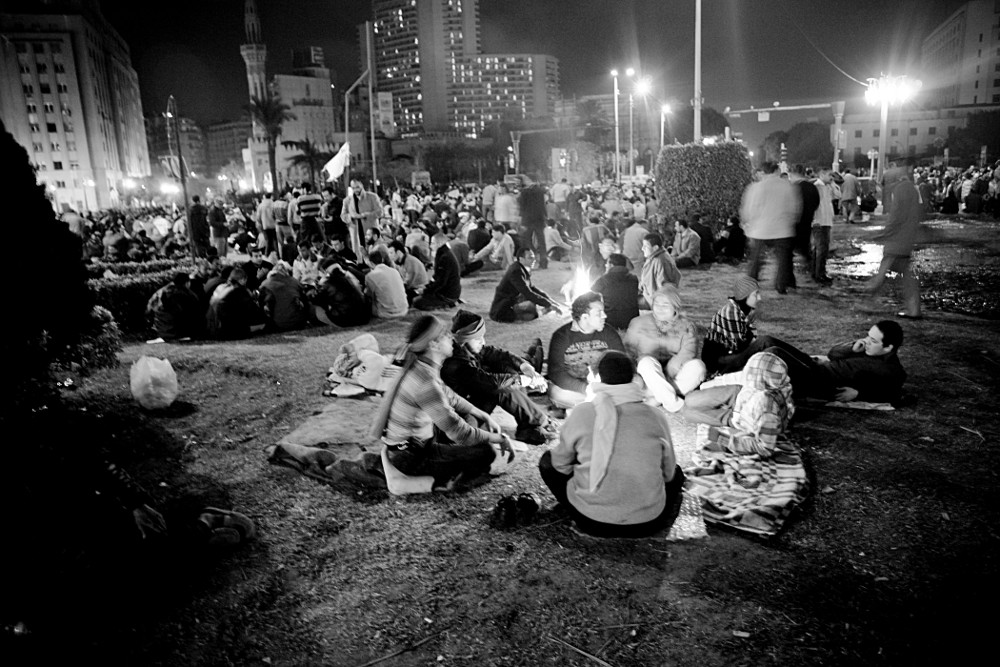
Camp at Tahrir Square last night. Photo: 3arabawy.
The whole of Egypt is now in a precarious balance. That same precariousness applies to the role of the armed forces, the sole remaining fulcrum of the regime. On paper it is a formidable force, as solid as the aforementioned pyramid. But armies are composed of human beings, and are subject to the same pressures as any other social stratum or institution.

From one minute to the next the protesters awaited the order from the President for the army to disperse the crowds. "The soldiers are not out here for the people, they are out for the president," said a middle-aged man. As darkness fell, the loud whirring of military helicopters could again be heard above central Cairo. Despite this, the rebels continued to chant angrily for President Hosni Mubarak to step down, some waving the Egyptian flags. Air force jets made multiple passes overhead. But on the ground the troops made no attempt to break up the protests.

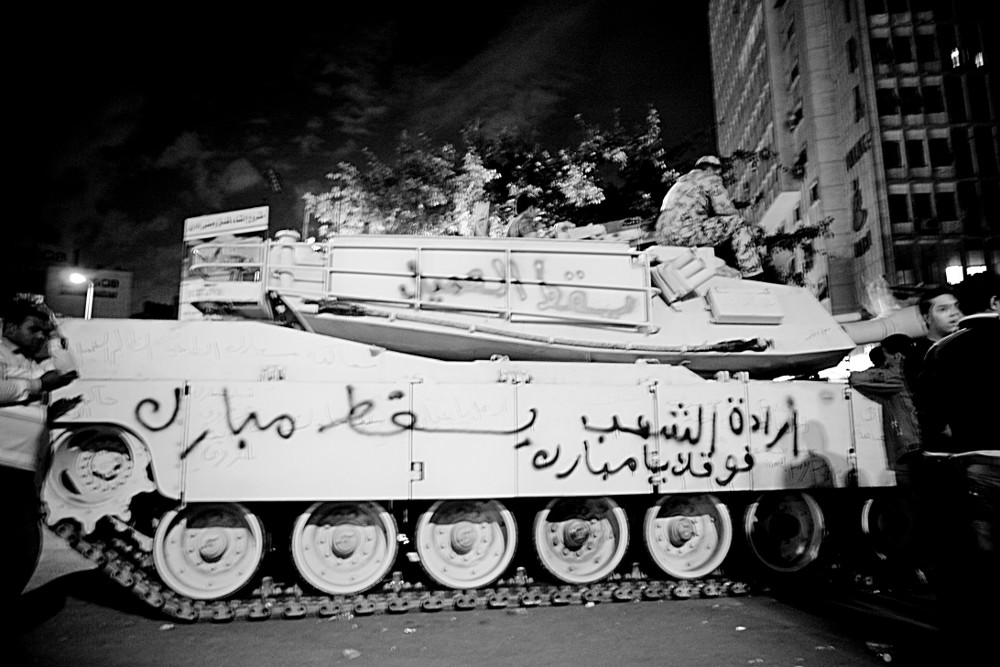
The tanks that rolled into Tahrir Square were meant to intimidate. But they were immediately surrounded by a human mass that impeded their progress. There have been shows of solidarity with protesters sharing their food with soldiers and in one case, carrying a young officer on their shoulders. The longer the army is in contact with the revolutionary masses, the greater will be the effect and the more difficult it will be to use it to crush the revolution.

The display of military might was meant to have a psychological effect on the tens of thousands of protesters gathering in Tahrir Square. However, the tanks have failed to stop the protests. Mubarak, a former air force officer, decided that fighter planes might get better results, since it is difficult to fraternize with a high-flying pilot. Yesterday fighter jets flew low over the protesters in an attempt to cause panic. But just as they had quickly adjusted to the presence of tanks on the streets, demonstrators were undeterred.

Instead of fear, however, this intimidatory gesture caused anger. “Look! They are sending the air force against us. From this moment we have no President. We will get rid of Mubarak or we will die here.” That was the reaction of one protester. "At first, I was frightened from the sound of the planes, but now it's as if I'm listening to music," commented a student who had come out to protest for the first time. "It's okay, they're not going to kill us," she said, then added, "although some people do say the president might kill all the country just to stay on."

In a revolution, as in a war, timing is of the essence. The same is true of a counterrevolution. Decisive action is necessary if order is to be imposed by force of arms. But here there is no decisive action, only hesitation, prevarication and indecision. Mubarak is “willing to wound, and yet afraid to strike”. This is a sure recipe for undermining any authority he may still have had. Machiavelli said that it was better for a ruler to be feared than to be loved. Just one week ago Mubarak was not loved but he was feared. Now he is regarded with contempt. He has lost the initiative and it will be impossible to regain it.

General strike

It is obvious that society cannot continue like this. Either the old order will re-impose its authority – a perspective that is becoming increasingly unlikely – or the masses will impose a new order. There is talk of a general strike. Groups of protesters camped out in the capital overnight, determined not to leave until Hosni Mubarak goes. The momentum of the movement continues to grow as we write these lines. Thousands rallied over the weekend in Alexandria and there were also sizeable demonstrations in Mansoura, Damanhour and Suez.

Crowds are again building in Cairo's Tahrir Square, despite army checkpoints designed to limit access. A march billed as the "protest of the millions" is taking place today (Tuesday). More than a million people are out in Tahrir Square, 300,000 in Suez, 250,000 in Mahalla, 250,000 in Mansoura, and 500,000 in Alexandria. Protesters are out in every single city and town in Egypt, approximately four million all over Egypt. It is the moment of truth.

Even without a general strike normal economic life has already ground to a halt. The Japanese car maker Nissan has announced that it is halting production at its Egypt plant for a week, and it has urged non-Egyptian employees to leave the country. The impact is already being felt in global markets. The Nikkei fell in early trading in Tokyo as the Egyptian unrest prompted investors to dump risky assets.

'The Will of The Egyptian People is above you Mubarak'. Photo: 3arabawy
Most shops and businesses in Cairo are closed. The middle classes are rushing to withdraw money from bank cash machines. The few supermarkets that are open are stripped bare by shoppers, stocking up with food. In the poor areas, the bakeries are running out of the small round loaves of bread that are a staple of the national diet. Streets are said to be piling up with rubbish as shops and hotels run out of basic supplies as infrastructure breaks down due to the unrest.

In a further vacillation the police have been ordered back on the streets again. State television has warned there are gangs on the rampage, although some believe it is exaggerating the threat to scare people. The regime is trying to create an atmosphere of tension to justify a clampdown. Security forces in plainclothes are engaged in destroying public property in order to give the impression that many protesters represent a public menace. A recent Stratfor report indicated that plainclothes police from Egypt’s internal security apparatus are the main drivers behind the growing insecurity in the streets over the past few days. It says:

“It is important to keep in mind that historically, animosity has existed between Egyptian police and army officers. The Interior Ministry, according to STRATFOR sources, wanted to prevent the military from imposing control in the streets. It appears that the absence of police on the streets Jan. 29 was (at least in part) encouraged by the outgoing interior minister, who was sacked the same day along with the rest of the Cabinet. Egyptian plainclothes police allegedly were behind a number of the jailbreaks, robberies of major banks and the spread of attacks and break-ins in high-class neighbourhoods. The idea behind the violent campaign was to portray the protesters as a public menace and elicit a heavy-handed army crackdown to embroil the military in an even bigger crisis.”

The reaction of the people has been to begin to take over the running of their areas. The protester are forming people’s committees to protect public property and also to coordinate demonstrators’ activities, including supplying them with food, beverages and first aid. In some neighbourhoods, residents are erecting makeshift checkpoints. They arm themselves with sticks and pistols against looters. Some use equipment left by police officers after they abandoned their usual positions.

Images of the scenes unfolding are being broadcast into homes across Egypt and the Arab world, and large audiences are watching and waiting to see what happens. The authorities are attempting to get a monopoly over the means of communication by restricting the printed media and the internet. The information ministry has closed the local Al-Jazeera office in a fresh attempt to control the message. However, such efforts seem futile. The ever-resourceful Egyptians are continuing to tune in to satellite television to hear the news.

An “orderly transition”

Amid growing fears in London and other European capitals that “extremists could try to exploit the situation”, British premier David Cameron spoke to King Abdullah of Jordan on Sunday about the situation in the Middle East and North Africa. (*) British foreign secretary William Hague told the BBC: "It's to avert those risks and meet the legitimate grievances and aspirations of the Egyptian people that we are urging the Egyptian authorities... to create a more broadly-based government." He said reforms should be "real and visible" and elections "free and fair".

But there is one small problem with all this well-meaning advice. Mubarak seems determined not to run away as Ben Ali did. And in fact the Americans don’t wish that either. They can see that the resulting power vacuum would be very dangerous for them. The Americans have warned President Mubarak urgently that there must be no more killings. They know that one bloody clash would be sufficient to split the army in pieces. Then the floodgates would open. That is why the army has stated that it will not use force to suppress the demonstrations. This is the kiss of death for Mubarak.

ElBaradei and the other “reformers” are pleading with the Americans to intervene: "It is better for President Obama not to appear that he is the last one to say to President Mubarak: 'It's time for you to go'." But Obama has not said this – not yet anyway. The masses want a complete transformation. But Barack Obama wants only an "orderly transition". An orderly transition – to what? We do not know. But we do know that Obama has called for Mr Mubarak to initiate it. That is to say, he is willing to give the old dictator a key role in making arrangements for the future of Egypt. We know also that Washington sees Egypt is a key “ally” in the Middle East. It has given it billions of dollars of aid, and it wants value for its money.

The White House says Mr Obama made a number of calls about the situation over the weekend to foreign leaders including Turkish Prime Minister Recep Tayyip Erdogan, King Abdullah of Saudi Arabia and British Prime Minister David Cameron. The protests in Egypt are top of the agenda of a meeting of European Union foreign ministers in Brussels on Monday. All are terrified about the effect of “contagion” from Egypt.

The BBC correspondent John Simpson says: “From the American point of view, the best thing that could happen would be a peaceful end to the protests, the retirement of Mr Mubarak and the continuation of some part (at least) of the system which he has created - shorn, hopefully, of its corruption.” But he adds a warning: “It won't be easy and it won't appeal greatly to the demonstrators, who have condemned Mr Mubarak's entire political structure and want to bring it down.”

The strategists of Capital are relying on the fact that people will be tired, and that there will be a general desire to get back to ordinary life, and this will bring a gradual end to the protest. Then the system if not the president himself might survive. But everything depends on the demonstrators: if they hold out - an “orderly transition” will not be possible, and the movement could go far further than anybody suspects.

Last night on (British) Channel Four News there was a debate between an American and a British “expert”. The American – a typically bone-headed right winger – was optimistic about a “managed transition to democracy”. His British counterpart was not impressed. “This is a revolutionary situation,” he replied with icy sarcasm. “You cannot hope to manage a situation like that.” There can be no doubt that the latter evaluation is the correct one.

Meanwhile, China has added its voice to the chorus calling for a return to “order”. A Chinese foreign ministry spokesman said on Sunday: "Egypt is a friend of China's, and we hope social stability and order will return to Egypt as soon as possible". The Chinese regime is interested in global economic stability because it wants to continue to earn a lot of money from exports. But it is also afraid of anything that could provide an impetus for strikes and protests in China itself. That explains why the Chinese regime has blocked the use of search engines to find news on the events unfolding in Egypt!

The masses fight, the politicians intrigue

The Americans are desperately manoeuvring behind the scenes. For the last week there have been intense discussions with senior U.S. officials, the government and the tops of the army. The military is preparing the time for Mubarak’s political exit. Until this happens, the unrest in the streets will continue. But who and what will take his place?

In its search for an “orderly transition”, the western media is trying to build up the figure Mohamed ElBaradei. The television cameras somehow always manage to locate him among a mass of demonstrators. But it brings to mind the following anecdote. A man was seen wandering aimlessly behind a crowd of demonstrators. When someone asked him who he was, he answered: “Me? I’m their leader.”

Although he played no role in organizing the protests, he is nevertheless presented as the leader of a mysterious “opposition coalition”, which apparently includes the Islamist Muslim Brotherhood, which also played no role in organizing the protests and at first did not even participate in them. This “coalition” is calling for a national unity government to be set up. Who will be in this government? Nobody knows. Who elected this “opposition coalition”? Nobody knows. Yet behind the backs of the masses, these gentlemen are already making plans to seize the reins of power.

The leaders are jockeying for power. The opposition is unified in its hatred against Mubarak, yet divided on almost everything else. Already there were signs of disunity within the “united” opposition. The Muslim Brotherhood is having second thoughts about its endorsement of leading figure Mohamed ElBaradei as a negotiator with Mr Mubarak. A spokesman for the Muslim Brotherhood, Mohamed Morsy, told the BBC:

"The people have not appointed Mohamed ElBaradei to become a spokesman of them." That is quite true. The people have not appointed Mohamed ElBaradei, but neither have they appointed the Muslim Brotherhood. They have not appointed anybody because they have not been consulted. They are fighting and dying on the streets, and their objective is not to further the careers of opportunist politicians but to change their lives.

The revolts in Tunisia and Egypt are largely secularist and democratic, and often deliberately excluding the Islamists. The conventional wisdom that only the Muslim Brotherhood can organise grassroots opposition movements in the Middle East is false, as is the idea that it is the ‘only real opposition’. The protests indicate the extent to which Egyptians have rejected jihadist ideology. They prove that Islamists do not have a monopoly on grassroots movements. The basic demands of the Egyptian demonstrators are for jobs, food and democratic rights. This is nothing to do with the Islamists and is a bridge to socialism, which has deep roots in the traditions of Egypt and other Arab countries.

The moment of truth

Tensions are growing between the army and the police and between the police and protesters. The revolution has provoked a crisis in the state. There are reports of a major confrontation that has been played out behind the scenes between the Interior Ministry and the military. The army must try to end the protests on the streets. But it will not be easy, now that the masses have got a sense of their own power.

The political structure of the state is crumbling, forcing the army to assume direct responsibility for the running of society. The military is supposed to be the guarantor of the state. But the military is not a monolithic entity. The army in Egypt is not like the army in Britain or the USA. The lower and middle ranks of the officer caste reflect the pressure of the masses. The entire history of Egypt places the possibility of a colonel’s coup on the agenda. The result could be a nationalist regime like that of Gamal Abdel Nasser, a colonel in the armed forces, who overthrew the British-backed monarchy in 1952.

In the present situation, it is possible that history will be repeated. But whatever “transitional” government is formed will be under close scrutiny. It will feel the hot breath of the masses on its neck. The key to the whole situation is the mass movement. All the contradictions are coming to a head. The coming hours will be decisive. The moment of truth has arrived.

London, on the morning of February 1, 2011


(*) Note: No doubt Cameron was advising the King of Jordan on what to do to placate the masses. The latest news is that King Abdullah II of Jordan has now sacked his government. This has come after huge street protests inspired by the revolutions in Tunisia and Egypt. This is confirmation that, after the protests in Yemen, Algeria and other countries, what started in Tunisia could engulf the whole of the Arab world.

Egypt: Feminist Nawal El Saadawi

Eyewitness Egypt: Feminist Nawal El Saadawi --'No discrimination between men and women ...That’s what women and men are saying'
LINKS INTERNATIONAL JOURNAL OF SOCIALIST RENEWAL - INTERNATIONAL JOURNAL OF SOCIALIST RENEWAL | FEBRUARY 1, 2011
http://pulsene.ws/Wgtw

January 31, 2011 -- Democracy Now! -- Renowned feminist and human rights activist Nawal El Saadawi was a political prisoner ..