Mu

Mu

Tuesday, October 12, 2010

Who's Who: France's rulers scramble for Africa

La Forge
December, 2004

Debt, Looting and Economic Subjugation
A Small Collection of Tycoons of the Economy in French-Speaking Africa

We describe below the main French monopolies who are the real economic masters in French-speaking Africa.

The list is clearly not exhaustive. Some of these enterprises were established since colonial times (this is the case of the CFAO), others came at the time of independence and neo-colonialism (such as Dagris). These latter have notably profited from the wave of privatizations imposed by the IMF, the World Bank and the Club of Paris at the end of the 1980s. This was the time of the buying up of African public enterprises sold off to Bouygues, EDF and France Telecom, who got their hands on the water, telecommunications and energy sectors.

Many of these French monopolies are still nationalized, but their privatization has already been announced. There were, at that time, few voices raised in the trade unions to denounce their predatory policies in Africa and in Latin America (particularly in Argentina), even though they foreshadowed, in caricature, the policy of privatization that would affect the monopolies in France itself.

The social and human damage caused by this self-off was considerable for these countries in which economic development had been hindered during the whole colonial period. The period of neo-colonialism, that of formal independence and of economic, political and military subjugation to the imperialist power, has seen a certain economic development, but this has remained very dependent on the metropolitan power. These countries furnished – and continue to furnish – raw materials (agricultural and mineral products) at low prices, and have their outlet guaranteed by the products of the monopolies.

To this mechanism of subjugation by debt one should add monetary dependence on the franc, by means of the CFA [French African Community – translator’s note] franc. In other words, the 15 countries of the franc zone do not have any control of their own money. When the Euro was created, the CFA franc was "tied to" it. This "strong" currency is not a reflection of the economies of those countries that use it. This means that the prices denominated in CFA francs are overvalued. The [prices of] the export products of these countries are artificially elevated, which penalizes them on the world market. When the Euro increases in value in relation to the dollar, this has dramatic consequences for the export products of these countries (cotton, cocoa, etc.), which are also in competition with the products of neighboring countries outside the franc zone, but also with the products denominated in dollars.

The devaluation of January 1994 cut in half, from one day to the next, the weak purchasing power of the peasant masses, of the workers in the towns, of the artisans and the small shopkeepers. Conversely, the profiteers in the leading circles had taken precautions and found themselves twice as rich.

Today, one demand is being put forward, even in economic circles, that is, the dissolution of the CFA franc.

Bolloré

The Bolloré group made a large part of its fortune in Africa, where it realizes a third of its turnover. Under Michel Roussin, it added services of portfolios as one of the pillars of the resources of French Africa, with franchises in some 20 countries of the zone.

The strongpoint of the group is its control of all the transport links for raw materials throughout the continent (there are now 43 African countries!), from trucks to trains, including hangars, port services and container ports. The group also has interests in the rubber plantations in Liberia, palm oil in Cameroon, and tourism in Senegal. It is in the process of withdrawing from cocoa in the Ivory Coast.

It is characteristic of this group, which is strongly marked by the personality of its boss, that it proceeds by "blows," it does not hesitate to withdraw, from one day to the next, if a greater opportunity presents itself. Bolloré recently began investing capital in Liberation [major left-liberal newspaper in France – translator’s note]. It plans to form a media branch, with televisions and newspapers.

Roussin is the very prototype of French Africa, which combines private economic interests, the resources of information services and the army. Responsible for the African-Caribbean zone to Medef, today he is an adviser for Bolloré.

The CFAO Group

A former colonial trading group, it has been present on the African continent for more than 100 years, selling rubber as well as machines and cars. Since 1997, it has extended into the Mahgreb [former French colonies in North Africa – translator’s note] and English-speaking Africa, with an increase in sales of 66%. Its objective is the telecommunications and computer sectors.

The Castel Group

Wherever you are, from Ethiopia to Tunisia, or in any of the 16 French-speaking African countries, when you order a beer, the chances are you will be drinking a Castel or one of its numerous national variations. As long as you are not drinking wine, Coca-Cola or Orangina, you will still be a customer of Castel. With 45 production sites, it is also one of the largest owners of Bordelais.

Dagris

This company with public capital has controlled "French" cotton since 1949, in other words, cotton that is produced in 20 countries, including Burkina Faso, Senegal, Gambia, Togo, Zimbabwe, Madagascar, Morocco and Algeria. Its present director is engaged in the process of privatization and majority control of all its African subsidiaries. It is, as it were, the "French cotton belt."

Total

The world’s fourth largest oil and gas company still realizes one third of its turnover in Africa. With its change of name and merger, Elf has become a "state within a state" and mixes business, trade and politics, as can be seen from several trials of mafias in French Africa.

The offensive of the British companies in Chad, Guinea and Angola, shows the desire of U.S. imperialism to implant itself on the continent and to take control of its oil fields.

The General Society

This is one of the big French banks, which controls the banking sector of Cameroon, the Ivory Coast, Senegal, a part of the banking sector of Ghana, Tunisia and Morocco. It is the main banking group in the franc zone and in the Mahgreb and it is still expanding. With a balance sheet of $7.5 billion in 2002, it made $503 million in profits.

From Ouagadougou to Bamako, from Abidjan to Yaoundé [capitals of Burkina Faso, Mali, Ivory Coast and Cameroon, respectively – translator’s note], French Africa has gone on too long.

Solidarity with the African Peoples!

Another step in party-building in P.R.

Communist Party of Puerto Rico Founded
Written by Juan Zapata

After an absence of almost 20 years, Puerto Rico once again has a Communist Party, founded on June 19 in the city of San Juan at the Electrical Workers union hall. News of the refounding of a communist party in Puerto Rico was reported in newspapers throughout Latin America, Spain and in Spanish-language newspapers of the United States.

In a resolution proclaiming the founding of the Communist Party of Puerto Rico, they state: “The deepening of the now irreversible capitalist crisis and its ever worsening effects against the working, dispossessed and exploited masses makes it more necessary than ever” that there be an active Communist Party in Puerto Rico.

The crisis in the world communist movement of the early 1990's resulted in confusion among Marxist-Leninist parties throughout the world, leading to the demise of a number of communist parties. One of these was the Puerto Rican Communist Party, founded in 1934, though another factor leading to the destruction of that party was the merger of another a left group which acted as a faction.

Ten years later in 2001 a group of former members of the PCP and others formed Communist Refoundation of Puerto Rico with the goal of reconstituting a Marxist-Leninist party in Puerto Rico.

One of the goals of Communist Refoundation was educational, to prepare communist cadre with the study of economic, history of the labor and communist movements in the world and in Puerto Rico, and Marxist theory and practice. To this end they formed the Lenin School which has classes in the south and western parts of the country.

“We direct this ideological work mainly to the youth and the working class,” CPPR spokesman Miguel Cruz Santos told progressive Swedish journalist Dick Emanuelsson. “Socialist organizations had let go of the work of educating cadre and we have retaken that as a basic task to move our work forward. We cannot develop the revolutionary struggle of our class without having cadre that is prepared.”

Cruz Santos told Emanuelsson that the lapse in ideological and educational work has led to a “social-democratization” of the revolutionary movement.

Another goal of Communist Refoundation is the unity of all forces that fight for socialism, irrespective of their ideology. In this regard, the communists have participated in the Socialist Front, a coalition of different socialist organizations and individuals. Even though the members of the Socialist Front work together to develop joint policies in struggle without attacking one another within it, each organization is free to develop its own ideological perspective and criticize opposing ones in its own work.

The CPPR will continue this work, according to its 74-page political program, but not the exclusion of other practical political work.

Among the immediate tasks that Puerto Rican communists have decided to work on is to fight to restructure the unfair and regressive tax structure. Communists are demanding the end of the sales tax imposed a few years ago after the government stop providing almost all services due to a financial crisis.

The CPPR also demands the end of highway tolls “which fall upon the backs of wage workers” as well as raising taxes on corporations and even higher taxes on “non-productive, speculative, financial corporations,” as well as cutting deductions which only benefit the rich.

High on the priority for the Puerto Rican communists is fighting for labor rights. The “CPPR is on the front lines in the struggle in defence of the labor rights won and for the ongoing broadening of those rights...” declares the party program.

Currently the pro-statehood government of Luis Fortuño is attempting a “labor law reform without loss of rights” to bring Puerto Rican employment laws to follow US labor laws. This would mean rolling back rights and benefits that Puerto Rican workers have won which are better than those under US laws.

Another part of fighting the anti-worker plans of Gov. Fortuño is revving up the fight against his neo-liberal Public-Private Alliances (PPA) which seeks to privatize services provided by the government and has resulted in the lay-off of tens of thousands of workers.

Other arenas of struggle for the Puerto Rican communists include the fight to preserve and strengthen the co-operative enterprises by exempting them from taxation, strengthening the Co-op Bank, and stopping the privatization of co-ops through the PPAs. Puerto Rico has historically had a vibrant co-op movement.

Besides other questions like defense of the rights of immigrants, women, LGBT people, education and the environment, Puerto Rican communists put a special emphasis on the national question.

While there continues to exist a “relationship of colonial subjugation” of Puerto Rico by the United States, “the colonial question is a priority political issue” states the PRCP Program.

“Humanity has categorically condemned colonialism since the middle of the 20th Century, and for good reasons; it embodies a form of exploitation that is particularly repugnant since it destroys the opportunity nations have to organize and establish their own State for their own economic, social and cultural benefit and not for the colonizing country's thieving capitalists. Colonialism tends to corrupt and make vile the peoples dominated by this form of oppression, creating sick and mutilated societies, lacking feelings of solidarity and with an absence of a vision for the future,” proclaims the CPPR.

They note that even though the world condemns colonialism to the point where “Puerto Rico is one of the few countries” that is still under colonial domination, that still doesn't prevent the bourgeosie of the imperialist countries from such a system of colonial exploitation. “Puerto Rico is effectively one of the last colonies on the planet and home to 80% of the peoples of the world under this shameful system of exploitation.”

Conscious of countries that have obtained their formal independence but are under neocolonial economic and political domination by the imperialist countries, the Communist Party says a sovereign Puerto Rican national state cannot be designed the “colonial burocracy of the United States” nor can there be any restrictions on political nor social liberties, type of social system the people decide upon, nor relationships with any other country and this includes whether to form a “federation with republics of the Caribbean or Latin America.”

Material conditions for workers fightback already exist

French Labor Activism, US Labor Passivism
by Rick Wolff

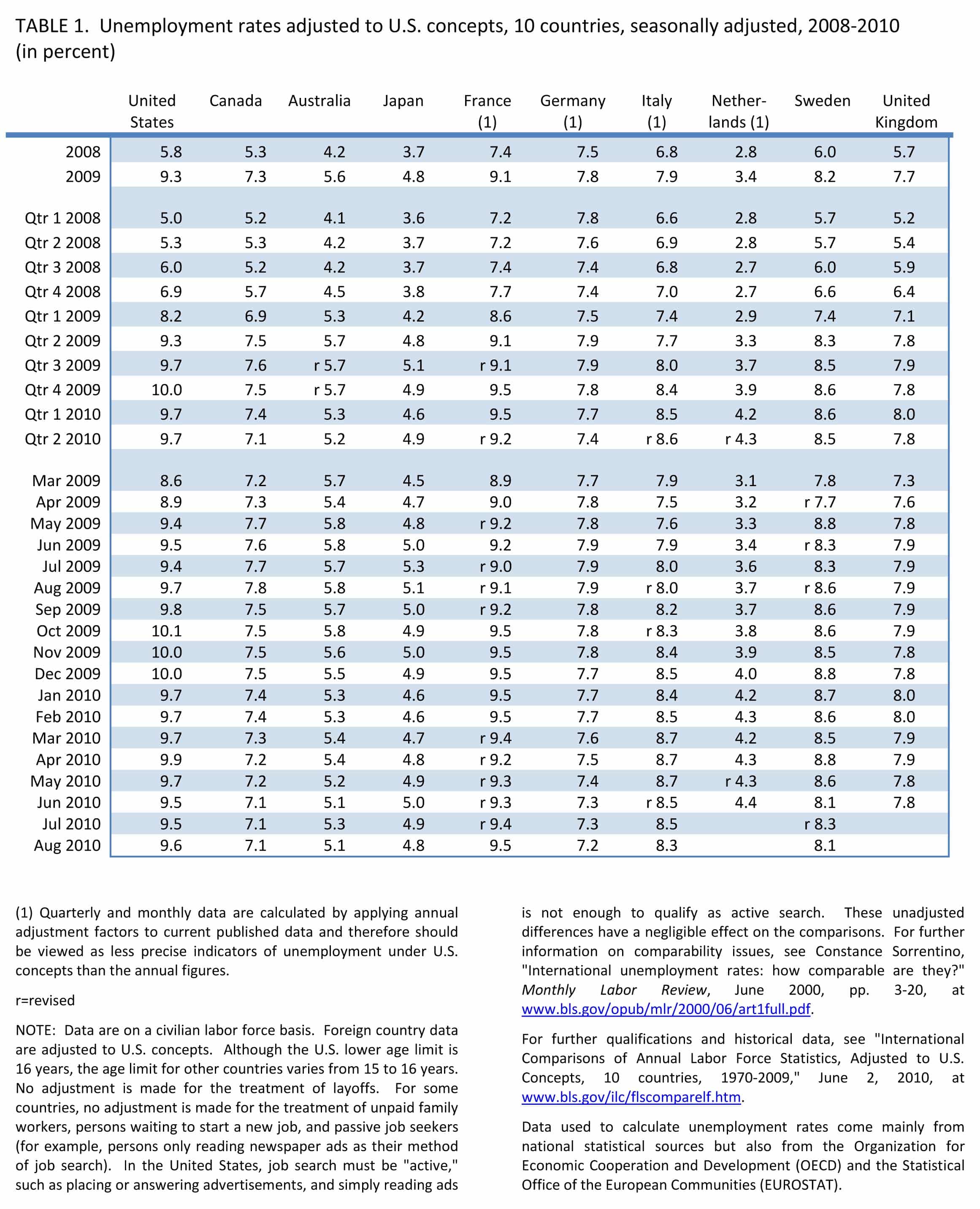
US workers suffered a major rise in unemployment from its level in 2008 (5.8 %) to its level in the second quarter of 2010 (9.7 %). By comparison, French unemployment rose from 7.4 % in 2008 to 9.2 % in the second quarter of 2010. These data from the Bureau of Labor Statistics (BLS) show clearly that unemployment rose further and faster in the US than in France across this crisis's first three years.

Table 1

Yet French workers by the millions are in the streets marching against anti-worker "austerity policies," demanding that government not cut its payroll or the services it provides the public. In contrast, US workers offer no equivalent resistance as US states and towns cut payrolls and public services and as President Obama's special commission gets ready to reduce social security benefits to the American people. Consider that in September 2010, according to the BLS, while the total US private sector added 64,000 jobs, state and local governments fired 77,000 people. This was done in a time of national economic crisis and record-high US unemployment rates. Nonetheless, worker mobilizations against austerity in the US have been, in comparison to the French, scattered and sporadic.

What differentiates French labor activism from US labor passivism are decades in which US labor unions and the US left declined in size, militancy, and social influence far further and faster than their French counterparts. In France the electorate and mass public opinion are now swinging left against the austerity policies of the Sarkozy government in solidarity with the leadership shown by labor and the left. French public opinion polls show that two-thirds of French public opinion either supports or is sympathetic with the repeated huge labor strikes and demonstrations against austerity. Such poll results in favor of these massive actions are not only extraordinarily high but also have been stable for months at that height. In contrast, within the different US conjuncture, the Democrats fear a major electoral loss in November 2010, to an extremely conservative, pro-austerity Republican party.

One key lesson of this crisis's different evolution in the US and France is this: the basic economic welfare of the working majority inside a modern industrial capitalism depends on maintaining a strong, militant trade union movement and a strong anti-capitalist movement and tradition. In France, labor and the left always included socially significant groups and movements, theoretical and practical, who were critical of capitalism and committed to basic social change beyond capitalism. That organized radicalism kept alive the notion of a real alternative to the present system. It also sustained many complex connections among militants. Those connections are now being effectively mobilized to forge an historic resistance inside capitalism to its costly crises and the ruling class's response to them. Moreover, because of its anti-capitalist components, that resistance may mature into a social movement for basic social change.


Rick Wolff is a Professor Emeritus at the University of Massachusetts in Amherst and also a Visiting Professor at the Graduate Program in International Affairs of the New School University in New York. He is the author of New Departures in Marxian Theory (Routledge, 2006) among many other publications. Check out Rick Wolff’s documentary film on the current economic crisis, Capitalism Hits the Fan, at www.capitalismhitsthefan.com. Visit Wolff's Web site at www.rdwolff.com, and order a copy of his new book Capitalism Hits the Fan: The Global Economic Meltdown and What to Do about It.
URL: mrzine.monthlyreview.org/2010/wolff111010.html

USA: THE PRISON-HOUSE OF NATIONS


The Death Penalty, Mumia Abu-Jamal, and the European Parliament

by Victor Grossman

What does the USA have in common with China, Iran, Iraq, Saudi Arabia, and North Korea? You would hardly guess, but the European Parliament stated loud and all too clear on October 2nd: those are the countries which put lots of people to death. In a long, detailed resolution, approved almost unanimously by 574 members (only 25 opposed and 39 abstained), the members from all over Europe named people on death row and threatened with execution in several countries and right there between those in Iran and Iraq were two Americans: Mumia Abu-Jamal in Pennsylvania and Troy Davis in Georgia. The delegates also voiced regret at the recent executions of Holly Wood in Alabama and Teresa Lewis in Virginia, both of whom were mentally retarded.

True, as the resolution pointed out, the USA cannot match China, which killed about 5,000 inmates last year, but it was still near the top behind Iran with 402, Iraq with at least 77, and Saudi Arabia with at least 69. In the USA the number was 52.

It was noted that 154 countries have abolished the death penalty completely or almost completely (with occasional exceptions such as for wartime treason). In Europe only Belarus has failed to do so, while the new constitution of far-off Kyrgyzstan just joined the ranks of those who generally agree, as the resolution points out, that "the death penalty is the ultimate cruel and inhuman and degrading punishment, which violates the right to life as enshrined in the Universal Declaration of Human Rights," and "detention conditions created by the death penalty decision amount to torture that is unacceptable to states respecting human rights." It reports that "various studies have shown that the death penalty has no effect on trends in violent crime . . . whereas evidence shows that the death penalty affects first and foremost underprivileged people."

After listing cases in other countries where pressure is needed, the delegates noted that "35 states in the USA still have the death penalty, although 4 of them have not held executions since 1976" and that US executions increased to 52 in 2009 even as "some states [in the USA] have moved against the death penalty through measures including a moratorium on executions or its abolition."

Mentioning Mumia Abu-Jamal twice in the resolution indicated that people in many European countries are worried about his case (currently nearing a new sentencing hearing that may result in a fatal decision), considered emblematic of the state of American justice.

A delegate of Germany's Left Party, Sabine Loesing, who was particularly active in getting this resolution passed, told how happy she was that so many from a wide range of political parties had voted for the resolution and added that she would see to it that the pressure on Catherine Ashton, foreign minister of the European Union, would not let up, so that Ms. Ashton raises the position of the resolution whenever she meets with leaders of states where capital punishment still prevails.
Victor Grossman, American journalist and author, is a resident of East Berlin for many years. He is the author of Crossing the River: A Memoir of the American Left, the Cold War, and Life in East Germany (University of Massachusetts Press, 2003).
URL: mrzine.monthlyreview.org/2010/grossman111010.html

80th anniversary of foundation of Indochinese Communist Party

Vietnam's Independence Day

Vietnam won its independence 65 years ago. On September 2, 1945, in Hanoi’s Ba Dinh Square, hundreds of thousands of people heard President Ho Chi Minh, on behalf of the provisional government, read out the Declaration of Independence.

Led by the Vietnamese Independence League, or Viet Minh, the August Revolution of 1945 ended 80 years of French colonial domination, abolished the monarchy and re-established Vietnam as an independent nation. Vietnam was the first country in Asia to achieve independence from colonial domination.

But the Vietnamese people’s battle for freedom was not over. It took another 30 years of bitter struggle and war to finally win complete liberation and independence.

On the evening of December 19 1946, President Ho Chi Minh made an appeal to the nation:

“Compatriots: We want peace, and we have made concessions. But the more concessions we make, the more the French colonialists use them to encroach upon our rights. They are determined to reconquer our country.

“No. We would rather sacrifice all than lose our independence and be enslaved. All of you, men and women, young and old, whatever your region, ethnic origin, or political opinion, arise to struggle against French colonialism and save the homeland. Let those who have guns use their guns, those who have swords use their swords, those have neither guns nor swords use hoes, pick-axes, and sticks. Let all arise to oppose colonialism and defend our homeland.... Our people will win”.

The Vietnamese people did just that. They resisted the French reoccupation, finally decisively defeating the French at the battle of Dien Bien Phu, led by General Vo Nguyen Giap. The Geneva Accords signed in 1956 were an agreement for the French and their supporters to regroup in the South before final withdrawal. But US imperialism, which had been bankrolling the French war, now openly took over the struggle against the Vietnamese people, and denied the Vietnamese their unity and independence.

Vietnam was invaded by more than half a million US troops, and its enormous war machine. They were joined by troops from Australian and other countries. More than 7 million tonnes of bombs were dropped, the equivalent of 640 of the atomic bombs dropped on Hiroshima; nearly 4 million land mines were laid throughout the country; more than 300,000 tonnes of napalm were dropped on the Vietnamese people, and nearly half a million tonnes of defoliants such as Agent Orange containing deadly dioxin.

The Vietnamese people heroically resisted in the North and the South, assisted by a huge public opposition and protests against the war in the US and Australia and around the world. The US was forced to sign the Paris Peace Accords in January 1973 and transfer the open fighting to their puppet regime in the South. But in 1975 a powerful six-weeks Spring Offensive swept out the last remnants of the imperialist forces and their puppets, leading to final victory on April 30, 1975.

The headline on the cover of a special issue of Direct Action in 1975 proclaimed it “A victory for all humanity”. And it was.

But that was still not the end of it for the brave and long-suffering Vietnamese people. After their final liberation in 1975 they still had to face: incursions and harassment by the Pol Pot regime in Cambodia; invasion by China; economic embargo and boycott by US imperialism for decades; refusal by Washington to pay a cent of the more than 3 billion US dollars of reparations agreed upon; the continuing devastation from unexploded mines and bombs, and the ongoing effects of Agent Orange on millions of Vietnamese.

[clip]

As well as being the 65th anniversary of Vietnamese independence, 2010 is an important anniversary year for many other events in Vietnam’s history — the 35th anniversary of the final liberation and reunification of the country; the 80th anniversary of the foundation of the Indochinese Communist Party; the 45th anniversary of the first demonstrations in Australia against the war in Vietnam, and the 40th anniversary of the big Moratorium demonstrations here.

Revisiting "The Tragedy of the Chinese Revolution"

As a rising labour movement gains strength in China, the reprint of Harold Isaac's classic Marxist history of the Chinese revolution provides both inspiration and a warning from history, writes Chris Nineham.

The Chinese Revolution

Harold R Isaacs, The Tragedy of the Chinese Revolution (Haymarket Books 2009), 500pp

As all eyes are on China, the reprint of this classic Marxist history should be a major event. The book is not about Mao’s peasant led 1949 revolution but the story of the great worker led insurrection of 1925 to 1927. It is an extraordinary half-buried story of popular uprising and political betrayal, brilliantly told. And even though it was written in 1937 it’s a story that throws much light on China’s subsequent development.

Despite its relative obscurity, the Chinese revolution of the 20’s was a major turning point. Isaac’s book helps explain the shape of revolutionary struggle in the twentieth century and up to our day. It gives context to the defeat of the working class internationally in the 1920s and 30s. It also helps to explain the pattern of so many anti colonial uprisings which often succeeded in throwing out colonial occupiers but never in solving the problems of the mass of the population.

It suggests too an alternative model for liberation in the developing world. We are witnessing a new series of struggles for democratic and social change against authoritarian regimes from Burma to Egypt, from Thailand to Nepal. Chinese workers themselves are taking strike action on a scale not seen since the 1970’s. Isaacs’s book is an inspiration and a warning.

The seeds of revolt


Isaacs lived in China for the first part of the 1930s and he outlines the background of desperate economic suffering and imperial oppression in early twentieth century China with a rare combination of anger and insight.

The secret to the revolutionary period was that social change came late and therefore in a concentrated, explosive way to China. The country was drawn into the capitalist world by colonial brutality. The British devastated the export trade and social fabric of China during the Opium Wars in the mid-nineteenth century. They used opium to force entry in to Chinese markets.

The attention of colonial powers had a contradictory impact on China. As well as wiping out traditional manufacturing it created a layer of comprador capitalists who made huge fortunes. The colonialists’ sponsorship of merchants, landlords, officials and warlords helped to perpetuate pre-capitalist forms of organisation but at the same time they introduced the most modern forms of production.

The new market relations ruined millions of peasants whose families had survived off their small plots for generations. Meanwhile the industrial development that was being grafted onto the country in such a chaotic way sucked millions into unprepared cities creating a rapidly growing, immiserated working class.


The movement against imperialism began to stir during the First World War. One fascinating section of the book outlines the impact of the Russian Revolution on the East. Isaacs describes how a combination of war weariness and the example of the Russian revolution generated national and anti-colonial revolts in Turkey, Syria, Egypt, Arabia, Afghanistan, India, Indonesia, Indo-China, and Korea and beyond. The revolution’s impact was reinforced when the new workers’ government withdrew its claims on foreign territory in China and elsewhere. The revolution also embodied vital theoretical and strategic lessons.

As it turned out the importance of the Russian Revolution was double-edged. It helped unleash rebellion across the region, but the immense and unchallenged authority it gave to the Russian State became a liability.

The great divide in Chinese society was between the new industrialists, bankers, brokers, capitalist landowners (local and foreign), and the mass of the poor. While the Chinese bourgeoisie played a subservient role to the foreigners and no doubt fantasised about independent capitalist development, the gulf between them and the poor was much greater than any antagonism with their foreign colleagues. For Isaacs, ‘this fundamental fact predetermined the unity of the Chinese and foreign exploiters against the exploited.’

The spreading revolutionary mood collided with the plans of Japanese imperialism and the cynicism of the imperialist horse traders at the treaty of Versailles. On May 4, 1919 there were huge student demonstrations in Peking which were quickly joined by striking workers, some of whose leaders had laboured abroad during the war and had had contact with the socialist movement.

Though the movement led to a huge revival in the mainstream nationalist Kuomintang, it also led to the growth of Marxist and socialist circles, many of which came together in 1920 to form the Chinese Communist Party.

Communists and nationalists


The central problem of the Chinese Revolution was the relationship between the left and the nationalist movement. There was never any doubt that the Communists should fight at the forefront of the anti-imperialist movement. But a new policy was developed by the Communist International for China, which led to a deal between Soviet diplomats and nationalist Kuomintang leader Sun Yat Sen. In January 1923 the two sides issued a joint communiqué agreeing that ‘the conditions did not exist in China for the successful establishment of socialism or communism’ and that the immediate aim for China should be the ‘achievement of national union and national independence.’

This was a clean break from the strategy agreed by the second world congress of the Communist International in 1922 and from the whole Bolshevik policy that culminated in revolution in October 1917. It meant an end to political and organisational independence of the Chinese Communist Party and an uncritical adoption of nationalist policies. The turn was justified by the novel argument that the Kuomintang was not the party of the emerging bourgeoisie but a party in which all classes united in common cause against the foreign interloper.

Isaacs argues this nonsense was a rationalisation of a pragmatic change of course in Russia. Listening to the experiences of the activists he interviewed convinced him of the correctness of Trotskys’s analysis of the defeat in China and its connection witrh the degeneration of the Russian revolution. The development of the ‘two stages’ theory of revolution embodied the realism of the emerging Stalinist leadership. It marked a turn away from an internationalist policy of spreading revolution to realpolitik of alliances with ‘progressive sections of the bourgeoisie’. It was part of an accommodation to capitalist reality and it set the pattern for communist policy internationally.

It was a policy that was pursued with great energy by the Chinese Communist Party. Their leaders went out of their way in a series of open letters, articles, telegrams and meetings to reassure the nationalists that there was no prospect of the party threatening the interests of the bourgeoisie.

The results of the policy were catastrophic. The militancy and initiative of the Chinese working class reached great heights. General strikes had spread from Honk Kong and Canton in 1925 and helped create the first power base for the nationalist Kuomintang in Guandong in the South. They also triggered peasant insurgencies across Southern China.

Workers led an insurrection in Shanghai on 21 March 1927 in advance of the approach of the nationalist army. The city was brought to a standstill by a general strike in which more than half a million workers played an active role. A workers militia of 5,000 took the main police stations and military outposts. Although they started off with just 150 pistols in one day they confiscated enough guns to lead the workers in an assault on the key arsenal in the South of the city. There the soldiers surrendered without a fight and the workers were able to arm themselves fully and take the other key strategic targets in the city.

By the time the nationalist troops arrived, all of Shanghai was in the hands of the workers with the exception of the international settlement and the French concession where foreigners cowered, fearing for their lives.

The Shanghai insurrection deepened the rebellion on the land. To the horror of the Kuomintang leaders the slogan ‘Down with the bad landowners’ turned into the longer but rather more radical ‘all who have land are oppressive and there are no gentry who are not bad.’ In Isaacs’ words the shock waves from the workers action had helped ‘generate the realisation amongst the toilers on the land that they too were human beings, that they too existed. From that, the will to live not as an animal but as a man, hurled not one but millions of toilers into a struggle against the system that had made them the packhorses of a civilisation thousands of years old’.

The great Chinese revolt of spring and summer 1927 confirmed Lenin and Trotsky’s analysis that even in the most impoverished and underdeveloped countries revolutionary action led by workers can defeat the best armed ruling classes and change the course of history. This was the basis on which they both fought for the revolution in October 1917.

The tragedy was that the Chinese experience of 1927 also became a negative confirmation of Lenin and Trotsky’s views. Both of them had concluded that the middle classes could no longer be relied upon to play any progressive role, even in anti-imperialist struggles. This was the starting point for Trotsky’s theory of Permanent Revolution and the rationale for the Russian October. But it was this insight that the Communist International had abandoned when it ordered the Chinese Communists into an uncritical ‘alliance of equals’ with the Kuomintang.

The great betrayal


When Kuomintang leader Chaing Kai-Shek landed at Shanghai on the afternoon of 26 March 1927 he was welcomed as a hero by the CP-led workers. The next day a demonstration of 50,000 filled the streets to greet him. The communist leaders failed to inform the workers that the nationalist army had delayed its advance on Shanghai in the hope that the workers movement would be contained or crushed by counter revolutionary forces.

Now the nationalist leaders had to take the situation into their own hands. The workers’ movement had served its purpose for them. It had given Chinese bankers and merchants a lever with which to extract concessions from the foreign capitalists. Now it had to be broken.

The process had started earlier in February when Chiang Kai-Shek had ordered the dissolution of the communist-led Kuomintang in the militant city of Nanching. Leaders had been arrested and the unions and student organisations had been suppressed. Once again the communist leadership failed to explain these facts to the Shanghai workers.

In Shanghai the repression had to be planned more carefully and reach a much higher level. Chiang prepared the ground by removing garrisons sympathetic to the workers and drafting in soldiers fresh from the country. He organised and made deals with occupying armies, particularly the French, but including British and Japanese units. He appeased the communist workers for a few weeks before unleashing a co-ordinated wave of terror.
Unarmed demonstrators were massacred with machine guns, working class areas were terrorised, activists picked up in their hundreds in dawn raids while special courts threw thousands into prison.

Thanks to the policies and active collaboration of the communist leaders the working class was taken completely off guard and was unable to defend itself effectively. The carnival of reaction that followed was evidence of the fact that every section of the Chinese bourgeoisie felt in the end of the day closer to the imperialist capitalists than to the Chinese masses. There were of course different sections of the Chinese bourgeoisie. The comprador capitalists, brokers of foreign capital, were the most conservative and corrupt section of the Kuomintang alliance. But once the workers’ rebellion was in full swing even the most liberal of the Chinese middle classes became alarmed. They acknowledged that the labour movement had been useful but the feeling grew, in the words of one amongst them, that ‘it is one thing to utilize the workers… but quite another to let them bite off more than they can chew.’

Unbelievably the Communist Party learnt nothing from this disaster of Shanghai. A year after the massacre, Mao Tse Tung, the future leader of the Red Army, was once more promising the nationalist leaderships that the party had renounced the struggle for workers’ power. He even provided guarantees that if the forces of revolution raise their heads again the Chinese Communist Party would play the role of executioner.

The result of such capitulation was the decimation of the working class movement and the Communist Party through bitter demoralisation and sheer terror. Bizarrely the CP responded with a sharp left turn and a call to prepare for insurrection. But internal Comintern documents admitted that the CCP had no surviving groups in any of the great industrial centres.

The legacy


The damage was lasting. Remaining leftists fled to the countryside and formed armed groups that sought support amongst the peasantry. There was such a sense of betrayal and distrust amongst the peasants that they often drove Communist Party members out of their districts. In other areas these de-classed Red Army groups managed to rebuild relations with the peasants and regroup. Mao himself was involved in the desperate defensive manoeuvre that was later to be known as the Long March. But the Communist Party lost all connection with the organised workers.

Meanwhile free from any pressure from its left, the Kuomintang fought a half-hearted and purely military struggle against the Japanese occupiers. They relied on British and American aid even though neither state was prepared to openly oppose Japan’s actions and both had ambitions to dominate the region themselves. Such alliances were preferable for the Chinese capitalists to any attempt to stir up mass resistance to the Japanese. The war continued indecisively, exhausting the economy and the country.

In 1935 the Communist International made a turn away from any semblance of revolutionary policy. Frightened by the defeat of the German workers and the rise of Hitler, Stalin turned to a policy of wooing the western democracies as potential allies against fascism. The Communist International announced its struggle was now not for workers’ revolution but for bourgeois democracy. Communist parties everywhere were officially suspending hostility towards capitalist governments in return for alliances with Moscow. What remained of the party in China moved towards another deal with its own butcher, the Kuomintang.

The turn in the Communists fortunes came on the basis of a concerted peasant war against the Japanese and then the Kuomintang itself. When it came a decade after Isaacs wrote his book, the liberation of China was led by the Communist Party. Mao Tse Tung, who had rebuilt his support amongst the peasantry, led a decisive struggle against the discredited Kuomintang. The world started talking of a 'victory for communism' in China. The Chinese Communist Party was however to characterise its military victory over the Kuomintang as the 'victory of the national bourgeois democratic revolution' which had begun 38 years earlier. And for good reason.

The theory of the two stages of the revolution had been completely internalised by the world Communist movement. What this really amounted to was the internalisation of bourgeois nationalist politics, the accommodation of Marxism to the demands of national capitalist development. Workers played no role in the final liberation of China, not because they were unorganised, but because they were told not to by the CP. As they approached the cities Red Army leaders sent orders ahead that ‘workers and employers in all trades will continue to work and business will operate as usual.’ When Mao announced that the transformation to socialism would come later what he meant was workers' rights would have to wait and workers aspirations would have to be put on hold, as the first and only priority was capital accumulation.

For all the romantic myths that surround Mao, the Great Leap Forward and the Cultural Revolution were nothing but the working out of the brutal logic of the two stage revolution. They were centralised and savage attempts to increase work discipline and productivity. The project of state-led capitalist development succeeded in driving China forward but at a terrible price.

Now Chinese workers have started to rebel against the conditions created by the final accommodation of the Chinese Communist Party: the opening to the market. The tragic story of the workers insurrection of the 1920’s shows how history could have taken a very different course. The working class is incomparably stronger than it was in the twenties but anyone fighting for workers’ rights, democracy and social change today would do well to investigate the half forgotten story of the Chinese revolution and study its lessons. Isaacs’ book is a fine place to start.

Rationalizing jobless recovery


Mark Carney on the “Natural Rate”
of Unemployment

Andrew Jackson

I was disturbed to read this comment on the current state of the U.S. economy in Governor of the Bank of Canada, Mark Carney's speech last week.

“The natural rate of (U.S.) unemployment may be increasing sharply. The scale of industry restructuring means that some unemployed workers do not have the skills suitable for the expanding sectors. Other job seekers are tied to their local area, due to an inability to sell their homes in distressed markets, hampering the mobility that has been a hallmark of the American labour market. The current cycle is also self-reinforcing. As long-term unemployment becomes more entrenched, workers’ skills deteriorate and their reintegration into the labour force becomes more difficult.”

Why is this disturbing?

In the first place, claims that structural unemployment in the U.S. are on the rise serve an ideological purpose. There just isn't any convincing evidence that any significant part of U.S. unemployment is “structural” as opposed to being the result of the economy operating well below capacity, but opponents of fiscal and monetary surplus want us to believe otherwise.

The American economist and Nobel Laureate, Paul Krugman recently blogged on this as follows:

“Claims that there has been a huge jump in structural unemployment – that is, unemployment that can’t be cured by increasing aggregate demand – are playing a large role in the argument that we should basically do nothing in the face of a terrible economy. No need for the Fed to do more; no need for more fiscal stimulus – hey, it's all about defective labour markets, and we should work on structural reform, one of these days. And don’t expect improvement for years to come. Structural unemployment is invoked by Fed presidents who want to raise rates, not cut them, by economists who want austerity now now now, and in general by almost everyone in the pain caucus.”

As he also notes in a column as well as his blog post, high and extended unemployment could have an effect on the skills of workers, lowering future economic potential. But there is zero evidence of significant unfilled job openings in the U.S. right now. A recent EPI study found no evidence for what he calls “labour mismatch – layoffs in some industries combined with labour shortages in others; high unemployment for some types of labour combined with tight markets and soaring wages for others; high unemployment in some regions but exceptionally good hiring in others…. none of these things are, in fact, visible.”

The Bank of Canada's Higher Unemployment Target

So, just why is Canada's Mark Carney siding with the more conservative elements in the U.S. Federal Reserve?

And what is even more disturbing is his adoption of the language of a “natural” or “non accelerating inflation” rate of unemployment, generally defined as the rate to which unemployment cannot fall without triggering an accelerating increase in inflation (than which there is, of course, nothing worse in the lexicon of central bankers.) This is something of a throwback to the 1980s.

The Bank of Canada has (unlike the OECD) actually avoided such language in recent years, focusing on the more nuanced concept of an output gap. In this view, there is more to the economy's capacity than the job market, and there is some recognition that we cannot know in advance at what level of unemployment inflationary pressures would start to build. The U.S. experience in the Clinton years was that inflation did not pick up as unemployment fell to low levels, and the same was true of Canada before the recession when unemployment fell to 6%, far below most previous estimates of the “natural” rate.

As critics of the natural rate concept have long argued, it is a circular concept, in which central banks fear testing the limits of capacity out of exaggerated fear that unemployment might be pushed to levels which are “too low.” They put on the monetary brakes prematurely to avoid running a risk which is purely theoretical. Far better to test the limits, and then to react to any inflationary pressures which actually happen, rather than exist only in econometric models.

If Carney really thinks structural unemployment is on the rise in the U.S., he probably thinks the same may be the case here. In which case, he and the economists at the Bank of Canada are probably redefining “full unemployment” as something closer to 7% than the pre recession rate of 6%.

Which may in turn explain why they were so quick out of the gate to start to withdraw “extraordinary monetary stimulus.” •

Andrew Jackson is Chief Economist and National Director of Social and Economic Policy with the Canadian Labour Congress (CLC), where he has worked since 1989. He is also a Research Professor in the Institute of Political Economy at Carleton University, a Research Associate with the Canadian Centre for Policy Alternatives, and a Fellow with the School of Policy Studies at Queen's University. He has written numerous articles for popular and academic publications, and is the author of Work and Labour in Canada: Critical Issues, published by Canadian Scholars Press (2005).