Mu

Mu

Thursday, October 7, 2010

An injury to one is an injury to all

The All-African People's Revolutionary Party (GC)

(202) 719-0529

Email: info.a-aprp-gc.org

Web: http://a-aprp-gc.org

The Official Statement by the All-African People’s Revolutionary

Party (GC) on the FBI’s Illegal and Immoral Violation of the

Offices and Homes of Anti-War and Solidarity Activists

The All-African People’s Revolutionary Party (A-APRP) (GC) recognizes that the coordinated raids and intelligence actions directed at the homes and offices in Illinois, Minneapolis, Wisconsin, California, North Carolina, and Michigan on Friday, September 24, 2010, of Anti-War and Solidarity Activists, crimes committed by the Federal Bureau of Investigation (FBI), are a continuation of the FBI’s depraved history of intimidation, destabilization, manipulation, and destruction of Nationalist, Pan-Africanist, Socialist, Anarchist, International Solidarity, Environmentalist, Women’s, Peace, Anti-War and Repression, Trade Unionist, and other progressive and revolutionary movements. Activists, under the penalty of prison for non-compliance, are being coerced to appear in front of a federal grand jury. The grand jury is the despicable instrument of coercion and protector of bourgeois law, as the political enforcer of the policy of reaction and repression.

The use of the FBI and the grand jury, instruments of repression by the US government, cements the need for greater organization, solidarity and unity in the movement s for national liberation, social, economic, and political justice, whether it is in North, South, or Central America, Africa, the Middle East, particularly, Palestine, Europe, Asia, or Polynesia. Every effort is being made to thwart the advance of the struggle to end the oppression and exploitation of one human being over the other. We must stiffen our resolve to not retreat on the righteousness and justness of our struggle.

The A-APRP (GC) recommends the following individual and coordinated actions be taken as one way to advance our common struggles, goals and aspirations:

  • Intensify the research, discussion, and educational work on the role of the FBI and grand jury in stifling and impeding the organization and works of those who are opposed to the domestic and international crimes against Humanity committed by the US government and are also establishing International and Pan-African Solidarity of progressive and revolutionary forces.
  • Organize or join protests against the FBI- An Enemy of all Humankind!
  • Intensify the struggle to build and strengthen alliances in the Solidarity, Anti-War and Anti-Repression, Environmentalist, Anti-zionist, Political Prisoner, Peace, Pan-Africanist and Socialist movements.
  • Join movements of Solidarity and Support for all Justice seeking People attacked by the FBI and subpoenaed by the grand jury.
  • All women and men of conscience must join a progressive or revolutionary organization that is working for Justice for the People.

.
.
The A-APRP (GC) is the inheritor and continuator of the revolutionary theory and practice of Kwame Nkrumah, Sekou Toure and Kwame Ture. Our objective is Pan-Africanism: the total liberation and unification of Africa under scientific socialism. Pan-Africanism is the only solution to the chronic capitalist and imperialist imposed problems of the 1.5 billion African People who are scattered, suffering and struggling throughout Africa and the African Diaspora. Our ideology is Nkrumahism-Toureism. Revolution is our work and study. We will go wherever the African Revolution needs or sends us!

We Will Forever Stand With Those Who Seek Justice For World Humanity!

Monday, October 4, 2010

UAW's Bob King: "by their words ye shall know them"

‘A UAW for the 21st Century’:Boss-Union ‘Partnership’

On August 2, fresh from his coronation as head of the UAW, President Bob King delivered a talk to the Center for Automotive Research Conference, an industry group, where he laid out his vision for the union’s future:

• “We are deeply grateful to the Obama administration…for saving the American auto industry. Enabling our companies to survive and turn around has saved hundreds of thousands of good jobs that would have been gone forever.…UAW members took wage-cuts of $7,000 to $30,000 a year. Benefits were also reduced significantly. Restructuring resulted in the loss of nearly 200,000 jobs.”

• “The UAW of the 21st Century must be fundamentally and radically different from the UAW of the 20th Century. This is a new world, and we must reinvent our union….”

• “The 20th Century UAW fell into a pattern with our employers where we saw each other as adversaries rather than partners.…The 21st Century UAW no longer views…management as our adversaries or enemies, but as partners.…Our new relationships…are built upon a foundation of respect, shared goals and a common mission.”

• “So the keywords of the 21st Century UAW are flexibility, innovation, quality, teamwork, productivity, continuous cost savings and respect. The rigid demarcation between management and labor that was so entrenched in the old model is discarded.”

That’s it, from the horses’ mouth, proof positive of what PLP has always warned. The greatest threat to the workers and the revolutionary communist movement is not the gutter racists and open fascists, as bad as they are, but the liberals! The Tea Party or Sarah Palin didn’t wipe out 200,000 auto jobs and cut wages in half, although they certainly support it. It was Obama and the union leaders.

In a period of growing war and deepening economic crisis, “Shared goals and common mission” means doing whatever is necessary to maintain U.S. imperialism at the top of the heap. It means war and fascism, with a “thank” you from UAW President Bob King.


Marxism 2010 Videos

Istvan Meszaros - The Crisis of Parliamentarism - Marxism 2010

200 Years of Revolution

200 Years of Revolution
Class #2 - Marxism After Marx


It will be held at Mac's Backs Bookstore, located at 1820 Coventry Road, Cleveland Heights, OH, at 7PM on Tuesday, October 5th.

We will discuss:

Eduard Bernstein, Social-Democratic Party of Germany, the “Socialist International” (2nd International), the Fabian Society, Eugene V. Debs, Anarcho-Syndicalism (IWW), Daniel De Leon, Vladimir Lenin, World War One, Henry George, and much more.

You are invited to join us. For more information call: 330-347-5473, or visit Mac's Backs Bookstore, (216) 321-2665

Sunday, October 3, 2010

How I spent my summer vacation

I began Marxist Update a year ago as a part-time "hobby" because comrades kept
complimenting me on the informative articles I found on the web and emailed to
them. But of course sending out a dozen emails a day proved time-consuming, so
I decided to put the interesting articles I found all in one place, and just
give comrades the web address.

Due to a family situation I have had a hiatus for about six months, but the
family situation is running rather sweetly now, so I am back to the "hobby."
Work and family don't leave me the time for big writing projects I would like to
do (and I have a legal-size sheet of paper full of ideas) so this is about all I
can do right now.

What did I do during the hiatus? I read ten novels by Patrick O'Brian about the
Royal Navy during the Napoleonic era. That sounds outrageously escapist, but
any communist could appreciate these novels. The motivations of all the
characters are (whether understood so perfectly by them or not) economic. Royal
Navy ships that captured enemy vessels or transports got to divvy-up the prize
money, then run the gauntlet of parasitic "land sharks" when they got ashore.
Speculative financial bubbles on the stock exchange were rampant and ruinous
then, as well.

I also spent a lot of time with my grandson. (Don't rent "Marmaduke" with Owen
Wilson. To think he tried to kill himself before making that movie. I wonder
how he feels now?) My grandson Liam has play-dates with some home-schooled
children down the street, and says he is now a Christian. We left religion
alone, figuring he would ask at some point, and the point arrived this summer!
He says he now has four gods: "God, Jesus, Poseidon, and Ares the God of War."
Our evening meals are often droll.

When my wife can leave Farmville alone, I am also on Facebook:
http://www.facebook.com/home.php#!/profile.php?id=100001565934753

If anyone knows of any political activites coming up in Cleveland, please put me
on the contact list. Two years of the Democrats has given communists an
excellent opening to make the case for breaking with the Democrats and engaging
in some independent labor/community political action: the top priority for
communists in the U.S. for the last 90 years.

Comradely,

Jay Rothermel


Are the "dog days" of labor behind us?

Signs of the Beginning of the End of the Long Retreat of Labor
by Jon Flanders

Six years ago, I organized a bus from the Albany area to attend the "Million Worker March," which was an attempt by longshore local ILWU Local 10 and some activist African-American union leaders to present labor's demands during the 2004 election year. That rally was not supported by the AFL-CIO and of course fell far short of a million workers in attendance. Liberal panic was in full swing as almost everyone rallied behind the Kerry presidential campaign. The MNMM was a noble failure, one I am not sorry to have supported.

Six years later, with the Democrats having had two years to carry out an enormous "mandate" following Obama's blowout election of 2008, the AFL-CIO and its allies like the NAACP found it necessary to rally the troops to present labor's agenda in an election year that finds deep disappointment in the ranks about the Democrats in power.

The "One Nation" leaders are hoping that the 200,000 or so who boarded buses for the DC rally will be energized to pull the Democrats' fat out of the fire in time for the congressional election in November.

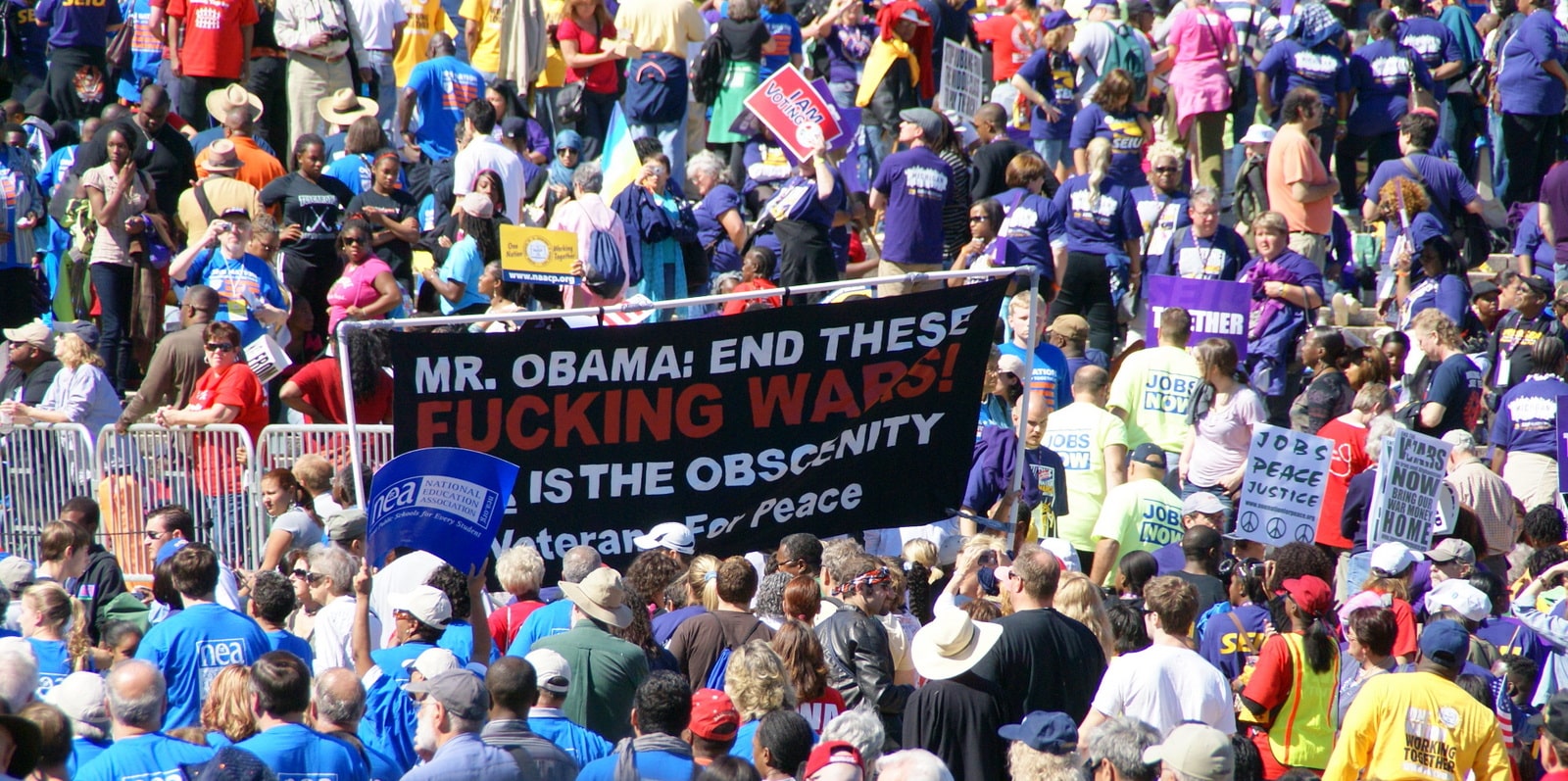
Mr. Obama, End These Fucking War!
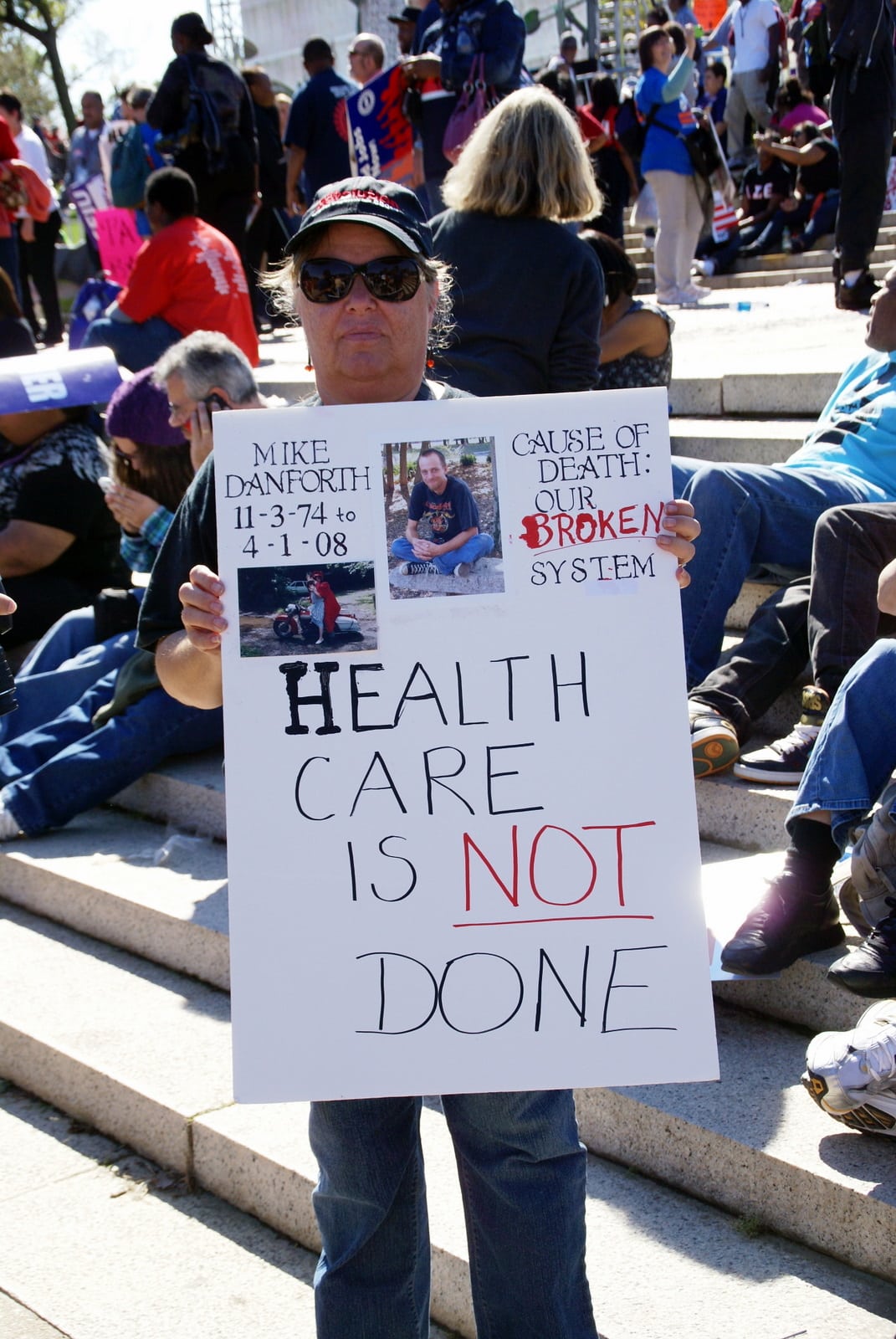
Health Care Is NOT Done
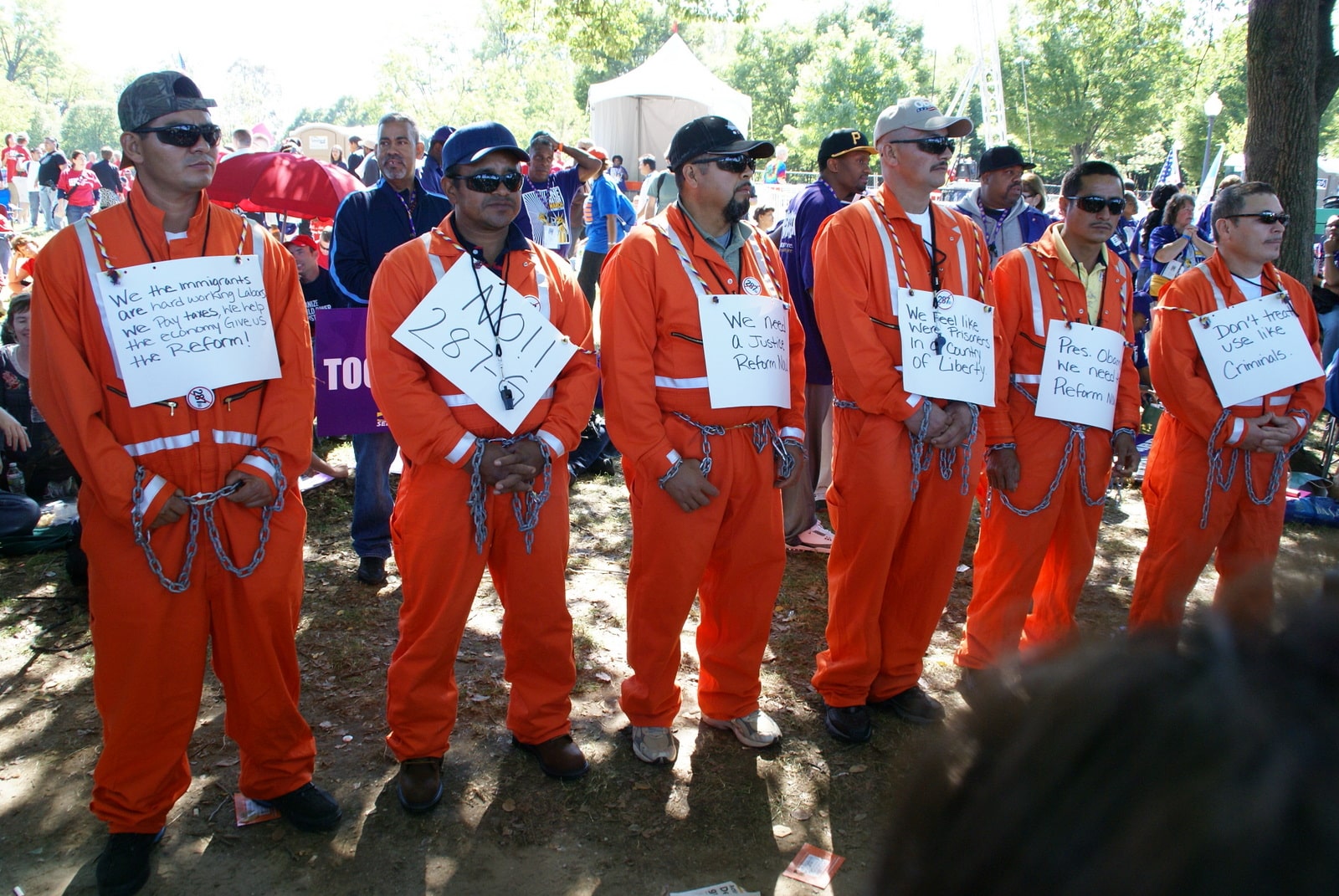
Immigrant Rights
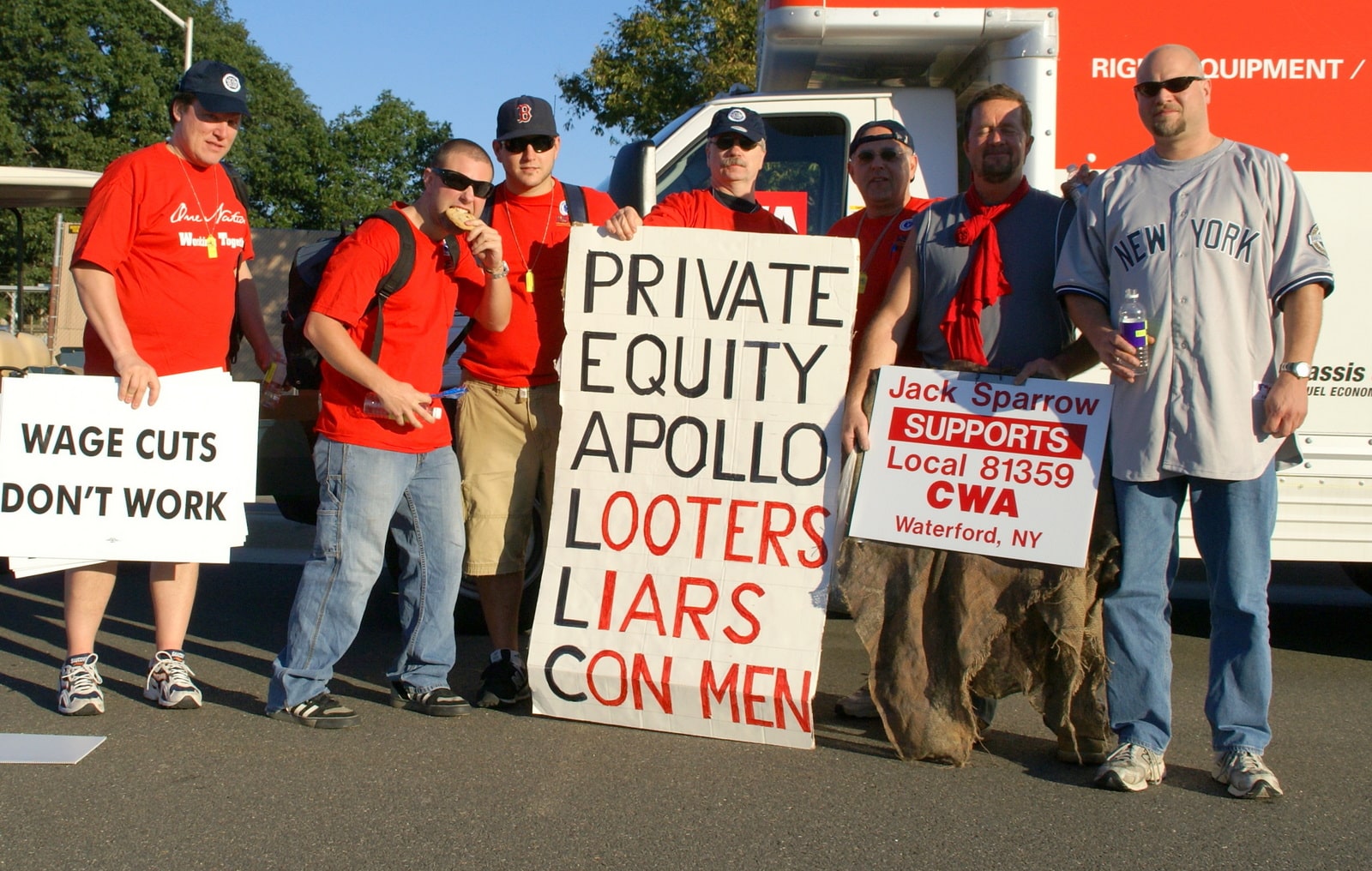
Wage Cuts Don't Work
Photo by Jon Flanders
Whether this attempt will be successful or not I have no idea, but I think that the pictures I took at the event show that the activists and workers who attended this rally shared the Million Worker March desire to not just cheer for the Democrats, but to make demands on them. This was articulated most clearly from the stage by Harry Belefonte, the singer and civil rights era icon, who forthrightly condemned Obama's Afghanistan war escalation. When he did this, the silence that enveloped the grounds was quite striking. There were no boos however.

Unlike the earlier Glenn Beck rally, the social composition of this event was heavily populated by virtually every minority group except perhaps the "model minority," the Asians. There was a striking immigrants-rights participation by workers dressed in prison orange, handcuffed, with signs supported immigration reform. Cameras surrounded their passage through the crowd.

Speaking of prisons, this is the first DC rally that I have attended where the infamous linked iron fences, "protest pens," made an appearance. These affronts to peaceful assembly are now almost always used in New York City. I will never forget how we were trapped in them during the huge 2003 protest against the Iraq war in the streets of Manhattan.

Broad steps normally open near the front of the Lincoln Memorial grounds were blocked off, you were forced into narrow corridors, and the various unions were each given their own "pen," where they could not be infected by another union's presence, I suppose. At one point, on the side of the rally where I was, the police suddenly and inexplicably closed off all passage, to the anger and dismay of the crowd. (I have some good video footage of this that I will post shortly.)

Clearly from the union leadership's view, they were just trying to fire up their activists for what they consider a crucial election, in the face of some serious demoralization in the ranks, given the failure of the Democrats to pass labor's top priority, the Employee Free Choice Act, and given the terrible economic situation facing millions of workers either unemployed or fearful of unemployment, while thirty years of wage stagnation hit home.

Nonetheless, as evidence from the attendees showed, the fact that the leadership had to do what they didn't do in 2004 -- support a mass mobilization of the ranks -- gave the folks on the ground a chance to make demands, and to feel their power, even in a small, one-day-event way. This in my opinion will sow some seeds for the future, as the overall condition of the capitalist world economy continues to worsen, at the workers' expense.

On my bus were leaders and activists from IUE/CWA 81359, who despite their rough treatment by their employer Momentive Performance Materials, with wage and benefit cuts hitting them hard, have maintained their resistance and have deepened their understanding of the union structures that hold them back.

In a number of union leadership elections -- the huge TWU 100 in New York City, Teamster locals there, and most recently the Amalgamated Transit Union -- we have already seen reform candidates who propose fighting the employers' attacks winning elections. Even in perhaps the oldest and most conservative union in the US, the venerable Brotherhood of Locomotive Engineers, insurgent candidate Tom Brennan stands ready to depose the ancien régime there, after the members resoundingly affirmed their desire for direct election of top officers.

At the Labor Notes' well-attended reception after the rally, a Washington, DC insurgent candidate for the teachers union told of how the teachers took down a mayor trying to impose Obama's "Race to the Top" version of education reform.

It all points to signs that the long retreat of labor, which has been the experience of my entire working life, is beginning to end. This is what I took away from my day in the Washington, DC sunshine on October 2nd.

To speak the truth

Obama and the Crisis of Neo-Liberal Black Intellectuals
Written by Anthony Monteiro

Charles Pete Banner-Haley's book From Du Bois to Obama: African American Intellectuals in the Public Forum (2010) is a history of African American intellectuals from the standpoint of Barack Obama's presidency.

From an Obama post-racial dream-world, Banner-Haley tells us, "African American intellectuals in the twenty-first century can take their cue from an Obama presidency and the words he spoke in Philadelphia during the race for the nomination. They can become "transformative black intelligentsia' (123)."

It should be obvious, the last thing black intellectuals need to do is "take their cue" from a pro-war, pro-Wall Street, pro-American-imperialism presidency.

Rather than fulfilling the legacy of W.E.B Du Bois (as the author claims) it is its opposite. Obama's presidency represents a rupture with Du Bois and the progressive wing of black intellectuals. Obama's Philadelphia speech was a neo-Booker T. Washington compromise speech (equivalent to Washington's Atlanta Compromise Address delivered in 1895). Obama decidedly argued that we had moved beyond racism's most lethal forms. While slavery was the nation's "original sin," racism left blacks and whites scarred. Hence, his white grandmother and Reverend Jeremiah Wright evidenced racial prejudice, stereotypes, fear, animus and anger. He positioned himself as representing the future of racial compromise and reconciliation. In neo-Booker T. Washington style he urged black folk literally to "cast your buckets down where you are," instead of challenging white supremacy.

The Obama presidency, in the end, seeks to fashion a racial compromise with conservatives, similar to Washington's compromise with the Jim Crow South. In Banner-Haley's dreamscape, Obama's election is both an end and a beginning. He insists, "Barack Hussein Obama in many ways was a culmination of the civil rights movement and the starting point for African American intellectuals to confront those new definitions of race and identity (7)." What he implies is that "the new definitions of race and identity" are those that arise from an alleged post-racial America. African Americans, to cite Obama, have come 90% of the way to freedom.

Obama, and by implication Banner-Haley, accept the neo-liberal position that the major problems confronting black folk are rooted in black culture, psychology and behaviors, especially of the poor. The author says Obama gravitated to Harvard sociologist William Julius Wilson's "synthetic analysis" that drew from both political liberalism and right wing conservatism. Wilson claims that since 1968 we have been in a period of the "declining significance of race".

The book points to a new crisis of African American intellectuals. Cloistered in elite universities and increasingly leaning towards neo-liberal ideas on race, economics and politics, they are separated from black working people, the poor and the black middle class. While Obama, remains popular among African Americans as symbol of racial progress, his policies, that favor large banks, Wall Street and the military, places him and those black intellectuals who "take their cue" from him, at odds with the fundamental economic and social interests of the vast majority of African Americans.

On the other hand, Obama's insulting and practiced indifference to black suffering, his performance of post racialism, while savage racism engulfs him, his family, his presidency and all African Americans, his practice of keeping most blacks at arms length, yet on occasion inviting chosen Negroes to the White House, is nothing short of a put down of African Americans; behavior none of us would accept from a white President, Democrat or Republican.

Banner-Haley says, "Unable to make the connection either with the immiserated black poor or many of those newly arrived in the black middle class, black intellectuals found themselves visible, but encapsulated in an insulated academic world that may listen but often does not hear and does not act on the ideas, analyses, and prescriptions that these women and men present (45)." Because they are preoccupied with talking to white elites, they lack moral standing with black people. This is the price they pay to integrate white elite and capitalist circles.

This, however, is only part of the problem. The larger part is that politically they are race neo-liberals. At the highest levels there is hardly a radical among them, unlike most in the past, who were race radicals. The other problem is that they choose not to live among black people. They have separated themselves in their life styles, culture, and aspirations form the working class and poor in particular.

Finally, they're caught in the bind of trying to appear to serve opposing social and economic class constituencies. Elite universities demand that black intellectuals assume a post-racial sensibility and lifestyle; on the other hand, the black masses daily experience the most savage racism. Faced with this dilemma, neo-liberal black intellectuals become apologists for race and class oppression, while performing a not very convincing symbolic blackness.

Banner–Haley has it wrong, there is no trajectory from Du Bois to Obama. A more accurate description would be from Booker T. Washington, and race compromise to Barack Obama and race neo-liberalism. Du Bois started his public intellectual career in 1897 founding, along with Alexander Crummell, Anna Julia Cooper and others, the American Negro Academy. In 1903 he publically presented his position on black leadership in the essay "The Talented Tenth." He assumed that leadership would come from the educated. Reviewing his earlier position on the talented tenth in 1948, he said, "I assumed that with knowledge sacrifice would automatically follow." Rather, he insisted selfishness was a far greater impulse. He criticized himself for not realizing that most in a privileged group would tend to constitute themselves as an aristocracy, rather than a leadership connected to the masses and their uplift.

In the year that he published the Talented Tenth essay he published The Souls of Black Folk. He made the famous prediction that the problem of the twentieth century would be the problem of the color line. What he meant was that liberal, or bourgeois democracy, could not advance, in fact would turn in upon itself, if the race issue went unresolved. While not being in the camp of liberalism, or of bourgeois democracy per se, he rightly understood that the obstacle to democracy for all excluded groups rested on resolving the race problem, especially the issue of black civil rights and the vote. But its resolution demanded the agency and activism of black folk, and black folk needed consistent and reliable leadership.

At a time when Booker Washington was arguing that race and civil rights should be taken out of public and political discourse and that black leadership should take a back seat to white intellectuals, Du Bois argued the opposite. In 1948, he disappointedly concluded, most of the talented tenth abandoned its possible historic mission and became consumed in universal selfishness. He called for a new configuration of black leadership and black intellectuals. Rather than a talented tenth he called for a guiding one hundredth; a new leadership cadre drawn not only from the educated, certainly not from the ranks of those chosen "to lead Negroes" by white elites, but from the educated lower middle classes and the working masses. At this point he saw class origins and class loyalties as a critical determinant of black leadership.

With the Civil Rights and Black Power movements completed and civil rights legislation on the books, rather than a new racial democracy we witnessed a counter-revolution against black equality, rooted in preserving white racial privilege, branded as a new conservatism (Reaganism). Yet a small segment of blacks have progressed. A new talented tenth, which attempts to straddle the ideological divide between Booker T. Washington and Du Bois. They claim Du Bois in words, but substantively are Bookerites.

Banner-Haley implies Du Bois ceased thinking after 1903, the year of The Souls of Black Folk. In truth, Du Bois became more radical the older he got. In the last quarter of his life he was a radical, anti-imperialist, socialist and communist. On this matter Martin Luther King Jr. declared, "We cannot talk of Dr Du Bois without recognizing that he was a radical all of his life. Some people would like to ignore the fact that he was a Communist in his later years." Most scholars wish either to ignore this fact or claim that Du Bois had by the 1940's lost his way and chosen "another path."

The break by significant elements of the black elite with Du Bois started with the Cold War and McCarthyism. The US government labeled him "an agent of a foreign government " for his pro-peace and anti-nuclear war stance. Many took solace in looking at the Du Bois of the early twentieth century, saying that his radicalism represented his loosing his way. He was, they insisted, no longer a part of civil rights movement, but of the far left. In the universities his name was seldom if at all mentioned.

It was only with the end of the Cold War and the collapse of the Soviet Union, that it became permissible to mention his name and write books and article on him. Still his radicalism was viewed as that of a disappointed and isolated elder. They explained his radicalism as the result of bitterness towards the talented tenth and not of his ongoing engagement with the realities of racism, war and colonialism. Du Bois biographer David Levering Lewis, along with Cornel West and most recently Harvard professor Martin Kilson have looked on the last quarter of Du bois' life as a rupture with his "great period", the period before 1945.

If we, as Dr King suggests, look at Du Bois' life as a whole and view his latter years as part of an intellectual and scientific continuum of philosophical and practical development of the race question, his radicalism makes all the sense in the world. Elite African American intellectuals, most educated in white universities and who teach in these institutions, have made a break with Du Bois, while many, oddly enough, claim to be Du Boisian.

American liberalism reached its high point in the 1930's with the Presidency of Franklin Roosevelt and the New Deal. Since the 1980's American democracy has become more right wing and more authoritarian and liberalism has become increasingly neo-liberal rationalizations of American empire. The banks, Wall Street and the military have undermined most avenues of democracy, including elections.

Black intellectuals in the second decade of the 21st century should not take a cue from Obama's presidency, but from Du Bois. They should stop being afraid of Du Bois' radicalism and anti-imperialism and end their kowtowing to the conservatism of the white academic establishment. Dr. King, one of the greatest black intellectuals, was right, "It is time to cease muting the fact that Dr. Du Bois was a genius and chose to be a Communist. Our obsessive anti-communism has led us into too many quagmires."

Charles Pete Banner-Haley's book is a political failure, but more, it distorts the truth and obscures the paths to developing a 21st century radical African American intelligentsia. Anchored in Obamism, and by implication neo-liberalism, Banner-Haley is blind to the real history of black intellectuals and of Du Bois. We do need a history of black intellectuals, (a project that professor Martin Kilson has for some years been working on) which is not an apologia for American capitalism and empire.

We need 21st century intellectuals who are not afraid to reject neo-liberalism, who will speak the truth about the Obama Administration and race and US Empire, who are not fearful of criticizing free market capitalism, and indeed like Du Bois stand for a human future beyond capitalism. Black folk need a new radical intelligentsia in the Du Boisian tradition.

Anthony Monteiro is a professor of African American Studies at Temple University.

August 25, 2010

http://blackagendareport.com/?q=content/du-bois-obama-african-american-intellectuals-public-forum