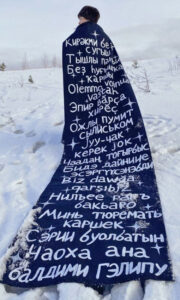
Inside Russia opponents of the war continue to find ways to express their opposition to the slaughter.
“I hear the voices of Russia” is the title of a series of artworks created by Alisa Gorshenina in Nizhny Tagil, a city in the Urals. One piece repeats the phrase, “We are against the war” in different languages.
“Russia is a multinational country, and I noticed that people had started to speak out against the war in their native languages,” she told the Moscow Times. A fifth of Russia’s population of 144 million are from over 160 ethnicities other than Russian. The Russian army’s foot soldiers come disproportionately from poorer regions like Buryatia and Dagestan and suffer high casualty rates in Ukraine. This spurs protests in these areas.
Hundreds have been dragged before Russian courts charged with the “crime” of spreading “fake news” about the war.
Dmitry Ivanov was sentenced to over eight years in prison March 7. He was accused of “political hatred” for posting online news about Moscow’s deadly attacks on Ukrainian civilians.
The day of the verdict, his supporters packed the courtroom. Ivanov expressed solidarity with fellow political prisoners and asked his supporters to write them letters and to attend their trials.
“Russia is not Putin. Tens of millions of Russians are against this criminal war,” he said. He noted that many have relatives in Ukraine. “This is a dark moment of our history, but the darkest moment always comes before dawn.”
Photo: Cape on artist Alisa Gorshenina in the Urals region of Russia says “No to war” in more than a dozen of the languages spoken across the huge country. “Russia is a multinational country, and I noticed that people had started to speak out against the war in their native languages,” she said.
Knocking on doors a few blocks from the derailment site March 15, members of the Socialist Workers Party found a wide range of opinions. Some told us they “trust what the government is doing,” but that seemed to be a minority view.
Lon Berresford, a carpenter who lives just south of the tracks, said he and his wife weren’t sickened by the chemical release, but heard there were more complaints on the other side of the tracks. Like several neighbors, they said they have no plans to leave. “If you’re afraid, you’re afraid,” he said, “but a lot of people are speculating on this.” So far 22 lawsuits have been filed against Norfolk Southern by area residents, and all but one are being consolidated into one big class-action suit.
Berresford had no doubt the railroad cut corners on safety. “All businesses try to make money, so it’s no surprise. That’s big business.” Like several other people we spoke to, he remembered when trains used to have a caboose, with crew members on the end who could respond to problems, like the overheating axle bearing that caused the derailment here.
Just north of the tracks, Kathy Smyth and Mark Thompkins said they and their 10-year-old daughter have all had symptoms since the derailment, including rashes, nose bleeds and severe eye irritation. SWP member David Rosenfeld said, “You can’t trust Norfolk Southern, the government regulators and politicians, or the wave of lawyers who’ve descended on this town.”
“That’s right,” said Smyth, who works two jobs, at a grocery store and a nursing home. “The only people we can trust are each other.”
Candace Wagner, a rail worker and member of the Brotherhood of Locomotive Engineers and Trainmen, pointed to the victory residents won in forcing Norfolk Southern bosses to rip up the tracks and remove contaminated soil, ballast and trackage from the area of the derailment. Their initial move was to get the trains rolling as quickly as possible, to start profits rolling again, and minimize the cleanup.
That was a victory, Smyth said, but the railroad-organized project is also kicking up toxic dust. She has visited clinics twice with severe eye irritation since it began. The town government has responded with street sweepers that can be seen on local streets.
Smyth and Thompkins, who work at a nearby factory, were interested in the issues rail workers face. “One of the main issues rail workers were ready to strike over last fall was schedules that make it hard for workers to build their union or have family time,” Wagner said. “But the Biden administration and Congress intervened to ban any strike and impose a contract on us.”
We discussed the fight needed by rail workers and our unions to control the conditions we work under with Sue Libert, who works as a church secretary. “They need to take better care of the rail workers,” Libert said. “I can’t believe how they work on call and don’t have sick days. And the trains are way too long.”
From the Dominican Republic and on behalf of the Sugarcane Workers Union UTC, we send our appreciation for the writings by George Novack in Labor, Nature, and the Evolution of Humanity. We were pleased to read George Novack’s biography (1905-92) and about his joining the Socialist Workers Party in the United States.
His writings about how humanity rose to civilization — as well as his analysis of the fundamental course of U.S. history — is of great importance, and in our view, essential to understand the present and future development of humanity, of the working class, and its future socialist system. It’s a pleasure to read and study his works because they make clear our political responsibility and provide a genuine understanding of the past, present, and future struggles of the working class and its vanguard, which is the party.
....By the early 1980s, however, the bourgeoisie and Islamic Republic were employing increasingly brutal repression to turn back and defeat struggles by working people and the oppressed, consolidating the rulers’ counterrevolutionary clutch at home.
After Iranian military forces pushed Saddam Hussein’s invading army back across the border in mid-1982, Tehran sent its own troops into Iraq in large numbers. Whatever defensive purpose this initially served, the Tehran regime over the next several years sent wave after wave of teenage and other young Iranian working people to needless slaughter as it assaulted population centers in Iraq. …
By the end of 1982, a combination of official and government-sponsored thug terror made it impossible for communists to any longer carry out political activity in Iran. The record of the proletarian internationalist course and unbroken continuity of that communist party, however, exists to be studied by new generations and put into practice as conditions permit. A good starting point can be found in issue no. 7 of New International.
Piketty or Marx? Capital in the Twenty-first century: a fundamental criticism Part 5 (last)
James Miller
Piketty does not mention the growth of credit, except in one instance, where he says,
"Broadly speaking, the 1970s and 1980s witnessed an extensive "financialization" of the global economy, which altered the structure of wealth in the sense that the total amount of financial assets and liabilities held by various sectors (households, corporations, government agencies) increased more rapidly than net wealth. In most countries, the total amount of financial assets and liabilities in the early 1970s did not exceed four to five years of national income. ... I should also point out that these international positions are in substantial part the result of fictitious financial flows associated not with the needs of the real economy but rather with tax optimization strategies and regulatory arbitrage (using screen corporations set up in countries where the tax structure and/ or regulatory environment is particularly attractive)."